Family Inheritance Law for Business Owners
Navigate family inheritance law for your business. Learn how to structure succession, avoid family disputes, and protect your company's future value.
September 25, 2026
By Remi Taffin · August 23, 2026
An HVAC owner can be the company’s best salesperson, estimator, dispatcher, trainer, and customer relationship manager at the same time. If that owner has a serious illness and can’t work for months, the business may still have trucks, technicians, contracts, and invoices, yet lack the person who keeps everything moving. That’s the risk key person insurance is designed to address.
Most owners think first about death benefits. That’s understandable, but it misses the harder scenario: the key person survives, cannot work, and leaves the business paying overhead while revenue, margins, and customer confidence weaken. A practical plan needs to protect against both outcomes.
The warning signs usually appear during an ordinary workday. An HVAC company owner suffers a stroke and can’t return to the business for eight months. The service manager can handle emergency calls, but customers still want the owner’s judgment, long-standing relationships, and approval on complex estimates. Technicians become uncertain about priorities, employees worry about job security, and several important commercial accounts start considering other contractors.
The company hasn’t lost its equipment or its insurance for property damage. It has lost access to the person who connects sales, operations, hiring, pricing, and customer trust. If the owner is also the lead estimator, the company may struggle to turn incoming opportunities into profitable work. If the owner personally manages the largest accounts, competitors may have an opening before the business can organize a response.
That concentration risk deserves a deliberate review. A useful starting point is the guidance in this owner-dependency planning resource, which focuses on reducing the amount of knowledge and decision-making trapped with one person.

A key person isn’t defined by job title. It’s the individual whose absence would create a serious financial or operational problem.
That might be:
Research cited by Legal & General’s business survey found that 71% of surveyed firms depended on one or two key people, while only 22% had key person life insurance. Those figures point to a practical mismatch. Many businesses recognize their dependency but haven’t funded the disruption that dependency creates.
Commercial property insurance protects physical assets. General liability responds to covered claims. Workers’ compensation addresses employee injuries. None of those policies automatically provides working capital when a founder or critical employee dies or becomes disabled.
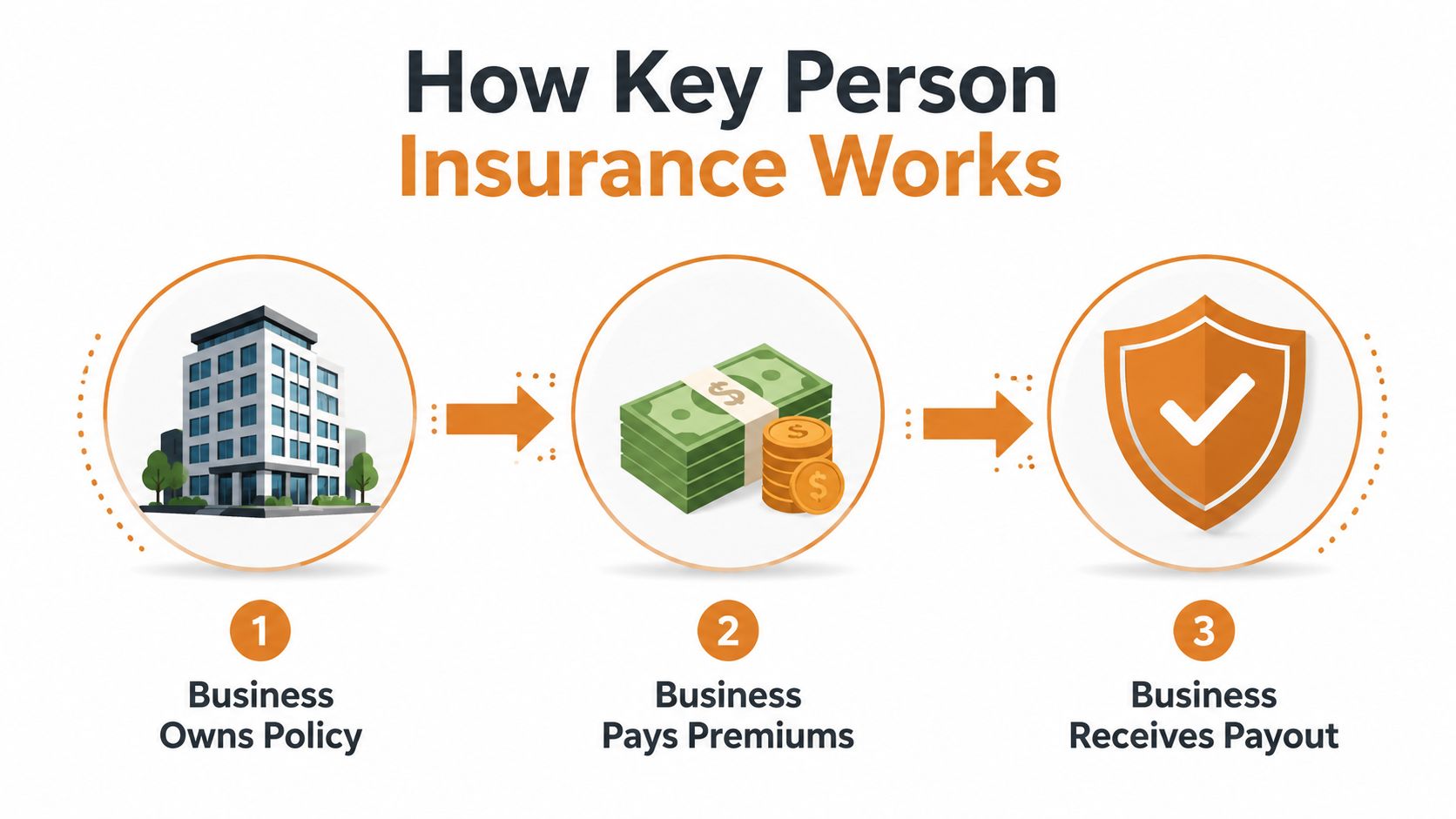
Key person insurance puts the business at the center of the contract. The company owns the policy, pays the premiums, and receives the benefit if the covered event occurs. That money can buy time, preserve payroll, pay for interim leadership, or support an orderly transition while the company decides whether to replace, restructure, or sell.
The structure is straightforward, but owners need to set it up correctly.
Suppose a plumbing company loses its owner to a covered event. The business might use the proceeds to retain an interim general manager, hire an experienced estimator, fund a search for a replacement, or maintain payroll while someone else takes over customer relationships.
A professional services firm may need a different response. It could use the money to bring in a senior practitioner, preserve client service, cover transition costs, and meet loan obligations while clients decide whether to stay. The policy doesn’t restore the person’s expertise, but it gives the company options instead of forcing an immediate sale or shutdown.
Practical rule: Treat the benefit as transition capital, not as a reward for the business. Decide in advance which financial pressures it should address.
Personal life insurance is generally designed to support an individual’s family or other personal beneficiaries. Key person insurance is designed to compensate the business for an economic loss connected to the insured person’s death or disability.
The distinction matters for ownership, beneficiary designation, consent, premium payments, claim administration, and tax planning. Keep the business policy and the owner’s personal protection separate unless qualified legal and tax advisers recommend a coordinated structure.
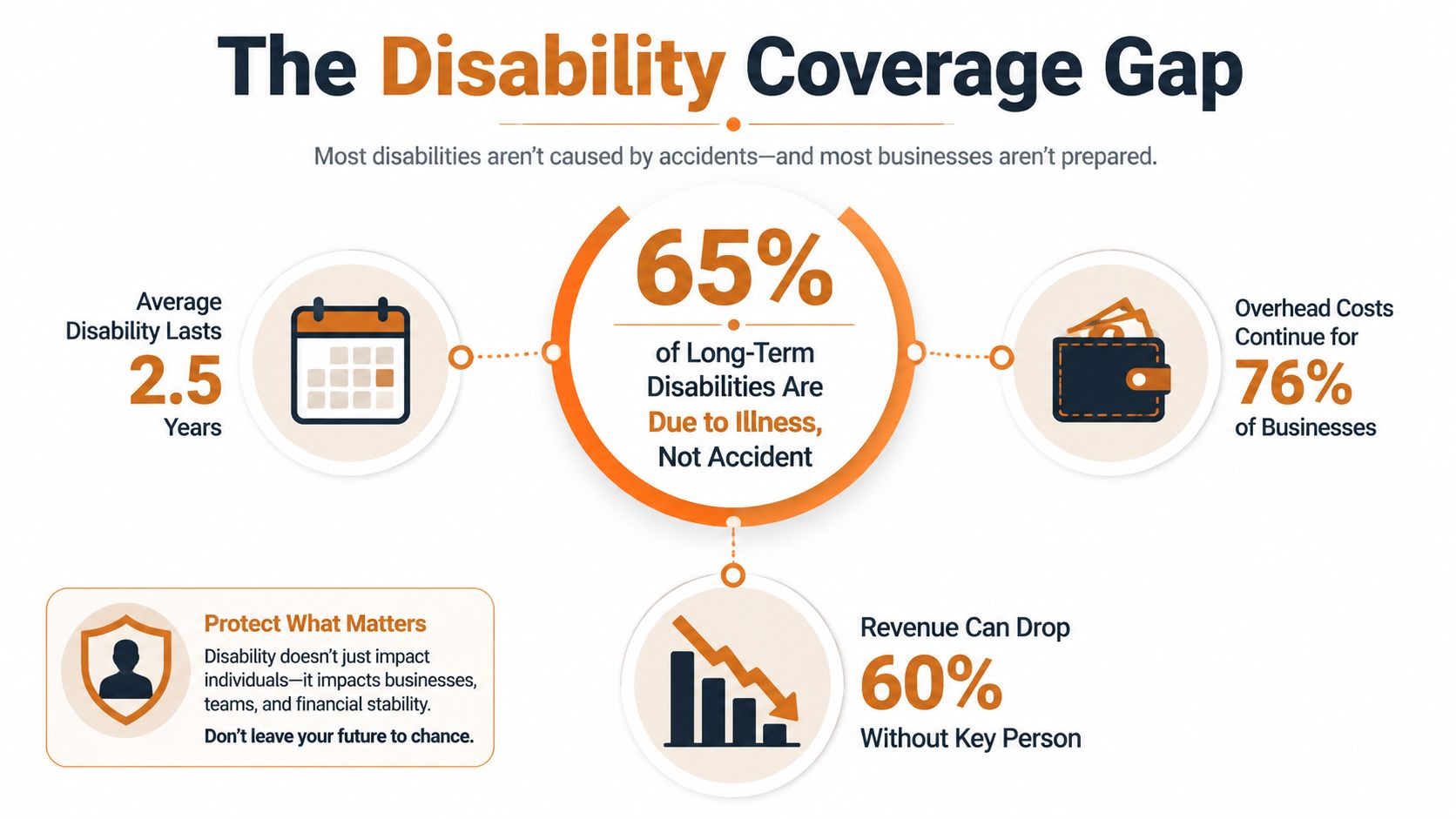
Death ends a role suddenly. Disability can leave the business in a more complicated position. The key person may remain on the payroll, remain involved in ownership, or remain central to customer expectations while being unable to perform the work that produces revenue.
That’s why a policy focused only on death can leave a major hole. An owner-operated trades business may survive a short absence but struggle during prolonged incapacity. The company may need temporary leadership, outside technical help, replacement sales capacity, and customer retention efforts while fixed overhead continues.
About 58% of key person policies in 2025 included both life and disability components, according to the Key Person Insurance Market report. The same source notes that domestic carriers may cap disability benefits around $750,000, an amount that can fall well below the needs of larger businesses.
A salary-based formula looks clean because compensation is easy to identify. It’s also often disconnected from the actual business exposure.
An owner’s economic contribution may include:
A business should estimate the financial effect of incapacity over the expected disruption period, then test that estimate against policy limits, waiting periods, benefit duration, and exclusions. The right question isn’t “What multiple of salary should we insure?” It’s “What cash shortfall would this person’s absence create, and what would it cost to stabilize the company?”
Start with a written incapacity scenario. Assume the person survives but can’t perform their normal duties for an extended period. Then identify the expenses and losses that would appear in sequence.
First, calculate unavoidable operating costs. Next, estimate the margin that could disappear because work is delayed, declined, or sold at weaker pricing. Add the cost of temporary expertise and the likely effort required to retain important customers. Finally, review whether the policy pays a lump sum or monthly benefit, because the timing of cash can matter as much as the total amount.
Disability definitions deserve close attention. “Unable to work” can mean different things under different contracts, and a policy that pays only under a narrow definition may not respond when the business expects it to. Have the specialist explain the trigger in plain English, including partial disability, elimination periods, benefit duration, and any limits that apply to the role.
The right policy depends on the risk you’re funding. A business with a loan tied to a founder may need temporary death protection. A family company preparing for ownership transfer may value permanent coverage. A firm dependent on an owner’s daily production may need disability protection designed around incapacity rather than a single death benefit.
| Policy Type | Typical Cost | Coverage Duration | Cash Value | Best For |
|---|---|---|---|---|
| Term life | Usually lower than permanent coverage, but pricing depends on underwriting and structure | A defined policy period | None in the usual structure | Loans, transition periods, and time-limited business risks |
| Whole life | Usually higher than term coverage | Permanent while required premiums are paid | May accumulate cash value | Long-term ownership planning and certain buy-sell structures |
| Disability coverage | Depends on the insured person, benefit design, and underwriting | Defined by the policy and benefit terms | No traditional life-policy cash value | Prolonged incapacity and income or continuity needs |
Term life is often the cleanest choice when the business risk has an identifiable end date. A company may want protection aligned with a business loan, a planned transition, or the period required to develop a successor. It can provide substantial protection without committing the company to permanent premiums.
The trade-off is simple. Coverage ends according to the contract, and it generally doesn’t create a cash value reserve. Owners should schedule a review before expiration rather than discovering at renewal that the business still depends on the same person.
Whole life may suit a company that expects a continuing need for coverage. A permanent policy can support a long succession horizon and may build cash value, subject to policy terms and performance. That flexibility comes at a higher premium commitment, so it shouldn’t be selected merely because it sounds more complete.
For a family business, permanent coverage may fit an ownership-transfer plan where liquidity will be needed whenever a triggering event occurs. The policy should still be coordinated with the buy-sell agreement, valuation provisions, and tax advice.
Disability coverage fills a different risk category. A disability rider may be convenient, but a standalone policy can offer a more deliberate structure, especially when the potential loss is tied to revenue, technical capacity, or an owner’s daily involvement.
Ask the specialist to show how each structure responds to partial incapacity, delayed recovery, and a return to work with reduced duties. The cheapest quote isn’t useful if it responds only to a scenario your business is unlikely to experience.
Coverage should reflect the company’s cash needs during disruption, not an arbitrary salary multiple. Build the estimate from the business outward.
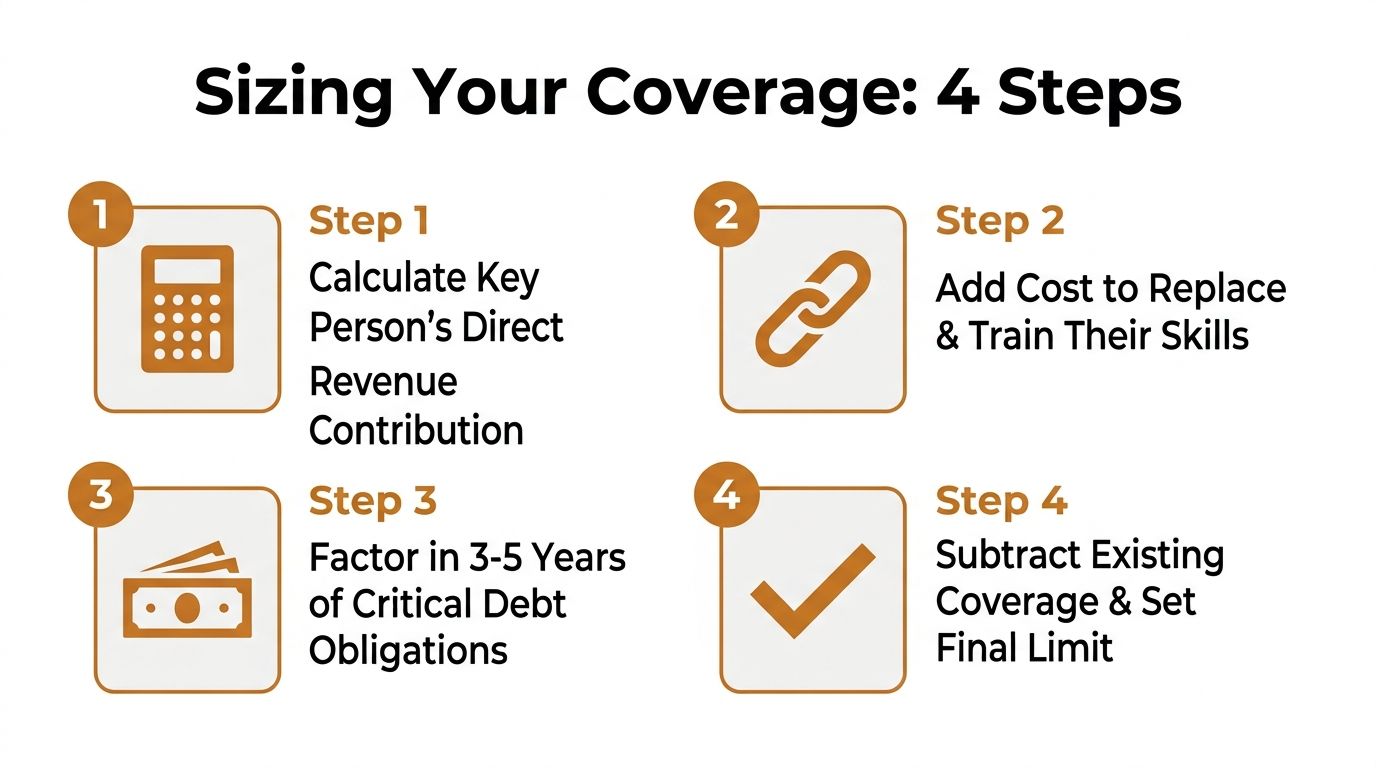
Identify what the key person does. An HVAC owner may generate sales, approve estimates, manage commercial accounts, and solve field problems. A lawyer or consultant may own client relationships and deliver specialized work. A master plumber may be the only person qualified to supervise complex projects.
Separate direct revenue from influenced revenue. Then estimate the margin, not just the sales volume, attached to that contribution. Revenue can look impressive while producing little cash after labor, materials, subcontractors, and overhead.
List the costs of keeping the company functional while you search for a successor:
A company selling recurring service contracts may need less replacement funding if trained managers can assume the work. A business built around the owner’s personal reputation may need much more because customer trust is harder to transfer.
Review loan documents, investor agreements, and other obligations that don’t pause when a key person is absent. The Seller’s Discretionary Earnings guide can help owners think more clearly about how personal owner activity affects normalized business earnings and, therefore, the size of the economic risk.
Do not confuse debt repayment with the full coverage need. Paying down a loan may protect the lender while leaving the company without enough capital to recruit, retain customers, or operate through the transition.
Finally, identify existing business cash reserves, other policies, cross-trained employees, and contractual protections. Only subtract resources that would be available during the specific event you’re modeling.
Coverage should buy decision-making time. If the limit pays the debt but leaves no money for leadership or customer retention, the company may still be forced into a bad decision.
Revisit the calculation after major changes in revenue concentration, ownership, debt, staffing, or succession timing. A policy sized for a small service company may become inadequate after the company adds major accounts or expands into more complex work.
Key person insurance works best when it supports the ownership plan rather than sitting in a separate file. The business may need one policy to protect operating continuity and another structure to provide liquidity for an ownership transfer. Those objectives can overlap, but they aren’t identical.
Premiums are generally not deductible when the business owns the policy and receives the benefit. Death benefits are typically received tax-free by the business, provided the arrangement satisfies applicable requirements. Tax treatment can vary by jurisdiction, consent, filings, and policy structure, so the company’s tax adviser should review the arrangement before implementation.
A buy-sell agreement answers who can or must buy an owner’s interest, how the interest is valued, and what event triggers the transfer. Insurance can provide the cash needed to complete that transfer without forcing surviving owners to use personal funds or the company to drain operating reserves.
In a cross-purchase arrangement, the remaining owners buy the departing owner’s interest. In an entity redemption arrangement, the company buys the interest and retires or reallocates it under the agreement. The correct structure depends on ownership, tax advice, legal drafting, and the number of owners involved.
A policy can be paid to the business while the agreement requires proceeds to support a buyout. That creates a coordination problem if the documents don’t clearly define how the money will be used. The policy amount, ownership terms, beneficiary designation, valuation method, and transfer trigger should be reviewed together.
For family-owned companies, estate planning for business owners should also address what happens to ownership when an owner dies or becomes disabled. Without an integrated plan, heirs may receive an interest they can’t manage, while the surviving owners face a cash shortage and operational uncertainty.
The insurance specialist can explain policy mechanics and underwriting. The tax adviser can assess premium and benefit treatment. The attorney can draft or revise the buy-sell agreement. The valuation professional can establish a defensible business value and explain how it should be updated.
Don’t ask one professional to improvise the entire structure. Give each adviser the same ownership chart, agreement, debt schedule, and coverage proposal so they can identify conflicts before a claim or transfer occurs.
Start with a one-page risk brief before requesting quotes. Name the people whose absence could disrupt the company, explain their responsibilities, list existing life and disability coverage, identify major debt or ownership obligations, and state your succession timeline. Include the longest realistic recovery period, not only a death scenario.
Ask each specialist:
Reject proposals based only on a salary multiple, vague disability wording, or a single policy without alternatives. Compare quotes using the same insured person, benefit amount, duration, trigger, exclusions, ownership, and beneficiary terms. A lower premium does not help if the contract ends before the business can replace an incapacitated leader.
Bring the insurance professional into the same process as your legal, tax, and valuation advisers. The Owner’s Shortlist provides owner-focused guidance on valuation, taxes, legal matters, financing, succession, and specialist decisions before you engage an adviser. Review The Owner’s Shortlist to connect with a vetted specialist who can help coordinate key person insurance planning.
Tell us your situation. We'll connect you with a specialist who works with owners like you. One conversation, no sales pressure.
Found this useful?
Add The Owner's Shortlist as a preferred source and get our articles highlighted in Google Search results.
Add to Preferred SourcesNavigate family inheritance law for your business. Learn how to structure succession, avoid family disputes, and protect your company's future value.
September 25, 2026
Learn how succession of business works, from choosing a pathway to timing the handoff. A clear guide for owners planning their next chapter.
September 20, 2026
Plain-language estate planning wills and trusts guide for business owners covering definitions, tax implications, and questions to ask attorneys.
September 18, 2026
Learn company ownership transfer options, valuation, taxes and timing. Compare sale, gift, succession and ESOP paths with checklists.
September 17, 2026