10 Business Transfer Lawyer Options for Owners
Compare 10 business transfer lawyer options for sales, succession, family transfers, and smaller deals, with questions, fee models, and red flags.
October 5, 2026
By Remi Taffin · August 20, 2026

You’re up before sunrise again, staring at a phone that already has eight messages, two of them urgent, and one from a customer who wants a callback yesterday. Payroll is due, the tech no-showed, the estimate stack is growing, and your spouse is asking, for the third time this month, whether you’re okay. That’s not a mood problem. That’s small business owner burnout in a business that still expects you to act like nothing’s wrong.
The mistake most owners make is treating burnout like a self-care gap. It’s usually a structural operations problem. If you’re carrying sales, scheduling, hiring, collections, customer fires, and cash anxiety in the same head, no amount of “take a walk” advice fixes the load.
At 6:00 a.m., the alarm goes off and you’re already behind. Payroll is due, a technician didn’t show, a vendor invoice bounced, and a customer wants a callback on something that happened after hours. You’re not managing one role. You’re running the entire company in your head, then walking into the shop or jobsite and pretending that’s normal.
That’s where owner burnout looks different from employee burnout. An employee can escalate a problem to HR, a manager, or finance. An owner is the escalation path. If you step away, revenue dips, jobs stall, and customers notice. There’s no clean handoff.
The body usually complains before the owner admits it. Chest tightness before opening the shop. Rage over a small mistake. Sunday-night dread that starts on Sunday morning. The spouse asking, “Are you okay?” again because the answer has been obviously no for a while.
Look at the business, not just your mood. Missed estimates, late follow-up, invoices that sit untouched, and vendor calls you keep avoiding all point to the same thing, the owner’s capacity is maxed out. The business starts leaking in places that used to be easy to control.
Practical rule: if the business only works when you’re personally on top of every loose thread, it’s not a business with a system. It’s a workload with a logo.
A 2024 report on entrepreneur mental health found 42% of business owners experienced burnout in the prior month, 24% were currently experiencing burnout, and 27% reported poor work-life balance, with 46% struggling with high stress in the same analysis (entrepreneur mental health statistics). That’s not niche, and it’s not confined to startup chaos. It’s what happens when the structure is too thin for the load.
This isn’t a personal weakness. It’s a load problem, and load problems have fixes.
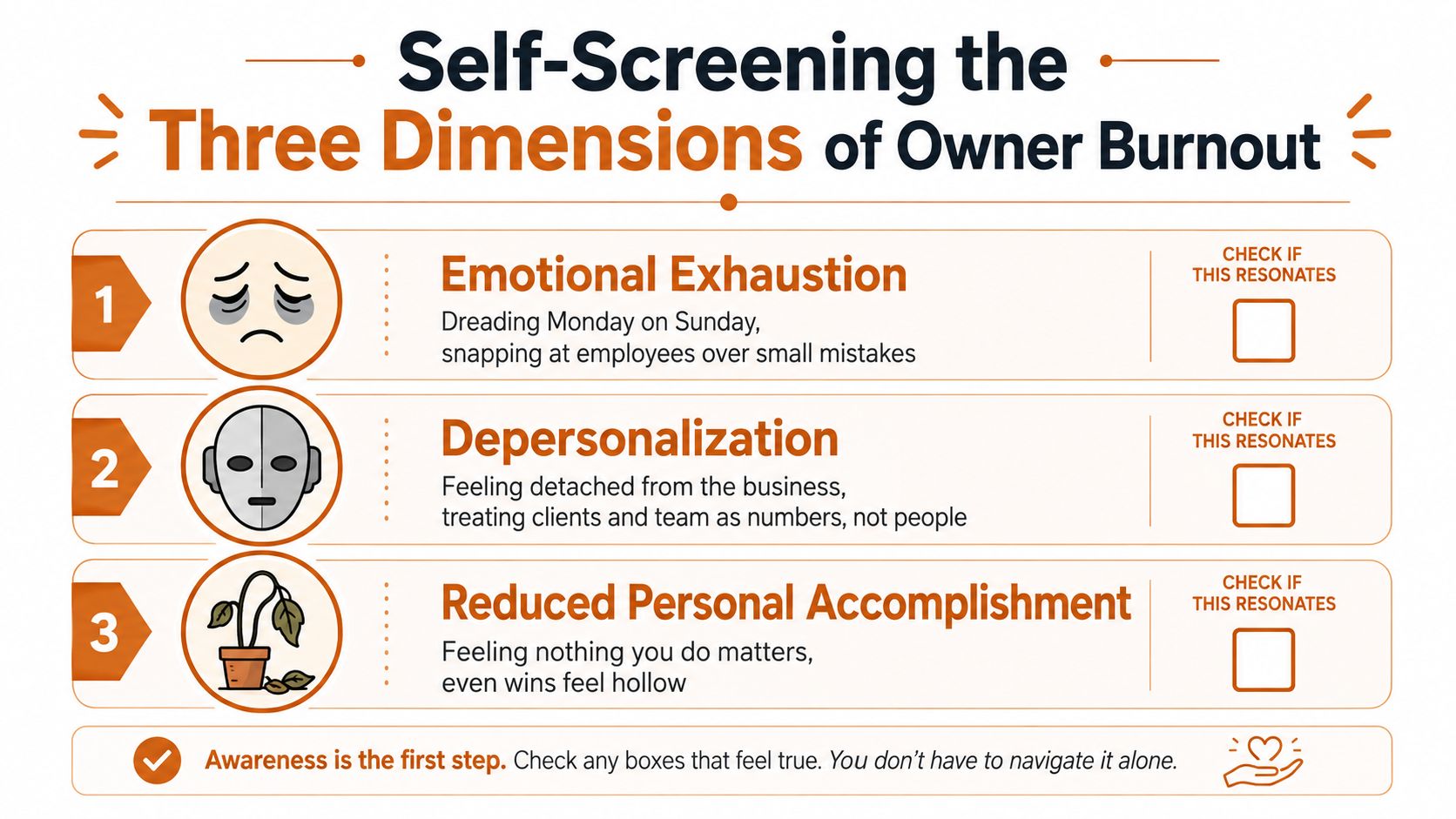
Start with a blunt check. Owner burnout usually shows up in three buckets, emotional exhaustion, depersonalization or cynicism, and reduced accomplishment, which is exactly how the entrepreneurial burnout literature frames it (systematic review of entrepreneurial burnout). That matters because it keeps you from mistaking a structural overload problem for a mood swing.
This is the “I have nothing left” stage. Monday feels heavy before it starts, minor mistakes set you off, and a closed deal barely registers. If wins stop landing, your battery is empty.
Burnout gets real when it starts showing up in your body. You wake at 3 a.m. replaying cash flow. Your jaw stays tight. Sleep breaks up, appetite shifts, and caffeine becomes a noon-or-later habit that keeps you propped up. The Bluevine small business burnout report ties burnout closely to sleep disruption and financial stress, not just workload (Bluevine small business burnout report).
This is the hidden drain. You avoid emails, delay hiring calls, and stare at QuickBooks before closing it again. Small choices start feeling expensive, so you push them onto a spouse, assistant, or senior employee just to get through the day.
Score each area as mild, moderate, or severe. Mild means you are strained but still operating. Moderate means the business needs structural changes this month, not later. Severe means you start 72-hour triage now.
If you are severe in two categories, stop pretending a cleaner calendar will fix this. You need load reduction, cash control, and outside help.
Use the screen to decide what kind of intervention you need. Burnout is not one vague feeling. It is exhaustion, sleep disruption, and decision breakdown showing up at the same time. That pattern points straight to the fix.
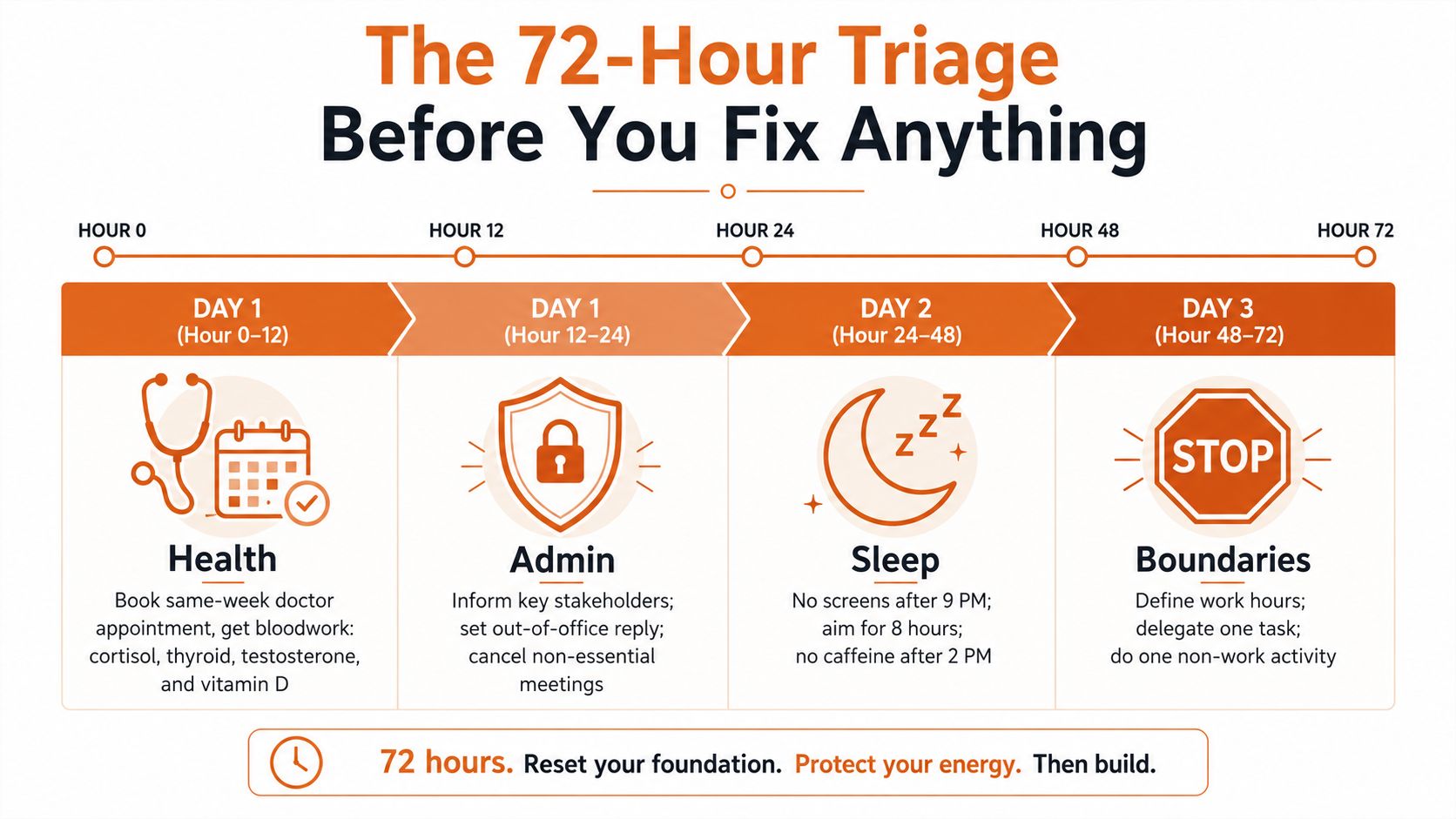
The next three days are for stopping the bleed. Skip the strategy deck, the rebrand, and the big reinvention. Burnout hits harder when your body is running hot and the business account is running thin. A 2026 U.S. small-business survey found 53.5% of owners lose sleep over the business at least a few times a week, 47.7% have skipped or delayed their own paycheck, 84.4% have sacrificed health, relationships, or wellbeing, and 47.2% say financial pressure has worsened over the past 12 months (Patriot Software small business owner burnout survey).
Book a same-week doctor visit. Ask for bloodwork that checks the basics your body may be signaling. Tell one trusted person you are struggling. Then shut off calendar notifications from midnight to 6 a.m. so the business stops invading your sleep window.
Confirm the next two payroll runs are funded. Call the largest unpaid invoice and collect. Pause non-essential recurring expenses. Freeze discretionary spend that does not protect revenue, labor, or collections.
Write one page listing the three biggest business fires. For each one, set one decision and one deadline. Then hand at least one fire to a senior employee or contractor who can carry it.
Analysts at Bluevine found the same pattern, owners under heavy financial stress also reported sleep loss and burnout signs (Bluevine small business burnout report). That is why cash control comes first. If the money side stays unstable, your nervous system stays on alert.
Rule: if it can wait 72 hours, it waits. Nothing strategic happens here. The point is to break the adrenaline loop so you can think again.
A burned-out owner usually doesn’t need a pep talk. They need their calendar taken apart with a scalpel. Track every recurring task for two weeks, then sort each one into Owner Only, Delegatable, or Automatable. That’s the cleanest way to see where the drag lives.
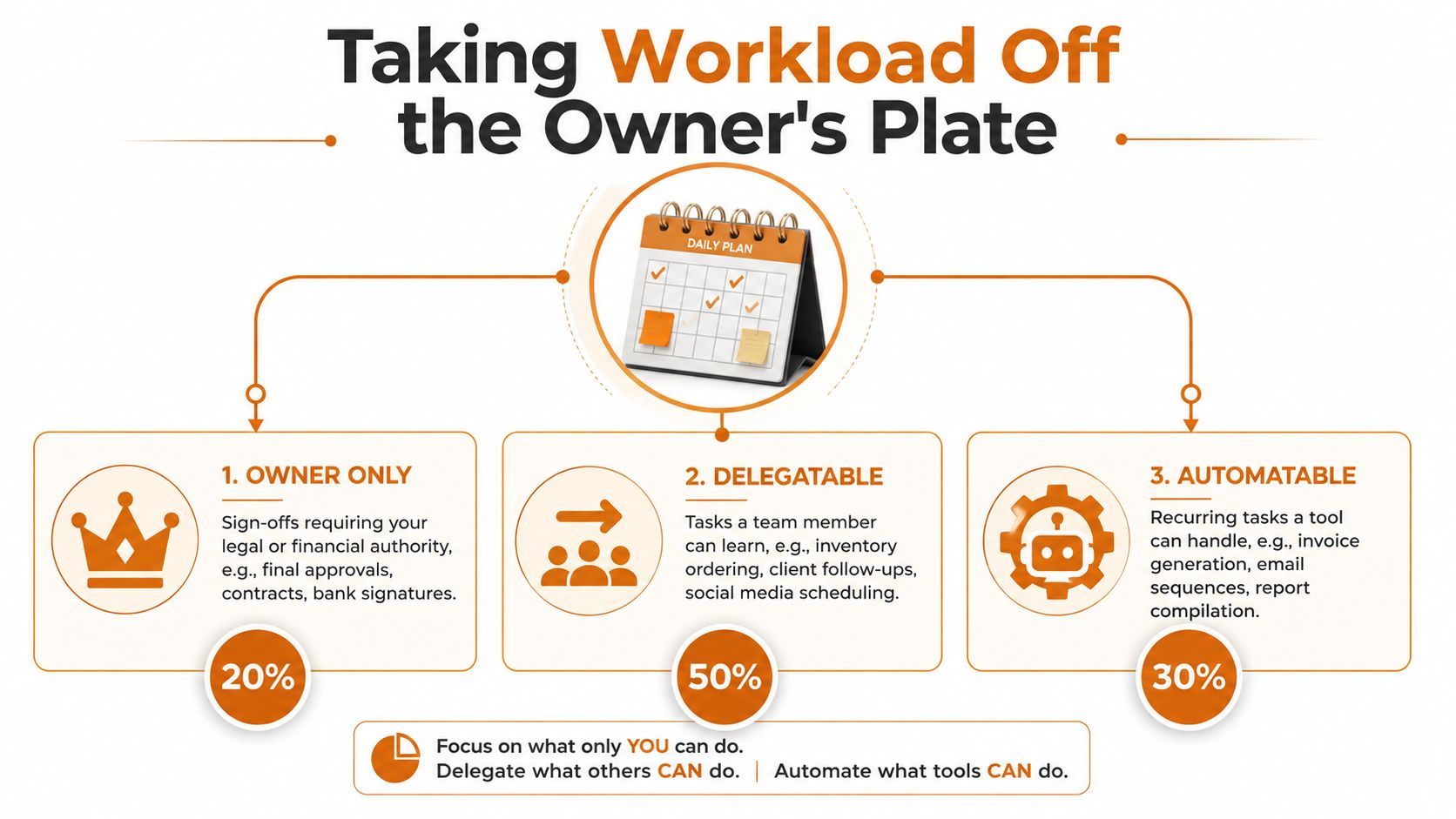
This bucket should be tight. It covers legal or financial sign-offs, key customer relationships with real revenue impact, and decisions you refuse to delegate. Everything else is probably being held too close.
Estimating, scheduling, vendor calls, HR paperwork, and customer follow-up are classic delegation targets. Don’t hand them to whoever looks less busy. Hire or contract for the gap. If you’re in plumbing or HVAC, a second estimator can pull the owner out of quote hell. If you run a salon, online booking should take you out of the front desk loop once it’s live.
Invoicing, appointment reminders, inventory reorder alerts, and weekly reporting shouldn’t live in your head. Tools like QuickBooks, Jobber, ServiceTitan, or a simple Zapier stack can handle a lot of the repetitive drag. The point isn’t shiny automation theater. The point is getting the owner out of the daily grind so energy returns to growth and recovery.
The Owner’s Shortlist can help you find vetted specialists for the parts you shouldn’t be guessing about, but the operating rule stays the same, reduce owner dependency first. Use this guide to reduce owner dependency as a practical model for what should leave your plate.
A business that depends on the owner for every quote, answer, and exception is fragile. A business that trains, documents, and automates is recoverable.
Clean books don’t create stress. Sloppy books do. A working budget, a simple forecast, and a clear line between owner pay and business profit make the business easier to run because they remove guesswork. When you can see cash clearly, you stop making panic decisions.
Start with the basics. Freeze non-essential spend. Renegotiate the two largest vendor contracts. Move to weekly cash forecasting. Put owner compensation on paper as compensation, not as a vague draw against whatever’s left. That separation matters because it forces you to see whether the company can support the owner or just keep consuming the owner.
| Operational Lever | Workload Reduction | Value Impact |
|---|---|---|
| Cleaner bookkeeping | Less time spent chasing numbers and reconciling surprises | Better buyer confidence and fewer due diligence delays |
| Weekly cash forecasting | Fewer late-night cash panic decisions | Stronger control of working capital and fewer discount-sale pressures |
| Separate owner compensation | Less confusion about true business performance | Clearer profitability and cleaner valuation math |
| Vendor renegotiation | Less recurring financial pressure | Better margin profile and more resilience |
| Documented SOPs | Fewer owner-only bottlenecks | Easier transition, lower key-person risk |
| Management team coverage | Fewer interruptions and less rework | Greater transferability and higher enterprise value |
Exit planning helps even if you never sell. A business that can run without you is a less exhausting business to own. That means documented SOPs, a management team that can hold the line, and customer concentration kept from leaning too heavily on one account. A valuation readiness review shows which three or four operational changes will move enterprise value most, and those are usually the same changes that cut owner workload.
That’s why exit prep is cheap insurance. Not because you have to sell tomorrow, but because it forces the discipline that makes burnout less likely today. If you want a plain-English walkthrough, use this exit planning guide as a reference point.
The burned-out owner’s worst habit is waiting too long to buy expertise. By the time they’re exhausted, every decision feels loaded, and they start picking helpers based on urgency instead of fit. That’s expensive. The better move is to shop the problem directly and bring in the specialist who already solves it.

Constant physical exhaustion and brain fog point you toward a functional medicine doctor who can check hormone imbalance, gut health, and nutritional deficiencies. Snapping at the team and watching turnover rise points to an HR consultant or PEO advisor. Feeling overwhelmed by daily decisions calls for a fractional COO or similar operations leader. Financial anxiety and reactive spending belong in front of a fractional CFO.
For owners who need a financing or cash perspective, start with what a fractional CFO actually does. For legal, tax, and transition issues, the right fit is usually a business attorney, tax advisor, valuation specialist, or M&A advisor depending on the problem.
Define the problem in one paragraph. Request matched specialists. Compare proposals. Engage directly, without intermediaries standing between you and the person doing the work. Then check references, verify licensing where relevant, and confirm they’ve worked with businesses your size and stage.
A polished website doesn’t solve a payroll problem. A long résumé doesn’t mean the person has handled owner-operated companies under real pressure. You want someone who understands the business model, the pressure points, and the kind of decisions a tired owner has to make.
If you’re choosing between “good enough tonight” and “right for the problem,” choose the person who has solved your exact problem before.
The Owner’s Shortlist is one place owners can look for vetted specialists across valuation, taxes, legal matters, financing, and succession. Used correctly, it’s not a shortcut. It’s a faster path to the right expert.
The first 30 days are about stabilization. Get the physician visit on the calendar. Secure payroll coverage. Automate one recurring process that’s eating time every week. Block one delegation hour on the calendar and keep it sacred.
Days 31 to 45 are about structure. Hire or contract for the two roles causing the most owner load. Document three core SOPs that others can follow. Install a 15-minute shutdown ritual at the end of the workday so your brain stops carrying the shop home.
Days 46 to 60 are about finance. Review cash forecast weekly with a fractional CFO or finance partner. Start valuation prep if exit is on the table. Have a tax advisor review compensation and entity structure before year-end, not after a mess has already been created.
Days 61 to 90 are about lock-in. Build a monthly owner scorecard that tracks hours worked, major decisions made, and energy level. That scorecard should make one thing obvious, whether the business is getting less dependent on you or still bleeding your time.
The recovery arc is not a rescue mission with a finish line. It’s a permanent operating discipline. Owners who recover well don’t just rest more. They restructure the business so the same burnout pattern can’t keep coming back.
If you’re ready to stop guessing and start bringing in the right help, The Owner’s Shortlist gives you a curated way to find vetted specialists for valuation, taxes, legal work, financing, and succession. Use it when burnout is telling you the business needs structure, not more willpower.
Tell us your situation. We'll connect you with a specialist who works with owners like you. One conversation, no sales pressure.
Found this useful?
Add The Owner's Shortlist as a preferred source and get our articles highlighted in Google Search results.
Add to Preferred SourcesCompare 10 business transfer lawyer options for sales, succession, family transfers, and smaller deals, with questions, fee models, and red flags.
October 5, 2026
Interest rates, inflation, the headlines. None of it matters as much as owners think. Here's what actually determines whether now is the right time to sell.
October 5, 2026
What is a tuck-in acquisition? Learn how these deals impact owner-operated businesses, trades, valuation, and when to consult an M&A specialist.
September 29, 2026
Learn what reps & warranties mean in M&A deals, why they matter, and how to negotiate them effectively. A clear guide for business owners.
September 27, 2026