Business Valuation Meaning for Owner Operated Firms
Explore business valuation meaning for owner-operated firms. Learn valuation methods, drivers, misconceptions, and steps to secure a defensible valuation.
September 28, 2026
By Remi Taffin · October 2, 2026

An HVAC owner has spent years turning service calls into a dependable livelihood. The trucks are busy, customers know the company by name, and the owner can probably estimate a good month from the number of jobs on the schedule. Then a succession conversation begins, and one uncomfortable question appears: what is the business worth to someone else?
The answer isn’t just the amount invested in equipment, vehicles, advertising, or improvements. A buyer is evaluating sustainable earnings, customer relationships, operational risk, and how well the company can function without its owner. This business valuation guide explains those ideas in plain language, with particular attention to owner-operated trades and the recurring revenue that can make an otherwise owner-dependent company easier to transfer.
A plumbing owner may want fewer working hours and a clear path to selling. The company has a strong local reputation, a full customer list, and experienced technicians. Yet the owner still approves estimates, manages the largest accounts, handles difficult complaints, schedules major jobs, and knows which technician can solve each unusual problem.
Those duties show commitment, but they also reveal transfer risk. A buyer may see a business that depends heavily on one person rather than an operation that can continue smoothly after the sale. The difference resembles buying a shop with a trained team and repeat customers versus buying the owner’s personal route of work. In the second case, the buyer may be acquiring a job, a customer list, and a transition problem at the same time.
Recurring revenue can change that picture. Maintenance agreements, service plans, and other repeat arrangements give a buyer a clearer view of future work than one-time emergency calls. They do not remove owner dependency by themselves, but documented renewals, consistent service processes, and customer relationships held by the company can make revenue easier to transfer.
A realistic valuation also supports decisions before a sale. It can help an owner compare retirement options, plan a family transfer, review insurance needs, discuss estate arrangements, and decide whether hiring a manager justifies the cost. It provides a baseline for judging whether an improvement is building transferable value or merely making the owner’s current workload easier.

For many owner-operated companies, valuation centers on Seller’s Discretionary Earnings, or SDE. Industry guides commonly report multiples around 2x to 4x SDE for many small businesses, though the range changes with sector, customer risk, and revenue quality, as described in this small-business valuation overview.
That range is an estimate, not a promise. A business producing $500,000 in SDE might be valued roughly between $1 million and $2 million, depending on its industry, customer concentration, and recurring revenue quality. Two companies with similar earnings can reach different values because buyers are assessing whether those earnings will continue after the owner leaves.
Practical rule: Start valuing the business before you need to sell it. Owners need time to reduce dependency, document processes, and build recurring revenue into normal operations.
Early valuation work also corrects a common assumption. Owners may expect value to equal the purchase price, improvement costs, vehicles, tools, and years of effort. Those investments can support the company, while buyers generally focus on the earnings and risks they can take over. Finding that gap early gives the owner time to address it before negotiations.
A business valuation is a set of lenses, not one universal formula. The right lens depends on what creates value, how reliably the company can produce future benefits, and how similar businesses have been priced. For an owner-operated trade business, the choice also needs to expose a hidden risk: earnings may look strong while depending heavily on one person’s relationships, decisions, and daily work.
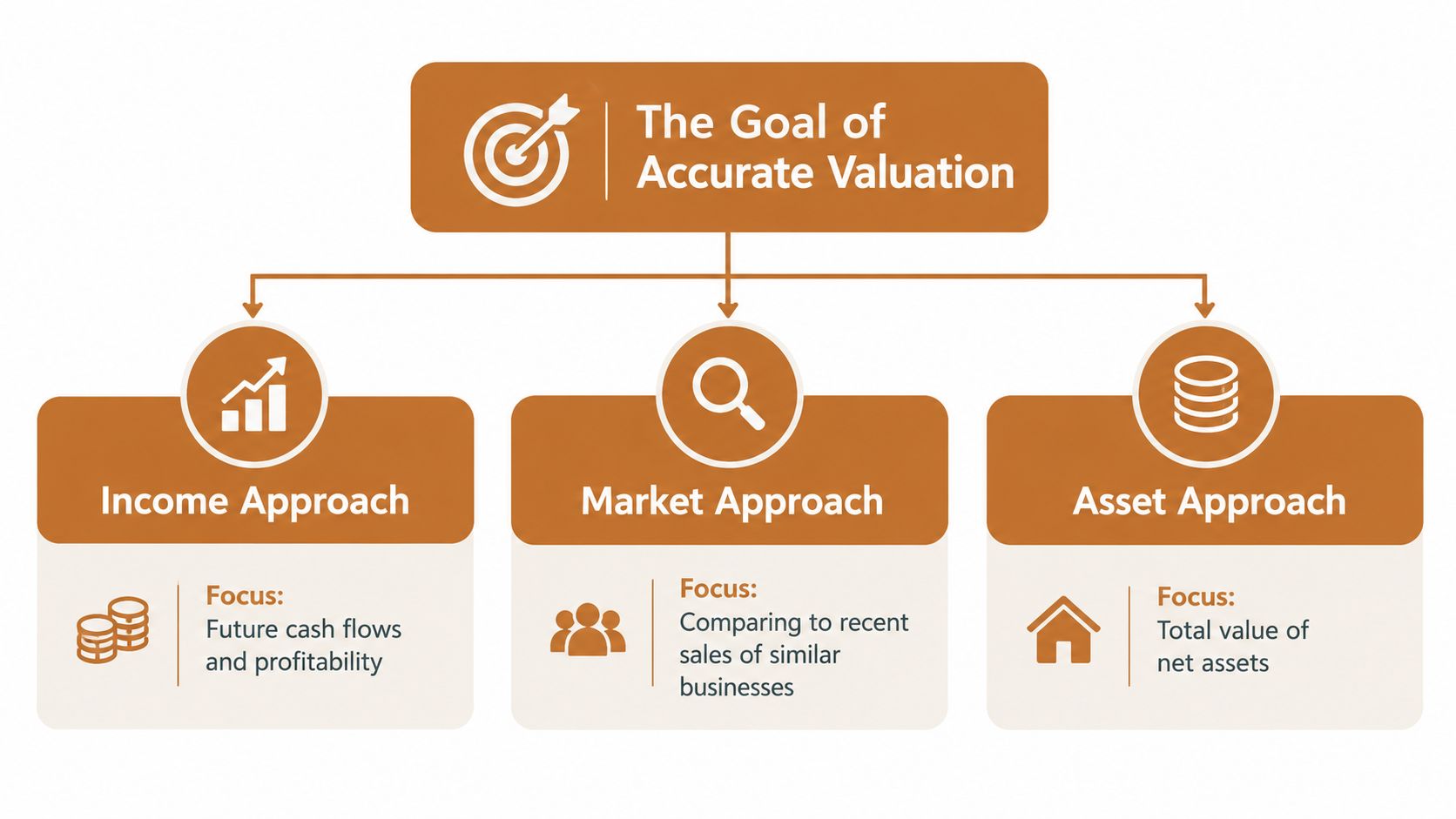
The income approach asks, what future economic benefit can this business generate, and what is that benefit worth today? An analyst may review projected cash flow, expected growth, capital needs, working capital, and risk. A company with documented maintenance agreements and repeat service work may fit this approach more naturally than a business whose revenue depends on unpredictable emergency calls.
Discounted cash flow, or DCF, is one form of the income approach. The analyst forecasts future cash flows and discounts them because money received later is worth less than money available now, particularly when the forecast involves uncertainty. The private-company valuation explanation from the Corporate Finance Institute notes that private-company discount rates are often higher than public-market WACC because of company size, illiquidity, and company-specific risk.
For privately held companies, expert sources commonly place discount rates around 15% to 30%, according to that source. A higher perceived risk reduces present value even when projected cash flow remains unchanged. That calculation explains why an optimistic forecast alone cannot raise a company’s value. A buyer will test whether the forecast rests on repeatable customer demand, transferable processes, and work that someone other than the owner can perform.
Recurring revenue can strengthen the income case because it gives the buyer a clearer starting point for future activity. An agreement for planned inspections is easier to model than a customer who may call only after a breakdown. The agreement still needs to be profitable, documented, and transferable.
The market approach compares a company with relevant transactions or comparable businesses. Relevance matters more than superficial similarity. A large regional service company with professional management, broad customer coverage, and documented contracts is a poor comparison for a small plumbing company where the owner answers every call and holds the key customer relationships.
The earnings measure must match as well. An SDE multiple belongs with SDE, while an EBITDA multiple belongs with EBITDA. Applying an SDE multiple to EBITDA, or the reverse, can produce a neat calculation with a misleading result. Owners can review this guide to comparable company analysis for a closer explanation of how analysts compare companies.
A second plain-language reference, Stewart Accounting Services business valuation, outlines common valuation concepts and the information professionals typically examine. These references can help an owner understand the questions behind a multiple, rather than treating the multiple as a fixed price tag.
The asset approach focuses on what the company owns, less what it owes. It can suit an asset-heavy business, a company with weak or inconsistent earnings, or an operation where equipment provides much of the economic value.
For an operating HVAC business, adding every truck and piece of equipment to an earnings-based value may count the same value twice. Those assets may already be required to produce the earnings being valued. The analyst must establish whether equipment, inventory, cash, debt, and working capital are included in the assumptions before drawing conclusions.
SDE often suits a smaller company in which one owner actively operates the business. It reflects the financial benefit available to that owner-operator after appropriate normalization. EBITDA is more useful when the company can support management and operations apart from one specific owner.
Normalization adjusts reported financial statements to show sustainable operating performance. An analyst may examine owner compensation, personal expenses, unusual gains or losses, related-party rent, and costs the business has deferred. An add-back is not automatic. If the owner performs work a buyer must replace, that replacement cost remains part of the company’s economics.
The video below provides a visual introduction to business valuation concepts.
The right method does not produce a magical number. It produces a reasoned conclusion showing what the number measures, which assumptions support it, and which risks could change it.
Two plumbing companies can report the same SDE and still attract different offers. One may have maintenance agreements, diversified customers, and a manager who handles daily scheduling. The other may depend on the owner’s personal relationships, emergency calls, and a handful of large commercial accounts.
The difference is quality of earnings. Buyers pay more confidently when earnings are repeatable, transferable, and supported by systems that don’t disappear at closing.
A service call produces revenue once. A maintenance agreement creates a reason for the customer to return, a scheduled opportunity to provide service, and a relationship another owner can potentially continue. Recurring revenue doesn’t eliminate cancellations, service problems, or competition, but it can make future activity easier to forecast.
Consider two hypothetical HVAC businesses. The first waits for customers to call when a system fails. The second sells maintenance agreements that bring customers back for planned inspections and create opportunities to identify repairs before a crisis. The second company may offer a buyer greater visibility into future workload, provided the agreements are documented, profitable, and transferable.
Owners can learn more about the mechanics of this value driver in this explanation of what recurring revenue means. The important question isn’t whether a company uses the phrase “recurring revenue.” It’s whether customers have an ongoing commercial reason to stay.
An owner who is the chief salesperson, estimator, dispatcher, technician, and relationship manager may be the company’s greatest producer. That same concentration can make the business difficult to transfer.
A buyer will ask practical questions:
A strong answer to those questions can support confidence. A weak answer may force the buyer to price in extra management, lost customers, slower sales, or a lengthy transition. In other words, the owner may be profitable but not yet replaceable.
High revenue doesn’t automatically mean high value. A company can generate substantial sales while spending too much on labor, vehicles, callbacks, materials, advertising, or poorly priced jobs. Buyers examine whether margins are stable and whether the reported profit survives normal operating costs.
A margin review should separate profitable work from busy work. Which services produce reliable contribution after direct labor and materials? Which customers negotiate heavily? Are emergency jobs profitable after overtime and callbacks? Does the company price maintenance agreements so they support service capacity rather than consume it?
A buyer doesn’t just purchase the amount of money the business made. The buyer purchases the confidence that the business can keep making it.
Owners should also watch for concentration. A large customer can make a year look excellent while increasing the consequences of one lost contract. A broader customer base, written agreements, consistent pricing, and a capable team all reduce the amount of trust a buyer must place in one person or one relationship.
A plumbing company built around its owner may produce strong earnings yet attract a lower multiple than a similar company with trained managers, documented processes, and contracted repeat work. Buyers are pricing the business they can take over, not only the income it produced under the current owner. Business size changes the earnings measure and the risk buyers must absorb.
Businesses under about $2 million are often valued with SDE, while businesses from roughly $2 million to $50 million are more often valued with EBITDA, according to this small-business valuation guide. The dividing line reflects how the company operates, not a rigid revenue rule.
| Business profile | Common earnings lens | What buyers tend to examine |
|---|---|---|
| Small owner-operated service company | SDE | Owner dependency, customer retention, local reputation, repeat work, and the buyer’s ability to replace the owner |
| Larger service company with management | EBITDA | Management depth, margin consistency, systems, contracts, and cash flow after operating leadership |
| Asset-heavy manufacturer | EBITDA and asset support | Production capacity, equipment condition, customer concentration, capital requirements, and management continuity |
The same market guidance reports that, in Q2 2025, the sub-$500,000 segment averaged about 2.3x SDE, while the $5 million to $50 million segment was around 5.5x EBITDA. These figures show why larger companies can receive higher multiples when earnings no longer depend on one person. They are reference points, not a quote for a particular HVAC, plumbing, or manufacturing company.
Sector changes the range too. Service, retail, and food businesses are commonly discussed near 1.5x to 3.0x SDE, while manufacturing businesses are often placed closer to 3.0x to 5.0x or more, depending on their equipment, customer base, and operating profile, as described in Morgan & Westfield’s valuation guidance. Manufacturing may support stronger pricing through specialized equipment or repeat production. Trades may require less capital, but buyers still assess technician retention, local competition, callbacks, and the owner’s customer relationships.
Recurring revenue can change that calculation. Maintenance agreements, service contracts, and repeat commercial accounts give a buyer a clearer view of future work than one-time jobs. An owner-run company under roughly $5 million in revenue may fall around 2x to 4.5x SDE, while stronger recurring-revenue companies can command materially higher EBITDA multiples because contracts reduce buyer risk, according to CTA Acquisitions’ valuation resources.
A range starts the investigation. The useful question is, “Which businesses are comparable?” Compare owner dependence, earnings quality, contract transferability, customer concentration, and management depth before treating an online multiple as a target.
A valuation becomes more useful when an owner-operated business can be understood, run, and checked by someone outside the owner’s head. For an HVAC, plumbing, electrical, or other trade company, that means turning personal know-how and customer trust into evidence a buyer can verify. The goal is not to remove the owner’s personality. It is to make the company’s value visible beyond the owner’s daily presence.
Separate business and personal spending. Reconcile accounts consistently, and keep financial statements aligned with tax filings, payroll records, bank statements, and job-level reporting. Prepare a clear schedule of proposed normalization adjustments so a buyer can see which costs belong to ordinary operations.
Explain unusual expenses without asking an accountant to reconstruct the story. If the business pays rent to a related party, document the arrangement. If the owner uses a vehicle for both business and personal reasons, separate the relevant costs. If a storm caused an unusual repair expense, keep the invoice and explain why it does not reflect normal trading activity.
Clean records act like a well-labeled workshop. They let a buyer find the tools, understand their use, and check that nothing important is missing.
Document how the company answers calls, prices work, dispatches technicians, orders materials, handles callbacks, invoices customers, and collects overdue balances. Tools such as QuickBooks for accounting, ServiceTitan or Housecall Pro for field-service workflows, and a shared operations manual can preserve that knowledge in a form the team can use.
The software matters less than the outcome. A buyer should be able to identify who performs each task, what information that person needs, and what happens when the usual person is unavailable. If every important decision still passes through the owner, the buyer is also acquiring a job, not just a business.
Replace informal promises with written maintenance agreements, renewal procedures, service histories, and clear pricing. Recurring service work gives a buyer a more dependable view of future activity than a file of one-time jobs, especially when contracts transfer cleanly and customers are not tied only to the owner.
Train another person to review estimates, handle customer escalations, and monitor technician performance. Begin transferring customer relationships while the owner can still correct mistakes. That gradual handoff helps show whether the business can retain work after the owner exits.
AI and automation require the same practical test. Recent market commentary says buyers are examining risk more closely and that AI is changing operations and evaluation, while a 2026 market pulse reports that AI has not yet produced consistent valuation premiums or discounts. An AI-enabled workflow has value when it improves documentation, response time, scheduling, quality control, or decision visibility without creating privacy, reliability, or ownership problems. The 2026 market discussion of AI and acquisitions describes this unresolved gap.
In a DCF valuation, the discount rate reflects the risk attached to projected cash flow. Private-company discount rates are often around 15% to 30%. A higher perceived risk lowers present value even when the projected cash flow stays unchanged, as explained in the Corporate Finance Institute’s private-company valuation resource.
Better records, reduced owner dependence, diversified customers, and documented contracts make forecasts easier to support. They may also reduce the uncertainty a buyer associates with the business. Ask the accountant, attorney, and valuation professional how those improvements affect the selected method rather than assuming every upgrade creates a direct increase in value.
A calculator can help an owner frame an initial conversation. It can’t reliably decide whether a personal expense is a legitimate add-back, whether a customer contract will transfer, whether equipment is already included in the operating value, or how much management the buyer must replace.
Professional advice becomes especially important when the result will influence a legal, tax, ownership, or family decision. That includes a planned sale, a shareholder dispute, a divorce, an estate transfer, a buyout, a partner admission, or a succession arrangement involving children. It also matters when the company has several entities, related-party transactions, unusual assets, significant debt, or a mix of service and product revenue.
A preliminary estimate can help an owner identify the questions that need answers. Gather tax returns, interim financial statements, owner compensation details, customer and contract information, debt schedules, asset lists, and explanations for unusual income or expenses.
Then test the estimate against reality:
A certified valuation specialist can select appropriate methods, normalize the financial statements, review market evidence, explain discounts, and prepare a report suited to the decision. A broker or M&A advisor may contribute market knowledge and buyer access, but those roles aren’t identical to an independent valuation engagement.
Before hiring anyone, ask what deliverable you’ll receive, which valuation standard applies, what records the professional needs, and whether they understand owner-operated trades. The practical guide on how much a business valuation costs can help owners prepare for that conversation without treating a generic fee estimate as a quote.
The strongest valuation is not necessarily the highest number. It’s the number you can explain, support, and use to decide whether to sell now, improve the company first, transfer it to family, or continue operating with a clearer plan.
The Owner’s Shortlist connects long-tenured business owners with curated specialists for valuation, tax, legal, succession, financing, and related decisions. Visit The Owner’s Shortlist to review plain-language guides and find an appropriate specialist for your company’s valuation and exit-readiness questions.
Tell us your situation. We'll connect you with a specialist who works with owners like you. One conversation, no sales pressure.
Found this useful?
Add The Owner's Shortlist as a preferred source and get our articles highlighted in Google Search results.
Add to Preferred SourcesExplore business valuation meaning for owner-operated firms. Learn valuation methods, drivers, misconceptions, and steps to secure a defensible valuation.
September 28, 2026
What Is Recurring Revenue. Learn what recurring revenue is, how ARR and MRR work, real trade examples, and why this revenue model shapes business value and exit
September 23, 2026
Learn how much to sell a business for with SDE and EBITDA multiples, adjustments, and deal tips to set a defensible price and maximize proceeds.
September 21, 2026
Understand business valuation cost, fee structures, price ranges and what drives fees so you can budget wisely and get accurate quotes.
September 19, 2026