How to Sell My Plumbing Business: A Practical Roadmap
Ready to sell my plumbing business? Follow a step-by-step roadmap for valuing, marketing, and closing the sale with confidence and clarity.
October 15, 2026
By Remi Taffin · July 21, 2026 · Updated October 1, 2026
A professional small-business valuation usually costs $3,000 to $10,000, with the typical price centering around $5,000 for a standard certified appraisal. You can spend less on a basic broker opinion, often $0 to $3,000, or much more when the business is larger, more complex, or needs a deeper, defensible report.
If you’re asking this now, you probably have a real decision in front of you. Maybe a buyer asked what the company is worth. Maybe your partner wants out. Maybe your lender mentioned a valuation for an SBA loan, and now you’re staring at a fee proposal that seems high for “just a report.”
My blunt advice is this. Stop shopping for the cheapest valuation before you know what the valuation is for. Owners waste money in two ways. They either overbuy a formal report they didn’t need, or they underbuy a cheap estimate that nobody can use when the stakes rise.
That’s what determines how much a business valuation costs. Not just size. Purpose.
You get a quote for $1,500 from one firm and $8,000 from another. If you are a first-time owner, that spread looks absurd. It is not. You are not comparing the same product.
Business valuation cost depends on the job the report has to do. A rough estimate for planning, a pricing opinion for a sale, and a defensible report for an SBA lender or legal dispute sit at different price points because they involve different levels of analysis, documentation, and risk.
For many small and mid-sized businesses, owners should expect a few thousand dollars at the low end and a materially higher fee once the valuation has to hold up under outside scrutiny. The practical point is simple. Price only makes sense after you define the purpose.
Use that purpose as your filter:
Owners frequently waste money on business valuations. Some buy a full formal valuation for a basic planning exercise and overpay for detail they will never use. Others buy the cheapest opinion available, then discover the report is useless once a bank, buyer, or opposing counsel asks how the number was calculated.
Buy for the decision in front of you.
If the valuation must stand up to review, challenge, or documentation requests, do not shop by lowest fee. Shop by fitness for purpose. A cheap report that cannot be used is more expensive than a higher-priced report that works the first time.
An owner gets a broker’s pricing opinion for a possible sale, then takes that same document to an SBA lender. The lender rejects it. Now the owner pays twice and loses time.
That is a key difference between valuation tiers. The cheaper option is not the better option if it cannot do the job.
A broker opinion of value is the lightest service in the market. It is usually built for sale prep, not formal review. Brokers use market experience, buyer demand, recent deal activity, and rule-of-thumb pricing to estimate what a business might sell for.
For the right purpose, this can be money well spent. If you are deciding whether to go to market, testing an asking range, or sizing up exit timing, a broker opinion may be enough. Pricing varies by broker, some do it free as part of getting to know your business, others charge $500 to $3,000 upfront. We can match you with a broker who offers a free BOV if that matters to you.
For anything that needs documentation, it is the wrong tool. Lenders, courts, tax authorities, and attorneys usually want a real valuation report with supporting analysis. A broker opinion often lacks that support.
A calculation engagement sits in the middle. The analyst and client agree on a narrower scope, and the result is a calculated value rather than a fully developed conclusion of value.
This tier fits owners who need a more grounded number for planning but do not need a report built for scrutiny. Common uses include internal planning, early partner discussions, preliminary buyout talks, and strategy decisions where the number guides a decision rather than proves a case.
It is a practical middle option. You spend less than you would on a full report, but you also accept limits on the analysis, methods, and documentation. If your situation later turns into a lender file, tax matter, or dispute, you may need to start over with a higher-level engagement.
A full valuation engagement is the highest tier. This is the version to buy when the number has to hold up under questions, review, and documentation requests.
Use this tier for SBA loans, IRS matters, gift or estate planning, divorce, shareholder disputes, litigation, and formal transactions where someone on the other side will examine the report. The analyst will usually review more records, apply valuation methods more fully, and explain how the final conclusion was reached.
Yes, it costs more. It should. You are paying for supportable work, not just a number on the last page.
Here is the practical breakdown:
| Valuation Type | Typical Cost | Best For | Key Limitation |
|---|---|---|---|
| Broker Opinion of Value | Low cost or sometimes included in brokerage discussions | Early sale planning, rough pricing conversations | Usually not suitable for lenders, courts, or tax filings |
| Calculation Engagement | Mid-range fee | Internal planning, early negotiations, some buyout discussions | Narrower scope and less support than a full valuation |
| Full Valuation Engagement | Highest fee | SBA loans, tax matters, legal disputes, formal transactions | More time, more documentation, higher cost |
Buy the report that matches the decision in front of you.
If you need a pricing sense for internal use, keep the scope narrow and control the fee. If the valuation has to survive outside review, pay for the full engagement the first time.
Two owners can hire for the same company size and get very different proposals. The reason is usually not the headline revenue number. It is the amount of work required, the level of scrutiny the report must survive, and the kind of firm they hired.
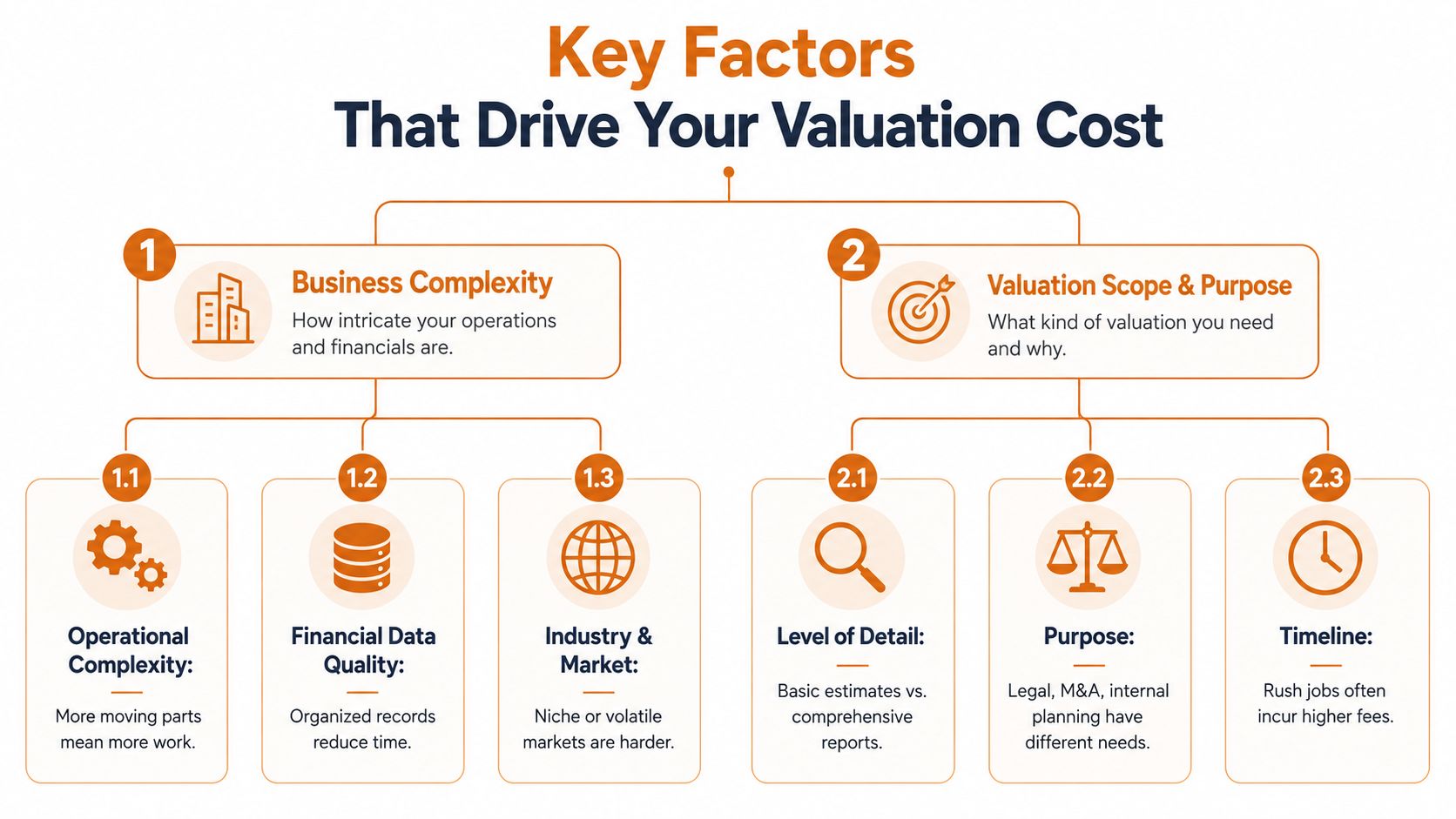
A one-location plumbing business with clean books costs less to value than a company with multiple entities, related-party transactions, messy bookkeeping, and owner perks running through the income statement.
That difference is not cosmetic. It changes the analyst’s workload.
The valuator has to recast financials, separate personal spending from business expenses, review contracts, test assumptions, and decide which methods fit the facts. If the business also has unusual assets, customer concentration, pending litigation, or uneven margins, the file gets slower and more expensive.
Industry matters too. Software, healthcare, construction, manufacturing, and franchise systems often need more judgment than a simple local service business. If you want a clearer sense of the methods behind that process, this guide on how to value a small business gives useful background before you compare proposals.
This is the factor owners miss most often.
A valuation for internal planning is one job. A valuation for an SBA lender, the IRS, a divorce case, or a shareholder dispute is a different job because the report has to answer tougher questions and document the reasoning in more detail.
That is why the cheapest proposal is often the wrong one. If your goal is a formal loan or legal matter, a light report can turn into a wasted fee because the lender, court, or tax advisor may reject it. If your goal is planning, paying for litigation-level support is wasteful. Match the assignment to the decision.
Many owners find this short video useful because it shows why the same business can receive very different quotes based on scope and intended use.
A solo appraiser, a boutique valuation firm, a regional CPA firm, and a national accounting firm do not price the same way. They carry different overhead, review standards, and liability exposure.
For a straightforward small business, a specialist who works with owner-operated companies is usually the right fit. You do not need a giant firm unless the assignment involves major legal exposure, complex entities, or highly knowledgeable parties on the other side who will challenge every assumption.
Pay for fit, not prestige.
Some cost drivers are built into the business. Several are under your control.
Good preparation does more than trim the fee. It also improves the result. The analyst spends less time sorting through avoidable messes and more time producing a valuation you can use.
A plumbing company doing $800,000 a year should not buy the same valuation report as a software firm with deferred revenue, outside investors, and messy cap table history. Owners waste money when they shop by price alone. The right question is whether the report fits the job.

For a local service business under $1 million in revenue, a professional valuation often lands at the lower end of the market. Expect something in the low-thousands if the company has one entity, clear tax returns, and financials that do not need repair.
That describes a lot of trade businesses. One-location HVAC, plumbing, electrical, and landscaping companies often fit this profile.
Do not overbuy here.
If your goal is internal planning, partner discussions, or getting a realistic sense of value before a sale, a narrower engagement is usually enough. If the number needs to hold up for financing, litigation, or a formal transaction, buy the stronger report from the start. A cheap report that cannot be used for the actual decision is not a savings.
Once a business moves into the mainstream small-business range, valuation fees usually rise with the amount of judgment required. A company with several managers, customer concentration, add-backs that need scrutiny, or multiple locations costs more to value than a simple owner-run operation, even if revenue is still modest.
Many owners make the wrong call. They assume a business that feels familiar should be cheap to value. It often is not. A niche distributor, a larger home services company with service contracts, or a professional firm with uneven owner compensation usually needs more normalization work and more support for the final conclusion.
If you want to understand the mechanics before hiring an appraiser, this guide on how to value a small business gives a plain-English overview of what analysts examine and why it affects the fee.
Owners usually do not have a price problem. They have a fit problem. They buy too little for a serious need, or too much for a simple one.
By the time revenue reaches the lower middle market, costs can climb fast. The reason is not just size. It is complexity.
A manufacturer with inventory issues, a healthcare practice with regulatory risk, a software company with recurring revenue, or a business with several legal entities usually needs more than a basic review. Analysts may need deeper financial modeling, better comparable data, and tighter support for discounts, projections, and risk assumptions. The American Institute of CPAs explains the broader valuation process and standards in its business valuation services overview.
Industry can raise the fee even when revenue does not. Specialized companies take longer because the appraiser has to understand how that specific business makes money, where the risks sit, and which valuation methods are most appropriate. That is why two companies with similar sales can get very different quotes.
The practical rule is simple. The farther your business is from a clean, single-entity, owner-operated company, the less likely you are to get an entry-level price, and the more important it becomes to buy a report built for your actual purpose.
Owners often ask the wrong question after hearing the fee. They ask, “Why is this report so expensive?” The better question is, “What exactly am I buying?”
A valuation report isn’t just a number on the last page. You’re paying for the analysis, support, documentation, and logic that lead to that number.
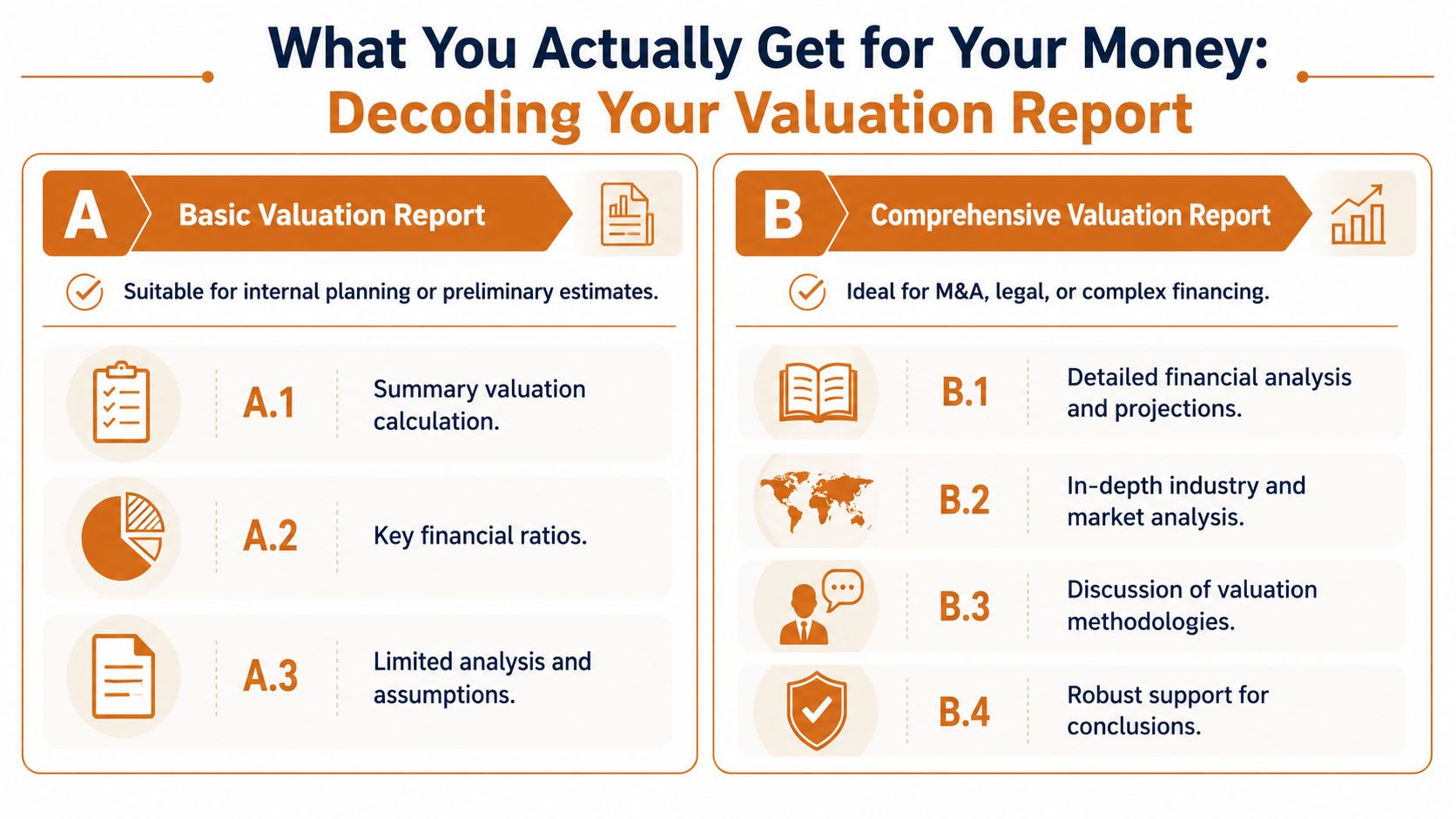
At the lower end of the market, you should expect a more limited package. That might include a summary analysis, fewer adjustments, less narrative support, and a narrower explanation of assumptions. For some internal uses, that’s perfectly fine.
The danger is assuming a lighter report can do a heavier job. It often can’t.
A limited-scope engagement may still be useful if your goal is internal planning, rough pricing expectations, or early-stage negotiation prep. But if another party is likely to challenge the number, you need more than a summary and a spreadsheet.
Once you move into the higher-priced end of the small-business market and beyond, you’re usually paying for more than a thicker PDF. You’re paying for more financial recasting, more support for assumptions, more than one valuation method, stronger comparable analysis, and a conclusion that someone can defend in a serious conversation.
That’s also where jargon starts to confuse owners, so let me simplify it:
If you want to understand how valuation methods like multiples fit into that report, this plain-English guide on how businesses are valued and how multiples work is a useful companion.
Here’s a practical checklist for reviewing any proposal or sample report:
| What to Look For | Why It Matters |
|---|---|
| Clear statement of purpose | Tells you whether the report matches your actual need |
| Scope of analysis | Shows whether the work is limited or fully developed |
| Explanation of assumptions | Helps you judge whether the conclusion is credible |
| Valuation methods used | Reveals whether the specialist considered the business from more than one angle |
| Report usability | Tells you whether the output is for planning only or can support a formal process |
A good valuation report doesn’t just tell you the number. It shows how the appraiser got there and why that path fits your situation.
A bad valuation provider can waste your money in two ways. They can oversell you a report you don’t need, or undersell you one that won’t hold up. Your job is to screen for fit, not just credentials and price.
Start with straightforward questions. If the specialist answers clearly, that’s a good sign. If they hide behind jargon, move on.
If you need a starting point for finding firms, this guide to finding a business valuation specialist outlines what to look for, and The Owner’s Shortlist maintains a curated directory model for owners who want to compare relevant specialists without wading through generic listings.
Some warning signs are obvious once you know what to watch for.
You can also lower your own costs before you hire anyone.
The owners who get the best value from a valuation engagement usually do one thing right. They define the job clearly before they compare prices.
If you’re sorting through valuation options, The Owner’s Shortlist offers practical articles and a curated way to identify specialists in valuation, tax, legal, financing, and succession work, so you can start with the right conversation instead of guessing which type of advisor you need.
Tell us your situation. We'll connect you with a specialist who works with owners like you. One conversation, no sales pressure.
Found this useful?
Add The Owner's Shortlist as a preferred source and get our articles highlighted in Google Search results.
Add to Preferred SourcesReady to sell my plumbing business? Follow a step-by-step roadmap for valuing, marketing, and closing the sale with confidence and clarity.
October 15, 2026
Learn how to sell your service business with a practical, step-by-step roadmap. From readiness and valuation to deal structure and closing, get actionable
October 14, 2026
Learn how business valuation EBITDA works for service companies. Discover adjustments, multiples, and owner-dependency tests before you sell.
October 12, 2026
Thinking 'I want to sell my landscaping business'? Learn how to value your company, prepare financials, handle labor risks, and find the right buyer quietly.
October 11, 2026