Business Valuation Report: A 2026 Guide
Discover what a business valuation report includes, how to interpret it, and why it matters for your company's financial strategy.
October 6, 2026
By Remi Taffin · October 7, 2026

SDE is the pre-tax, pre-financing cash benefit available to one working owner, used as the headline earnings figure in small business sales. It isn’t the same as profit or post-sale cash, because the buyer still has to account for replacement labor, reinvestment, working capital, taxes, and debt.
A plumbing, HVAC, or other service-business owner often sees three different versions of the company’s earnings. The tax return shows one number. The operating account suggests another. The broker’s marketing package presents a third, usually after adding back owner compensation, personal benefits, and selected expenses.
Buyers don’t pay for the most flattering version. They pay for the cash flow they believe will remain after the transaction.
That distinction is why Seller’s Discretionary Earnings, usually shortened to SDE, deserves more attention than its simple formula suggests. The calculation is only the starting point. The true work is building a bridge from reported net income to sustainable buyer cash flow, then defending every adjustment with records and operational logic.
SDE is a normalized earnings measure designed for a business where one buyer is expected to work in the company. It starts with reported net income and adds back eligible owner compensation, owner benefits, financing costs, depreciation, amortization, and legitimate nonrecurring expenses. The result estimates the economic benefit available to one working owner before personal taxes and acquisition financing.
That definition matters because SDE isn’t a GAAP line item. Owners and advisors reconstruct it from the tax return, profit and loss statement, payroll records, general ledger, and supporting documents. Seller’s Discretionary Earnings guidance describes the conventional starting point as net income plus defensible owner-related and nonrecurring adjustments.
A buyer of a small owner-operated company usually isn’t purchasing a fully independent management platform. The buyer may answer calls, quote work, manage technicians, maintain key accounts, or perform the skilled labor previously handled by the seller. SDE reflects that reality. It answers, “What can one working owner reasonably take from this business?” It doesn’t answer, “What cash will a passive owner receive?”
SDE becomes dangerous when sellers treat every possible add-back as permanent cash. A personal vehicle may include a genuine business component, but the company may still need transportation after closing. A family member’s payroll may be removable, but only if the work disappears or can be absorbed without replacing that person. A legal bill may be nonrecurring, while software, maintenance, and marketing expenses labeled “one-time” may return every year.
The practical test is simple:
SDE is useful only when the buyer can follow the number from the tax return to sustainable post-close cash flow.
Keep a separate schedule for every adjustment. Include the account, amount, date, business purpose, supporting document, and expected post-sale treatment. Even routine administrative records can help. For example, consistent expense documentation through a tool such as Snyp receipt automation can make it easier to identify personal, mixed-use, and purely business-related spending before diligence begins.
The conventional calculation begins with reported net income, not the owner’s preferred cash figure. Starting with the filed financial record gives both parties a common reference point and makes unexplained adjustments easier to identify.
The formula then adds back expenses that either belong to the current owner personally, relate to financing or accounting presentation, or won’t reasonably recur for the buyer. The purpose isn’t to make earnings look larger. It is to isolate the benefit available to one owner under a normal operating arrangement.
| Line Item | What It Represents | Treatment in SDE |
|---|---|---|
| Reported net income | Profit shown in the tax return or financial statements | Starting point |
| Owner compensation | Wages, salary, or other compensation paid to one working owner | Usually added back, subject to replacement-labor analysis |
| Payroll taxes on owner compensation | Employer-side payroll cost connected to the owner’s pay | Generally added back with the related compensation |
| Depreciation and amortization | Noncash accounting charges | Usually added back |
| Interest expense | Cost of the seller’s financing structure | Usually added back because buyer financing differs |
| Income taxes | Taxes connected to the seller’s ownership and tax position | Added back in conventional SDE presentations |
| Discretionary expenses | Personal benefits or spending the buyer won’t retain | Added back only when the cost genuinely disappears |
| Nonrecurring professional fees | Isolated legal, accounting, or sale-preparation costs | Added back when documented and not part of normal operations |
| Nonrecurring repairs | Unusual damage or isolated replacement work | Added back when the expense won’t recur and the asset remains adequate |
| Non-operating income or loss | Activity outside the business being sold | Removed or adjusted to show operating earnings |
Owner compensation deserves special care. Adding back the seller’s full pay doesn’t mean the business produces that amount for every buyer. It means the metric assumes the buyer will perform the owner’s role. A buyer who plans to hire a manager must subtract that cost.
A defensible SDE schedule separates reported earnings, seller adjustments, and buyer adjustments. The first two describe the seller’s presentation. The last category addresses what the buyer must spend to operate the company normally.
That is why two advisors can start from the same net income and reach different “adjusted SDE” figures. They may disagree about whether an expense is personal, whether it will recur, or whether the owner’s responsibilities require replacement labor. The difference isn’t automatically a mistake, but every difference needs evidence.
Buyers don’t reject add-backs because they dislike the seller. They reject them when the adjustment fails the operating test: would this expense still hit the business if the buyer ran it normally?
Owner compensation and the employer taxes attached to it are usually among the strongest adjustments. Even then, a buyer may reduce the benefit by assigning a market-rate cost to the seller’s sales, estimating, dispatch, licensing, or management duties. The add-back survives as a presentation item, but its full value may not survive as buyer cash flow.
Personal spending is weaker. Country club dues, a personal vehicle, family travel, and a spouse’s compensation may be partly or entirely removed from the adjustment schedule. The question isn’t whether the seller enjoyed the benefit. The question is whether the company can stop paying for it after closing without losing revenue, capacity, compliance, or customer service.
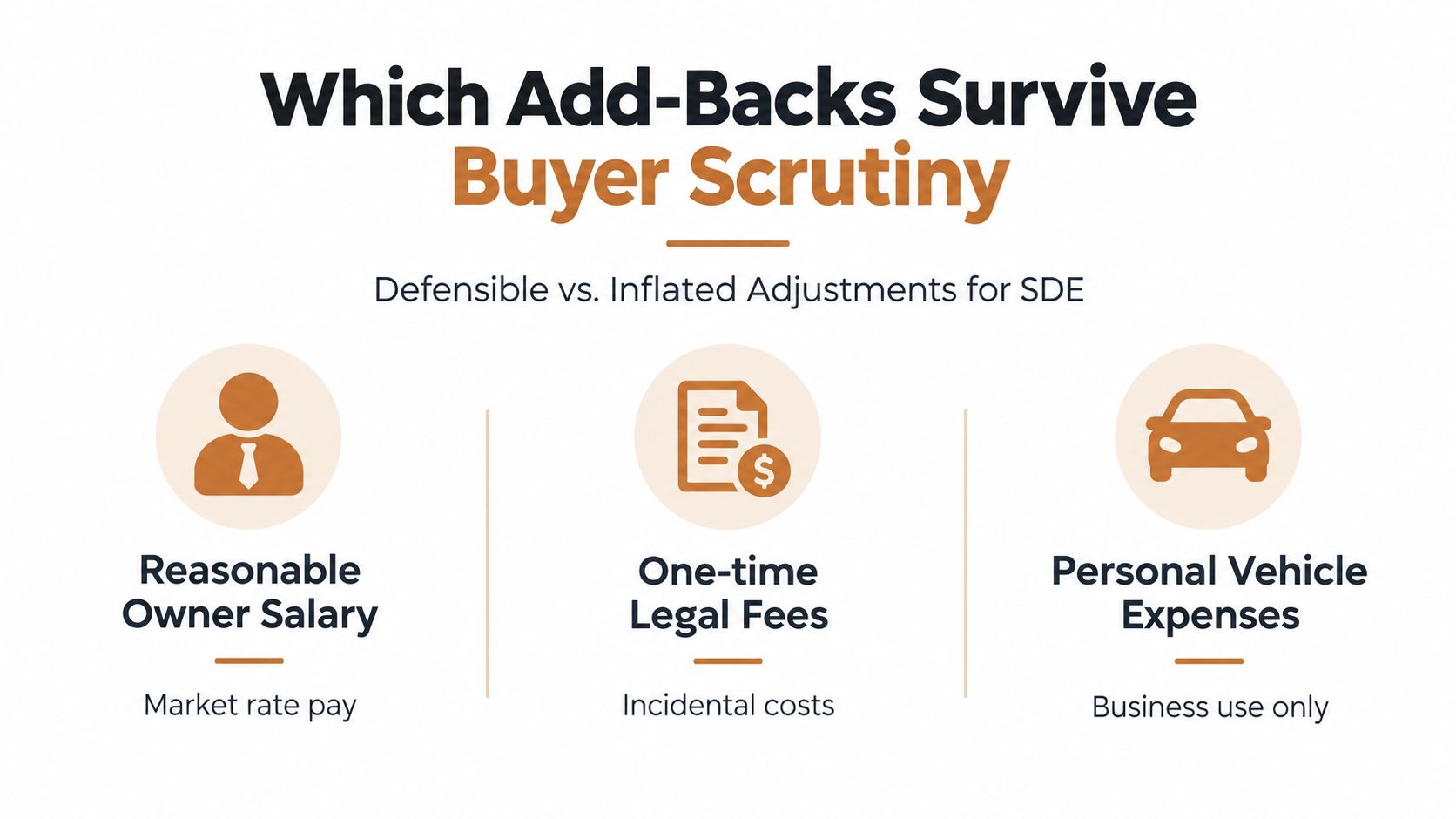
A one-time lawsuit, isolated storm repair, or unusual software migration can be defensible when the owner provides invoices, dates, explanations, and evidence that the event won’t become a recurring operating cost. A recurring campaign, annual equipment replacement, or predictable maintenance cycle doesn’t become nonrecurring just because it appears in a separate account.
A quality of earnings review is often useful when the add-back schedule has become complicated. A quality of earnings report can help organize the movement from reported results to normalized earnings and identify adjustments that require more support.
Consider a small services business with a strong claimed SDE but several personal expenses mixed into payroll and vehicle costs. The defensible figure may be lower once the buyer removes expenses that support ongoing operations and assigns a cost to replace the owner’s customer-facing work. That gap usually becomes a negotiation lever, not necessarily a deal killer. A seller who identifies it early can explain the reasoning instead of allowing the buyer to discover it under pressure.
SDE and EBITDA answer different questions.
EBITDA begins with earnings before interest, taxes, depreciation, and amortization. It focuses on operating performance before financing, tax structure, and selected accounting charges. SDE goes further by adding back one owner’s compensation, owner benefits, and certain discretionary expenses, because it assumes that owner will personally operate the company.
| Line Item | SDE Treatment | EBITDA Treatment |
|---|---|---|
| Interest | Added back | Added back |
| Taxes | Added back | Added back |
| Depreciation | Added back | Added back |
| Amortization | Added back | Added back |
| One working owner’s compensation | Added back | Usually retained or replaced with market management cost |
| Owner perks | May be added back if truly discretionary | Usually excluded from operating earnings only when normalized |
| Personal or discretionary spending | May be adjusted if it disappears | Usually normalized carefully rather than automatically removed |
| Replacement management | Must be considered by the buyer | Normally reflected through operating payroll |
| Core question | What can one working owner take? | What does the managed business produce? |
The decisive distinction isn’t company size. It is transferability. SDE makes sense when the buyer expects to step into the seller’s role. EBITDA becomes more useful when the company can support market-rate management and operate without the seller’s daily involvement. This is the practical distinction emphasized in SDE versus EBITDA guidance.
An SDE presentation tends to attract individual buyers and other owner-operators who are comfortable purchasing an active role. An EBITDA presentation is more relevant to buyers assessing a management-ready asset, recurring operating performance, and the cost of professional leadership.
Switching from SDE to EBITDA can make earnings appear smaller because the owner’s compensation is no longer treated as entirely available cash. That isn’t necessarily a deterioration. It may reveal the cost of replacing the person who currently sells the work, manages the team, and protects customer relationships.
Presenting the wrong metric creates avoidable friction. An owner-dependent company marketed like an institutional acquisition may attract buyers who want a manager-ready platform and then discount the offer sharply. A systematized company presented only as an owner-operator opportunity may never reach buyers who would pay for transferable operations.
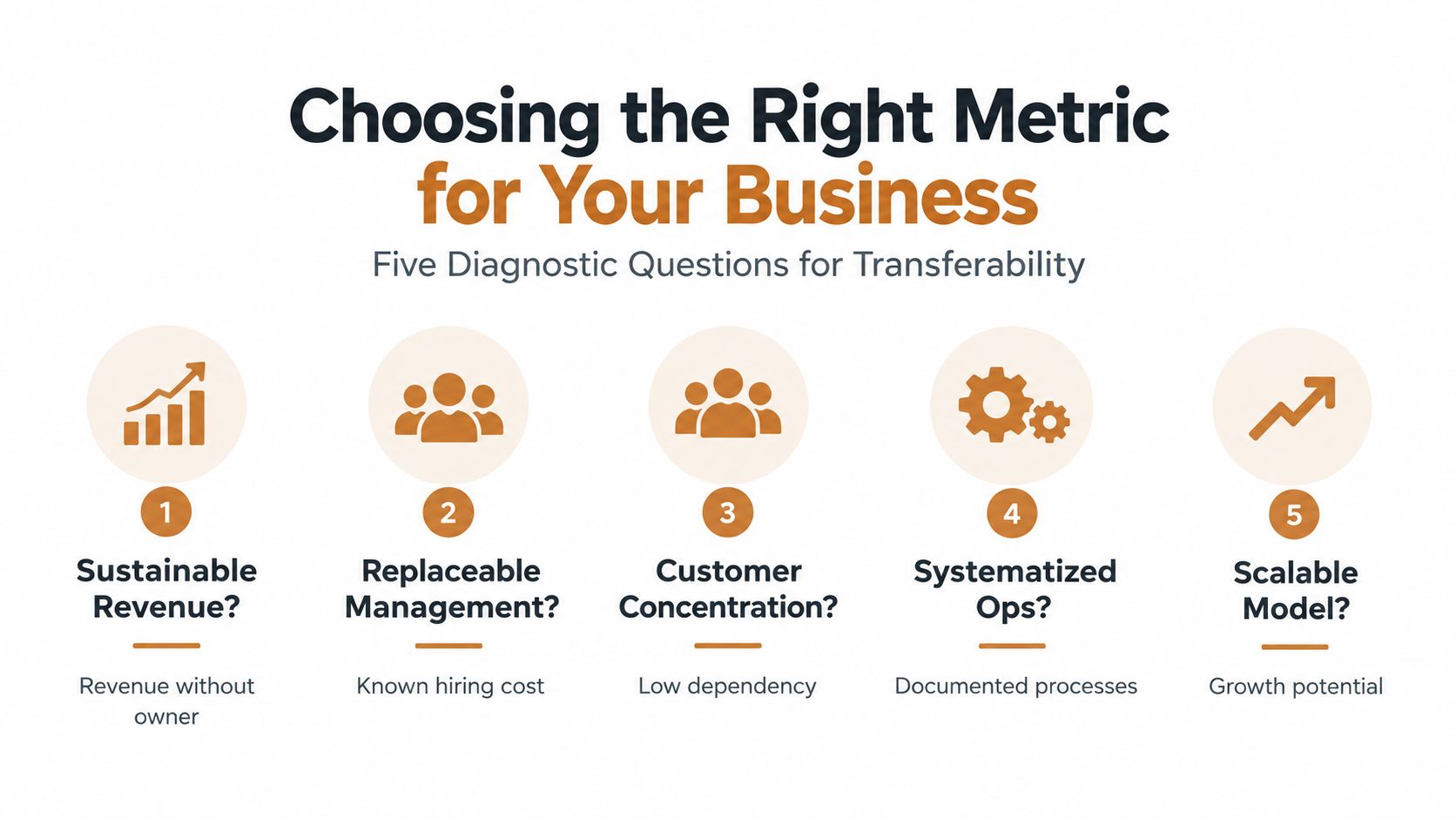
Use transferability, not a simple revenue label, to choose between SDE and EBITDA. Ask five questions about the company as it operates today.
Treat each answer as a diagnostic signal. Four or five affirmative answers point toward EBITDA because the business is closer to a transferable operating asset. Three or fewer suggest that SDE is the more honest headline metric. Mixed answers justify presenting both, with a clear reconciliation that shows owner compensation, replacement management, and other normalization items.
Don’t write “SDE” or “EBITDA” in a confidential information memorandum. Explain who currently performs the owner’s functions, which responsibilities transfer to employees, and what the buyer must spend to maintain normal operations.
That explanation helps right-size the buyer pool. It also prevents a common failure in which a seller markets an attractive headline number, receives interest from the wrong buyers, and spends months explaining why the business requires the seller’s involvement. A metric should describe the company a buyer can acquire, not the company only the current owner can operate.
Consider a residential HVAC and plumbing company whose owner handles estimating, high-value sales, technician oversight, and several important customer relationships. The financial statements show positive net income, but the owner’s compensation and several mixed personal expenses run through the business.
The calculation should proceed in layers:
That process may produce a reported SDE figure that looks attractive in a listing. It doesn’t make that figure the buyer’s sustainable cash flow. If the owner remains the lead estimator, the buyer needs a plan for that work. If the company’s trucks, tools, software, or equipment require ordinary replacement, those needs remain part of the operating model even if a particular expense is labeled nonrecurring.

A useful schedule has three columns: seller-reported earnings, accepted add-backs, and buyer-side normalization. Family vehicle costs may be partly accepted if business use is documented. Equipment replacement may be rejected if it represents a normal maintenance cycle. Owner compensation may be added back in the seller schedule and then reduced by a replacement salary in the buyer schedule.
The outcome should be a range with a written explanation, not false precision. One buyer may operate the business personally and accept more of the SDE. Another may need management immediately and underwrite a lower cash figure. Both can be acting rationally because they have different post-close labor plans.
The financial analysis should be paired with operational verification. This video provides additional context for examining business earnings and sale preparation:
SDE becomes a valuation input when a buyer applies a market multiple to normalized earnings. The multiple reflects risk, customer concentration, recurring revenue, owner dependence, staff depth, documented systems, industry conditions, and the quality of the financial records. It isn’t a reward for choosing an aggressive add-back schedule.
Lenders also examine whether the business can support acquisition debt after the buyer takes over. A headline SDE number that ignores replacement labor, working capital, equipment needs, or customer risk can produce a financing case that looks good on paper and fails under lender review.
| Business Profile | Typical SDE Multiple Range | Likely Buyer | Financing Notes |
|---|---|---|---|
| Highly owner-dependent service company | Market-specific and usually lower than a transferable peer | Individual owner-operator | Underwriting focuses on buyer’s ability to perform the role |
| Stable local service company with a trained team | Market-specific and dependent on documented earnings quality | Individual buyer or small acquisition group | Lender examines customer retention, payroll, and operating continuity |
| Systematized company with recurring revenue | Market-specific and potentially stronger than a comparable owner-dependent company | Strategic buyer, search fund, or professional operator | Financing case benefits from transferable management and repeatable reporting |
| Management-ready platform | Market-specific and generally analyzed through normalized EBITDA | Strategic or institutional buyer | Buyer focuses on recurring operating cash flow, management depth, and diligence quality |
An unsupported add-back can trigger a purchase price reduction, escrow protection, an earnout, or a broader investigation into the seller’s accounting. Even when the transaction closes, an inflated number damages credibility at the moment the seller needs the buyer to trust the rest of the information.
The same SDE can also produce different offers from different buyers. A first-time buyer who will work full time may value the owner’s role as an opportunity. A strategic acquirer may treat that same role as a cost because it already has management infrastructure. A search-fund buyer may accept the operational burden but require a different financing structure and transition plan.
A seller should therefore market the quality and transferability of earnings, not just the largest adjusted number. Business sale valuation guidance can help owners connect adjusted earnings with the wider valuation story, including buyer expectations and preparation.
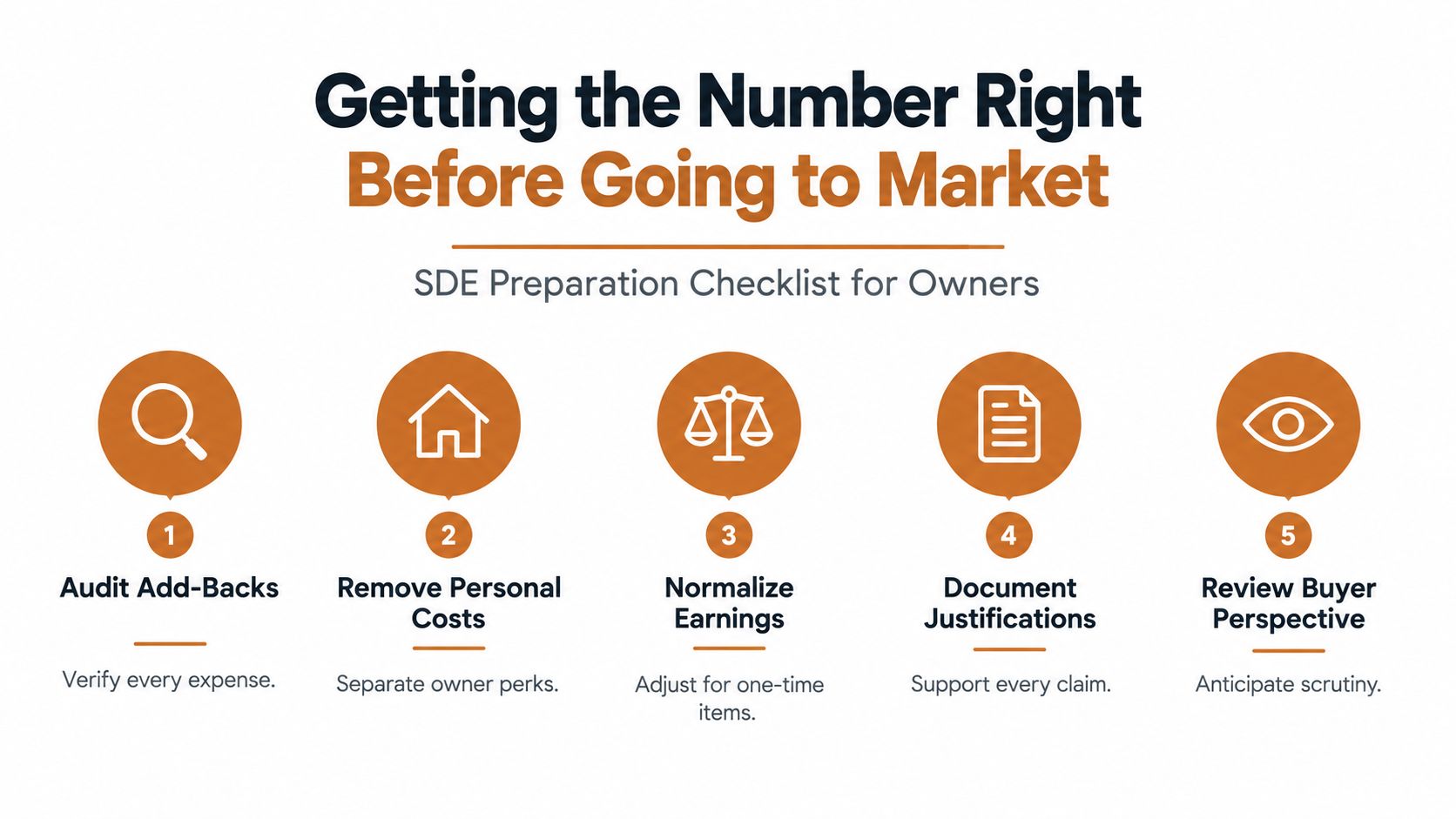
The best time to challenge SDE is before the business reaches buyers. A seller should be able to explain every adjustment without searching through old emails or relying on memory.
Start with a recast profit and loss statement and a separate add-back memo. Then test each item against five questions:
Working capital and capital needs deserve their own review. SDE isn’t cash available for every purpose. Inventory purchases, deferred maintenance, equipment replacement, taxes after acquisition, and debt principal can reduce what the buyer ultimately receives.
Expect a valuation specialist or M&A advisor to ask who performs sales, dispatch, estimating, field supervision, bookkeeping, and customer retention. They’ll want compensation history, related-party transactions, family payroll, vehicle use, unusual legal expenses, non-operating income, major repairs, and evidence supporting each proposed adjustment.
Build the file over a focused 30 to 60 day cleanup period, using the period as a preparation window rather than a claim about market timing. The deliverables should include reviewed financial statements, a recast P&L, a normalized SDE schedule, and an add-back memo that can travel with the CIM.
The Owner’s Shortlist connects long-tenured business owners with vetted specialists for valuation, taxes, legal matters, financing, succession, and related decisions. Use The Owner’s Shortlist to review practical guidance and identify a specialist who can help turn your SDE schedule into a defensible buyer cash-flow analysis before you go to market.
Tell us your situation. We'll connect you with a specialist who works with owners like you. One conversation, no sales pressure.
Found this useful?
Add The Owner's Shortlist as a preferred source and get our articles highlighted in Google Search results.
Add to Preferred SourcesDiscover what a business valuation report includes, how to interpret it, and why it matters for your company's financial strategy.
October 6, 2026
Explore the best value drivers that influence exit value, with practical steps owners can take before engaging a valuation specialist.
October 4, 2026
Confused by SDE vs EBITDA? Learn when each metric applies to your owner-operated business, how adjustments change valuations, and which buyers prefer which
October 3, 2026
This business valuation guide explains how to calculate what your company is worth using proven methods. Get clarity for 2026 sale, funding, or planning.
October 2, 2026