8 Best Value Drivers Before a Business Sale
Explore the best value drivers that influence exit value, with practical steps owners can take before engaging a valuation specialist.
October 4, 2026
By Remi Taffin · October 3, 2026
Use SDE for small, owner-operated companies, and move toward EBITDA as the business develops a management layer and can operate without the founder. Market guidance places the crossover roughly around $1M to $5M of earnings or EBITDA, although the right point depends on the buyer and operating model.
An owner preparing to sell an HVAC company asks a broker, “Should I value my business on SDE or EBITDA?” The answer depends on whether the company still relies on that owner every day and whether the realistic buyer is an individual operator, a search fund, or an institutional sponsor.
That question usually appears just before several other important conversations. A lender wants to understand repayment capacity. A broker wants a defensible earnings figure. A buyer wants to know whether the purchase includes a job for the buyer or a management-independent company. Those are different questions, and SDE and EBITDA answer them differently.
| Decision factor | SDE | EBITDA |
|---|---|---|
| Best fit | Small, owner-operated company | Business with a management layer |
| Main perspective | Total economic benefit available to one working owner | Operating earnings after accounting for required management |
| Owner compensation | Added back as part of one owner’s compensation package | Usually normalized to the cost of replacement management |
| Typical buyer | Individual operator, SBA-financed buyer, search-fund-style acquirer | Private equity sponsor, strategic buyer, institutional acquirer |
| Main risk | Overstates value if the owner’s role requires expensive replacement management | Undervalues the company if the buyer will personally operate it |
| Multiple approach | Use SDE market evidence | Use EBITDA market evidence |
A plumbing owner can have strong reported profit and still be unsure which number belongs in the sale materials. The owner may run dispatch, sell larger jobs, approve every estimate, manage technicians, and maintain the most important customer relationships. On paper, the company has employees. In practice, the owner remains the operating system.
That distinction changes the valuation conversation. SDE includes the economic benefit tied to one owner’s work, while EBITDA is designed to show what the company earns after recognizing the management required to operate it. The same company can therefore show a materially higher earnings base under SDE than under EBITDA, and the selected metric normally comes with a different market multiple. CTA Acquisitions explains why SDE and EBITDA must be normalized before valuation.
Suppose a buyer plans to leave a corporate job and personally run an HVAC service company. That buyer cares about the combined benefit of ownership and employment. SDE gives the buyer a practical view of that opportunity.
Now consider a sponsor-backed roll-up. The sponsor doesn’t want to become the dispatcher, lead estimator, or service manager. It wants to understand the earnings remaining after paying people to perform those functions. EBITDA is more useful because it strips the analysis away from the personal economics of the selling owner.
Using the wrong metric early can attract the wrong inquiries. It can also create confusion during SBA loan underwriting, buyer due diligence, and seller representation, especially when the marketing materials present SDE but the buyer’s model deducts a replacement manager.
Practical rule: Choose the earnings measure that matches the buyer who can realistically close, not the measure that produces the larger headline number.
The Owner’s Shortlist serves owners who need plain-language clarity before a valuation, financing, succession, or sale conversation. The useful question isn’t just, “Which metric is better?” It’s, “What kind of ownership transition does this business support today?”
If the owner waits until a buyer submits an offer, every adjustment becomes negotiable. Owner compensation, personal vehicle expenses, family payroll, related-party rent, and unusual professional fees may all be challenged. The buyer may accept the reported SDE but underwrite the deal using an EBITDA figure after deducting the cost of management.
That disconnect can make an apparently attractive valuation difficult to finance. It can also force the seller to defend adjustments that should have been documented before the business went to market. Deciding the metric early gives the owner time to clean up records, clarify responsibilities, and target the right acquisition path.
Seller’s Discretionary Earnings, or SDE, is an owner-operator measure. It is defined as EBITDA plus one full owner’s compensation package, benefits, and discretionary perks. It reflects the total economic benefit available to a single owner who expects to work in the business.
SDE: Earnings available to one owner-operator, including that owner’s compensation, benefits, and discretionary perks.
SDE commonly starts with the company’s operating earnings and adds back expenses that belong specifically to the selling owner. Those may include the owner’s salary, benefits, personal or discretionary expenses paid through the business, and legitimate one-time items. Each adjustment still needs support. An owner can’t add back an expense merely because it feels inconvenient.
EBITDA means earnings before interest, taxes, depreciation, and amortization. It is a corporate-style operating measure that helps a buyer evaluate the business independently of financing structure, tax position, and certain noncash accounting charges.
EBITDA: Operating earnings before interest, taxes, depreciation, and amortization, normalized for the management and expenses required to keep the company operating.
The conceptual boundary is owner benefit versus company performance. SDE asks, “What can one working owner receive from this business?” EBITDA asks, “What does the operating company earn after paying for the people needed to run it?”
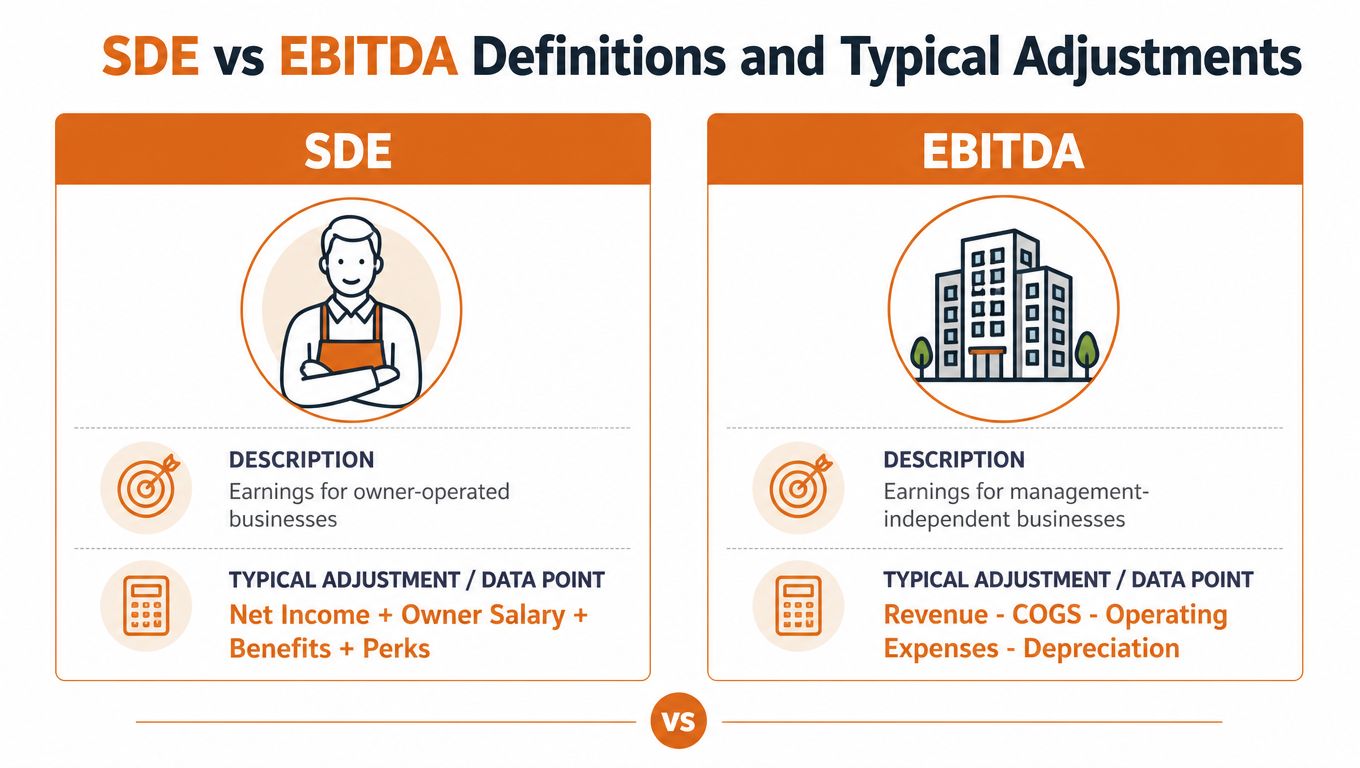
SDE often adds back one owner’s full compensation package because the likely buyer expects to replace the owner personally. That doesn’t mean every owner-related cost disappears from the analysis. If another owner, family member, or employee performs necessary work, the business may still need to pay that person after closing.
EBITDA generally keeps the cost of required management in the earnings calculation. If the owner is paid above the market cost of replacement, a portion may be added back. If the owner is paid below market or performs unpaid work, the normalized figure may need to be reduced.
That distinction matters for trades and professional services. A founder who personally sells every large account has a different EBITDA profile from a founder who reviews monthly reports while a sales manager handles customers. Both may report the same owner salary, but the replacement cost is not the same.
For a practical explanation of the owner-operator measure, see this guide to seller discretionary earnings. The calculation should be documented line by line, with a clear explanation of why each adjustment represents ongoing economic reality.
SDE and EBITDA aren’t interchangeable labels for the same valuation exercise. SDE is normally paired with lower multiples, because it usually describes a smaller, owner-dependent company. EBITDA is normally paired with higher multiples, because it more often describes a business with management depth, transferable operations, and a broader institutional buyer pool.
The higher SDE number can mislead owners. If one owner’s compensation is added back, SDE will usually exceed EBITDA. Applying an EBITDA multiple to SDE can overstate value because the SDE figure has not deducted the cost of replacing the owner. Applying an SDE multiple to EBITDA can understate the financial benefit available to an individual operator.
Assume a company has normalized EBITDA of E and one owner’s compensation package of O. Its normalized SDE is therefore E + O.
The SDE figure is larger, but it should be multiplied by SDE market evidence. The EBITDA figure is smaller, but it should be multiplied by EBITDA market evidence. The resulting values cannot be compared fairly unless the earnings definitions, transaction terms, and buyer assumptions are consistent.
| Metric | Typical multiple range | Implied value outcome |
|---|---|---|
| SDE | Varies by industry, risk, owner dependence, and comparable transactions | Higher earnings base, generally matched with a lower market multiple |
| EBITDA | Varies by scale, management depth, recurring revenue, and buyer demand | Lower earnings base than SDE, generally matched with a higher market multiple |
The important point is not which row produces the better answer. The point is that the metric and the multiple must travel together. A valuation based on comparable transactions should use comparable earnings definitions. A comparable company analysis is useful only when the underlying companies and measures are genuinely comparable.
Owner pay creates the most common distortion. Under SDE, one owner’s compensation can be part of the benefit being measured. Under EBITDA, the company needs to show the earnings left after paying reasonable compensation for the work required.
Discretionary perks create another problem. A vehicle, travel expense, or family benefit might be personal, business-related, or partly both. The seller needs to separate those categories and show what will continue after closing.
One-time add-backs require the same discipline. A nonrecurring legal bill may be a legitimate adjustment. A recurring maintenance cost described as “unusual” is not. Buyers and lenders will test whether the expense disappears or returns under a different name.
SDE makes sense when the buyer expects to become the operator. That usually means a small company where one owner handles a meaningful share of sales, management, customer relationships, or technical work. The buyer isn’t purchasing a passive investment. The buyer is acquiring an income-producing business and stepping into the role that currently supports it.
Individual operators are the clearest example. A buyer with industry experience may take over a plumbing company, manage technicians, answer key customer calls, and replace the seller’s daily involvement. The buyer evaluates the opportunity based on the total financial benefit available to one working owner. SDE gives that buyer the right lens.
SBA-financed buyers also tend to focus on SDE when the acquisition depends on a working owner. Their underwriting still examines debt service, taxes, reinvestment, working capital, and other cash requirements, but the buyer’s compensation is part of the operating model. Search-fund-style acquisitions can also lean toward SDE when the incoming operator is expected to take direct control.
Industry guidance places the crossover around roughly $1M to $5M of earnings or EBITDA, but the range varies by source and business model. Morgan & Westfield discusses the scale and management factors behind the SDE-to-EBITDA crossover. Treat that range as a prompt for analysis, not an automatic switch.
A business near the crossover can still be SDE-appropriate if the founder remains central to the customer and operating model. A smaller business can be EBITDA-appropriate if a capable management team already runs it without daily owner involvement.

HVAC, plumbing, electrical, and other home-services companies often begin as owner-operated businesses. The owner may be the primary estimator, relationship manager, and escalation point even after hiring a team.
Recurring service agreements can change the analysis. They make revenue more transferable, but they don’t automatically remove owner dependence. Ask who renews the contracts, who handles service failures, who prices complex work, and who maintains referral relationships. If the answer is still the founder, SDE may remain the honest measure.
SDE also signals something to buyers and lenders: the business still depends on a working owner. That’s not a weakness by itself. It defines the deal. If the owner wants a strategic or institutional buyer, the company may need to demonstrate a management structure that supports EBITDA-style underwriting.
EBITDA becomes the better metric when the business can operate as a company rather than as the owner’s job. The owner may still lead strategy, but managers handle operations, sales, service delivery, finance, and customer retention. The buyer can acquire the organization without personally filling every critical role.
This is why institutional buyers, sponsor-backed roll-ups, and strategic acquirers generally prefer EBITDA. They want to compare the operating company after accounting for the management needed to keep revenue and service quality intact. They aren’t buying the seller’s personal workload.
Look for these practical indicators:
If several of these signals are present, prepare both SDE and EBITDA internally before speaking with buyers. Use SDE to understand the current owner’s economic benefit, then normalize EBITDA to show what remains after paying the management required for continuity.
Insisting on SDE because it produces the larger earnings figure can make a mature business look less transferable. An institutional buyer may remove the owner’s compensation, add back only the excess over replacement cost, and value the resulting EBITDA. If the seller’s materials don’t explain that bridge, the buyer may assume the business has more owner dependence than it really does.
The solution isn’t to force EBITDA onto a founder-led company. It’s to present the business clearly and prepare the metric the likely buyer will use. The guide to EBITDA for business owners can help frame that distinction before a broker or lender builds the formal analysis.
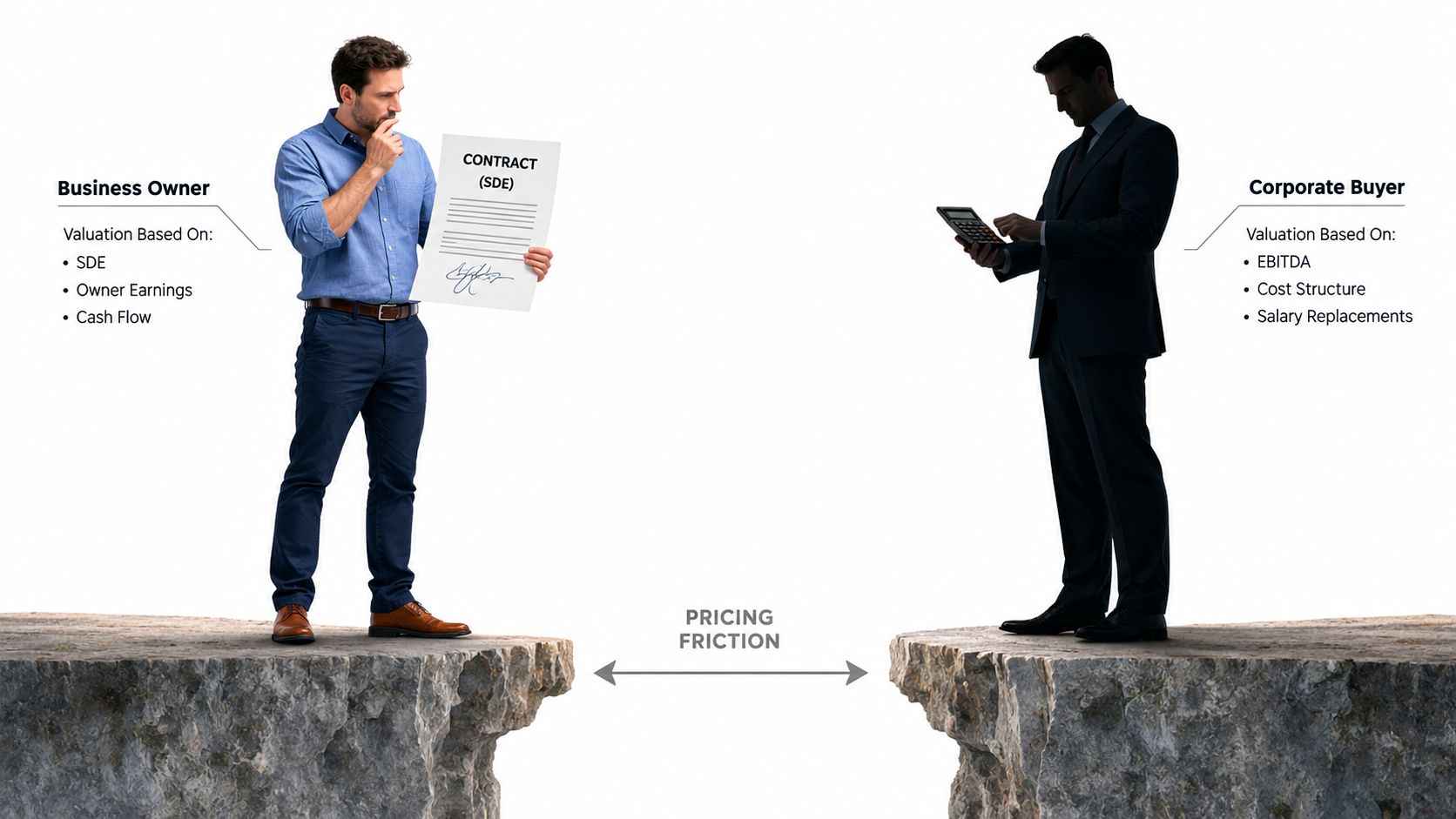
A growing business can sit between buyer categories. The owner may still work in the company, but the next buyer may need to hire a manager. In that situation, the buyer may pay on SDE while underwriting the replacement manager through an EBITDA analysis.
That creates a pricing gap. The seller sees a large SDE figure because the owner’s compensation and perks are included. The buyer sees a smaller normalized EBITDA figure because someone must continue doing the owner’s work after closing. Both calculations may be reasonable. The disagreement comes from using different definitions for different purposes.
Assume the reported owner compensation is O. The seller adds O to the operating earnings base to calculate SDE. The buyer instead estimates replacement management at R and deducts that cost from the owner’s benefit to calculate a normalized corporate earnings view.
If R is materially different from O, the valuation changes even before either side discusses a multiple. A high owner salary doesn’t prove that replacement management costs the same amount. A low owner salary doesn’t prove that the role is inexpensive to replace.
The same issue applies to perks and one-time add-backs. A seller may remove a personal expense from SDE. The buyer may agree that the expense is discretionary but still identify a related operating cost that must continue. A seller may call a legal bill nonrecurring, while the buyer asks whether similar compliance work will recur under new ownership.
Market guidance uses broad rules of thumb, but the threshold varies widely. Some sources use about $1M of SDE, while others refer to $2M to $5M in earnings or revenue. MidStreet’s discussion of SDE versus EBITDA highlights the gap between those thresholds and the resulting normalization problem.
That variation matters because revenue scale alone doesn’t determine the right metric. A company can have significant revenue and remain dependent on one founder. Another company can have a smaller revenue base but a management team that makes the business independently transferable.
Owners should therefore choose a buyer model before choosing a valuation metric. Is the realistic acquirer an individual operator, a search fund, a sponsor-backed roll-up, or a strategic buyer? The answer tells you which earnings bridge needs the strongest support.
Start by preparing both views, even if one will lead the marketing process. Calculate SDE to show the benefit available to a working owner. Calculate normalized EBITDA to show the earnings remaining after paying for the management the business actually requires.
Use this preparation checklist:
Don’t wait for a buyer to challenge the numbers. Have a valuation specialist review the normalization schedule, and involve a tax or financing professional where the transaction structure requires it. Clean records won’t eliminate negotiation, but they make the earnings story easier to verify and defend.
The Owner’s Shortlist offers a curated directory of specialists for valuation, taxes, legal matters, financing, succession, and related ownership decisions. Visit The Owner’s Shortlist to review practical guidance and connect with a specialist before choosing the metric that will shape your sale.
Tell us your situation. We'll connect you with a specialist who works with owners like you. One conversation, no sales pressure.
Found this useful?
Add The Owner's Shortlist as a preferred source and get our articles highlighted in Google Search results.
Add to Preferred SourcesExplore the best value drivers that influence exit value, with practical steps owners can take before engaging a valuation specialist.
October 4, 2026
This business valuation guide explains how to calculate what your company is worth using proven methods. Get clarity for 2026 sale, funding, or planning.
October 2, 2026
Explore business valuation meaning for owner-operated firms. Learn valuation methods, drivers, misconceptions, and steps to secure a defensible valuation.
September 28, 2026
What Is Recurring Revenue. Learn what recurring revenue is, how ARR and MRR work, real trade examples, and why this revenue model shapes business value and exit
September 23, 2026