What Is SDE and How Does It Shape a Business Sale
What Is SDE. Learn what SDE means in business valuation, how to calculate it with common add-backs, how it differs from EBITDA, and why buyers and lenders focus
October 7, 2026
By Remi Taffin · October 9, 2026

You’re probably in the same spot a lot of HVAC owners reach after years of grinding, you’ve built a solid shop, the calls keep coming, and now you’re wondering whether to cash out, hand it to someone else, or keep pushing one more season. The wrong move is treating this like a one-day sale. A good exit is a 12 to 24 month operating decision that starts with how transferable your business really is, not just how much profit it shows on paper.
The first mistake owners make is asking, “What’s my HVAC business worth?” before they’ve decided what they want their life to look like after the sale. That question comes later. The better question is whether you want to spend the next two years turning your company into something a buyer, a child, or a key employee can run without you in the middle of every dispatch, estimate, and customer complaint.
You usually have four paths. You can sell outright to a third party, transfer to family, sell to a key employee, or stay on and cleanly separate yourself later through a staged transition. Each path demands different preparation, and the business won’t respond well if you try to keep all four options open without doing the work.
A business that depends on the owner’s voice, memory, and relationships is harder to sell than a smaller company with documented systems and a steady maintenance base.
If you’re on the fence, decide what matters most. If your priority is maximum cash, you’ll prepare one way. If your priority is keeping the name, staff, and local reputation intact, you’ll prepare another. If your goal is to pass the company to family or a top technician, the test is whether they can operate it, not whether they love the idea of owning it.
Be blunt with yourself. Can you step away for a week without the place wobbling? Does someone else know how to price replacement jobs, handle service issues, and manage the technicians when the schedule blows up? If the answer is no, then you’re not ready to sell, even if the P&L looks fine.
A practical readiness check should cover three things:
That’s why owners who start early do better. They aren’t just “getting ready to sell,” they’re building a company that doesn’t collapse when they step back. The market for HVAC services is growing, and buyers are still active, but they’re buying transferable businesses, not heroic owner stories. As the buyer pool has remained interested in HVAC, plumbing, and electrical platforms, the companies that prepare early usually have more room to choose their path and less pressure to accept a weak deal. HVAC services market outlook and buyer interest
Buyers do not pay for revenue by itself. They pay for earnings they trust, and they pay more when those earnings look portable, recurring, and not glued to the founder. A business can have strong top-line sales and still get a mediocre offer if the buyer thinks the owner is the only thing holding the machine together.
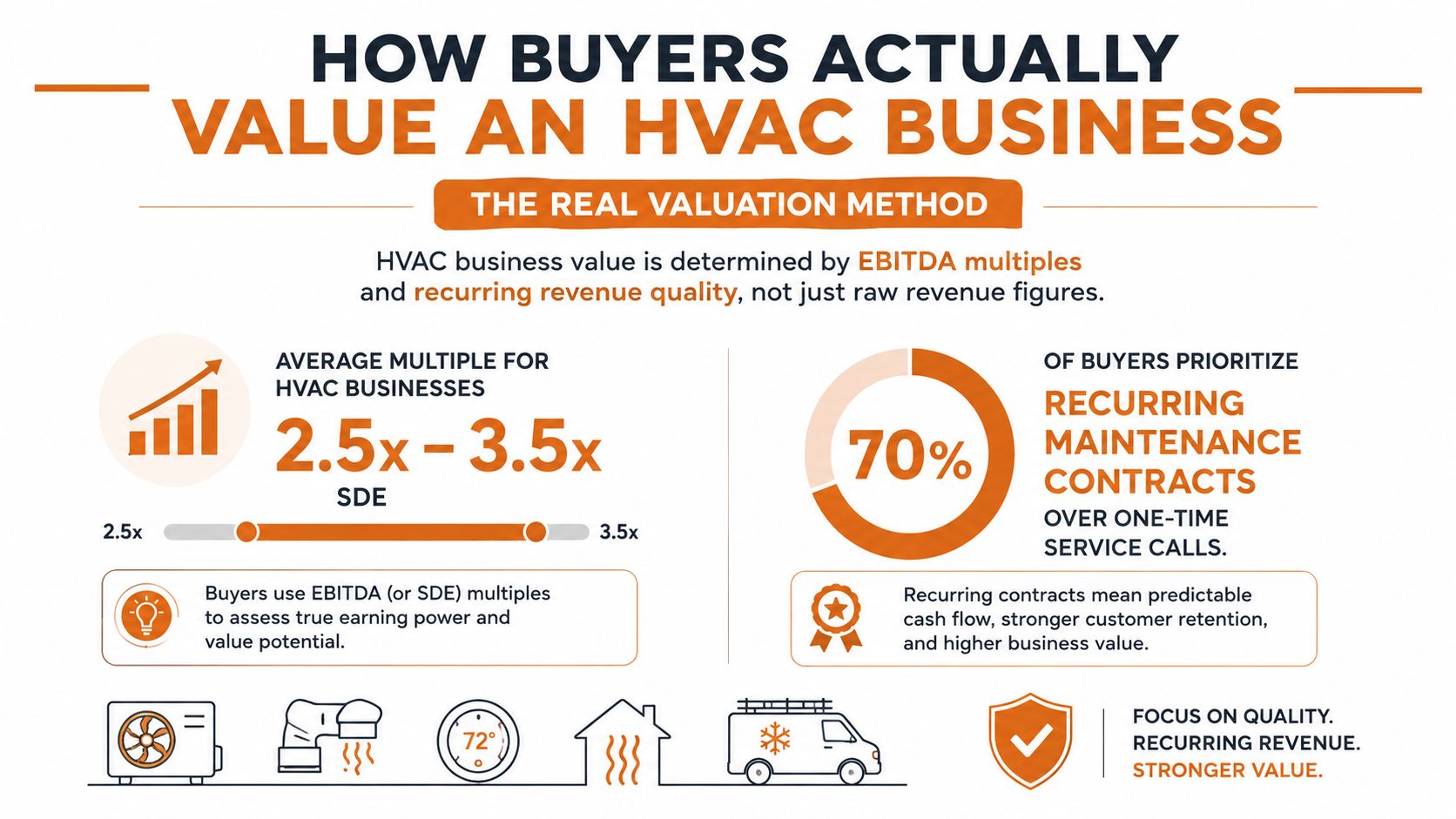
For HVAC deals, buyers focus on adjusted EBITDA or seller’s discretionary earnings, depending on company size and structure. One 2025 valuation compilation cited an industry-wide average near 8.0 times EBITDA, which is roughly 5.1 times seller’s discretionary earnings, while smaller owner-operated businesses generally trade lower than larger professionally managed platforms. HVAC valuation multiples
That gap matters. A business with the same revenue as another can land a very different offer if one has stronger maintenance contracts, better customer density, a management bench, and less owner dependence. Buyers also normalize the books, so they’ll look hard at owner compensation, personal expenses, related-party charges, and unusual repairs, then decide which add-backs are real and which ones disappear after closing. The more documentation you have, the less likely those add-backs get discounted.
Owners love to talk about installs, but buyers love recurring maintenance revenue because it steadies the cash flow story. They also care about the quality of the customer base, technician retention, fleet condition, and whether the company can keep operating if the seller takes a long vacation. In the transaction market, a 2025 compilation reported $1 million to $5 million EBITDA multiples of 7.4x for commercial heating, 7.9x for commercial cooling, 8.0x for residential heating, 7.9x for residential cooling, and 9.2x for residential all-purpose businesses, but those are benchmarks, not promises. HVAC EBITDA valuation multiples
A good quality-of-earnings file should already be in your drawer before you go to market. That means tax returns, bank statements, job-cost reports, deferred-revenue schedules, maintenance-agreement churn, customer concentration, callback rates, fleet records, licenses, insurance, and aged receivables. If you want a plain-language way to tighten the financial side, boost HVAC profit margins is a useful outside resource on what usually gets cleaned up before a sale.
If a buyer can’t tell which dollars are recurring, which are one-time, and which belong to the owner personally, the offer gets conservative fast.
For a more detailed framing of valuation language, the internal guide on HVAC business valuation is worth comparing against your own books. The point is simple, your business is worth what a buyer believes they can keep, not what you hope they’ll admire.
Preparation is where most owners either build value or waste it. The work isn’t glamorous, but it changes the deal math because buyers trust clean, organized, transferable businesses. A smart owner starts this work long before a letter of intent lands on the table.
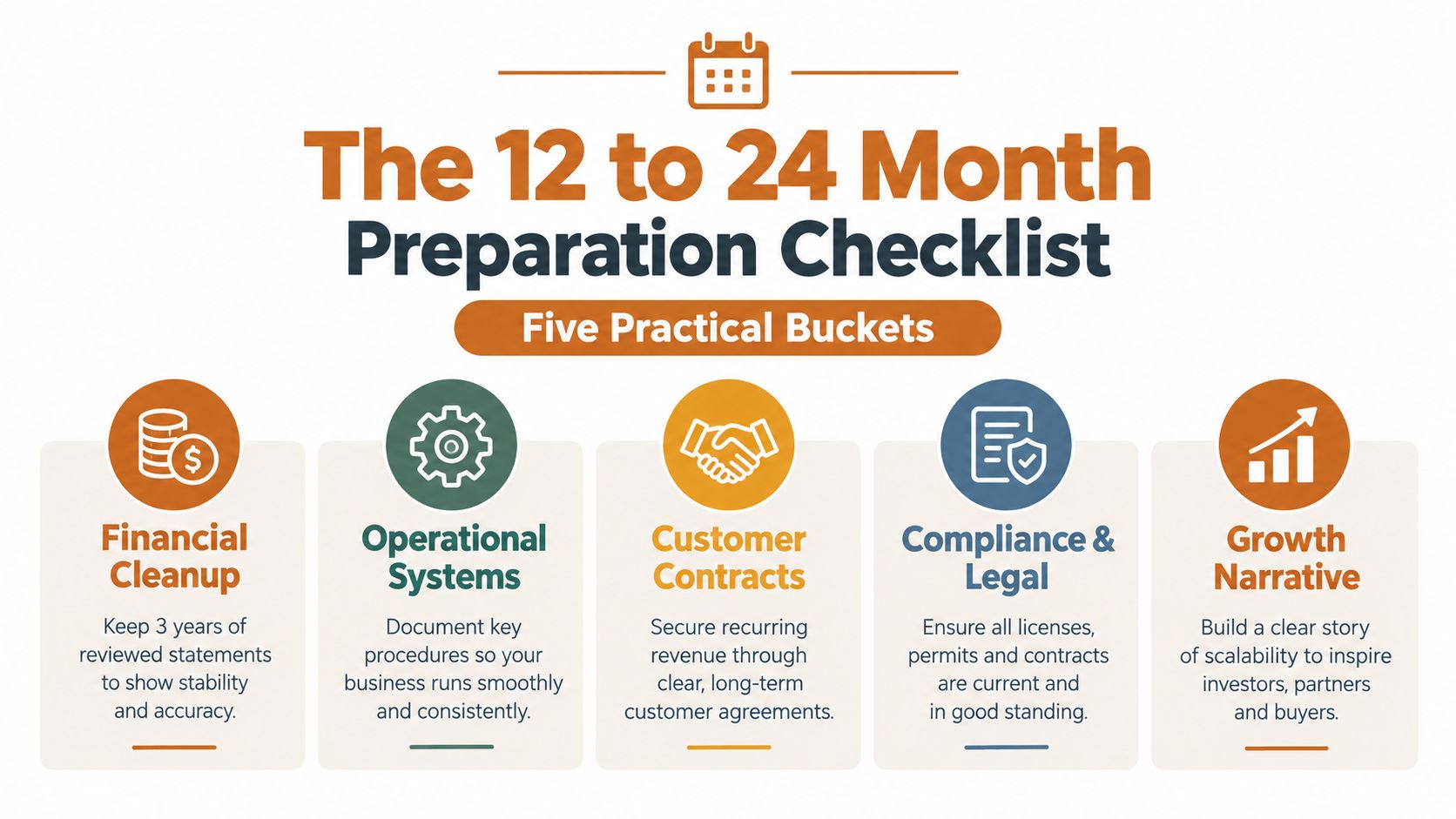
If your financials are a mess, fix that before you talk about price. Assemble at least three years of monthly statements, reconcile tax returns to the general ledger, and separate installation, replacement, repair, maintenance-plan, and commercial-contract revenue. A practical bookkeeping checklist from Book Tech LLC can help you spot the usual junk hiding in HVAC records.
Also build a simple add-back schedule with proof. Owner compensation above market, personal expenses, one-time legal or relocation costs, and nonrecurring repairs can be adjusted, but recurring labor, fleet, software, warranty, and marketing costs usually stay in the earnings picture. Buyers don’t reward wishful accounting.
Don’t just say you have maintenance plans, prove they renew. Pull together the signed agreements, renewal history, churn, average annual revenue per agreement, service-to-replacement conversion, and gross margin by segment. Then tie all of it back to invoices and the general ledger.
Buyers pay for maintenance revenue because it tells them what comes back next month without starting from zero.
Owner-dependent companies usually fall apart. Write down dispatch rules, pricing logic, warranty handling, permit history, and licensing continuity. If your service manager can’t explain how estimates are approved or how callbacks get handled, that’s a problem the buyer will see immediately.
The internal process guide on business systems and processes lines up with what buyers test during diligence. They want to see a business that runs on repeatable decisions, not memory and heroics.
You don’t need a perfect org chart, but you do need evidence that the shop can function without you in the truck, on the phone, and in the middle of every price decision. Test your service manager, back up your dispatcher, and watch what happens when you step out of the daily loop for a defined period. If the business gets shaky, that’s not a brokerage problem, it’s an operating problem.
Clean up license gaps, related-party charges, unusual repairs, and tax exposures before the market sees them. Buyers will also look at technician retention, warranty obligations, and whether the customer base is too concentrated among a few referral sources or accounts. The earlier you fix these issues, the less they control your negotiating position later.
Most owners start with the idea of selling, then discover that selling isn’t the only serious option. The right path depends on what you care about more, cash, certainty, control, tax treatment, or confidentiality. If you compare the options fairly, the “obvious” choice often stops looking obvious.
| Exit path | Cash at closing | Certainty of payment | Control after closing | Tax exposure | Confidentiality |
|---|---|---|---|---|---|
| Third-party sale | Highest potential | Medium to high, depending on structure | Low | Needs careful modeling | Medium |
| Family transfer | Usually lower upfront | Mixed, often staged | Medium to high during transition | Often complex | High |
| Key employee buyout | Usually moderate | Depends on financing | Medium | Needs planning | High |
| ESOP | Rare for smaller contractors | Varies widely | Low to medium | Complex | Medium |
If you want maximum cash and a clean break, a third-party sale usually wins. If you want the company to stay local and keep the same name, a family transfer or employee buyout may fit better, but only if the successor can run the shop. A sale to children who want ownership but don’t have management ability usually creates a slow-motion problem, not a succession plan.
A key employee deal can work when the person already runs day-to-day operations and can borrow or finance part of the purchase. That’s where staged buyouts show up, with the seller carrying some paper and the successor earning the rest over time. The tradeoff is obvious, you may protect continuity, but you give up certainty.
An ESOP can make sense in some businesses, but for a sub-$50 million contractor it’s usually not the first place I’d start. It adds structure, cost, and complexity. Most smaller HVAC owners need simpler tools before they need an employee ownership vehicle.
If you’re leaning toward employee ownership, the internal guide on selling a business to employees is a good reality check. The core question isn’t who would like to own the business. It’s who can carry customer trust, manage the technicians, and keep the cash flowing.
Don’t confuse loyalty with buying power. Your best technician may be the right successor, but only if they can manage the whole business, not just the trade work.
The headline number gets everyone’s attention, but the terms decide what lands in your account. A strong offer can still turn into a weak outcome if too much of it is deferred, contingent, or exposed to post-close disputes. Buyers know this, which is why they negotiate structure as hard as price.
The first lever is price against normalized EBITDA or SDE, because that sets the starting point. The next levers are seller financing, earnouts, working-capital targets, escrow, and transition support. A deal that looks big on paper can shrink fast if you’re carrying too much risk after closing.
Here’s the practical way to think about it. If you sell for a mix of cash, a seller note, and an earnout, the cash you keep depends on whether the buyer hits the milestones, whether the working-capital peg is reasonable, and whether the note is protected. Earnouts sound attractive when the buyer wants to bridge a valuation gap, but they often disappoint in service businesses where weather, staffing, and customer churn can move the numbers around.
Get specific on the non-price items. Seller financing amount, interest, non-compete scope, non-compete duration, escrow holdbacks, and post-close support should all be tied to the actual risk in the business. If the buyer wants you around for a transition, define the role and the hours instead of accepting a vague promise that you’ll “help as needed.”
Tax timing matters too. Asset versus stock structure changes the result, and installment treatment can affect when you recognize proceeds. If you’re changing state residency, that can matter as well. Model the deal with your CPA and attorney before you sign anything, because the purchase agreement can lock in outcomes that a later tax conversation won’t fix.
The best negotiation isn’t the one where you squeeze every penny out of the buyer. It’s the one where you don’t give away protection you’ll wish you had after closing.
A broker is useful only if they understand HVAC, the service mix, and how buyers judge owner dependence. A generic business intermediary won’t spot the issues that matter in this trade, like maintenance-contract quality, technician turnover, customer concentration, and the difference between a shop that looks profitable and one that can run without the founder.
Interview the broker like you’re hiring someone to protect a major asset, because that’s what you’re doing. Ask what HVAC deals they’ve closed, how they handled confidentiality, whether they’ve sold technician-heavy businesses, and how they screened for real buyers versus curiosity shoppers. Ask how they talk about recurring maintenance revenue, and what they do when a business is too dependent on the owner.
A good engagement letter should clearly cover scope, fee structure, confidentiality, marketing process, and who controls buyer access. If the broker can’t explain how they protect employees and customers while still creating competitive tension among buyers, keep looking.
Confidentiality isn’t a slogan. It means controlled introductions, selective data-room access, and no casual disclosure to the shop floor or the customer base. You don’t announce a sale because you’re curious about reactions. You disclose only when the process requires it.
The Owner’s Shortlist is one option for owners who want a person, not a directory, to match them with a specialist based on past deals and past client conversations. If you use a broker, remember the broker can open doors, but they can’t fix weak books, missing licenses, or a business that still depends on you for every key decision.
This is the sequence that usually works. Months one and two are for private readiness review, goal-setting, and a hard decision about whether you’re preparing for sale, family transfer, employee buyout, or a slower handoff. Months three through nine should be spent cleaning the books, documenting operations, proving recurring revenue, and reducing owner dependence.
Months nine and ten are the time to choose a broker, tighten confidentiality, and prepare the buyer-facing package. Months eleven through fifteen are for controlled marketing, screening buyers, and due diligence. Months fifteen through eighteen are where negotiation, working-capital terms, and closing mechanics usually get settled. Post-close transition support comes after that, but only if the deal needs it and the agreement says so.

The worst mistakes are predictable. Owners wait to fix license issues until after the letter of intent, understate working capital, treat earnout milestones like guaranteed cash, and present gross revenue instead of normalized earnings. The labor market makes the leadership bench a real value driver too, especially with nearly 110,000 unfilled HVAC technician positions, about 23,000 experienced workers leaving the trade each year, and roughly 75% of contractors reporting major hiring difficulty. HVAC labor shortage report
If your business still needs you to keep it together, start there. Buyers see that instantly.
Selling your HVAC business is not a single event, it’s a structured operating project that rewards preparation and punishes improvisation. If you want a quieter, more practical path through that project, The Owner’s Shortlist gives owners a plain-language way to think through brokers, succession, and exit readiness without turning the process into a sales pitch.
Tell us your situation. We'll connect you with a specialist who works with owners like you. One conversation, no sales pressure.
Found this useful?
Add The Owner's Shortlist as a preferred source and get our articles highlighted in Google Search results.
Add to Preferred SourcesWhat Is SDE. Learn what SDE means in business valuation, how to calculate it with common add-backs, how it differs from EBITDA, and why buyers and lenders focus
October 7, 2026
Discover what a business valuation report includes, how to interpret it, and why it matters for your company's financial strategy.
October 6, 2026
Explore the best value drivers that influence exit value, with practical steps owners can take before engaging a valuation specialist.
October 4, 2026
Confused by SDE vs EBITDA? Learn when each metric applies to your owner-operated business, how adjustments change valuations, and which buyers prefer which
October 3, 2026