Business Valuation Meaning for Owner Operated Firms
Explore business valuation meaning for owner-operated firms. Learn valuation methods, drivers, misconceptions, and steps to secure a defensible valuation.
September 28, 2026
By Remi Taffin · August 1, 2026
You’re sitting at the kitchen table after a long day, staring at a broker email and a valuation number that feels either too high or too low. Maybe a competitor just sold, maybe a private equity buyer called, or maybe you’re finally asking the question every owner asks in private, what is my HVAC company really worth?
The blunt answer is that hvac business valuation is rarely about one clean multiple. It’s about how much of your revenue is recurring, how much of it is transferable, and how much of the business disappears when you step away. Buyers don’t just ask what you earned. They ask whether the cash will keep showing up, whether the customers will stay, and whether the business can run without the owner in the middle of every decision.
A lot of owners first feel the gap when they hear that a competitor sold and the number sounds bigger than expected. Then they look at their own shop and assume the same logic applies. It usually doesn’t.
HVAC sits in a weird middle ground. It’s a skilled-trade service company, but it also has a recurring-revenue layer from maintenance agreements. That mix is why two businesses with similar sales can get very different bids. One buyer sees a book of repeatable cash flow. Another sees a pile of one-off jobs and a lot of owner control.
Practical rule: A buyer is usually underwriting three things at once, cash stability, transferability, and owner dependency.
The valuation question is not whether you have service agreements. It’s whether those agreements will survive after closing, whether the customers are spread out enough to reduce concentration risk, and whether technicians, dispatch, and sales are built on systems instead of the owner’s memory. Neutral industry guides make the same point, valuation depends on transferability, technician retention, service-versus-install mix, customer concentration, and owner-dependency, not just on earnings alone as summarized in this HVAC exit planning guide.
That’s why the headline multiple can mislead owners. A shop with the same EBITDA as another shop can trade differently if one runs on process and recurring contracts, while the other runs on the owner’s phone, the owner’s license, and a couple of loyal techs. Buyers pay for the business they can keep, not the one that only works while you’re in the building.
Buyers and appraisers usually lean on three methods. The method changes with the size of the company, the quality of records, and how much of the revenue is recurring. If you know which lane your business fits, you’ll understand why one advisor talks about SDE while another talks about EBITDA.
Seller’s Discretionary Earnings, or SDE, is common when the owner is still involved. It starts with profit and adds back owner compensation and other owner benefits to show what the business really produces for a single buyer-owner. That’s the method many small HVAC shops encounter first, because the buyer is often stepping into the owner’s seat.
EBITDA, earnings before interest, taxes, depreciation, and amortization, is the standard language for larger HVAC companies and platform buyers. It strips out financing and accounting choices so buyers can compare operating performance across businesses. For companies with cleaner systems and less owner involvement, EBITDA becomes the more useful lens.
Revenue multiples show up when recurring service contracts dominate the business, but they only make sense when the revenue is durable and transferable. Asset-based valuation matters more when the business is thin on earnings or when a buyer is really buying trucks, tools, parts, and working capital support. In practice, most HVAC deals are some blend of earnings analysis and adjustment for risk.
| HVAC Valuation Methods at a Glance | Best For | What It Measures |
|---|---|---|
| SDE | Smaller, owner-operated shops | Cash flow available to one owner-operator |
| EBITDA | Larger shops, roll-up targets, platform buyers | Operating earnings before financing and tax choices |
| Revenue multiples | Recurring-service-heavy businesses | Predictability and durability of sales |
| Asset-based or hybrid | Low-earnings or distressed situations | Tangible assets plus selected intangibles |
A clean way to think about it is this, SDE answers what one owner can take home, EBITDA answers what a buyer can finance, and a revenue multiple only works when the revenue itself is worth trusting. If you want a broader valuation primer, the framing in The Owner’s Shortlist guide on how businesses are valued lines up with the same earnings-times-multiple logic buyers use in the field.
Bottom line: If your shop still depends on you to make the wheels turn, SDE is probably the first conversation. If the business can run without you, EBITDA starts to matter more.
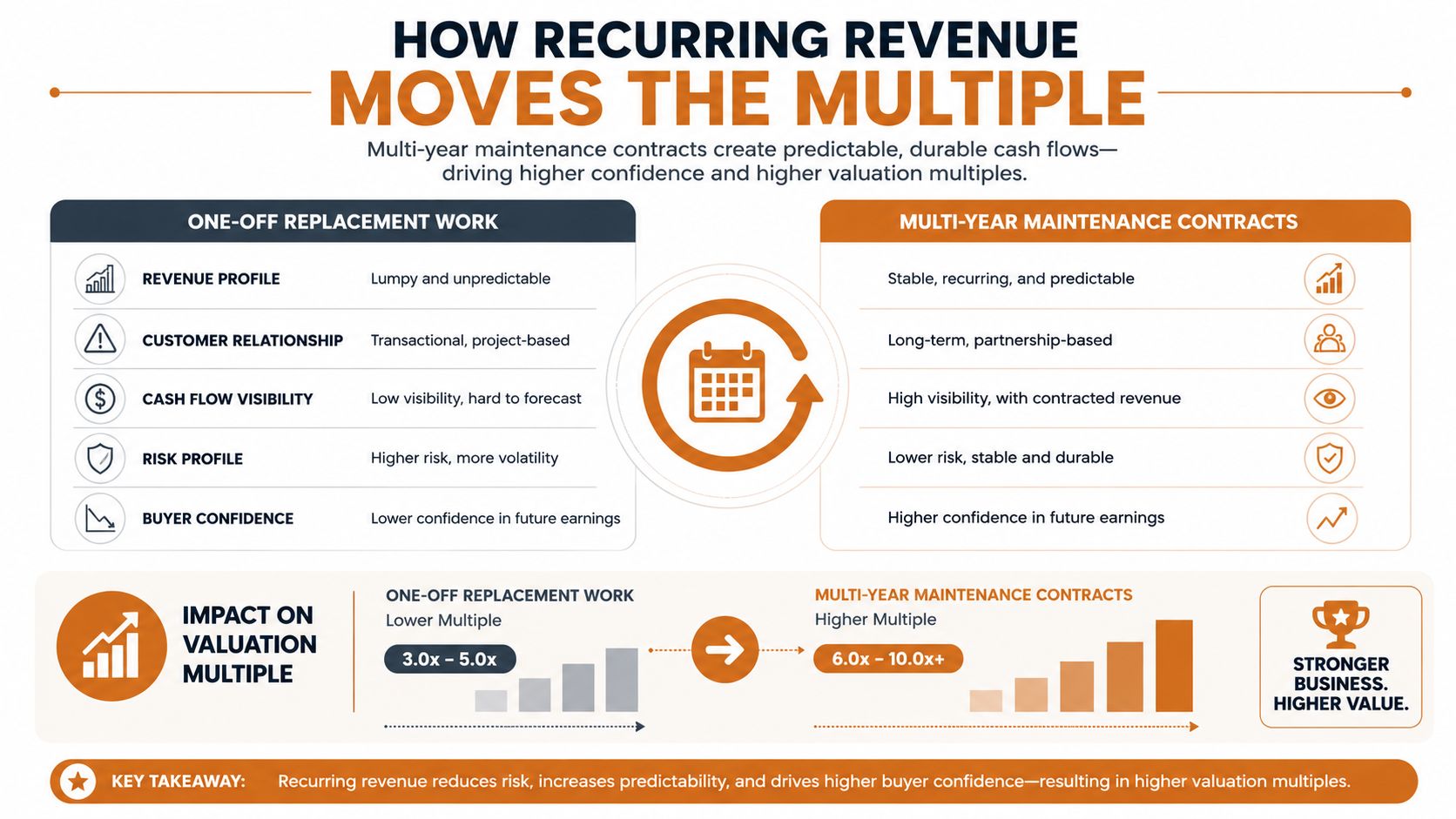
Recurring revenue changes the math because it changes the buyer’s confidence. One-off replacement work can be profitable, but it’s less visible. Multi-year maintenance contracts make cash flow easier to forecast, easier to finance, and less dependent on the next sales call.
That’s why the maintenance book matters so much. In HVAC valuation, recurring service-agreement revenue is one of the clearest multiple drivers, and when multi-year maintenance contracts exceed about 30% of total revenue, buyers often pay a 1.0x to 2.0x EBITDA premium because the cash flow looks more durable and less fragile as described in this valuation guide. The buyer isn’t just paying for volume. They’re paying for predictability.
Here’s what buyers inspect. Are the contracts in the company’s name, or are they really tied to one technician’s relationships? Do they auto-renew, or does every renewal depend on a handoff? Is the book spread across many customers, or concentrated in a handful of accounts that can walk? Those questions determine whether recurring revenue is recurring.
A maintenance agreement can be valuable and still be weak. If a business loses the technician who services the accounts, or if the owner handles every customer relationship, the recurring label starts to mean less. Buyers don’t pay a flat bonus for recurring revenue. They adjust for how much of that revenue is transferable.
Recurring revenue is not a toggle. It’s a quality score. The more durable and transferable that book is, the more likely a buyer is to stretch for a better multiple. The weaker the book, the faster the premium disappears.
Buyers rarely say, “I’m shaving the number because your business feels fragile.” They say the deal terms need to reflect risk. Same result, softer language. The adjustments usually come from the same handful of issues, and you can spot most of them before a buyer ever sees the books.
| Risk factor | Buyer’s question | Typical effect on value |
|---|---|---|
| Customer concentration | What happens if one account leaves? | Lower confidence, lower multiple |
| Technician retention | Will the field team stay after closing? | Higher risk if turnover is high |
| Service versus install mix | Is revenue recurring or project-driven? | More recurring work usually helps |
| Owner dependency | Can this run without the owner? | Heavy dependence usually hurts |
| License and dispatch risk | Who controls the critical day-to-day functions? | Concentrated control increases risk |
| Platform readiness | Are systems clean and visible enough to integrate? | Better systems usually support a stronger bid |
Recent M&A-focused guidance has started to treat software, cleaner books, and process documentation as valuation drivers, not just back-office preferences as noted in this 2025 to 2026 HVAC valuation guide. That matters because a buyer is not only buying earnings. They’re buying the ability to integrate the business without chaos.
If your reporting is messy, your job-level data is weak, and your owner control is brittle, the buyer has to assume more work after closing. If your books are clean and your systems are documented, the business is easier to monitor and easier to scale. That’s worth something.
Practical rule: A buyer will pay more for a business they can plug into a platform without rebuilding the engine.
There’s a simple self-test here. If a key technician left tomorrow, would the business wobble or keep moving? If the owner took two weeks off, would dispatch and sales still function? If a buyer asked for customer lists, contract terms, and service history, could you hand over clean records fast? The answers tell you where your multiple is likely to move.
One more thing. You don’t get credit for pretending the risk isn’t there. You get credit for reducing it.
Two shops can post the same revenue and still land miles apart on valuation. That’s not theory. That’s how buyers think.
Shop A makes a lot of money from replacement work and a few large commercial customers. The owner still handles big estimates, the dispatcher leans on tribal knowledge, and one veteran technician carries too much of the customer load. Shop B has a deep residential maintenance book, steadier service calls, and enough process to keep the business moving without the founder hovering over every detail.
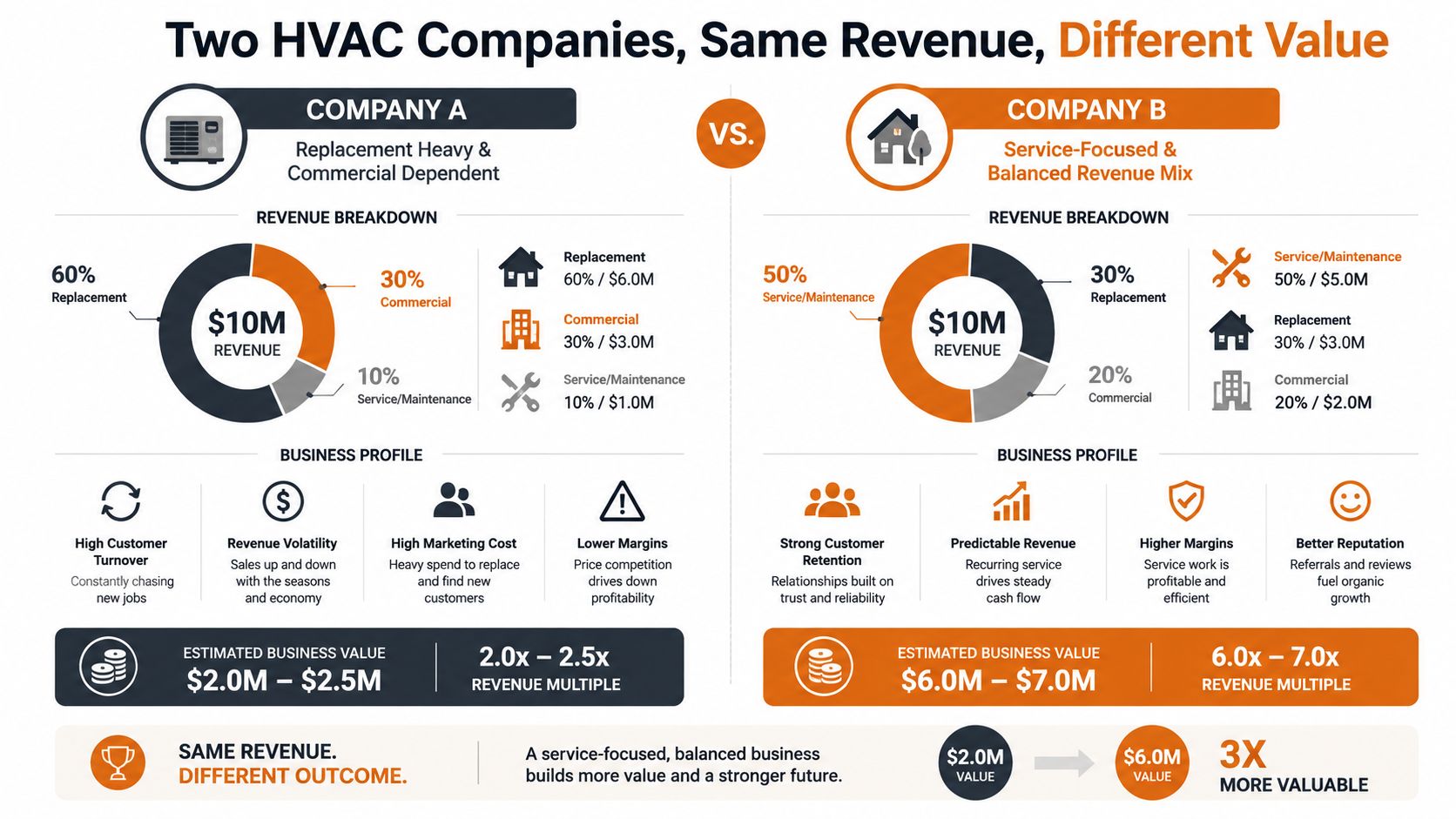
Here’s the basic logic buyers use. Shop A may produce solid earnings, but the revenue is less durable because it’s tied to project cycles and a small client base. Shop B may produce the same revenue with less drama because the maintenance book is more predictable and the customer base is broader.
The difference isn’t just in the earnings line. It’s in the trust the buyer places in the earnings after closing. A buyer will usually pay more for the business that feels easier to inherit, easier to finance, and less dependent on one or two people.
A simple mental model helps. Same sales, different mix. Same mix, different dependency. Same dependency, different systems. Each layer changes the buyer’s comfort, and buyer comfort is what eventually shows up in the number.
Most owners first hear about add-backs when a buyer starts asking for tax returns and monthly financials. The gap between tax return profit and valuation profit is not a trick. It’s a normalization. Buyers are trying to see what the business earns without personal noise and one-time distortions.
Defensible add-backs usually include owner personal expenses run through the business, one-time equipment purchases, and owner compensation that’s above what a hired operator would cost. Those items don’t represent the ongoing earning power of the shop, so buyers look at them separately.
Buyers push back when an owner tries to normalize away a recurring cost, smooth over a bad year without support, or treat a routine expense as one-time just because it hurts the number. If the cost comes back every year, it’s not an add-back. It’s part of the business.
Practical rule: If you can’t explain an adjustment with records, receipts, or a clear operating reason, expect a buyer to discount it.
Tax returns and adjusted earnings are different lenses. Tax returns reflect how the business was reported. Adjusted EBITDA or SDE reflects how a buyer thinks the business will perform after closing. That’s why owners should expect diligence to focus on consistency, not just the latest year-end result.
A good prep step is to reconcile your books before anyone asks. The Seller’s Discretionary Earnings guide from The Owner’s Shortlist uses the same logic buyers apply, remove owner-only noise, normalize the true operating picture, and show what’s left for a new owner. That’s the number buyers care about.
The important thing is to stop thinking of add-backs as a bargaining trick. They’re a cleanup exercise. The cleaner the cleanup, the less friction you’ll get when diligence starts.
A quoted price is only the start. The deal structure decides how much of that price lands in your account, when it lands, and how much risk you keep after closing. Two offers with the same headline number can leave you with very different outcomes.
An asset sale and a stock sale don’t feel the same to a buyer or a seller, because taxes and liabilities follow different paths. Earn-outs and seller financing can make an offer look bigger on paper while pushing part of the risk back onto you. Rollover equity can create upside if the buyer grows the platform, but it also means you’re still tied to the ride.
The tax side deserves its own planning conversation. Owners should get familiar with the basics and then talk to a specialist, including the possibilities discussed in The Owner’s Shortlist tax planning guide. The point isn’t to become a tax expert. It’s to avoid handing away value because you waited too long to structure the deal properly.
A higher headline number with weak structure can pay less than a slightly lower number with clean cash at close. That’s why valuation is really a process. Price, structure, and taxes all move together.
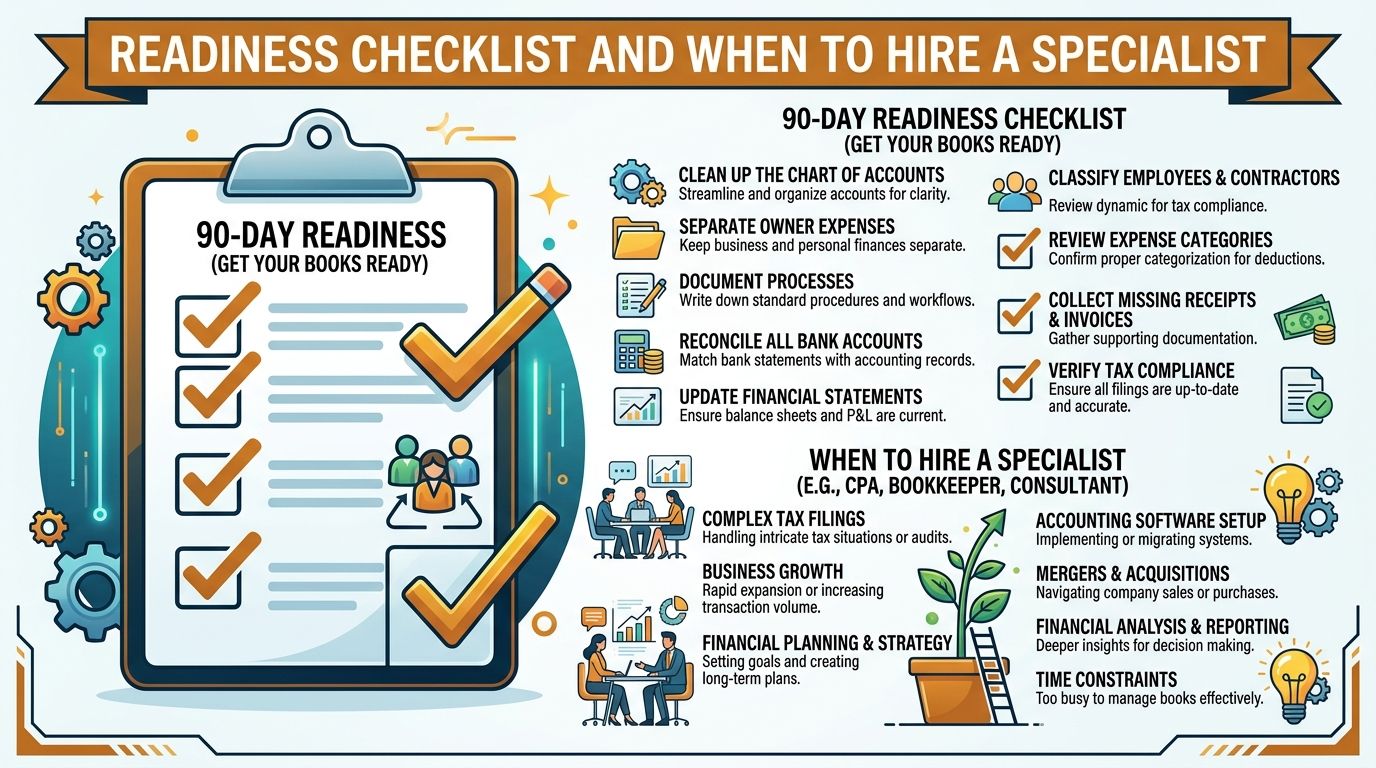
Start with the books. Clean up the chart of accounts so service, install, and recurring revenue are easy to separate. Then strip out owner expenses from operating costs, document your maintenance contracts, and make sure your reporting can show what happens job by job.
Practical rule: If a buyer asked for a 30-day operating snapshot tomorrow, you should be able to produce it without panic.
Hire a valuation specialist when you’re within two to three years of a sale, when a life event forces a shorter timeline, or when the business is likely to justify a formal quality of earnings report. That’s especially true if you expect a premium because of recurring revenue, strong systems, or low owner dependence. At that point, guessing gets expensive.
You don’t need to fix everything before you ask for help. You do need to know which levers are in your control and which ones aren’t. The cleaner the business looks on paper and in operation, the better your negotiating position will be.
If you want plain-language help on valuation, taxes, and sale prep, The Owner’s Shortlist organizes vetted specialists and practical guides for owner-operated businesses like HVAC shops. Visit The Owner’s Shortlist to compare options and get a clearer read on what drives your number before you sit down with a buyer.
Tell us your situation. We'll connect you with a specialist who works with owners like you. One conversation, no sales pressure.
Found this useful?
Add The Owner's Shortlist as a preferred source and get our articles highlighted in Google Search results.
Add to Preferred SourcesExplore business valuation meaning for owner-operated firms. Learn valuation methods, drivers, misconceptions, and steps to secure a defensible valuation.
September 28, 2026
What Is Recurring Revenue. Learn what recurring revenue is, how ARR and MRR work, real trade examples, and why this revenue model shapes business value and exit
September 23, 2026
Learn how much to sell a business for with SDE and EBITDA multiples, adjustments, and deal tips to set a defensible price and maximize proceeds.
September 21, 2026
Understand business valuation cost, fee structures, price ranges and what drives fees so you can budget wisely and get accurate quotes.
September 19, 2026