Business Valuation EBITDA: What Owners Must Know
Learn how business valuation EBITDA works for service companies. Discover adjustments, multiples, and owner-dependency tests before you sell.
October 12, 2026
By Remi Taffin · October 11, 2026

Most advice on how to sell a landscaping business starts with clean books, a newer fleet, and a list of recurring customers. Those matter, but they rarely kill a deal. Labor fragility, owner-dependent estimating, and a deal structure that shifts risk back to the seller are what cause buyers to reduce price, demand an earnout, or walk away.
A buyer isn’t purchasing your trucks and customer list. They’re purchasing cash flow that should continue after you leave. That means your crews must show up, supervisors must make field decisions, estimates must be repeatable, contracts must transfer, and customers must stay without your personal intervention. The U.S. landscaping-services sector generated approximately $123.63 billion in revenue in 2024, according to the Federal Reserve Bank of St. Louis series based on Census Bureau data. The market is large, but market size won’t rescue a company that depends on one owner, a few crew leaders, or undocumented operating knowledge.
Revenue is not the value of your landscaping company. Revenue is the raw material from which a buyer tests the quality of your earnings.
Published transaction data covering 945 landscaping and yard-service businesses sold through 2021–2025 reported a median sale price of $425,000, compared with a $450,000 median asking price. The same dataset reported an average valuation of 2.46 times seller’s discretionary earnings, or SDE, and 0.70 times annual revenue, with the average SDE multiple rising from 2.30x in 2021 to 2.55x in 2025. These are historical reference points, not a price promise, and the data should be read alongside the company’s size, service mix, management depth, and risk profile. The underlying landscaping transaction benchmarks illustrate why a revenue-only calculation is too crude.

For an owner-operated company, buyers usually begin with SDE. It adds back owner compensation and legitimate personal or one-time expenses to show the economic benefit available to one working owner. That measure fits a business where the buyer expects to replace the seller’s daily role.
A company with a management team that can operate without the owner requires a different lens, adjusted EBITDA. Buyers remove unusual or nonrecurring expenses, test whether each add-back is defensible, and then apply a market multiple to sustainable operating earnings. Available transaction benchmarks place owner-operated landscaping companies around 2.0x to 3.0x SDE, while more professionally managed businesses with recurring commercial contracts may trade around 4.0x to 7.0x EBITDA, according to landscaping valuation guidance from DealScorePro. Those ranges are benchmarks, not an appraisal.
Practical rule: If a buyer must hire someone to replace work you currently perform, that replacement cost belongs in the buyer’s analysis. Don’t add back labor that the buyer will immediately need to purchase.
Your financial statements should split recurring maintenance, enhancements, design-build, irrigation, and snow or seasonal work. A signed maintenance agreement with a clear renewal process supports a different risk assessment from a project that must be sold again after completion.
Buyers also examine renewal history, gross margin by service line, customer concentration, route density, and whether contracts transfer to a new owner. A project-heavy company may have excellent revenue and weak forward visibility. A maintenance-heavy company may have less exciting projects but a more dependable earnings base.
Build an earnings bridge that starts with reported profit, identifies every adjustment, and shows how the buyer gets to normalized SDE or EBITDA. A useful business valuation guide can help organize the distinction between earnings, assets, debt, and equity value. You can also use this business worth calculation resource as a plain-language starting point before paying for formal advice.
Don’t present one inflated number. Present a range with buyer-specific sensitivities, including the effect of a 10% change in normalized EBITDA on enterprise value. That model forces you to confront what happens if labor costs rise, a major account leaves, or the buyer discounts owner-dependent revenue.
Diligence is where buyers test whether your business exists independently of your memory. The buyer’s team will compare tax returns to monthly books, payroll to job costing, bank deposits to reported revenue, contracts to customer records, and equipment schedules to what physically sits in the yard.
Start before confidential marketing. Reconstruct at least three years of monthly profit-and-loss statements, then reconcile them to tax filings and bank activity. Monthly detail matters because seasonal revenue, weather disruption, payroll spikes, and equipment repairs can disappear inside annual totals.
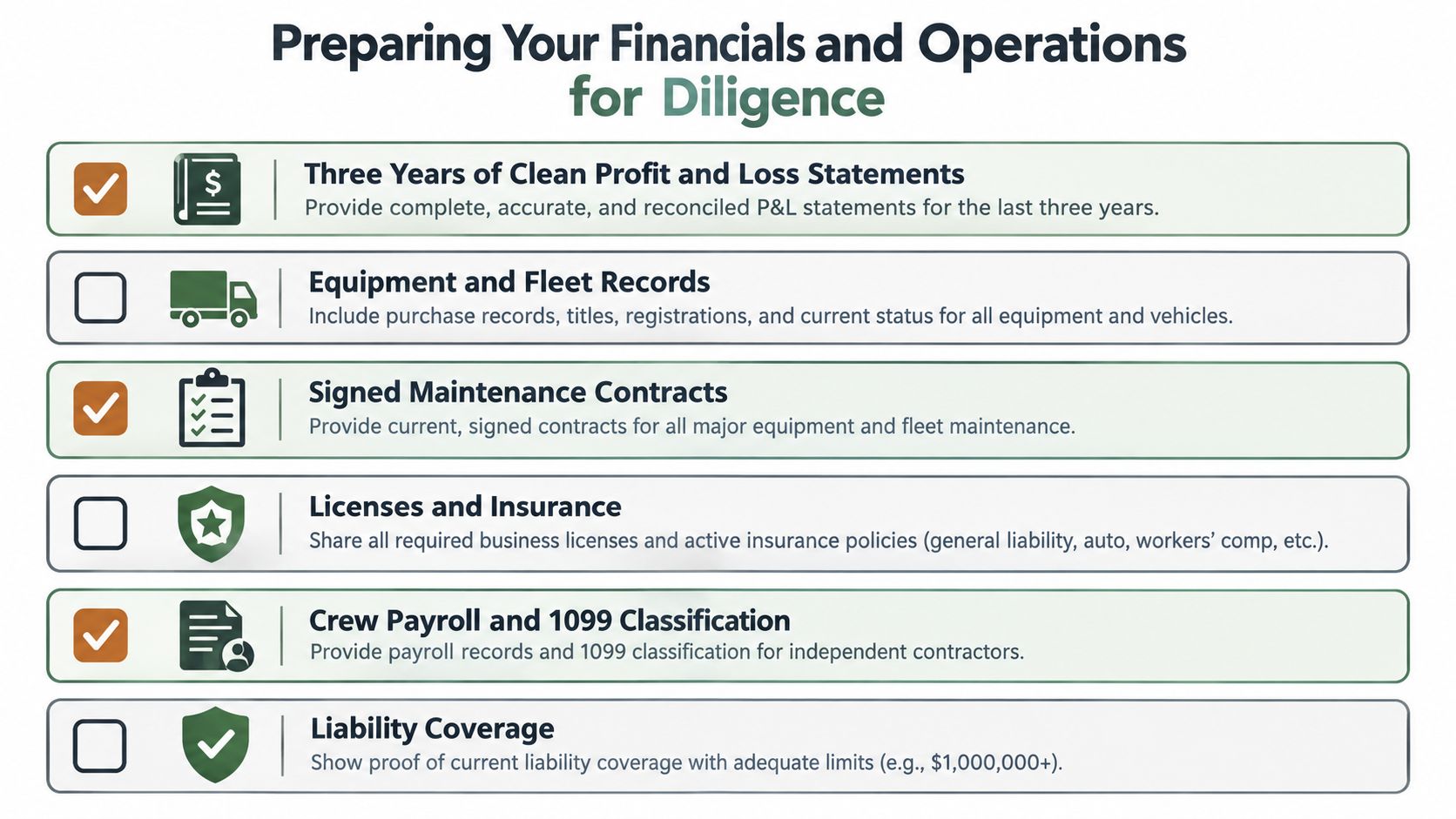
Organize the records by subject, not by whichever drawer they came from. A buyer should be able to trace a customer, employee, truck, contract, or insurance policy without calling you.
Your customer database needs more than names and phone numbers. Reconcile each account to revenue, service frequency, renewal history, gross margin, geography, and the employee responsible for the relationship. This process often exposes accounts that aren’t profitable after drive time, callbacks, materials, and supervision.
Working capital is a closing adjustment, not an afterthought. Calculate a defensible target using the trailing-twelve-month average, then agree with the buyer on what stays in the business at closing and what qualifies as debt, cash, or an excluded asset.
The buyer doesn’t want to purchase a company that closes with empty operating accounts, unpaid payroll obligations, or an artificial spike in receivables. You don’t want to leave excess working capital behind because the purchase agreement uses vague language. Ask your CPA and transaction attorney to define the calculation before signing a letter of intent.
Lender-ready records broaden the buyer pool. SBA acquisition data show that trades-business acquisitions financed through SBA 7(a) loans totaled 4,370 transactions and $4.42 billion in approved lending from FY2020–FY2025, according to the cited SBA acquisition data. Owners who want to clean up cash tracking should also find business bank statement tips, then have their accountant reconcile the results rather than relying on informal explanations.
Document dispatch, estimating, chemical handling, safety, recruiting, fleet maintenance, quality control, and customer complaints. A buyer should receive procedures, templates, permissions, and decision rules, not a promise that you’ll explain everything after closing. Practical business systems and process guidance can help you identify the personal know-how that needs to become company-owned process.
A clean income statement won’t save a landscaping deal if the buyer can’t see who will perform the work next season. Labor is an operating risk, a margin risk, and a customer-retention risk at the same time.
Recent industry coverage reports that labor can represent roughly 55% to 65% of grounds-maintenance contract revenue, while seasonal crew turnover may reach 60% to 70% annually. Those figures come from industry coverage of landscaping staffing costs. A buyer will ask whether your margins survive wage pressure, whether your crews can fulfill signed contracts, and whether you personally solve every staffing crisis.
Prepare a workforce-risk schedule alongside the financial statements. It should show:
Don’t hide seasonal labor dependence. Explain it, quantify its operational effect, and show the buyer what happens when the labor plan fails. A buyer can accept a seasonal model that has documented recruiting, cross-trained teams, dependable supervisors, and pricing discipline. A buyer won’t accept a model that depends on the owner finding replacement workers overnight.
Many owners say the business can run without them because crews handle production. Then diligence reveals that every profitable estimate passes through the owner’s phone, the owner knows which properties are underpriced, and no one else can judge whether a job has enough labor hours.
That isn’t management depth. It’s personal goodwill.
Create an estimating playbook with scope templates, production assumptions, material allowances, approved pricing rules, change-order procedures, and a review threshold for unusual jobs. Have someone besides you prepare and defend estimates before the sale process begins. If you still approve every quote, the buyer may treat part of your earnings as a replacement cost or protect the offer with an earnout.
Retention work also needs a system. A practical SMB guide to employee retention can help you review communication, recognition, training, and advancement practices, but the sale file must connect those practices to named supervisors and documented routines. Review key-person insurance considerations with your advisers where a small number of people carry disproportionate operational knowledge.
A buyer doesn’t need a perfect workforce. A buyer needs proof that the workforce isn’t held together by one exhausted owner.
The right buyer isn’t automatically the one offering the highest enterprise value. In a landscaping sale, the practical question is how much money is dependable at closing, how much remains at risk, and what control you keep afterward.
A 2025 market update reported 108 landscaping transactions in the U.S. and Canada through September, down from 138 in the comparable 2024 period, while 78 of those 108 transactions involved private equity, according to Hyde Park Capital’s landscaping services market update. The buyer pool includes financial sponsors, sponsor-backed platforms, individual operators, strategic acquirers, and family offices. Each evaluates your company differently.
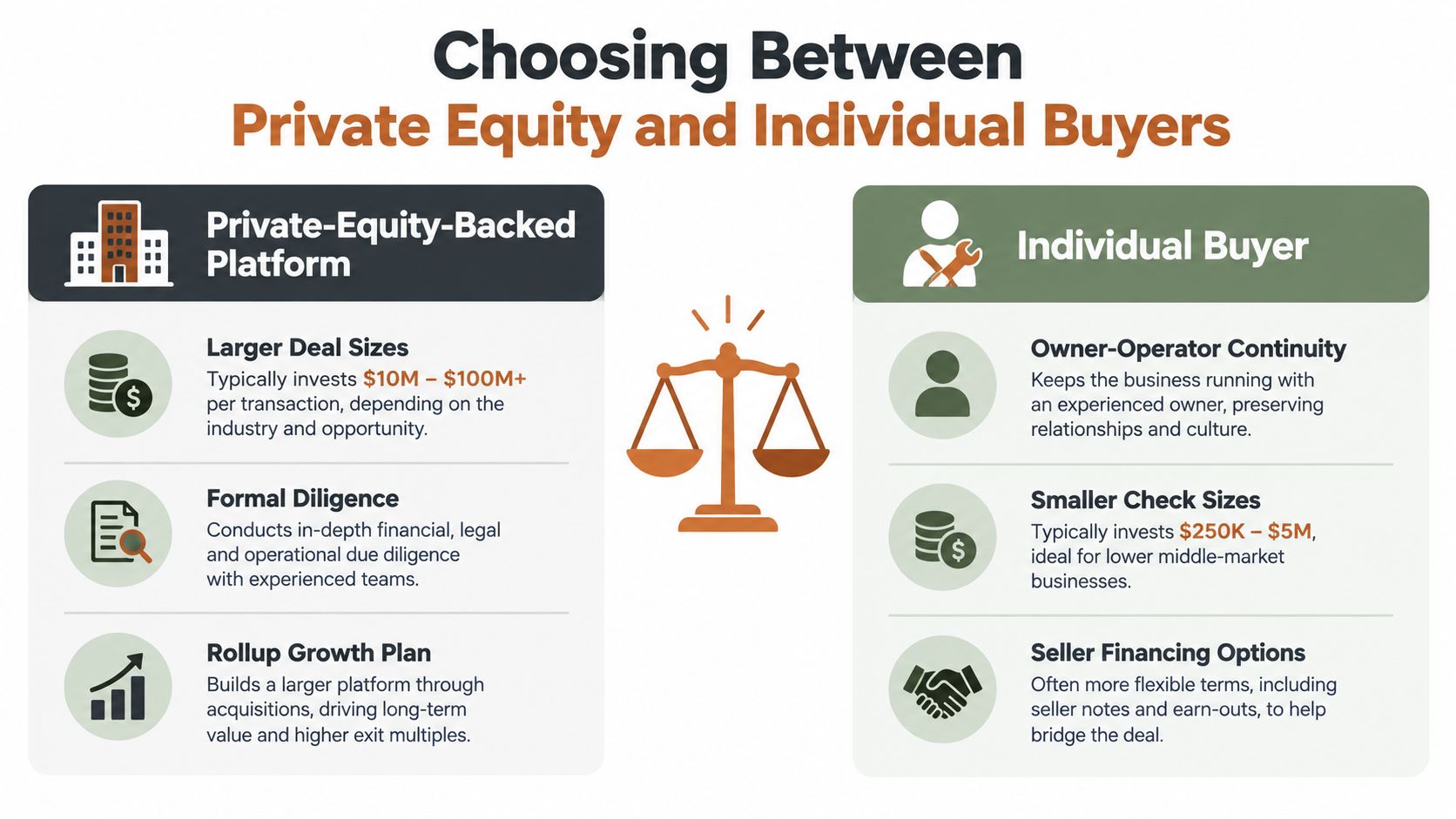
A sponsor-backed buyer may value recurring commercial maintenance, route density, management depth, and acquisition potential. It may also bring a formal diligence process and ask you to stay involved while the platform integrates the company.
The headline offer may include:
An individual buyer may offer less headline value but provide cleaner continuity, direct control, and a simpler operating plan. That buyer may need seller financing because outside financing doesn’t cover the full purchase price, so “all cash” still isn’t the only measure of certainty.
Compare offers using probability-adjusted cash at closing, not the largest multiple. For every proposal, calculate what you receive immediately, what must happen for contingent payments to trigger, what security protects a seller note, and what happens if the buyer changes the business model.
Ask who controls pricing, staffing, customer communications, and future acquisitions. Ask what happens to your rollover equity if the platform sells. Then decide whether your priority is a clean exit, employee protection, a long-term upside position, or the highest possible stated value.
Watch this explanation of transaction structure before you compare term sheets:
A landscaping business can lose value before it sells if employees hear that the owner is leaving, a competitor approaches key crew leaders, or a commercial customer delays renewal. Confidentiality isn’t a courtesy. It’s part of the value-preservation plan.
Start with a small, qualified process. Prepare a blind profile that describes the service mix, geography, customer type, recurring revenue quality, management structure, and normalized earnings without naming the company. Share detailed information only after a prospective buyer signs a confidentiality agreement and passes basic qualification.
Use a staged process:
Don’t let a generalist broker treat your company like a classified listing. Interview advisers about comparable trades deals, their buyer relationships, how they protect customer identities, and who will handle diligence. Ask for verifiable examples of transactions involving recurring service revenue, field labor, equipment, and owner transition.
A broker should challenge your asking price, explain which adjustments a buyer will reject, and help separate operational improvements from cosmetic preparation. If the adviser only wants to publish a number and wait, find someone else. A confidential sale needs active buyer selection, not passive exposure.
Signing a letter of intent doesn’t mean the deal is done. It means the buyer has a framework for testing your claims, rewriting the economics through diligence, and negotiating the purchase agreement.
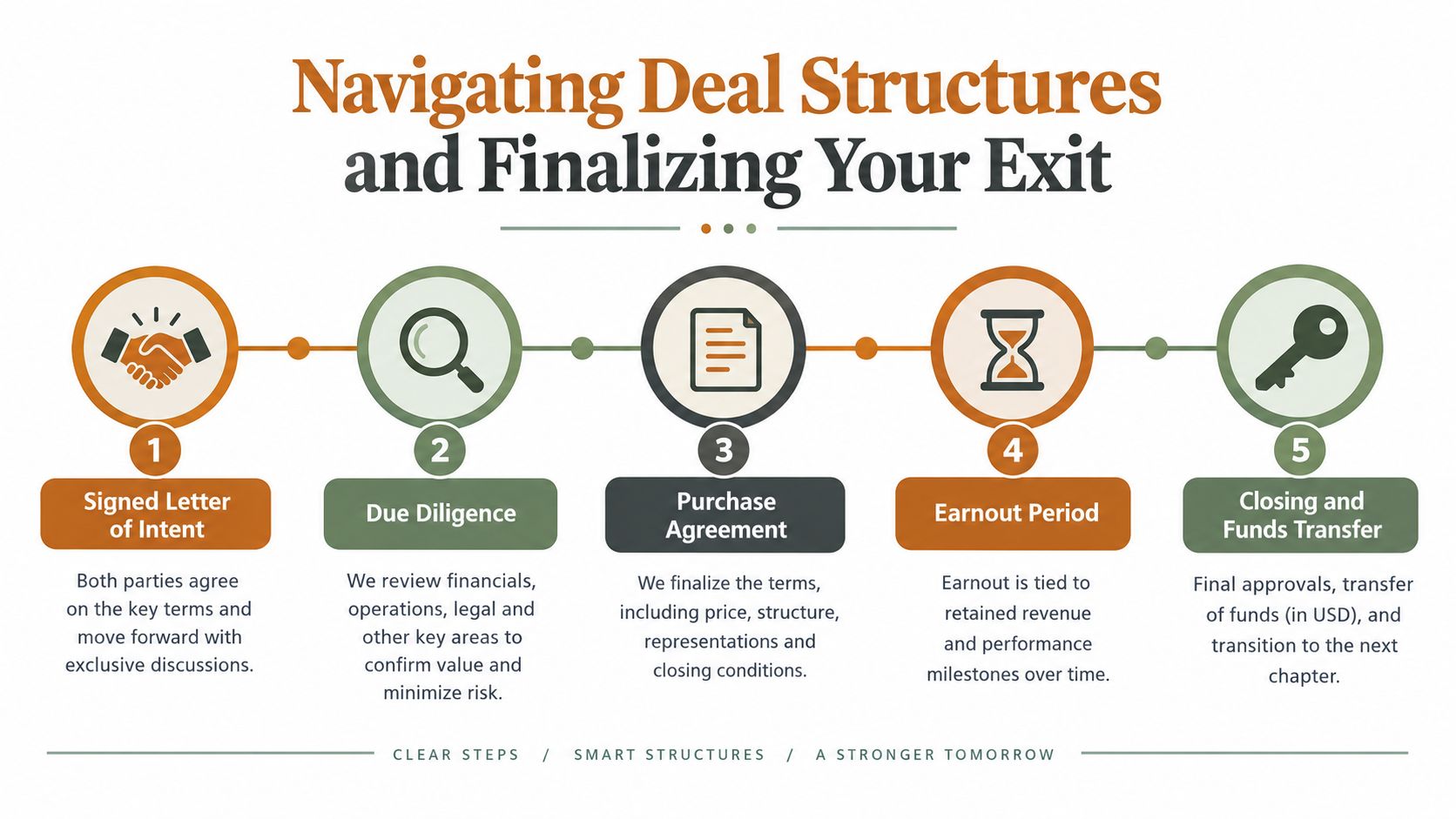
An earnout makes part of your price depend on post-closing performance. That creates danger when the buyer controls staffing, pricing, customer assignments, accounting policies, and which work gets accepted. If an earnout is unavoidable, define the metric, reporting access, operating covenants, dispute process, permitted changes to the business, and payment timing.
A seller note makes you a lender. Negotiate interest, maturity, payment schedule, default remedies, financial reporting, personal or corporate guarantees, and restrictions on additional debt. Don’t accept a promise to pay without understanding your position if the buyer’s company fails.
The working-capital peg determines whether the buyer claims a shortfall after closing. Define the accounting principles, excluded items, seasonality treatment, and dispute process before the final agreement. The indemnity cap, basket, survival period, and escrow determine how much of your proceeds remain exposed to warranty claims.
Enterprise value isn’t the same as equity proceeds. The closing statement may deduct debt, transaction expenses, working-capital adjustments, escrow, seller notes, rollover equity, and taxes. Have your transaction attorney and tax adviser model an asset sale and a stock or equity sale before you accept a structure.
Asset sales may allow the buyer to allocate value among equipment, contracts, goodwill, and other assets, while the seller’s tax result depends on the allocation and entity structure. Equity sales may produce a different tax result and transfer different liabilities. Don’t rely on a buyer’s tax summary. Get advice based on your actual entity, basis, debt, and state obligations.
Before signing an LOI, assemble your diligence file, identify owner-dependent estimates, document the workforce, reconcile working capital, and decide which deal terms are nonnegotiable. Then compare offers by cash certainty, control, tax treatment, downside protection, and employee impact, not by the biggest number on the first page.
The best exit is the offer you can understand, collect, and live with after the trucks leave your yard.
If you’re considering whether to sell your landscaping business, The Owner’s Shortlist provides plain-language articles on valuation, buyer searches, negotiations, and exit preparation, and can introduce you to one reviewed specialist whose experience fits your company. Visit The Owner’s Shortlist to explore the resources or start a confidential conversation before you approach buyers.
Tell us your situation. We'll connect you with a specialist who works with owners like you. One conversation, no sales pressure.
Found this useful?
Add The Owner's Shortlist as a preferred source and get our articles highlighted in Google Search results.
Add to Preferred SourcesLearn how business valuation EBITDA works for service companies. Discover adjustments, multiples, and owner-dependency tests before you sell.
October 12, 2026
Sell My HVAC Business. Thinking about selling your HVAC business? Learn how owners prepare, value, negotiate, and close a sale
October 9, 2026
What Is SDE. Learn what SDE means in business valuation, how to calculate it with common add-backs, how it differs from EBITDA, and why buyers and lenders focus
October 7, 2026
Discover what a business valuation report includes, how to interpret it, and why it matters for your company's financial strategy.
October 6, 2026