Sell My Landscaping Business: Valuation and Exit
Thinking 'I want to sell my landscaping business'? Learn how to value your company, prepare financials, handle labor risks, and find the right buyer quietly.
October 11, 2026
By Remi Taffin · October 12, 2026

You’ve spent years building a dependable HVAC, plumbing, electrical, roofing, or landscaping company. The trucks are busy, customers call by name, and the P&L shows a profit after you’ve paid yourself, covered the shop, and handled the tax bill. Then a buyer asks for adjusted EBITDA, and the number suddenly looks less flattering than the business feels.
That disconnect catches experienced owners off guard. Buyers aren’t paying for the effort you’ve put in or the tax strategy you used over the years. They’re paying for the operating earnings they believe will remain after you leave, then adjusting that value for debt, cash, working capital, deal terms, and risk. Understanding business valuation EBITDA means understanding both halves of the calculation, the earnings base and the transferability of those earnings.
A plumbing owner can show a modest taxable profit while running a healthy company. Compensation, vehicle costs, family payroll, equipment purchases, and other legitimate expenses may all sit inside the business. The company can still have loyal customers, experienced technicians, and steady demand.
A buyer rebuilds that picture around one question: what earnings remain after the owner leaves? Some expenses may come out. The owner’s contribution may have to go back in as a cost. If you personally handle estimating, commercial relationships, hiring, and emergency decisions, the buyer will ask who performs those jobs after closing, and what that replacement will cost.
That is why net income and EBITDA answer different questions. Net income includes financing costs, taxes, depreciation, amortization, and the accounting choices recorded in the statements. EBITDA means earnings before interest, taxes, depreciation, and amortization. It provides a view of operating earnings before financing and certain non-cash charges.
Buyers commonly apply an EV/EBITDA multiple to estimate enterprise value. Enterprise value represents the operating business before considering its financing. The standard relationship is market capitalization plus total debt minus cash, as shown in Aswath Damodaran’s EV/EBITDA valuation data.
For example, $2 million of normalized EBITDA at 5.0x implies approximately $10 million of enterprise value. That figure is not the owner’s closing check.
With $3 million of debt and $1 million of cash, implied equity value is approximately $8 million, before other adjustments. Working capital requirements, transaction costs, taxes, seller financing, earnouts, and closing conditions can change the amount ultimately received.
Practical rule: Treat enterprise value as the starting line, not the amount deposited after closing.
Rebuild the earnings carefully. Explain which tax-oriented expenses do not reflect ongoing operations, then accept the cost of work the owner currently performs. For a structured outside view of that earnings-rebuild process, see valuation support for UK SMEs, which walks through how advisers test each add-back. The audience and market may differ, but the discipline is useful: every adjustment needs a defensible reason and supporting records.
Normalizing earnings means adjusting reported results so they reflect the company’s ongoing economics under the relevant buyer. It isn’t a contest to create the largest possible EBITDA. Every adjustment needs a paper trail and a credible explanation of why the cost won’t continue.
Start with the reported operating results, then build a bridge. Don’t make adjustments directly in a spreadsheet without tying each one to the general ledger, payroll records, invoices, or contracts.
Some items may be reasonable to review:
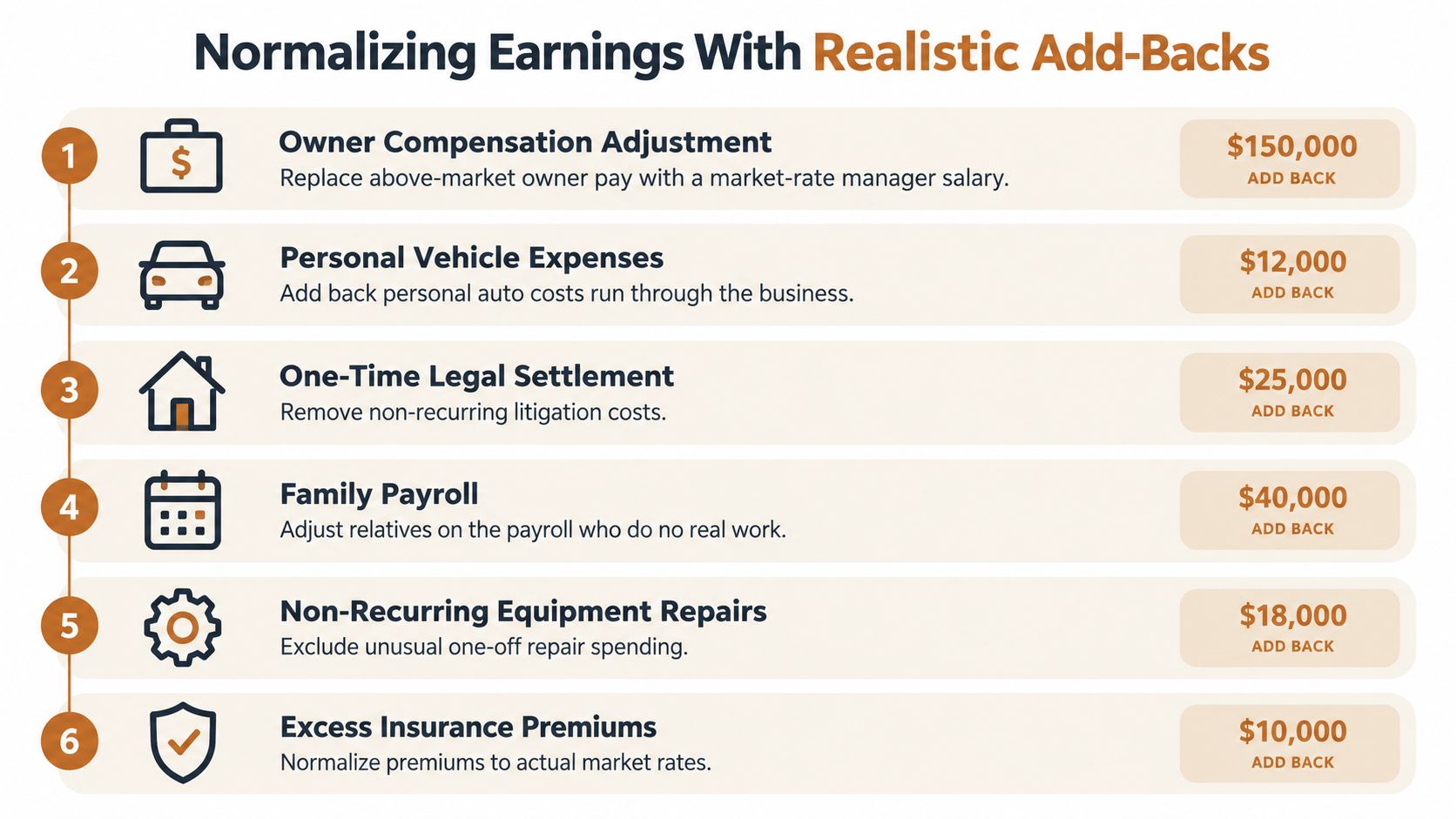
A buyer will usually challenge adjustments that rely on memory, informal explanations, or unsupported assumptions. “I worked for free on weekends” doesn’t automatically create an add-back. The buyer may say that the company needs a paid operations leader to keep the same service level.
Undocumented cash discounts given to preferred customers are another weak adjustment. They aren’t expenses that disappear after a sale. They may instead indicate pricing leakage, incomplete records, or customer relationships that depend on the owner.
For each proposed adjustment, record the amount, date, general-ledger account, supporting documents, business reason, and expected treatment after closing. Then ask four questions:
The last question is where many owner-prepared valuations fall apart. Adding back an owner’s full salary may look attractive, but it can overstate earnings if that salary covered work the business still needs. A defensible schedule might add back only the above-market portion and deduct a market-rate replacement salary.
The finished schedule should be conservative enough that a quality of earnings reviewer can follow it without relying on the owner’s personal knowledge. Credibility matters. An aggressive EBITDA number that gets cut during diligence can hurt negotiating position more than a careful number would have.
A seller hears “5 times EBITDA” and starts doing math in his head. Then the draft closing statement shows debt payoffs, customer deposits, lease obligations, and a working-capital adjustment, and the number that hits his bank account is lower than the headline price. That gap is where owners get surprised.
Enterprise value = normalized EBITDA × EV/EBITDA multiple
That formula is only the starting point. Enterprise value is the value of the operating business before the deal accounts for debt, cash, and other balance-sheet items. Equity value is the amount left for the seller after those items are settled under the purchase agreement.
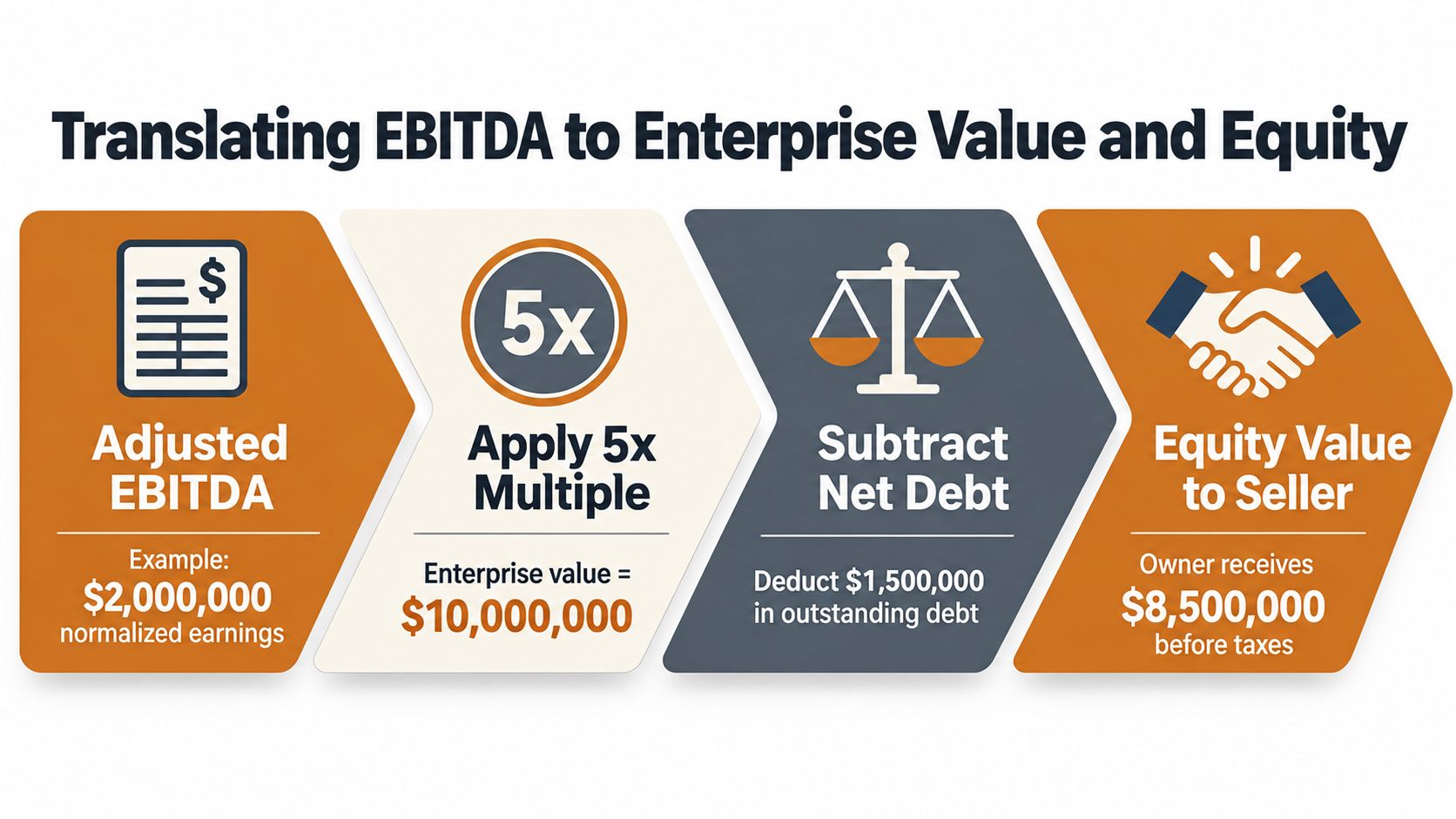
Assume a service company has $2 million of normalized EBITDA and a buyer applies a 5.0x multiple.
On paper, that looks straightforward. In an actual deal, it rarely stops there.
Buyers usually buy the business with a target level of working capital included. If receivables are slow, payables are stretched, or inventory is light at closing, the buyer may reduce the price dollar for dollar. If the business carries excess cash and the seller wants to keep it, that has to be spelled out clearly before the closing statement is drafted.
The same goes for liabilities that owners do not always group with “debt.” Bank loans are easy to spot. Finance leases, overdue sales taxes, payroll tax balances, unfunded earned vacation, customer deposits, deferred revenue, and unresolved claims can all become closing adjustments if the purchase agreement defines them that way.
This is also where the owner-dependency issue starts affecting what lands in your pocket. A business may show $2 million of normalized EBITDA, but if the buyer believes your relationships and daily intervention are holding up part of that performance, they may still use the same formula while changing the inputs. They can cut EBITDA for replacement management cost, lower the multiple for transition risk, or do both.
The result matters more than the headline multiple. A 5.5x offer on earnings that do not transfer cleanly can produce less equity at closing than a 4.75x offer on buyer-trusted earnings.
Use this video as a visual explanation of how EBITDA-based valuation moves from operating earnings toward value:
A buyer sits across the table, sees solid EBITDA, then asks a simple question: “What breaks if you leave on Friday?” That question cuts more value out of trades deals than any spreadsheet formula.
In owner-led service companies, the core issue is not whether the business made money last year. It is whether the same earnings will hold up without the owner pricing jobs, calming key customers, approving problem invoices, and stepping into dispatch when the day goes sideways.
That is the owner-dependency test.
Titles hide risk. “President” or “operator” tells a buyer almost nothing. A weekly owner-duty inventory tells them a lot more.
Write down the actual work the owner handles:
Then name the person who will do each job after closing.
If there is no clear answer, buyers do one of three things. They put a management hire into the model. They lower the multiple for transition risk. Sometimes they do both.
Owner pay is not the same as owner replacement cost.
That gap gets missed all the time. An HVAC owner may take one salary, but the work they perform may really require a sales manager plus an operations leader. Adding back the owner’s pay can make EBITDA look cleaner. It does not remove the cost of replacing the function.
Owner dependency is not only a payroll issue.
If the biggest commercial accounts buy because they trust the owner personally, a buyer will question how much of that revenue is transferable. If pricing rules, scheduling decisions, and vendor workarounds live in the owner’s head, the business has weak infrastructure even if the income statement looks healthy. If one customer makes up a large share of revenue and that relationship runs through the owner, the risk rises again.
I usually boil the review down to four questions:
Clean SOPs, shared account coverage, department leads who can make decisions, and reporting that someone other than the owner understands all help. They do not guarantee a premium. They do make the earnings easier for a buyer to trust.
Earlier market data in this article showed that middle-market EBITDA multiples can look healthy on paper. A one-plumber shop or founder-led contractor with no second layer of management rarely gets those averages, whatever its EBITDA.
Here is the practical difference. Two businesses can post the same EBITDA and still trade far apart. The company with documented processes, spread-out customer relationships, and managers who already carry the load usually holds its multiple better. The company that still runs through the owner’s cell phone usually gets marked down.
Seller Discretionary Earnings, or SDE, is designed for a different buyer situation than EBITDA. SDE generally reflects the total economic benefit available to one working owner, including owner compensation and certain personal benefits. EBITDA treats owner compensation as an operating expense because the analysis assumes someone must be hired to perform the owner’s role.
That distinction is critical for a small contractor where the buyer plans to take over estimating, sales, dispatch, and customer management. It’s less useful for a company that already has a general manager and department heads.
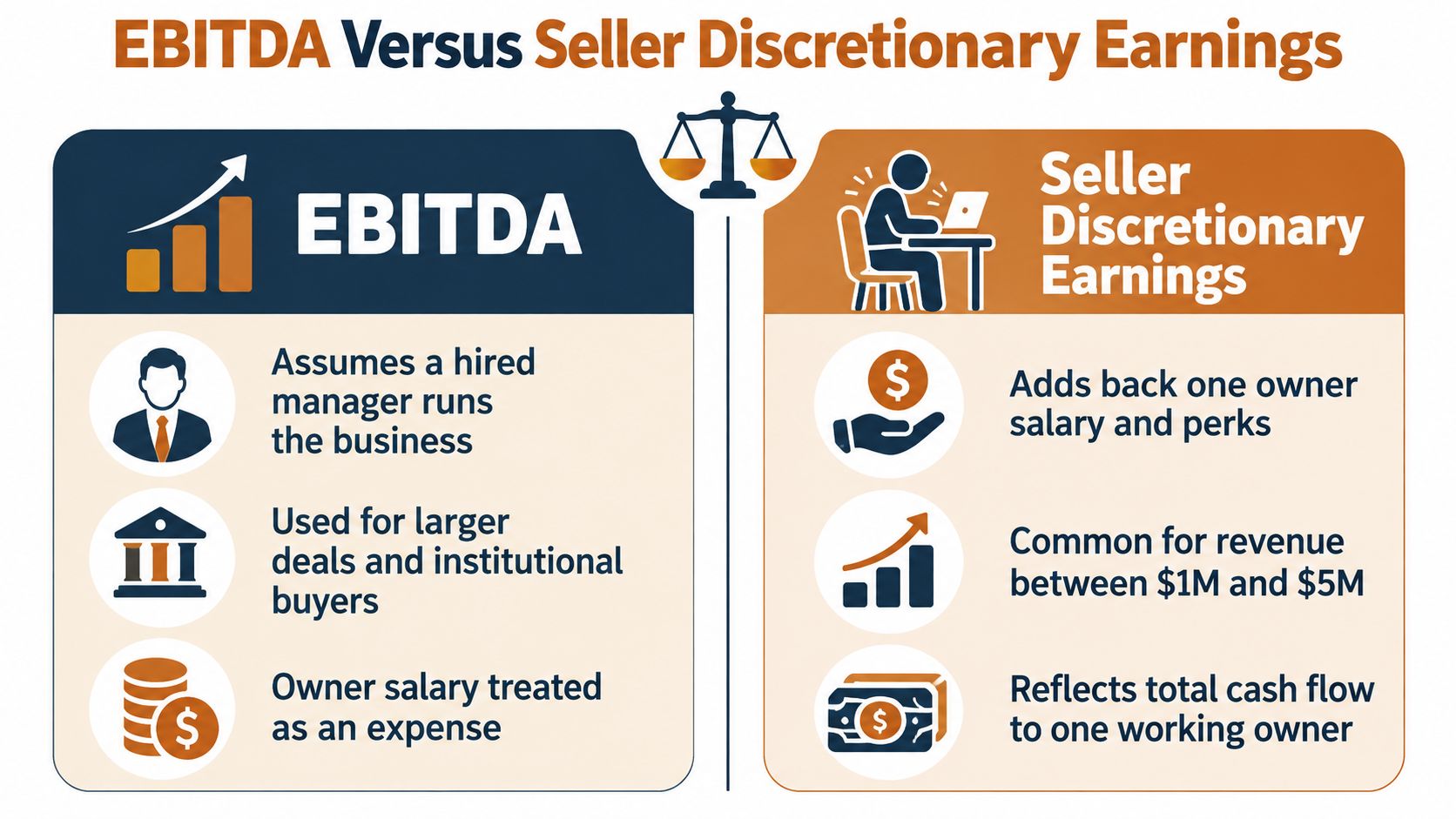
| EBITDA | Seller Discretionary Earnings |
|---|---|
| Assumes a hired manager runs the business | Reflects the cash flow available to one working owner |
| Treats owner compensation as an expense | Adds back one owner’s compensation and eligible benefits |
| Fits larger, professionally managed businesses | Fits smaller owner-operated businesses |
| Often used by institutional or strategic buyers | Often used by individual owner-operators |
There isn’t a single revenue threshold that switches every company from SDE to EBITDA. The right metric depends on the staffing model, owner involvement, buyer pool, management depth, and purpose of the valuation.
A company can have positive SDE and weak or negative EBITDA. That may mean the business supports one working owner but doesn’t yet support a separate manager. An individual buyer may find that attractive. A financial buyer may see a management gap and value the company more cautiously.
Use a comparison such as SDE versus EBITDA for business valuation to frame the discussion, but don’t apply a formula without considering who will operate the business after closing.
SDE is not a permission slip to add back every owner-related cost. If the business requires the owner to work full time, the buyer is purchasing an owner-operator opportunity, not passive cash flow. The buyer needs to understand the hours, duties, skills, and risks involved.
EBITDA becomes more relevant as the company develops management depth and the owner’s weekly contribution declines. That shift can broaden the buyer pool, improve the credibility of the earnings, and make the business easier to compare with other professionally managed service companies.
Two contractors can post the same EBITDA and still get very different offers. The gap usually comes down to risk after closing. Buyers pay more when they believe the earnings will hold up once the owner steps back.
That is why sector benchmarks only get you in the ballpark. A plumbing company with maintenance agreements, trained field supervisors, and clean job-costing can trade very differently from a roofing company that lives on storm work and the owner’s personal sales relationships. The multiple follows durability, not just margin.
The table below is where I would start with an owner who wants to know why one buyer says “strong platform” and another says “too much key-person risk.”
| Premium Multiple Drivers | Discount Multiple Drivers |
|---|---|
| Recurring service agreements and repeat work | Heavy dependence on one-off projects |
| Diverse customer relationships | Concentration in a few accounts |
| Documented procedures and trained managers | Owner controls sales, pricing, and operations |
| Reliable job costing and margin visibility | Unclear job profitability |
| Maintained equipment and fleet | Deferred repairs and replacement needs |
| Predictable staffing and recruiting processes | High turnover or dependence on key technicians |
| Consistent performance across periods | Volatile or declining earnings |
Notice how many of those discount factors tie back to owner dependency. If the owner still prices the work, saves problem jobs, approves every hire, and keeps the top customer accounts in a personal cell phone, buyers usually lower the multiple. They are not buying a stable cash-flow stream. They are buying a job with transition risk attached to it.
A few examples come up in trades deals all the time. HVAC buyers like service-contract revenue because it gives them visibility into renewal rates, dispatch volume, and future replacement work. Roofing buyers often spend more time on backlog quality, referral sources, weather exposure, and whether sales production is tied to one rainmaker. Landscaping and pest control buyers usually look hard at route density, retention, and crew stability. Same EBITDA concept. Different drivers underneath it.
Owners often chase revenue because it is easy to see on a dashboard. Buyers look at how that revenue repeats, how much gross profit survives after direct labor and callbacks, and whether someone other than the owner can keep it coming in.
Use comparable company analysis for valuation to frame a reasonable valuation range. Then pressure-test where your company belongs inside that range based on customer stickiness, management depth, margin control, and capital needs.
The improvements that move the needle are usually practical. Shift customer relationships from the owner to account managers. Put pricing rules in writing. Track gross margin by job and by crew. Clean up deferred maintenance on trucks and equipment. Keep service history, memberships, and follow-up activity in the operating system your team already uses.
Software alone does not raise a multiple. Continuity does. If a buyer can see that the business will keep running, collecting, and retaining customers without the owner doing daily rescue work, the valuation discussion gets a lot easier.
Preparation should start well before the company goes to market. Owners who wait until a buyer submits a letter of intent often discover that the financial records don’t support the story they’ve been telling.
A practical preparation period is 12 to 18 months, which gives the company time to establish cleaner reporting and prove that improvements are recurring.
Owners who need help organizing messy records can review Estimatty’s cleaning accounting guide for a practical starting point. The aim isn’t to make the statements look artificially strong. It’s to make the company’s actual economics understandable.
A buyer’s accountant may test revenue cutoffs, receivables, inventory, payroll, owner compensation, customer concentration, related-party transactions, and the sustainability of adjustments. A clear quality of earnings report can help organize that review before negotiations become expensive.
Keep the company in transaction-ready mode, not tax-minimization mode. Your CPA, valuation adviser, and broker should agree on the earnings bridge, the likely buyer metric, and the operational evidence supporting the valuation.
The Owner’s Shortlist helps established service-business owners understand valuation issues and get introduced to one reviewed specialist whose past work fits their industry and company profile. If you’re considering a sale, succession, or a quiet valuation discussion, visit The Owner’s Shortlist to speak with a real person and explore your options without listing the business.
Tell us your situation. We'll connect you with a specialist who works with owners like you. One conversation, no sales pressure.
Found this useful?
Add The Owner's Shortlist as a preferred source and get our articles highlighted in Google Search results.
Add to Preferred SourcesThinking 'I want to sell my landscaping business'? Learn how to value your company, prepare financials, handle labor risks, and find the right buyer quietly.
October 11, 2026
Sell My HVAC Business. Thinking about selling your HVAC business? Learn how owners prepare, value, negotiate, and close a sale
October 9, 2026
What Is SDE. Learn what SDE means in business valuation, how to calculate it with common add-backs, how it differs from EBITDA, and why buyers and lenders focus
October 7, 2026
Discover what a business valuation report includes, how to interpret it, and why it matters for your company's financial strategy.
October 6, 2026