How to Sell My Plumbing Business: A Practical Roadmap
Ready to sell my plumbing business? Follow a step-by-step roadmap for valuing, marketing, and closing the sale with confidence and clarity.
October 15, 2026
By Remi Taffin · October 14, 2026

You may be thinking about selling because retirement is getting closer, a family member has shown interest, or the business has become too dependent on you. The trucks are busy, customers keep calling, and the financial statements look healthy. Yet when you ask what would happen if you stopped answering the phone tomorrow, the answer may be uncomfortable. Key relationships sit in your head, estimates depend on your judgment, and the team still comes to you when a technician, customer, or supplier needs a decision.
That’s why learning how to sell your service business starts before valuation, advertising, or buyer meetings. A successful exit is usually a succession project first and a transaction second. You’re building a company that can transfer to someone else without losing its customers, employees, cash flow, or reputation.
A plumbing owner once told me he planned to leave by year-end. Revenue was steady, the phones stayed busy, and his crew was loyal. Then we examined what a buyer would inherit. He could not produce a complete list of recurring agreements, the dispatcher’s workflow existed mainly in his memory, and several major customers dealt with him personally.
He had decided to sell, but the company was not ready to change hands.
That gap determines whether an exit becomes a controlled succession or a rushed negotiation. A buyer pays for the transferable ability to produce earnings through employees, systems, customer relationships, equipment, and documented processes. If the owner still handles sales, estimates, scheduling, field supervision, and problem resolution, the buyer must price the transition risk.
The 2025 U.S. Bank small-business succession survey found that more than half of surveyed owners were over age 55. Only 54% had created a succession plan, while 62% said the process felt overwhelming. The survey also found that 56% worried they would not receive a reasonable price, and 53% lacked the resources or guidance needed to plan effectively.
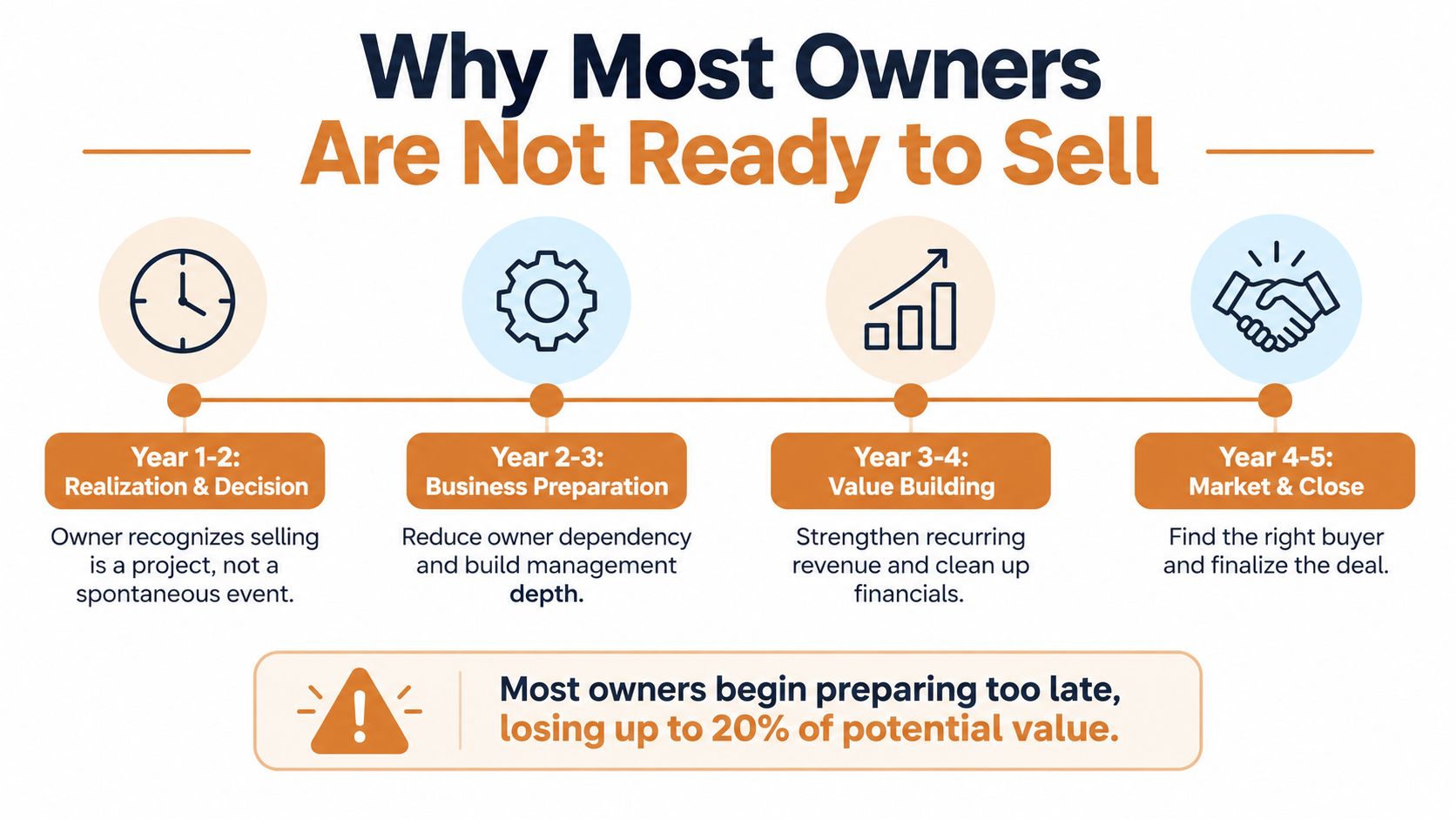
A health event, family issue, or unsolicited inquiry often forces owners to confront succession before they have chosen the outcome. That pressure can narrow their options and weaken their negotiating position. The same U.S. Bank survey found that 37% expected to sell within the next 12 months, leaving little time to reduce founder dependence or clarify the buyer’s role.
Start by answering four questions:
Owners with succession plans reported stronger recent growth in the U.S. Bank survey. 64% of owners with a plan reported substantial growth in the prior year, compared with 50% without one, according to the same survey. A plan does not guarantee growth. It forces owners to identify operational constraints while there is still time to address them.
Practical rule: Do not ask, “What could I list this business for?” Ask, “What would a capable buyer still need me to do after closing?”
A valuation guide can clarify how earnings, owner involvement, recurring revenue, and risk shape buyer thinking. Business Loan Warrior’s valuation guide offers a useful starting point, but treat any broad valuation range as an investigation prompt, not a promise.
The buyer you choose changes the business you need to build before any listing exists. An outside buyer will want proof that the company can run without you. A child or key employee may know the customers and culture, yet still need financing, training, governance, and a fair pricing method. Selling is therefore a succession decision before it becomes a transaction.
Gallup’s 2025 research found that 74% of U.S. employer-business owners planning to retire expected to sell or transfer ownership (Gallup’s business-owner research). Only 35% intended to use a sale or gift as their primary route. The reported options included 23% planning to sell, 26% planning to give the business to a family member or another person, and 2% hoping to take the company public.
An external buyer will test whether the company works without its founder. Prepare for questions about:
For a plumbing or HVAC company, the buyer may care less about how many calls the owner personally closes than whether dispatchers, comfort advisors, service managers, and technicians can maintain results without daily intervention. A high owner salary is not the only issue. The buyer must understand which relationships, decisions, and skills transfer with the company.
A family transfer raises questions about fairness and control. Is the price fair to children who work in the business and those who do not? Will the departing owner retain authority during a gradual handover? How will taxes, estate planning, voting rights, and disagreements be handled?
An employee purchase may preserve jobs and culture, but the successor still needs a credible financing plan and authority to make decisions. An experienced operations manager may run the company well and still need support with ownership, capital allocation, and long-term strategy.
International evidence also points to the value owners place on continuity. Germany’s KfW SME Panel, based on 11,328 participating small and medium-sized enterprises in 2023, found that 57% preferred leaving the business to a family member, compared with 43% preferring an external sale and 28% preferring a transfer to employees, according to KfW’s succession findings.
Choose the intended outcome before polishing sales materials. Maximum price, family control, employee continuity, confidentiality, and a clean retirement may pull the deal in different directions. Your choice determines what you build, whom you approach, and which terms you can accept.
A buyer needs to see a company, not a demanding job with trucks attached. The preparation work is operational first. It turns informal knowledge into repeatable systems and gives a successor a realistic path to run the business.

Start by listing everything you personally approve, explain, sell, schedule, or repair. Then assign each responsibility to a named person and document the standard process.
For a plumbing company, that might mean writing down how emergency calls are triaged, how estimates are approved, how warranty work is handled, and when a service manager escalates a customer complaint. An HVAC company should document maintenance renewal procedures, replacement estimates, financing conversations, and seasonal staffing decisions. A landscaping company may need clear routes for scheduling, weather delays, crew assignments, equipment maintenance, and commercial contract renewals.
Your operating file should include:
Buyers don’t expect every business to operate perfectly. They do expect the owner to understand the risks and show how the team manages them.
Clean books don’t mean every expense must disappear or every year must look identical. They mean a buyer can reconcile the financial statements to source records and understand which adjustments are legitimate.
Keep financial, tax, payroll, customer, and legal records according to the requirements that apply to your jurisdiction and entity. If you operate across borders, the NAS Ledger guide to how long to keep accounting records in the UAE illustrates why retention rules should be checked with a qualified adviser rather than guessed.
A simple data room structure helps:
Document the business systems that make performance repeatable. This resource on business systems and processes can help you identify where undocumented owner knowledge is creating transfer risk.
An owner’s eventual absence should be tested before the business is marketed. Take a planned step back from one operating area at a time. Let the service manager handle customer escalations, allow the estimator to own the pipeline, or have the office manager run the weekly operations meeting. The gaps you find are valuable preparation data.
A short walkthrough of the sale process can also help align the management team before confidential discussions begin.
A direct sale can work when the buyer is already known, the business is specialized, and confidentiality is manageable. It becomes harder when you need to create competition, screen unfamiliar buyers, coordinate lenders, explain normalized earnings, and negotiate terms without signaling weakness.
Public marketplaces create reach, but reach isn’t the same as fit. An open listing may attract curious buyers, undercapitalized inquiries, competitors, or people who want operating information without the ability or intention to close. In a local service market, one careless disclosure can unsettle employees and customers.
A broker or M&A adviser should do more than upload a description. The right specialist understands the economics of your trade, knows which buyers have completed comparable deals, and can control the release of information. Ask what they’ve sold, who handled the buyer’s diligence, how they protect confidentiality, and how they distinguish a serious buyer from a request for free information.
| Aspect | Curated Broker Matching | Direct Sale / Public Marketplace |
|---|---|---|
| Buyer access | Introductions are selected around industry, size, geography, and objectives. | Wider exposure, but inquiries may vary sharply in quality. |
| Confidentiality | Information can be released in stages after qualification and confidentiality agreements. | A public listing can reveal identifying details before a buyer is fully screened. |
| Valuation discussion | The adviser can explain normalized earnings and risk to the right audience. | The owner must defend the price and adjustments personally. |
| Negotiation | A specialist manages process, deadlines, offers, and buyer communication. | The owner handles negotiation while continuing to run the company. |
| Cost and control | Professional fees may be justified by process management and buyer access. | Lower adviser cost, but more time and execution responsibility for the owner. |
| Best fit | Owners seeking discretion, structured competition, or help with complex terms. | Known buyers, narrow niches, or owners comfortable managing the process. |
A direct sale often appears cheaper because the owner sees no intermediary fee. That calculation ignores management time, missed operating decisions, weak buyer screening, and the cost of accepting poorly protected terms.
For transaction mechanics, a founder can learn useful sequencing from By Design Law Firm’s merger and acquisition playbook. It doesn’t replace advice from counsel who understands your entity and transaction, but it can make the stages less opaque.
Owners who prefer a direct route should still build a professional team. A CPA can normalize earnings and model taxes. An attorney can prepare confidentiality agreements, letters of intent, purchase documents, and closing conditions. A lender can test whether the proposed buyer can finance the deal.
This guide to selling a business without a broker is useful for owners considering that path. The decision should reflect your confidentiality needs, buyer access, transaction complexity, and willingness to remain involved in the process.
The most dangerous mistake is comparing offers by headline price alone. A clean cash offer, a seller note, an earnout, and retained equity are not interchangeable. They differ in certainty, timing, control, tax treatment, security, and exposure to what the buyer does after closing.
Start by separating the economics:
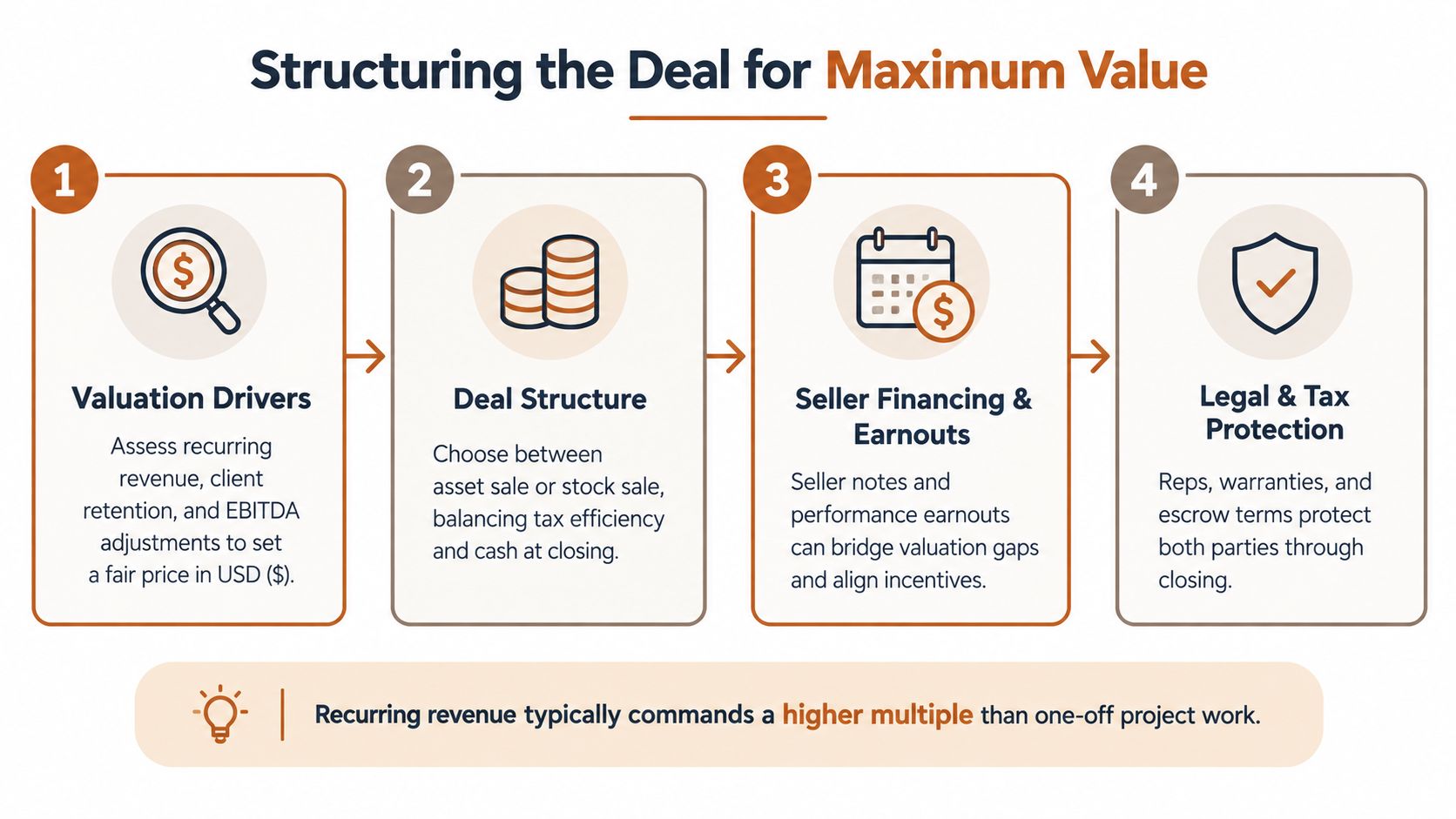
Service businesses become more attractive when revenue is predictable, customers stay, margins are understandable, and the owner can be replaced by a competent management structure. Recurring maintenance agreements can reduce uncertainty. One-off project revenue may still be valuable, but it generally requires a closer look at backlog, sales conversion, customer concentration, and delivery capacity.
Normalize the financial statements carefully. Separate genuine operating expenses from personal or unusual items, but don’t add back costs the buyer will need to incur after closing. If the owner handles sales, estimating, or operations, a buyer may need to budget for a replacement salary. Presenting that expense openly strengthens credibility.
IBBA’s Q3 2023 Market Pulse executive report states that most Main Street and lower-middle-market transactions carry some seller financing, typically around 10% to 20% of total deal value, according to the IBBA Market Pulse report. Seller financing can bridge a valuation gap, but it also makes the seller a creditor after closing.
A seller note should specify interest, amortization, payment dates, collateral, guarantees, subordination, default triggers, and acceleration rights. Review the buyer’s cash flow and stress-test repayment if a major customer leaves, labor becomes more expensive, or margins narrow.
Earnouts require even more precision. Define the metric, accounting rules, measurement period, exclusions, reporting rights, dispute process, and restrictions on actions that could manipulate results. An earnout based on EBITDA can become contentious if the buyer changes overhead allocations, pricing, staffing, or acquisition-related accounting.
A higher contingent price isn’t automatically better than a lower cash price. Compare the money you can reasonably expect to receive, when you’ll receive it, and what you can do if the buyer misses the agreed performance.
A practical comparison looks like this:
| Structure | Certainty | Seller control after closing | Main exposure |
|---|---|---|---|
| Cash at closing | Highest, subject to closing adjustments and indemnities | Minimal | Lower headline price may reduce total proceeds. |
| Seller note | Depends on buyer repayment capacity and security | Limited creditor rights | Default, subordination, and buyer cash-flow risk. |
| Earnout | Uncertain until the metric is achieved | Usually limited | Buyer decisions may affect the measurement. |
| Rollover equity | Long-term and uncertain | Depends on governance rights | Future company performance and exit timing. |
For a deeper practical discussion of note terms, review this guide to seller financing. Your advisers should compare offers using probability-weighted expected proceeds rather than the highest advertised number.
For a U.S. asset sale involving a trade or business where goodwill or going-concern value attaches, both buyer and seller generally must file IRS Form 8594. The IRS instructions for Form 8594 explain the residual allocation method, which applies consideration first to Class I assets, then Classes II through VI, with the residual generally assigned to Class VII goodwill and going-concern value.
Inventory every transferred asset and assumed liability. Obtain fair-market-value support for equipment, vehicles, inventory, customer lists, trademarks, and noncompete agreements. Then negotiate an allocation that appears in the purchase agreement and can be reported consistently by both parties.
Have a tax professional model at least two allocations before signing a letter of intent. One may emphasize the seller’s near-term tax position, while another reflects the buyer’s desired depreciation and amortization profile. The allocation isn’t clerical cleanup. It affects the seller’s gain or loss, the buyer’s tax basis, and the likelihood of late-stage renegotiation.
A signed letter of intent is not the finish line. It establishes the commercial framework while the buyer verifies the business, financing is arranged, documents are drafted, and both sides discover whether the proposed deal can survive diligence.
Prepare a diligence index before the buyer asks for it. Keep one controlled version of financial statements, contracts, employee records, permits, insurance, customer information, equipment records, and litigation disclosures. Respond accurately and consistently. A missing document is manageable. An unexplained contradiction can damage trust.
The purchase agreement should define more than price. Pay attention to representations, warranties, indemnities, escrow or holdback provisions, working-capital adjustments, restrictive covenants, assumed liabilities, and closing conditions. Your attorney should explain which obligations continue after closing and which depend on your conduct during the transition.
The handover deserves its own written plan:
If an earnout or seller note remains outstanding, preserve clear communication and reporting rights. Your reputation also matters. Customers and employees will remember whether the transition felt organized or abrupt, and the buyer’s ability to retain them may affect the payments you’re still waiting to receive.
The best handover makes the new owner increasingly independent. Your role should shrink because the systems and management team are working, not because everyone has learned to work around your absence.
Bring in help before buyer contact if the business is approaching the $1 million to $50 million range, the owner remains central to operations, family members disagree about succession, or seller financing and earnouts may form part of the deal. A broker, transaction CPA, M&A attorney, and transition adviser can each address a different risk. Start with a confidential review of your goals, records, management depth, and likely buyer type.
The Owner’s Shortlist connects service-business owners with a vetted specialist for sale preparation, buyer selection, diligence, and deal terms, with owners never paying for the introduction. Visit The Owner’s Shortlist to speak with a real person and explore a confidential next step before market pressure makes the decision for you.
Tell us your situation. We'll connect you with a specialist who works with owners like you. One conversation, no sales pressure.
Found this useful?
Add The Owner's Shortlist as a preferred source and get our articles highlighted in Google Search results.
Add to Preferred SourcesReady to sell my plumbing business? Follow a step-by-step roadmap for valuing, marketing, and closing the sale with confidence and clarity.
October 15, 2026
Learn how business valuation EBITDA works for service companies. Discover adjustments, multiples, and owner-dependency tests before you sell.
October 12, 2026
Thinking 'I want to sell my landscaping business'? Learn how to value your company, prepare financials, handle labor risks, and find the right buyer quietly.
October 11, 2026
Sell My HVAC Business. Thinking about selling your HVAC business? Learn how owners prepare, value, negotiate, and close a sale
October 9, 2026