Business Broker Credentials Explained: CBI, M&AMI, CEPA
CBI, M&AMI, and CEPA sound similar but prove different things. Here's what each credential actually certifies, and how to verify one before you rely on it.
September 25, 2026
By Remi Taffin · September 26, 2026
The popular advice is simple: skip the broker, save the commission, and keep more of the sale proceeds. That advice is incomplete. Selling directly can work, but only when you replace the broker’s buyer screening, confidentiality controls, marketing, negotiation support, and transaction coordination with a disciplined process and the right specialists.
If you’re asking how to sell my business without a broker, start with a harder question: can you manage the work a broker normally absorbs while continuing to run the company? A direct sale isn’t a shortcut. It’s an owner-led M&A process.
A broker commission commonly runs 5% to 10% of the final sale price, according to this guide to selling a business without a broker. On a $2 million transaction, the fee ranges from $100,000 to $200,000. Keeping that money can justify a direct sale, but the owner must replace the broker’s screening, confidentiality controls, negotiation support, and coordination.
A capable broker also prepares marketing materials, manages inquiries, coordinates diligence, and keeps the parties working toward a closing. Remove that layer and the work moves to you, your attorney, your CPA, or a specialist team you assemble yourself. The commission should be compared with those costs, plus the value of the time taken from running the company.
Owner-led listings face a difficult closing problem in the Main Street market. One widely cited estimate says only about 20% of Main Street businesses listed for sale in the United States close, implying an 80% drop-off between listing and completion, as summarized by East Coast Advisory Team’s analysis of selling without a broker.
The same discussion reports brokered close rates of 18% to 20%, compared with 14% to 16% for owner-attempted sales. These figures show that finding an interested party and completing a transaction are two different problems, and the second one is where owner-led sales stall.
The owner must handle valuation, buyer qualification, confidentiality, negotiation, diligence, legal coordination, and transition planning. An HVAC owner spending ten hours a week on buyer calls is spending ten hours away from service contracts, staff issues, and customer relationships. That distraction can weaken the operating results a buyer will scrutinize, while an unqualified buyer can consume weeks before revealing a financing gap.
Going solo is rational in narrower situations than online checklists suggest:
A known buyer still needs financial qualification, legal documentation, and tax planning. Familiarity reduces marketing work, while transaction risk remains. Read candid frank confessions about brokers to examine where broker incentives can conflict with an owner’s priorities, then apply the same scrutiny to a buyer you already know.
Direct outreach also creates confidentiality risks, especially when an owner approaches competitors or industry contacts without a controlled process. Review the risks of a direct-buyer approach before sending financial information or announcing that the company may be available. A direct sale works best when the owner treats buyer screening and deal coordination as assigned responsibilities, with legal, accounting, and financing specialists brought in before problems reach the closing table.
Don’t start with a listing. Start with preparation. A practical no-broker process commonly takes 6 to 12 months end-to-end, including preparation, marketing, negotiation, diligence, documentation, financing, closing, and transition, according to BNY’s guidance for private business owners.
The preparation and valuation stage typically takes 2 to 3 months, so use that time to make the business easier to understand and harder to discount.
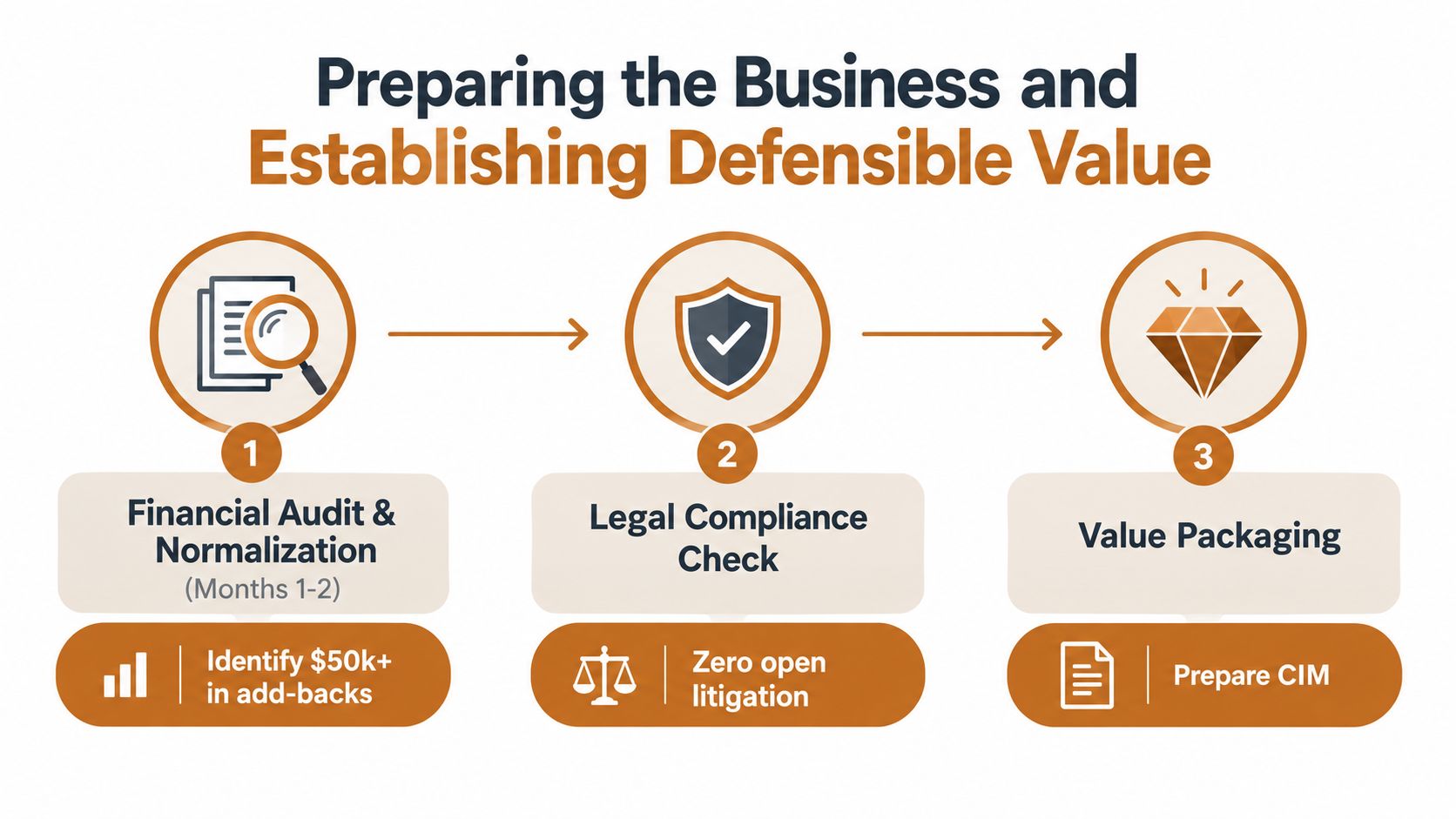
Give your CPA a clear assignment: reconstruct the company’s economic performance as a buyer will view it.
The result should be a clean historical financial package, a normalized earnings schedule, and a forecast that uses assumptions you can defend.
Use more than one valuation lens. The income approach focuses on expected cash flow and risk. The market approach compares relevant transactions. An asset-based approach examines the value of assets less liabilities, including intangible assets where appropriate. Your business valuation guide can help you organize the questions before engaging an independent valuation professional.
Don’t pick the highest result and call it the price. Establish a defensible range, identify the assumptions behind it, and decide which terms could justify a different headline price. A buyer may accept a lower cash price with stronger certainty, or a higher nominal price that includes contingent payments and seller financing.
At minimum, organize:
Correct gaps before a prospect sees the business. Buyers rarely pay a premium for a company whose records are difficult to verify, and every unresolved issue becomes a point of pressure against you during diligence.
The most dangerous buyer is not always the dishonest one. It’s the unprepared buyer who gets access to sensitive information, consumes your time, makes an attractive promise, and discovers later that they can’t finance the purchase.
A broker normally creates a screening layer. Without one, you need a written qualification policy and the discipline to follow it even when an inquiry comes from someone who sounds impressive.
A strategic buyer may be a competitor, supplier, customer, or adjacent company seeking synergies. That buyer may understand the industry quickly, but it also creates a heightened confidentiality risk.
An individual searcher may want to operate the company personally. Ask about relevant operating experience, the role they expect to play, and whether they have arranged acquisition financing.
A financial buyer may approach through an investment group or acquisition vehicle. Identify the people behind the entity and understand whether the buyer has authority to submit an offer.
An insider buyer may be a manager, employee group, or family member. Trust helps, but insiders still need independent financing, valuation, tax, and legal advice.
Don’t send financial statements because someone emailed “interested.” Use gates:
The BNY report on private business owners emphasizes the importance of preparation, paperwork, tax planning, and an advisory team. That applies directly to buyers too. A buyer who won’t explain financing, decision authority, or timing isn’t ready for sensitive diligence.
Record every inquiry, NDA status, documents released, questions asked, financing evidence, stated timing, and next action. This creates an audit trail and prevents you from treating the loudest prospect as the strongest prospect.
A buyer earns access to information in stages. Interest is not qualification, and qualification is not an offer.
Don’t let one attractive inbound inquiry eliminate competition before you know whether the buyer can close. If the company is valuable, controlled outreach to several appropriate prospects can preserve bargaining power without turning the process into a public auction.
Your outreach should reveal enough to attract a qualified buyer without identifying the company prematurely. A blind teaser can describe the industry, geography, broad business model, customer type, and high-level opportunity without naming customers, employees, or the company itself.
Use a separate NDA for each qualified prospect. Don’t rely on a casual promise in an email, and don’t send your customer list, employee roster, proprietary procedures, or detailed financial package before confidentiality protections are in place.
Create a secure data room with numbered folders and a release schedule. Start with the teaser. After the NDA and initial qualification, provide the confidential information memorandum. Release source documents only when the buyer has demonstrated a serious intent and your attorney agrees that the disclosure is appropriate.
Schedule management calls instead of accepting constant interruptions. Require consolidated questions through one channel. You’re selling a business, not offering unlimited consulting to every curious prospect.
A Letter of Intent usually sets the commercial and procedural framework for the definitive agreement. Even when most provisions are non-binding, the LOI can shape your negotiating power for the rest of the process.
Negotiate these points deliberately:
A useful resource on questions to ask before signing a letter of intent can help you pressure-test the document before exclusivity removes your alternatives.
Negotiation training built for commercial conversations, such as gap negotiation training for SDRs, can also sharpen your questioning and listening. But don’t confuse negotiation technique with legal advice. Your M&A attorney should review the LOI before you sign it.
The headline price is only one part of the deal. The form of consideration, payment timing, security package, tax allocation, indemnification, and post-closing obligations determine how much value you keep and how much risk remains after closing.
Seller financing deserves special attention. Independent market coverage reports that seller financing represented roughly 10% to 16% of transactions in early 2026, falling to about 5% in the $5M+ segment, according to William Bruce’s market report. The same report says 2,117 businesses changed hands in Q2 2026, down 10% quarter-over-quarter and year-over-year. These figures point to a practical conclusion: flexible terms can matter when an all-cash buyer is difficult to find, but flexibility must come with protection.
A seller note can bridge a gap between the buyer’s available cash and your valuation. It may widen the buyer pool, but you’re becoming a lender, so the note needs commercial discipline.
Require a written repayment schedule, interest terms, maturity date, default remedies, reporting rights, collateral, personal or corporate guarantees where appropriate, and clear subordination language if a senior lender is involved. Confirm who controls the business if performance deteriorates. Never accept a note just because it preserves the nominal purchase price.
Earn-outs require the same skepticism. Define the metric, accounting rules, reporting access, decision rights, treatment of extraordinary expenses, and what happens if the buyer changes the business. If you can’t verify the formula after closing, the earn-out is an unsecured hope.
| Structure Type | Seller Risk Level | Typical Use Case |
|---|---|---|
| All-cash closing | Lower after closing, subject to contractual liabilities | Buyer has sufficient cash or committed financing |
| Cash plus seller note | Moderate, because repayment remains outstanding | Buyer needs financing support or the parties must bridge a valuation gap |
| Cash plus earn-out | High, because payment depends on future performance | Buyer and seller disagree about growth, retention, or forecast reliability |
| Asset sale | Variable, with attention to excluded liabilities and allocation | Buyer wants selected assets and contracts rather than the entire legal entity |
| Equity or stock sale | Variable, with emphasis on inherited liabilities and representations | Buyer wants continuity of the existing entity and its contracts |
Get your transaction tax CPA involved before you sign an LOI. Asset and equity sales can produce different tax consequences, and the allocation among goodwill, equipment, inventory, non-compete rights, and other assets can affect after-tax proceeds. Your attorney should coordinate the language, but your tax specialist should model the outcome.
Don’t promise a buyer a tax allocation before receiving advice. A seemingly small concession in the purchase agreement can change the amount you keep, the timing of tax payments, or your exposure to future disputes.
Selling without a broker does not mean selling without professionals. It means you’re replacing one coordinating intermediary with a smaller team whose roles are explicit.
Hire an M&A attorney before signing the LOI. This lawyer should regularly handle business acquisitions, purchase agreements, representations and warranties, indemnification, non-competes, escrow, closing conditions, and post-closing disputes. Your local generalist may be excellent at real estate or employment law and still be the wrong person to lead an acquisition.
Bring in a transaction tax CPA early enough to compare asset and equity structures, model purchase price allocation, review seller financing, and coordinate tax filings. Add an independent valuation specialist when the price is disputed, the company has unusual assets, the buyer is using a formula you don’t trust, or family and management interests create conflicts.
Assign one person to maintain the buyer log, data room index, diligence tracker, and closing checklist. The attorney should control legal documents and issue lists. The CPA should control financial responses and tax analysis. You should control business decisions, commercial priorities, and the final acceptance of risk.
Ask each specialist:
The Owner’s Shortlist offers a curated directory and practical guidance across valuation, taxes, legal matters, financing, succession, and related owner decisions. Use it alongside independent referrals and interviews, not as a substitute for checking credentials and engagement terms.
Before closing, confirm that the purchase agreement matches the LOI, funds are available, lien releases are prepared, consents are obtained, escrow instructions are clear, and the transition schedule is realistic. Review every representation you’re making. An inaccurate disclosure can create post-closing liability, even if the mistake was accidental.
Your team should also document the handoff of passwords, contracts, customer relationships, vendor contacts, operating procedures, equipment, records, and authority. The buyer is paying for a functioning business, and you’re protecting yourself by proving exactly what was transferred and what you agreed to support.
Going without a broker can be a sound decision when the buyer is known, the business is manageable, and you’re prepared to run a professional process. It becomes reckless when “saving the fee” means skipping qualification, tax advice, legal review, or transaction control.
If you’re preparing to sell directly, use The Owner’s Shortlist to review practical guidance and identify vetted specialists for valuation, taxes, legal work, financing, and succession. Start by organizing your deal questions, then contact the professionals whose experience matches the risks in your transaction.
Tell us your situation. We'll connect you with a specialist who works with owners like you. One conversation, no sales pressure.
Found this useful?
Add The Owner's Shortlist as a preferred source and get our articles highlighted in Google Search results.
Add to Preferred SourcesCBI, M&AMI, and CEPA sound similar but prove different things. Here's what each credential actually certifies, and how to verify one before you rely on it.
September 25, 2026
Local brokers know your market. Regional brokers have reach. National niche brokers own one vertical. Here's how to pick the right type for your sale.
September 12, 2026
Find the right business brokerage Orlando FL for your sale. Our 2026 guide reviews top firms, specialties, and key questions to ask before selling.
August 2, 2026
Explore our curated list of the top business brokerage firms for 2026. Compare services, fees, and find the right partner to sell your owner-operated business.
July 31, 2026