How to Sell My Business Without a Broker
Learn how to sell my business without a broker. This guide covers valuation, buyer screening, deal structure, and when to hire specialists to protect your exit.
September 26, 2026
By Remi Taffin · July 31, 2026 · Updated September 7, 2026

You’re staring at a decision that feels bigger than the sale itself. Your books are in decent shape, the business still runs, and buyers keep asking questions, but you know one bad fit with the wrong intermediary can cost time, privacy, and negotiating power. Choosing the right business brokerage firm is really about matching the firm’s model to your company, your geography, and your deal size, not just picking the biggest name.
For owners, the core question is usually whether you need a main-street broker who knows how to handle a smaller, owner-operated sale, or a lower-middle-market advisor who can run a more formal process with deeper buyer outreach and tighter diligence. That distinction matters because the U.S. business brokers industry is still relatively small and fragmented, estimated at about $1.0 billion in 2025 and 2026 with 3,237 businesses in the industry in 2025, according to IBISWorld. In a market like that, fit often matters more than brand size.
Seven firms, their strengths, typical deal sizes, and general style. That’s a useful starting point. It’s not the decision.
In our experience, the person running your sale matters as much as the firm behind them. Every network on this list has offices that run disciplined processes and offices that don’t. That variability is real, and it can determine whether your deal closes cleanly or drags for a year. A firm’s brand tells you almost nothing about the specific broker who would manage your listing, screen buyers, handle diligence, and keep a deal alive when something goes sideways.
Which broker at these firms has closed deals in your industry? What’s their track record at your revenue level? How do they handle a buyer who tries to retrade at the last minute? No list answers those questions.
That’s what The Owner’s Shortlist is built for. We vet individual brokers on actual deal history, not just credentials or brand affiliation. When you tell us about your business, we match you to the right person, not just a firm name.
Tell us about your business and we’ll match you with the right broker.
Sunbelt makes sense for owners who want broad market reach without giving up local execution. Its network model is especially relevant if you’re selling a business that needs both nearby relationship selling and wider buyer visibility, which is often the case in trades, restaurants, services, and distribution. For owners comparing business brokerage firms, that mix of local offices and centralized listings can be a real advantage.
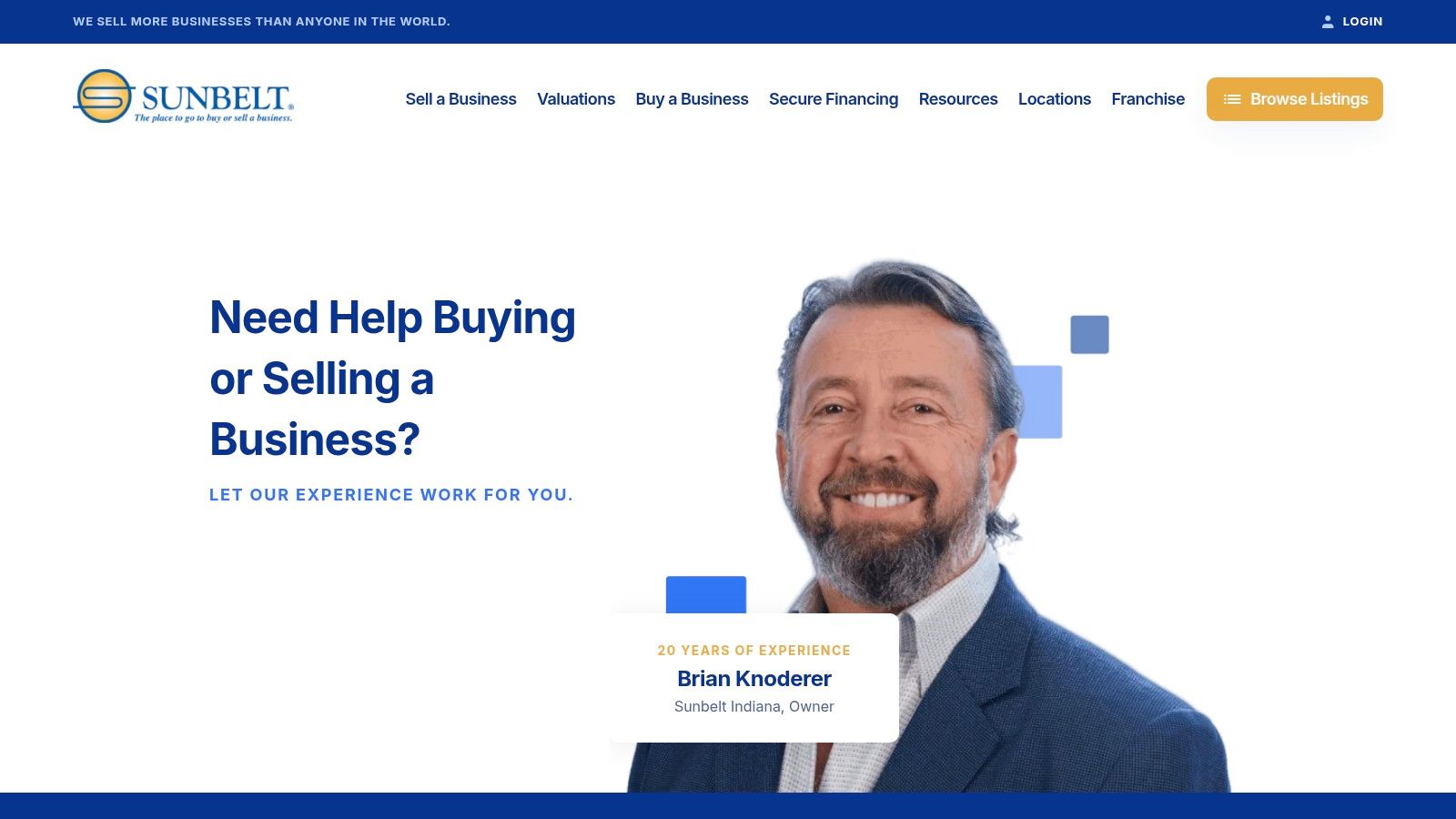
Sunbelt’s site shows a structured sell-side flow that starts with valuation and moves through due diligence and closing. That kind of step-by-step process helps owners stay oriented when the deal starts to feel messy, especially once buyer questions, lender coordination, and document requests start stacking up. The firm also highlights industry pages for trades, construction, manufacturing, services, restaurants, and distribution, which is useful if you want a broker who won’t need a crash course in your sector.
Sunbelt is strongest for owners who value coverage and process, especially if they want access to a broader buyer pool through a recognizable network. Select offices also support SBA financing and E-2 visa buyers, which can matter when the buyer pool is more diverse than a simple local owner-operator search.
Practical rule: If you want a large network but still expect one person to quarterback your deal locally, Sunbelt is worth a first call. If you need a deeply specialized, bespoke capital-markets process, you may want a different lane.
The main drawback is the franchise model. Service quality can vary by office, and fee specifics depend on location and deal size, so you’ll want to ask exactly who handles your file, how much of the process is local, and what the handoffs look like. Before you call, it helps to understand the role of a broker in plain language, which is why many owners read what a business broker actually does before hiring one.
Transworld is a strong option for owners who aren’t sure whether they’re selling a company, exploring a franchise path, or considering a more strategic exit. Its model combines small-business brokerage, franchise consulting, and M&A advisory, so it can route different deals to different internal teams instead of forcing every mandate through the same lane. That flexibility matters when owners are still sorting out what the business should become next.
The network’s scale is the main attraction. With 250+ offices and 1,000+ brokers worldwide, plus 45+ years of operations, Transworld has the kind of brand recognition that can help sellers feel they’re not starting from zero. Those figures come from Transworld’s own positioning, and they help explain why the firm shows up so often in conversations about business brokerage firms with broad market visibility.
Owners who want a recognizable platform and multiple advisory paths can get value here. If your company might be sold outright, rolled into a franchise system, or positioned in a larger growth story, the ability to move between services can be practical.
A few things still deserve scrutiny:
If you’re evaluating Transworld, ask for a direct walkthrough of buyer targeting, communication cadence, and who handles valuation versus closing logistics. That’s the kind of discipline owners should expect from any firm, and it aligns with the kind of questions smart sellers ask when they interview a business broker and prepare their own broker questions.
Murphy is a good fit when you want transaction support and valuation support under one roof. That matters more than many owners realize. A seller can get into trouble by hiring someone who knows how to list a business but not how to defend the number, document the assets, or support financing conversations later in the process.
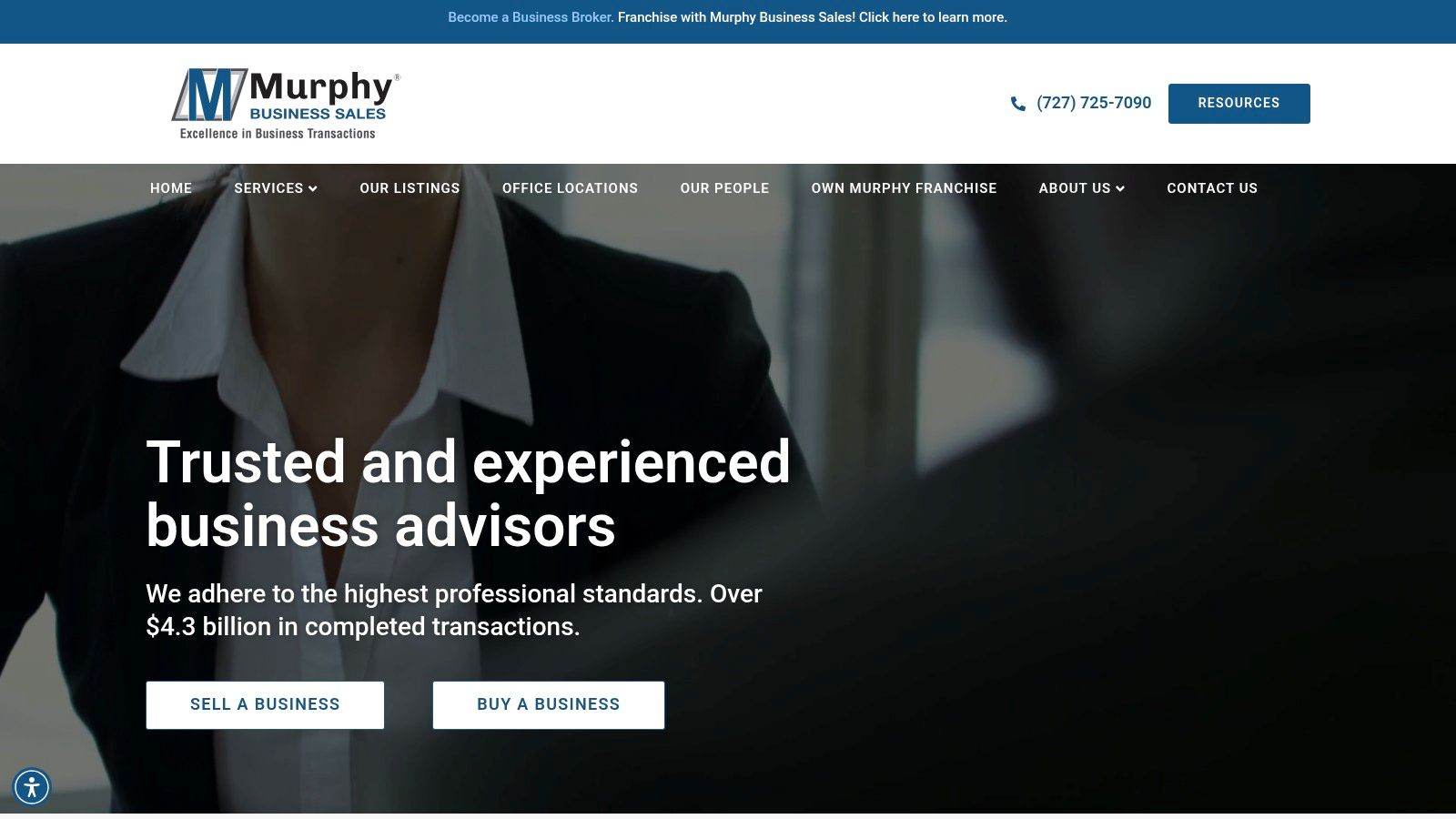
Murphy’s services include sell-side representation, formal business valuations, franchise resales, equipment appraisals, and lower-middle-market/M&A services. That breadth is especially useful for owner-operated businesses where hard assets, inventory, or machinery affect deal structure. When a buyer asks how the price was built, a broker who can speak to valuation and appraisal work has an edge.
Owners often underestimate how much time gets lost when pricing is soft or unsupported. A valuation that can stand up to buyer scrutiny, lender review, and internal family discussion reduces friction later. Murphy’s valuation and appraisal capability can help with that, especially for businesses where assets are central to the transaction.
The trade-off is the familiar one in franchise networks. Office quality and sector experience can vary, and upfront engagement structures may differ depending on location and service mix. That means your first conversation should focus less on slogans and more on who will prepare the valuation, who will field buyer questions, and how the office handles difficult diligence items.
If you’re looking at Murphy, ask whether the office has handled businesses like yours recently, especially if your exit depends on equipment, franchise transfer rules, or a complicated asset mix. A firm with valuation muscle can be a better partner than a pure marketer when the core issue is defensibility.
VR is built for owners who care a lot about confidentiality, buyer screening, and a familiar brokerage workflow. That makes it appealing for smaller companies and main-street sellers who don’t want sensitive financial details floating around too early. The firm’s long history and franchise footprint also give it staying power in a category where local reputation still matters a lot.

VR’s process emphasizes staged information disclosure to qualified buyers. That’s the right instinct for many owner-operated businesses, because not every inquiry deserves the same level of access. If the business is still running day to day, confidentiality can protect employees, vendors, and customers while the sale moves forward.
Practical rule: A good broker doesn’t just advertise a business. A good broker controls who sees what, when they see it, and what they have to prove before getting deeper access.
Some VR offices state that they don’t charge an upfront fee for most small businesses, which can appeal to owners who want a success-fee-oriented approach. That can lower the barrier to getting started, but it shouldn’t be confused with a better total outcome. What matters is whether the office can attract qualified buyers and keep the process moving.
The limitation is the same one you see across many franchise systems, uneven office quality. Some locations also focus on specific deal-size ranges, so a business that is too small or too large for a given office may not get the right attention. If you’re comparing firms, ask how many engagements the local office handles like yours and how it screens buyers before releasing more detail.
VR often works best for sellers who want a traditional brokerage feel with disciplined confidentiality and a straightforward buyer journey. It’s less compelling if you need a highly customized capital-markets process or a more intensive pre-sale readiness program.
Website: VR Business Brokers
Raincatcher is for owners who want a more banker-style sell-side process instead of a simple listing-and-wait model. That distinction matters. If you’re trying to create competitive tension and force buyers to engage on a timeline, a structured process with CIMs, targeted outreach, and staged bids tends to be more effective than passive marketing.
The firm operates like a lean investment bank for smaller and lower-middle-market deals. It helps owners organize the data room, prepare documents, and move toward LOIs and second-round bids with more discipline. That can be a strong fit if the business is valuable enough that process quality directly affects the result.
Raincatcher’s main edge is process. Instead of hoping the right buyer stumbles in, it creates a deliberate outreach list and manages the steps that keep serious buyers moving. That’s useful when you care about control, confidentiality, and deal momentum.
The firm also makes sense for owners who are willing to pay for structure. It often charges a modest retainer, so it’s not a pure success-fee-only model. For the right deal, that’s fine. For a very small sale, it may feel like more overhead than the business justifies.
Before engaging, ask how the firm decides which buyers get targeted, how it handles seller preparation, and how much owner involvement is expected in the first phase. Owners who want a practical overview of that kind of process can also review how The Owner’s Shortlist works for advisors and owners.
Raincatcher is a better match for sellers who want their deal run, not merely posted.
Website: Raincatcher
Calder Capital is a strong fit for owners in the lower-middle-market, especially if the company is large enough to justify a more formal M&A process. Calder publicly states a transaction focus of $1M to $100M in enterprise value, which immediately tells you this is not a main-street shop. That range matters because it helps owners self-select before making the call.
The firm’s approach is attractive to businesses in construction, distribution, light manufacturing, and business services. Those are exactly the kinds of companies where buyer reach, process discipline, and sector familiarity can materially shape outcomes. Calder also emphasizes national marketing and a proprietary buyer universe, which suggests a more deliberate buyer search than a local listing model.
For owners in the lower-middle-market, competitive tension is the goal. Calder’s process is designed to generate multiple offers and give sellers options, not just a single take-it-or-leave-it bid. The firm also uses a transparent buy-side retainer plus success-fee model, which helps clarify the economics early.
That transparency is a real plus. Owners know what kind of engagement they’re entering, and that reduces the feeling that fees will grow as the process drags on. The downside is simple, though. Very small main-street businesses under roughly that enterprise-value band may not be the best fit, and some mandates may require retainers that smaller sellers won’t want to pay.
If your business has enough complexity to justify a national search, Calder is one of the more serious choices in this group. If your business is smaller, owner-dependent, and fairly straightforward, you may get better value from a more main-street-oriented firm.
Website: Calder Capital
Morgan & Westfield is the best match for owners who want pricing clarity and process discipline before they ever sign an engagement. Its menu-style pricing is different from the usual open-ended commission approach, and that difference can be a relief for sellers who want to know what advisory work will cost up front. In a field where many firms stay vague about fees, that alone stands out.
The firm’s owner education materials are another advantage. Detailed FAQs, guides, and staged confidentiality tools like teasers, CIMs, and data-room workflows show that the firm treats preparation as part of the product, not an afterthought. That matters because a sloppy start tends to create a sloppy process later.
Morgan & Westfield works well for owners who want control. The firm says it offers flexible engagement terms, including no long-term contract and prorated refunds for cancelled work. That structure can lower the emotional barrier to getting started, especially for owners who are still deciding whether a sale is happening.
The trade-off is that package pricing may not appeal to owners who prefer a traditional commission-only setup. Local boots-on-the-ground presence can also vary depending on market, so the firm may feel more process-driven than relationship-driven in some regions.
If you’re the kind of owner who wants the engagement spelled out in plain English, Morgan & Westfield is one of the cleanest options on this list. If you want an office around the corner with a local network, another firm may fit better.
Website: Morgan & Westfield
| Firm | Implementation complexity | Resource requirements | Expected outcomes | Ideal use cases | Key advantages |
|---|---|---|---|---|---|
| Sunbelt Business Brokers | Moderate, standardized sell‑side process managed locally | Moderate, commission + local marketing; SBA/E‑2 support in select offices | Broad buyer reach; Good visibility for main‑street and lower‑middle deals | Main‑street sellers (<$1M) and $1M+ lower‑middle with local execution needs | Large nationwide network; clear step‑by‑step workflow |
| Transworld Business Advisors | Moderate, multi‑service network routing mandates internally | Moderate, franchise model resources; services span brokerage to M&A | Wide market exposure; Flexible outcomes (sale, franchise, growth alternatives) | Owners weighing sale vs franchising or needing varied advisory paths | Recognizable brand; ability to route by deal complexity |
| Murphy Business & Financial Corporation | Moderate, brokerage with formal valuation/appraisal processes | Moderate–High, in‑house valuation and equipment appraisal capabilities | Defensible pricing and stronger financing support; Better appraisal documentation | Owners needing formal valuations, appraisal support, or M&A guidance | In‑house valuation/appraisal depth; long operating history |
| VR Business Brokers | Low–Moderate, confidentiality‑focused staged workflow | Low, many offices use success‑fee; searchable listings reduce seller burden | Good for small sellers; Streamlined, confidential sale process | Main‑street and smaller firms seeking discreet sale (~$250K–$20M typical) | Confidential staged info release; some no upfront fee models |
| Raincatcher | High, banker‑style, competitive sell‑side process (CIMs, staged bids) | High, targeted outreach, data‑room prep; modest retainer common | Strong buyer competition; Faster, more organized diligence and bids | Sellers seeking competitive auctions and buyer tension in lower‑middle market | Structured process that generates multiple bids; strong deal preparation |
| Calder Capital | High, metrics‑driven, tech‑enabled M&A process for $1M–$100M | High, nationwide marketing to proprietary buyer universe; retainers possible | Multiple offers and competitive tension; Measurable outreach results | Lower‑middle market (construction, distribution, services) $1M–$100M | Transparent fee models; sector specialization and large buyer reach |
| Morgan & Westfield | Moderate, heavy up‑front preparation with package pricing | Moderate, menu‑style packages; owner education resources included | Predictable costs; Controlled, prepared sale process | Owners wanting transparent pricing, prep resources, and flexible engagement | Transparent, cancel‑anytime packages and detailed seller guidance |
The right business brokerage firm depends on your deal, not the other way around. Main-street sellers usually need a firm that knows how to screen buyers, protect confidentiality, and keep the process simple. Lower-middle-market owners usually need a more formal advisor who can build competitive tension, manage diligence, and support valuation defensibility.
The best time to make that choice is before you’re emotionally tied to a specific offer. If you’re still cleaning up books, normalizing earnings, or thinking through tax exposure and succession issues, you may need more than a broker. The advisory gap around pre-sale readiness is real, and many owners are better served by assembling the right specialists first instead of rushing straight to listing.
That point matters because the U.S. market for business brokers is still relatively fragmented. IBISWorld estimates the industry at around $1.0 billion in 2026 with 3,237 businesses in 2025, while Marketdata describes a broader market with more than 1,500 brokerage firms and about 8,800 brokers. In a market that fragmented, you’re not just buying access to buyers, you’re buying judgment, fit, and execution quality.
A good next move is to write down three things before making calls, your likely deal size, your preferred fee structure, and whether you need valuation or readiness help before outreach. Then compare firms against that short list, not against their marketing copy. That approach saves time and usually leads to a better first conversation.
If you want a clearer path through valuation, taxes, legal prep, and advisor selection, The Owner’s Shortlist is built for owners exactly in that stage. Visit The Owner’s Shortlist to find vetted specialists and practical guidance before you contact a broker or start the sale process.
Tell us your situation. We'll connect you with a specialist who works with owners like you. One conversation, no sales pressure.
Found this useful?
Add The Owner's Shortlist as a preferred source and get our articles highlighted in Google Search results.
Add to Preferred SourcesLearn how to sell my business without a broker. This guide covers valuation, buyer screening, deal structure, and when to hire specialists to protect your exit.
September 26, 2026
CBI, M&AMI, and CEPA sound similar but prove different things. Here's what each credential actually certifies, and how to verify one before you rely on it.
September 25, 2026
Local brokers know your market. Regional brokers have reach. National niche brokers own one vertical. Here's how to pick the right type for your sale.
September 12, 2026
Find the right business brokerage Orlando FL for your sale. Our 2026 guide reviews top firms, specialties, and key questions to ask before selling.
August 2, 2026