How to Sell Your Service Business: The Owner's Roadmap
Learn how to sell your service business with a practical, step-by-step roadmap. From readiness and valuation to deal structure and closing, get actionable
October 14, 2026
By Remi Taffin · October 15, 2026
You’re probably not “selling a plumbing business” yet, even if the thought has been sitting in the back of your head for months. More likely, you’ve had a long week, the phone keeps ringing, a key tech just gave notice, and your spouse asked the question out loud: what would it take to step away?
That’s the starting point. A plumbing sale usually doesn’t break on price first, it breaks on readiness. Owners lose money when the business still depends on them for calls, estimates, exceptions, and customer goodwill, because a buyer can see that risk immediately and price it in.
It usually starts small. You stop wanting to answer the after-hours phone yourself. You get tired of being the final approval on every estimate, every hire, every callback, every ugly job that went sideways. Then one day a competitor sells, a broker calls, or your spouse asks whether you really want another five years of this.
That moment matters because the business has already started telling you whether it’s sale-ready. If the owner is still the dispatcher, the closer, the chief problem-solver, and the person every customer asks for by name, the market treats the company as fragile. A buyer isn’t just buying trucks and tools. A buyer is buying continuity, and continuity takes time to build.
The twelve months before a sale are where value gets created or destroyed. You can’t cram in systems, documentation, and management depth in the final few weeks and expect a buyer to pay top dollar. Buyers want to see habits, not promises.
That means the work starts before anyone sees a CIM, a teaser, or a data room. Clean financials matter, but so does whether the shop can answer calls, dispatch jobs, and manage estimates without the owner standing over everyone’s shoulder. A business with that kind of operating discipline is a different asset from a profitable shop that just happens to have the owner in the middle of everything.
Practical rule: if the owner disappears for two weeks and the business stumbles, the sale price will reflect that.
Owners who wait until they’re exhausted usually leave money on the table. Owners who start while they still have energy can fix the weak spots, document the business, and walk into market with confidence instead of fatigue.
Buyers don’t fall in love with pipe wrenches, vans, or even gross margin. They pay for a business that produces cash without the founder directing every move. That’s why owner dependence is the first problem to kill before you think about going to market.
Start with the routine work that should never have lived on your desk in the first place. Estimating, dispatch, field supervision, and customer escalation all need clear owners inside the company, not just “call me if you need me.” If every decision still lands on you, the business looks smaller and riskier than it really is.
Document the job. Write down how the office handles calls, how estimates get approved, how warranties are handled, and how technicians are scheduled. If that sounds basic, good. Basic systems are exactly what buyers look for, because they want proof that the company can be handed off without chaos.
A strong answering process helps here too. If your shop still misses calls or makes customers wait while someone hunts you down, you’re leaking value every day. A professional plumbing reception and call handling setup is one way owners reduce that bottleneck before a sale, especially when the front office has been informal for years.
If you’re the only master plumber, the only estimator, and the only relationship holder, the company has personal goodwill, not transferable enterprise value. Replace that with structure. Make sure a master plumber or general manager can handle pricing, service issues, and crew coordination without you hovering over every decision.
The most transferable shops also have customer spread, not just one or two large accounts carrying the year. Buyers look at concentration risk very fast. If one commercial account walks and the revenue takes a hit, the multiple will move with it.
Recurring maintenance work matters because it gives the buyer something predictable. One-off installs can be profitable, but recurring service agreements are easier to underwrite. If you’re still leaning heavily on project work, push harder into maintenance before you sell.
For owners who need help tightening the operating model, a practical systems checklist lives at business systems and processes.
The point is simple. A profitable plumbing shop isn’t automatically a transferable plumbing shop. Transferability comes from people, process, and repetition.
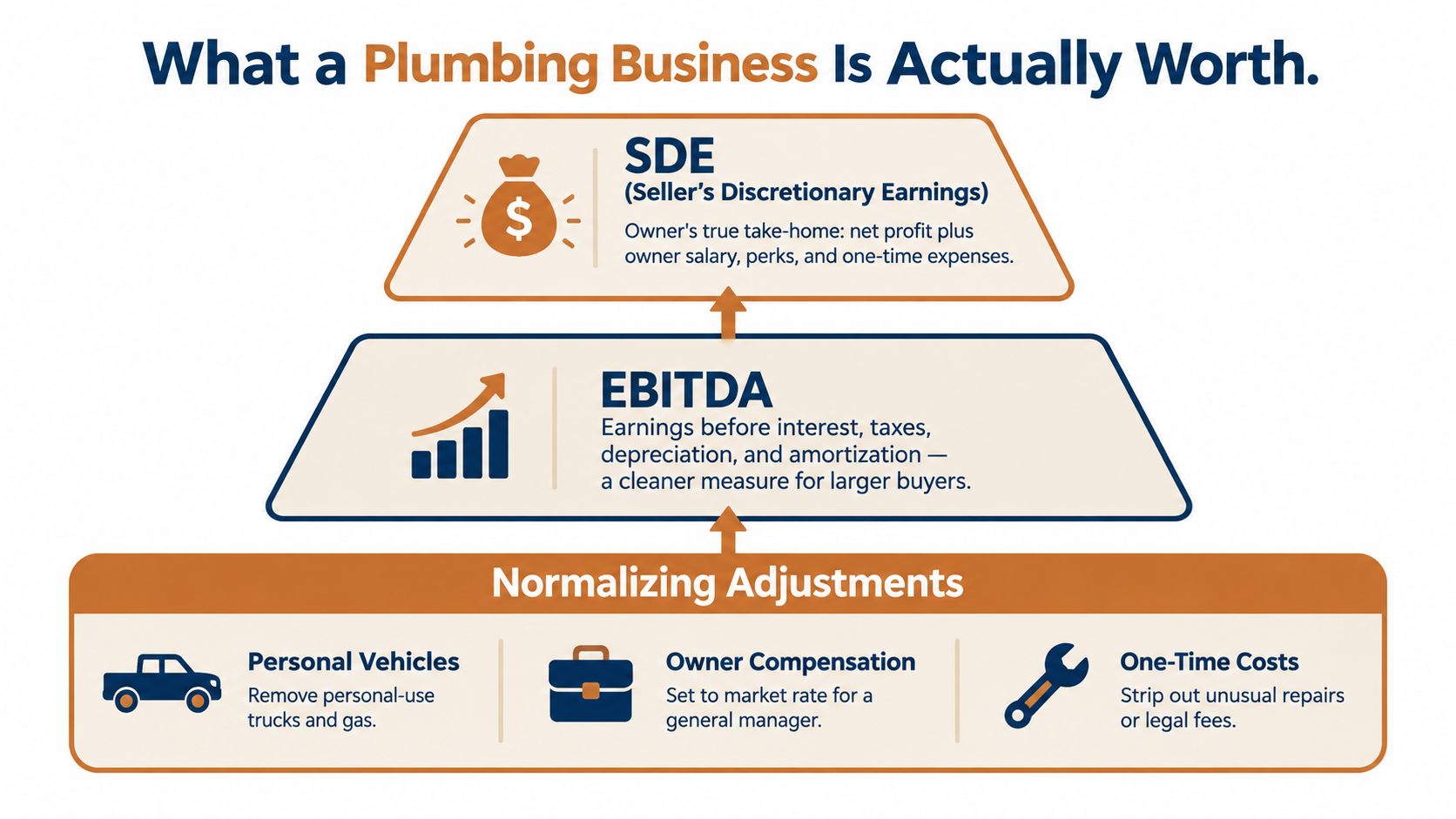
Valuation starts with earnings, not with what the owner hopes to retire on. For plumbing companies around $1 million to $50 million in revenue, the market usually looks at normalized earnings, not raw revenue, and then applies a multiple that reflects how transferable the business is. For owner-operated companies, that usually means SDE, while larger, management-run companies are more often priced on adjusted EBITDA. Recent transaction benchmarks cited for plumbing businesses show owner-operated firms commonly pricing around 2.2x to 3.5x SDE, while larger service-led companies with meaningful management depth may transact around 4.0x to 7.5x adjusted EBITDA. Valuation multiples for plumbing businesses
The buyer is not paying for every expense line exactly as you ran it. They’re paying for the earnings power after you strip out noise. That means removing one-time costs, excess owner compensation, personal expenses, unusual legal bills, and related-party payments that don’t reflect normal operations.
Do that work with support, not guesses. Tax returns, bank statements, general ledger detail, and job-costing reports need to line up. If an add-back doesn’t have a record, a buyer will likely push back hard.
Rule of thumb: the bigger the adjustment, the more evidence you need.
Take a plumbing company with $2.4 million in revenue and $720,000 of reported profit. If legitimate add-backs bring normalized earnings to $590,000 SDE, the valuation math gets straightforward.
| Company Profile | Earnings Basis | Typical Multiple Range | What Drives the Number |
|---|---|---|---|
| Smaller owner-operated plumbing company | SDE | 2.5x to 3.5x | Owner dependence, recurring service work, and customer spread |
| Better-run service shop with management depth | SDE | Higher end of SDE range | Documentation, retention, and stable field leadership |
| Larger management-run platform | Adjusted EBITDA | 4.0x to 7.5x | Systems, bench strength, and less owner reliance |
At 2.5x, that example business is roughly worth $1.475 million. At 3.0x, it’s about $1.77 million. At 3.5x, it lands near $2.065 million.
The reason buyers care so much about the add-backs is obvious. Supported adjustments create real value. Unsupported ones create friction, delay, and a lower offer. Buyers also separate revenue by type, because residential service, commercial service, installation, and new construction don’t carry the same risk profile. The cleaner that split is, the easier it is to defend the number.
For a deeper framework on the valuation process itself, owners can compare methods in plumbing business valuation.
The buyer type shapes the deal almost as much as the multiple. A strategic platform, a private-equity-backed roll-up, a competitor, and an internal successor all see your company differently. They don’t value the same things, and they definitely don’t tolerate the same weaknesses.
Strategic buyers are usually the regional or national plumbing and HVAC platforms. They pay for fit, density, and an existing service base that strengthens their footprint. If your business expands their geography, deepens their recurring work, or gives them technicians they trust, they’ll pay attention.
What they won’t pay much for is personality-dependent goodwill. If the owner still runs the whole relationship map, the strategic buyer knows they’re inheriting risk, not just customers. That usually means more diligence, more conditions, and a harder conversation around transition.
Private-equity-backed buyers care about whether the business can become part of a larger platform. They want a management bench, recurring revenue, and room to grow. They’re less interested in whether the owner is beloved by every customer and more interested in whether the company can be integrated and expanded.
The broader market has shifted, but not in a simple upward line. A 2025 commercial HVAC and plumbing report says strategic buyers represented 49.4% of tracked buyers year-to-date, down from 67.1% in 2024, while private-equity add-on activity rose 88.2% year over year, and median enterprise-value-to-EBITDA multiples fell from 16.6x in Q4 2024 to 12.6x in Q1 2025. Commercial HVAC and plumbing industry report
That’s the part sellers miss. More sponsor interest doesn’t guarantee higher prices.
An internal buyer, whether it’s a GM, a technician, or a family member, usually pays for continuity and a path to ownership. A direct competitor pays for market share, crew quality, and an easier growth route than building from scratch. In both cases, the company has to feel survivable after you’re gone.
That’s why a lower headline price can still be the better outcome for some owners. If you care about staff continuity, customer relationships, or family control, the highest bid isn’t automatically the smartest one.
The question is not who can write the biggest number. It’s who can carry the business forward without breaking what you built.
A lot of owners pick a broker the way they’d pick a service contractor, by name recognition and a quick gut check. That’s backwards. For a plumbing company, industry-specific deal experience matters more than a shiny brand.
Interview three brokers and ask them what they’ve sold that looks like your business. Not “have you sold businesses before,” but “have you sold a plumbing company with my size, my customer mix, and my level of owner involvement.” Then ask how they handled confidentiality, buyer screening, and lender questions.
A serious broker should be able to explain how they package the deal, who they call first, and how they avoid wasting your time with tire-kickers. They should also tell you what buyers in this niche always challenge, because those objections come up again and again.
If you want a broader checklist for screening advisors, questions to ask a business broker is a useful place to start.
The engagement letter should cover the basics clearly. You want fee structure, exclusivity period, confidentiality obligations, and who controls buyer communications. If the broker is vague on process, assume the process will be vague too.
A good process uses blind teaser materials, coded company names, staged release of financials, and pre-qualification before management meetings. The whole point is to protect the business while still moving serious buyers forward. If your broker thinks confidentiality means “just don’t tell your employees,” keep looking.
A good broker runs a process. They don’t just post a listing and wait. They pre-screen buyers, help organize the data room, manage follow-up, and keep the owner from saying too much too early in management meetings.
For owners who are also considering a succession or exit-planning advisor, there are SaaS exit consultant options that illustrate the broader point, which is that the right advisor depends on the transaction, not the logo on the website.
If the broker doesn’t understand lenders, confidentiality, and buyer psychology, you’ll spend the sale fixing their mistakes.
Don’t use a broker for every situation. Very small sales and clean internal transitions can sometimes be handled with lighter advice. But if your plumbing business has real staff, real revenue, and real transition risk, you want someone who has done this before.
Headline price gets people excited. Net proceeds are what matter. Two offers can both say $4 million, and one can leave you much richer than the other depending on how the money is structured, when it’s paid, and what has to happen before you see the last dollar.
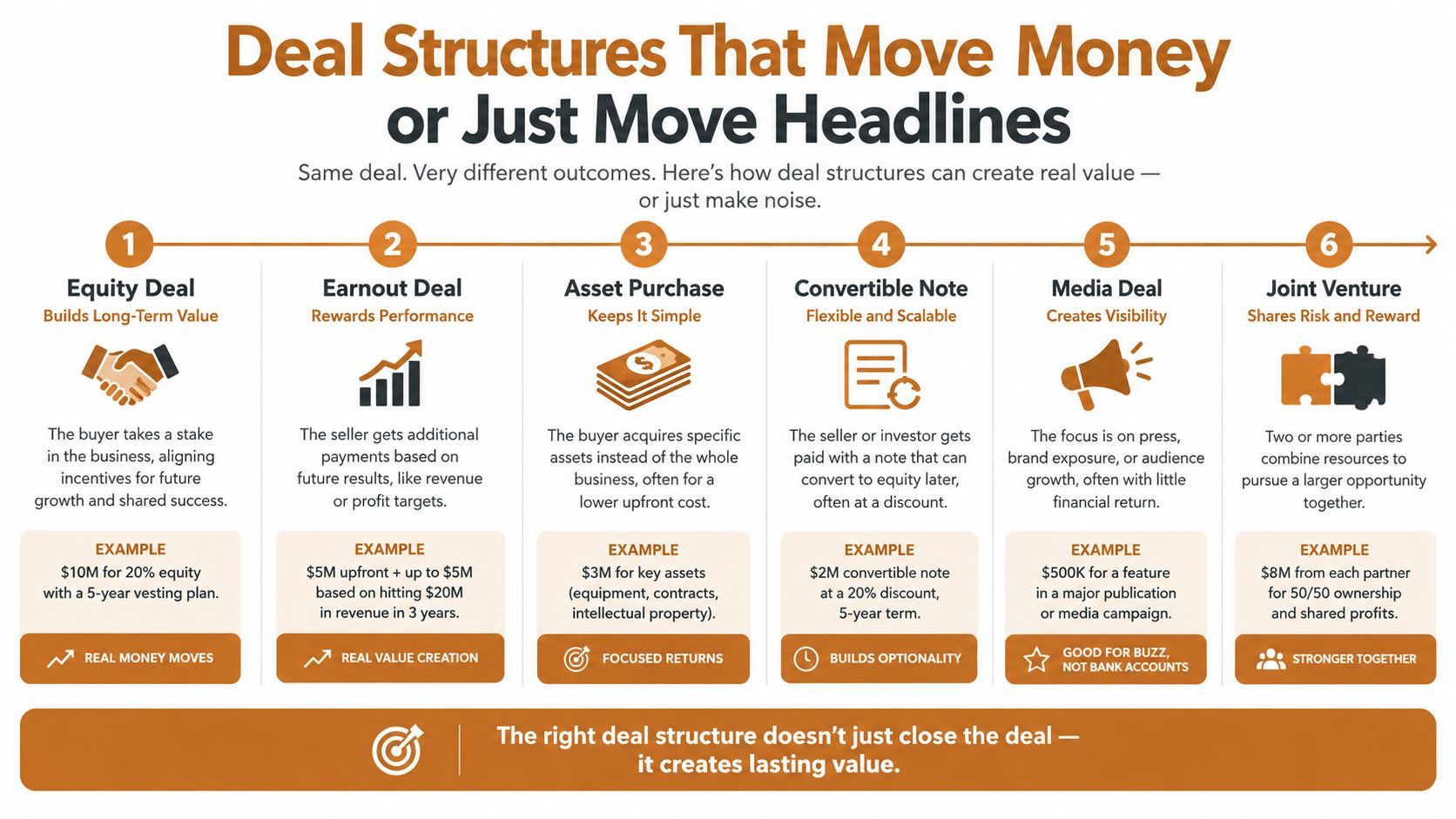
Cash at close is obvious. Senior debt is usually the lender piece. Seller financing turns part of the sale price into credit risk. Earnouts tie some of the price to future performance. Rollover equity keeps you invested in the buyer’s next chapter. Working-capital adjustments can push the final number up or down after closing.
Seller financing deserves special attention. Buyer-market data indicates 78% of surveyed buyers expect to use SBA financing, while 90% expect seller financing to be part of the acquisition strategy, but only 29% of owners plan to offer it. A reported analysis of more than 10,000 transactions found that businesses involving seller financing sold for 20% to 30% more than all-cash transactions, although that kind of comparison can reflect deal mix as much as price uplift. BizBuySell Insight Report
Suppose two buyers both headline $4 million. One pays mostly cash with clean terms and a short transition. The other leans on a seller note, an earnout tied to revenue definitions you don’t fully control, and rollover equity in a platform you can’t steer. Those are not the same deal.
The first one gives you certainty. The second one gives you more moving parts and more ways to lose value later. That’s why the term sheet has to be read line by line, not skimmed for the top-line number.
Practical rule: negotiate the structure before you negotiate the victory lap.
Seller notes can improve the appearance of value, but they also create collection risk. Earnouts can reward performance, but they can be defined in ways that the buyer controls after closing. Rollover equity can work well, but only if you’re comfortable staying tied to the platform and its future sale.
If you’re comparing offers, rank them by risk-adjusted value, not by the biggest font on page one.
The tax and legal side should start early, because deal structure changes tax outcome. Ask your CPA and transaction attorney about asset sale versus stock sale treatment, installment sale reporting, and state tax issues before you sign anything. If you’re in California or have succession questions tied to family ownership, California family business succession help is the kind of legal resource owners typically use when the sale is also a transition problem.
Months 1 to 3. Clean up the books, reconcile add-backs, separate plumbing revenue from any other trade activity, and build a credible earnings bridge. Pull together three years of financials, tax returns, service agreements, and key customer lists. This is also when you decide whether the business can be sold as it sits or whether it needs more operating discipline first.
Months 4 to 6. Interview brokers or advisors, sign the engagement letter, and prepare marketing materials. Tighten systems, shore up licenses and insurance, and coach the office team on confidentiality. If management can’t run a meeting without you, fix that now.
Months 7 to 9. Launch the process, screen buyers, and hold management meetings only with serious parties. Push hard on buyer quality, debt capacity, and proof of funds. If a buyer can’t explain how they’ll finance the deal, they’re not a buyer, they’re a distraction.
Months 10 to 12. Move through diligence, negotiate the purchase agreement, and plan the transition. Decide in advance how long you’ll stay, what authority you’ll keep, and how customers and employees will hear about the sale.
The first 90 days after closing should be about continuity. Keep key people in place, protect customer relationships, and stay disciplined about your non-compete and handoff obligations. If the business runs smoothly without you and the buyer doesn’t call you every day to fix things, that’s success.
The Owner’s Shortlist helps owners of established service businesses sort through brokers, valuation questions, taxes, and succession decisions in plain language. If you’re trying to sell your plumbing business and want a quieter, more practical way to compare options, visit The Owner’s Shortlist and start with the resources that fit your situation.
Tell us your situation. We'll connect you with a specialist who works with owners like you. One conversation, no sales pressure.
Found this useful?
Add The Owner's Shortlist as a preferred source and get our articles highlighted in Google Search results.
Add to Preferred SourcesLearn how to sell your service business with a practical, step-by-step roadmap. From readiness and valuation to deal structure and closing, get actionable
October 14, 2026
Learn how business valuation EBITDA works for service companies. Discover adjustments, multiples, and owner-dependency tests before you sell.
October 12, 2026
Thinking 'I want to sell my landscaping business'? Learn how to value your company, prepare financials, handle labor risks, and find the right buyer quietly.
October 11, 2026
Sell My HVAC Business. Thinking about selling your HVAC business? Learn how owners prepare, value, negotiate, and close a sale
October 9, 2026