Family Succession Planning for Business Owners
Learn how family succession planning works, compare transfer options, manage family conflict, prepare for taxes, and build a practical transition timeline.
October 21, 2026
By Remi Taffin · October 20, 2026

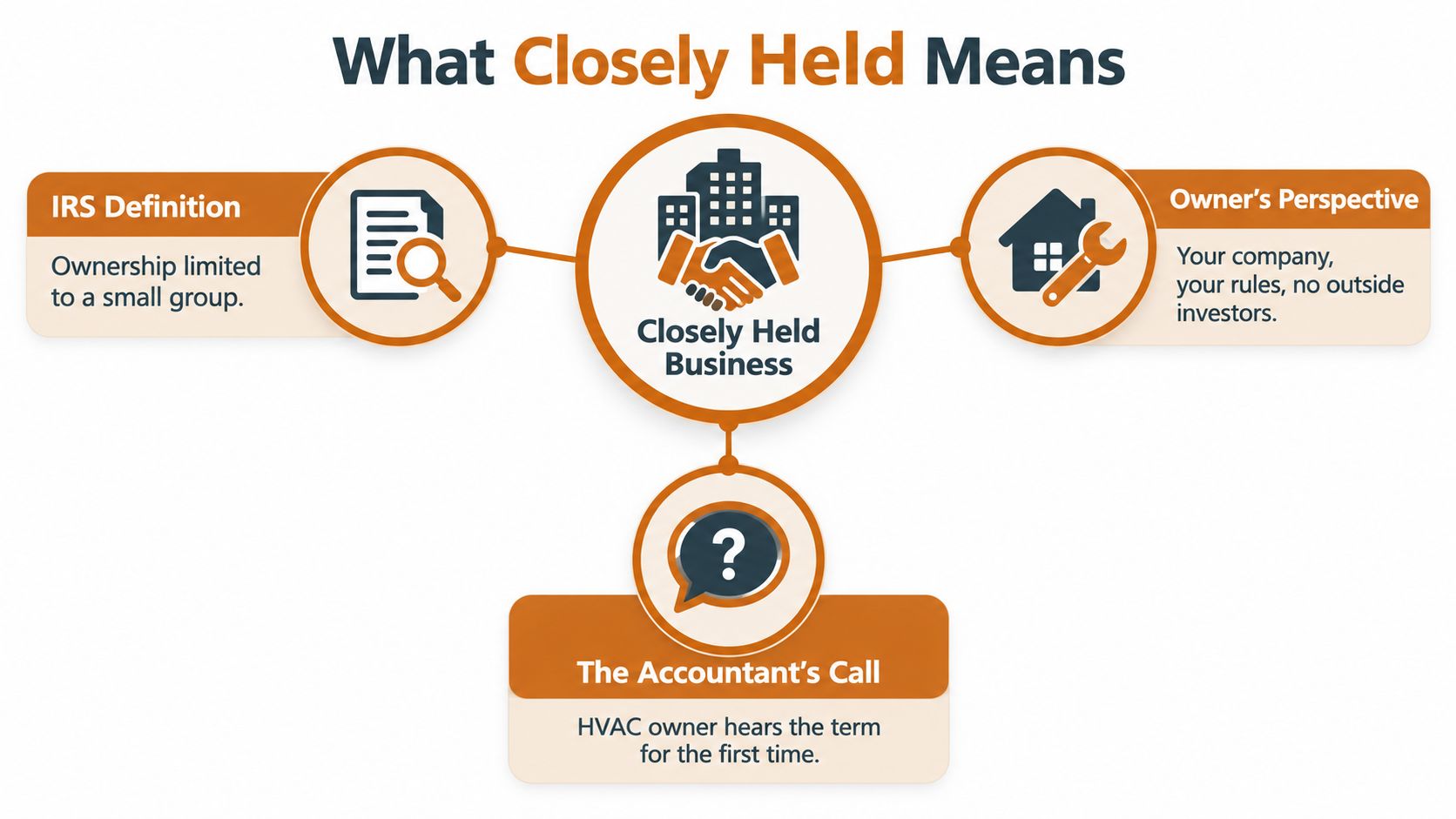
Under the IRS ownership test, a closely held corporation is one in which five or fewer individuals own more than 50% of the value of its outstanding stock during the last half of the tax year. In everyday terms, a small group owns most of the business, often works in it, and must figure out together what it’s worth and how to pass it on or move on.
An HVAC owner might hear the phrase from an accountant and assume it means the company is small. It doesn’t. The label is about who owns the corporation, not how large it is, what it sells, or how long it’s been in business. And because a few people hold much of the ownership, decisions about value, taxes, daily control, and succession can quickly become personal.
The IRS definition gives owners a practical place to start. For federal tax purposes, a closely held corporation is one where more than half the value of the outstanding stock belongs, directly or indirectly, to five or fewer individuals at some point during the last half of the tax year. The rule excludes personal service corporations. The IRS’s closely held corporation definition and tax guidance makes clear that this is an ownership test, not a measure of sales, staffing, industry, or age.
Say an HVAC owner has run a company for years with a longtime partner. If their ownership arrangement meets the IRS test, the business may be closely held whether it serves a local area or has grown into a much larger operation. The owners could be family members, unrelated partners, or a small group of investors. The label doesn’t tell you whether the company is thriving, struggling, or well known.
Why does that ownership test matter beyond the tax return? When a few people own most of the value, their relationships and decisions can shape the company’s future. One owner’s retirement, illness, disagreement, or desire to sell may affect the whole business. The owners may need to agree on how to value shares, who can receive them, and who will lead the company next.
The tax label doesn’t answer all of those questions. It does, however, flag that ownership is concentrated enough for owner-level decisions to matter. So when you ask, “What is a closely held business?” the plain-language answer is a corporation whose ownership is concentrated among a small number of people, with consequences that can reach into tax planning, governance, and exit decisions.
A family-run HVAC shop can make the structure easier to see. The family owns the company, its shares aren’t listed on a public exchange, and the owners help run the work. Those traits often travel together, though the IRS test itself is specifically about stock ownership and value.
The first ingredient is concentrated ownership. A few people hold most of the company’s economic value, and they may also hold most of the voting power. That can make a decision feel simple when the owners agree. If they don’t, even a routine question about hiring, spending, or expansion can turn into a dispute about who gets to decide.
The second is limited share liquidity. Owners generally can’t sell shares through a public market as though they were shares in a publicly traded company. A transfer may be limited by company documents or require approval. An owner who wants out therefore needs a buyer, a plan for transferring shares, or an agreement with the other owners.
The third is owner involvement in management. In many closely held businesses, owners also supervise crews, meet customers, estimate jobs, or manage the books. That overlap can make the company nimble, but it can also make a clean transition harder. A buyer or successor may be acquiring more than equipment and contracts. They may also need to replace the owner’s relationships and know-how.
Practical rule: Treat ownership, management, and employment as related but separate questions. Someone can own shares without running the company, and a capable manager doesn’t automatically own part of it.
Together, these ingredients help explain why an owner’s exit can affect both the company’s control and its operations. A succession plan needs to address who will own the business and who will keep it running, rather than assuming those roles will pass to the same person.
These labels describe different things. Closely held refers to a particular ownership test for a corporation under federal tax rules. Family business describes a relationship among owners or participants. Private generally means shares aren’t publicly traded, while small usually refers to a size standard used for a specific purpose. Publicly traded describes shares available for trading in public securities markets.
| Type | Defining test | Typical size | Liquidity | Typical owner role |
|---|---|---|---|---|
| Closely held | Ownership meets the IRS test for a corporation | Any size | Shares generally lack a public market | Owners may also manage the company |
| Family business | Family ownership or participation, depending on the definition used | Any size | Varies by structure | Family members may own, manage, or both |
| Private company | Shares aren’t publicly traded | Any size | Transfers may be limited | Owners may or may not manage |
| Small business | Meets a size standard relevant to the particular program or context | Small under that standard | Varies by structure | Owners often take an active role |
| Publicly traded company | Shares trade in public securities markets | Any size | Public trading is available | Owners commonly have varying levels of involvement |
The categories can overlap. A privately owned company may also be closely held, and a small contractor may meet the closely held test. But private doesn’t automatically mean closely held: a private company may have many owners. Likewise, being small doesn’t establish who owns its shares.
Family ownership is another separate question. A closely held corporation can belong to unrelated partners. A family company can have an ownership structure that doesn’t meet the IRS test, depending on how many people own it and how the stock value is distributed. Researchers also use different definitions of family business, so family ownership and the IRS closely held designation shouldn’t be treated as interchangeable categories.
When someone uses one of these labels, ask what they mean in that conversation. They could be talking about tax treatment, share transfers, eligibility for a program, or family relationships. The word alone won’t answer all of those questions.
If an owner wants to sell part of a plumbing company, there’s no public trading price to check. A closely held business’s value has to be supported by company-specific evidence, not assumed from its book equity or from a multiple someone saw applied to a public company.
Consider a plumbing business with a mix of service calls, replacement work, and ongoing customer relationships. Book value reflects accounting records for assets and liabilities, but it won’t by itself capture how reliably the company earns cash or whether customers will stay after the owner steps away. A revenue-based comparison may overlook the cost of earning that revenue. An earnings-based approach may depend on which owner expenses or compensation a buyer considers part of normal operations. Different methods can therefore produce different indications of value.
A valuation conversation should dig into the details: cash flow, owner compensation, customer concentration, recurring service work, equipment condition, liabilities, and how much the company depends on a particular owner. The buyer’s plans matter, too. A strategic buyer may see value in adding the company’s customers or crews to existing operations. A buyer who needs the current owner to keep relationships intact may assess the transition differently.

A minority share can also be worth something different from a controlling share in the same company. The minority owner may have limited voting power and no simple way to sell. Ownership percentage alone doesn’t tell the whole value story when rights and marketability differ. Cornell’s legal overview of closely held corporations discusses transfer restrictions and the practical importance of shareholder rights in this setting.
For an owner preparing to explore a sale, the business valuation guide can help frame the questions to take to a qualified valuation professional. The useful result isn’t just a number. It’s an understanding of what supports that number, what could weaken it, and what might change if the owner steps back.
A closely held company needs clear rules for decisions and ownership transfers. When the same people own the shares, manage the work, and depend on company income, an informal understanding can seem adequate until an owner wants to leave or the partners disagree.
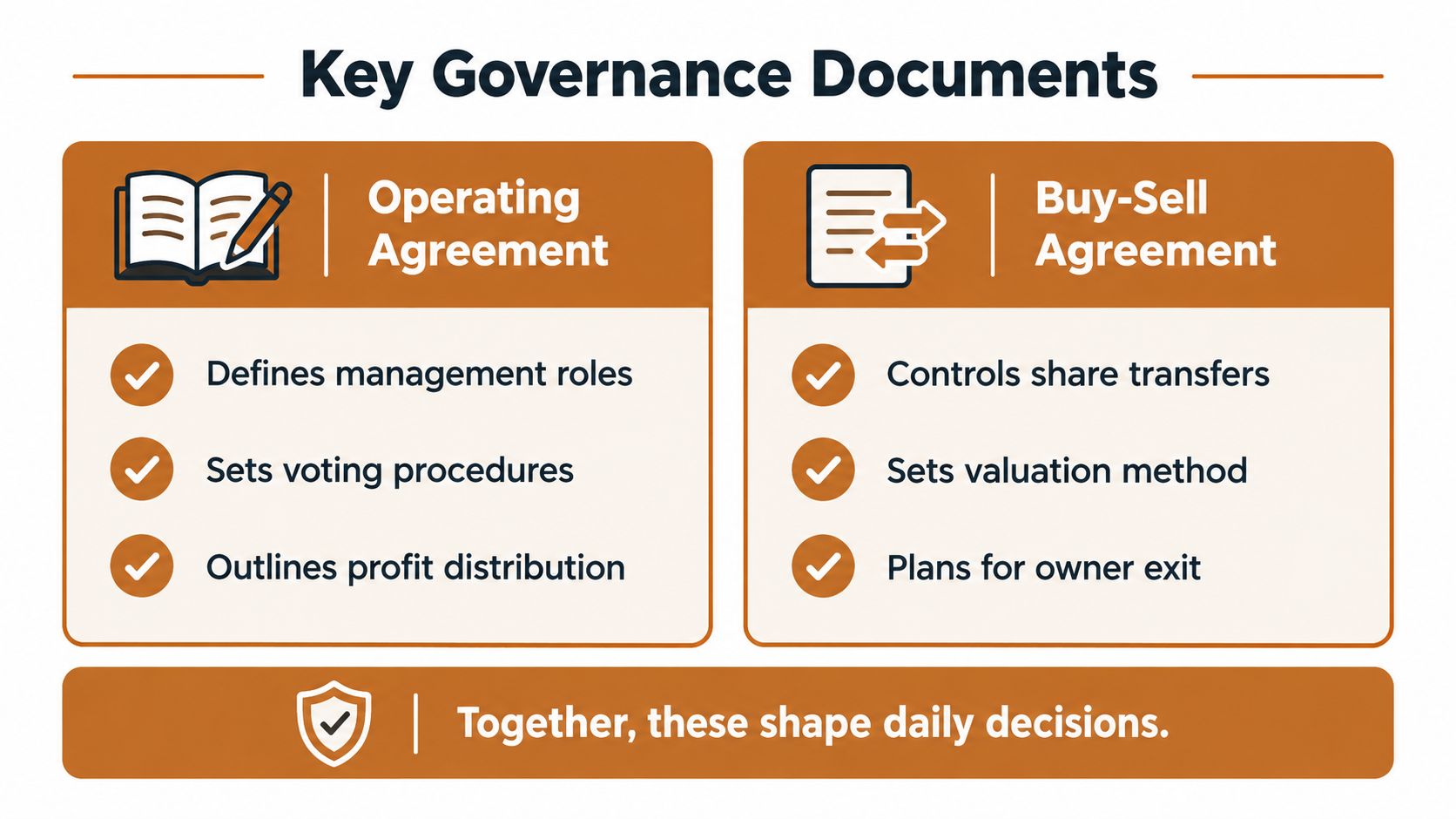
An operating agreement or bylaws, depending on the entity, can set out how the business makes decisions. A buy-sell agreement can establish what happens to an owner’s shares after death, disability, departure, or another specified event. These documents should fit together. If one promises a transfer that the other restricts, the owners may have a dispute exactly when they need a clear process.
Owners should settle practical questions while they can still discuss them calmly:
A minority owner isn’t automatically powerless. Shareholders may have rights that affect the corporation, and conflicts can lead to individual claims. That’s one reason majority owners shouldn’t assume that control means they can ignore the interests or legal rights of other shareholders.
For a contractor, the documents should reflect how the company operates. If one partner handles estimating and customer relationships while another manages crews and purchasing, say who can make which decisions and what happens if one steps away. Write the rules before a health crisis, family disagreement, or urgent offer forces the conversation.
The IRS closely held designation is a tax classification with specific consequences for corporations. It does not, by itself, decide every tax question for every privately owned business. The entity’s legal structure and tax elections still matter, so owners shouldn’t assume that the same rules apply just because their company has a small ownership group.
The IRS notes additional limitations for closely held corporations involving passive-activity losses, at-risk rules, and compensation paid to corporate officers. In practice, owners may need to distinguish between income or losses tied to active work and those connected to a passive investment. Whether a loss can be used, and when, depends on applicable rules and the owner’s circumstances. A working owner and a passive investor shouldn’t assume their tax results will match.
Compensation deserves careful attention as well. An owner who works in the business and receives corporate pay needs to understand how the company’s structure treats that compensation. Owners considering an S corporation election, operating as a C corporation, or using an LLC taxed as a partnership should compare the consequences with a tax professional. Entity choice can affect how income is reported and how a later transfer or sale is handled.
Bring this question to your CPA: Which rules apply because of our tax classification, and which apply because of our entity type and individual roles?
A company’s tax label isn’t a substitute for reviewing its operating and ownership documents. Nor does it tell an owner exactly how much tax a sale or transfer will trigger. The right next step is to review the company’s election and tax treatment with a CPA who understands the owners’ roles and plans. The business tax-planning resource can help an owner organize topics for that conversation.
An owner doesn’t have to choose between handing the whole company to a child and selling it outright. A transition can change ownership and management at different times. That distinction matters when a family member is ready to lead but can’t afford to buy the shares, or when an owner wants to reduce daily responsibilities without giving up all control at once.
Family-business research points to several possibilities beyond a simple handoff. PwC reports that 44% of U.S. family firms reported succession-related impacts on their business during the prior year, compared with 34% globally. The same PwC family-business survey reports that 26% of family businesses globally expected to seek outside investment within three to five years, 19% planned to increase nonfamily ownership, and 3% anticipated an outright sale. These figures describe family businesses under the survey’s definitions, not every closely held company.
Owners can compare four broad routes:
The best route depends on what the owner needs most: control, cash, fairness among family or partners, continuity, or a timely transition. Existing buy-sell terms may already limit some choices, so review those documents before negotiating a deal. For guidance on transferring ownership within a company, start by identifying whether you’re planning a change in leadership, ownership, or both.
You don’t need to decide today whether to sell or pass the business to family. You do need enough information to keep that decision from being made for you by a crisis, a partner dispute, or a potential buyer’s deadline.
Start with the company’s structure. Confirm what entity owns the business, how it’s taxed, and who owns each share or membership interest. If the records don’t match what the owners believe they agreed to, resolve that discrepancy with the company’s attorney and CPA.
Next, review the operating documents and any buy-sell agreement. Check whether they explain who can receive shares, how an exit is valued and funded, and how owners resolve a deadlock. If there’s no workable agreement, ask counsel what the company needs.
Then get a baseline valuation or a well-supported estimate. The purpose isn’t to lock in a future sale price. It’s to understand which parts of the business support its value and where the company depends too heavily on one person.
Finally, discuss the likely transition route with a small professional team. A CPA can help assess tax questions, an attorney can review ownership and transfer documents, and a qualified broker or advisor can help evaluate a sale or other transaction. Choose professionals based on the path you’re considering, and share confidential information only when you’re comfortable with the process.
Preparation gives you choices. A calm conversation now is easier than sorting out ownership, compensation, and family expectations while the business is under pressure. Write down the questions you need answered, then arrange a meeting with the right advisors to begin.
The Owner’s Shortlist offers a free, plain-language resource library and a person-to-person matching service for owners exploring business value, taxes, succession, or a sale. If you’re considering what comes next for your closely held business, visit The Owner’s Shortlist to learn about its resources and ask about a specialist introduction.
Tell us your situation. We'll connect you with a specialist who works with owners like you. One conversation, no sales pressure.
Found this useful?
Add The Owner's Shortlist as a preferred source and get our articles highlighted in Google Search results.
Add to Preferred SourcesLearn how family succession planning works, compare transfer options, manage family conflict, prepare for taxes, and build a practical transition timeline.
October 21, 2026
A practical guide to family business governance covering boards, family councils, succession policies, owner agreements, and conflict prevention.
October 18, 2026
Navigate family inheritance law for your business. Learn how to structure succession, avoid family disputes, and protect your company's future value.
September 25, 2026
Learn how succession of business works, from choosing a pathway to timing the handoff. A clear guide for owners planning their next chapter.
September 20, 2026