Family Succession Planning for Business Owners
Learn how family succession planning works, compare transfer options, manage family conflict, prepare for taxes, and build a practical transition timeline.
October 21, 2026
By Remi Taffin · October 18, 2026
Your daughter runs dispatch and wants authority to hire. Your son owns shares but doesn’t work in the business, and he wants a larger distribution. You still approve every important decision, but your spouse is asking what happens if you can’t come into work tomorrow.
Nobody is necessarily being unreasonable. The problem is that you’re answering questions about employment, ownership, and leadership through personal conversations rather than agreed rules. Family business governance means installing habits that let people make those decisions without renegotiating their family relationships each time.
A co-owner dies, and the surviving owners discover they never agreed who can authorize payments. A successor asks for a raise, and the conversation becomes an argument about fairness between siblings. Until that moment, informal arrangements seemed efficient because the founder could settle almost everything.
While the business is healthy, writing down authority can feel unnecessary. But trusting someone doesn’t tell you whether they can borrow money, remove a manager, or commit the company to a new location. Trust and clarity solve different problems.
Ask where people currently need your personal intervention. Look for decisions that stall when you’re unavailable, promises made privately to relatives, and financial information that only you understand.
Then assign each recurring decision an owner, an approval route, and a record. For help connecting those responsibilities to operating priorities, The OKR Hub’s governance frameworks for strategy execution is a useful companion resource.
The urgency isn’t theoretical. In Deloitte’s global family-business succession research, 40% of respondents were undergoing leadership succession or expected it within the following 10 years; 82% had some form of succession plan, but only 46% described it as broad and well developed. That distinction matters: intending to hand over the business doesn’t establish how authority will move.
Practical rule: Install the decision process while everyone can still afford to disagree calmly.
Governance also asks something of the founder. Once you delegate a decision, you can’t reverse it privately whenever the result isn’t your preference. Retain clearly defined emergency powers, but don’t treat every uncomfortable choice as an emergency.
The trade-off is less personal freedom in exchange for a business that doesn’t depend on your constant availability.
Your child asking for a job and your child asking for an ownership vote are making different requests. Discussing both at Sunday dinner invites everyone to use family standing as evidence of business authority.
Separate the conversations into ownership, family, and business execution. The same people may attend several forums, but they should know which role they’re exercising.
This diagram provides a starting point for separating those roles.
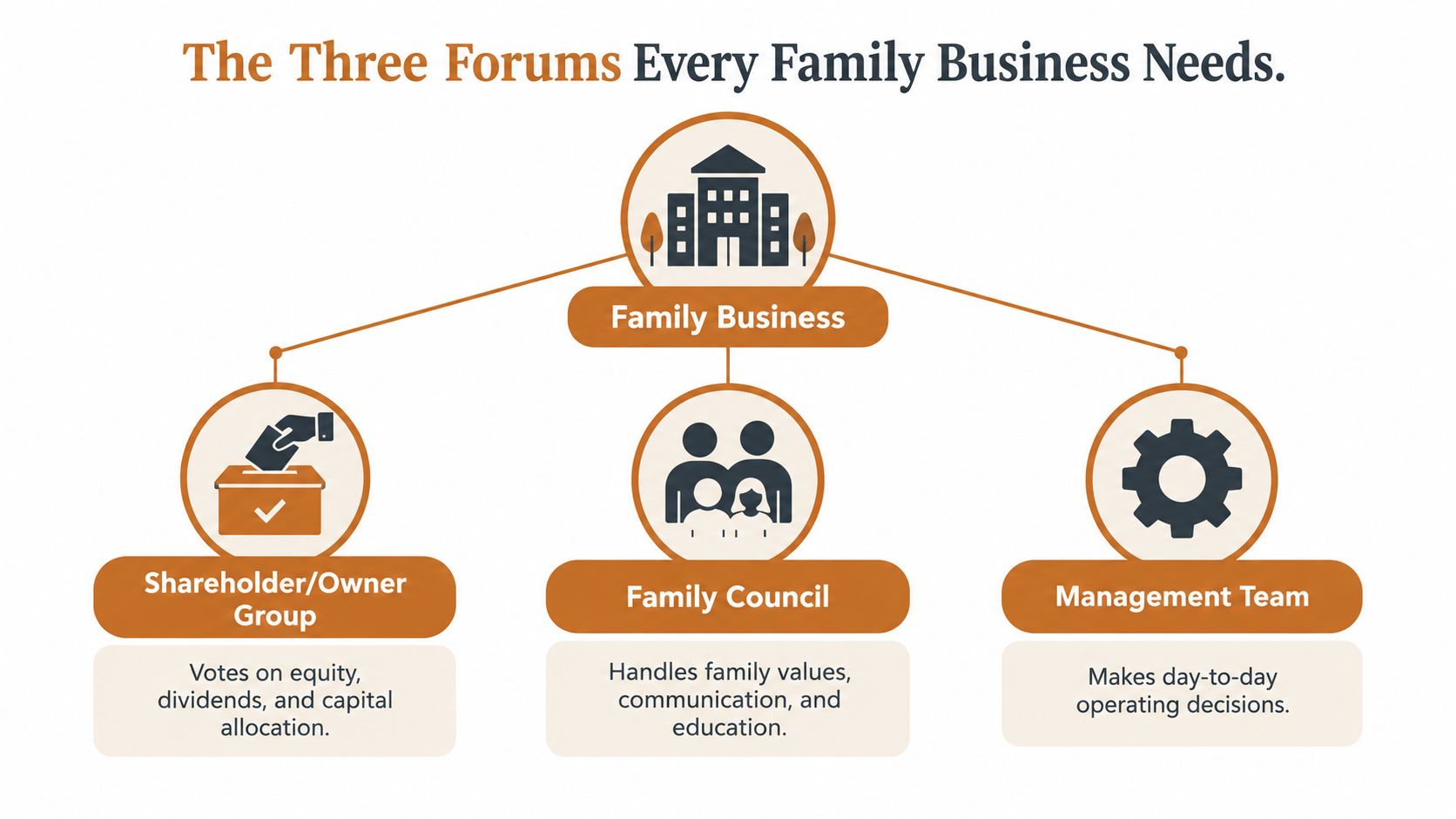
| Forum | Question it should answer | Boundary to preserve |
|---|---|---|
| Shareholder or owner group | What rights and economic expectations attach to ownership? | Owning shares doesn’t automatically confer operating authority. |
| Family council or structured family meeting | What commitments do relatives make to one another around the business? | Family membership doesn’t guarantee employment. |
| Business governance and management | What should the company do, and who executes it? | Managers shouldn’t negotiate ownership rights through workplace decisions. |
Within the business forum, distinguish board oversight from management execution. The board challenges strategy and evaluates leadership; management schedules crews, serves customers, supervises employees, and delivers the agreed operating plan.
Consider a hypothetical roofing company whose founder’s daughter wants to supervise estimators. The family forum can discuss eligibility and expectations, but management should assess whether she meets the role requirements. If she also holds shares, her ownership rights remain separate from the hiring decision.
A non-working owner should receive agreed ownership information without directing technicians or bypassing the general manager. An experienced non-family manager should have operating authority without being drawn into arguments about which sibling deserves an inheritance.
Separating the forums doesn’t mean keeping relatives apart. It means sending their requests to a place where someone has authority to answer them.
Use agendas to make the distinction visible. If an owner meeting drifts into a dispute about an employee’s schedule, move that issue to management rather than letting the loudest shareholder settle it.
A family council helps relatives agree how they relate to the business. A board holds business leadership accountable. Combining those purposes in an unstructured meeting makes it difficult to address either well: sensitive family expectations compete with discussions about cash, risk, and performance.
The distinction is especially important when the founder is simultaneously parent, controlling owner, and CEO. Each role creates different responsibilities.
The comparison below highlights the different purposes, although formal legal authority depends on the company’s structure and governing documents.
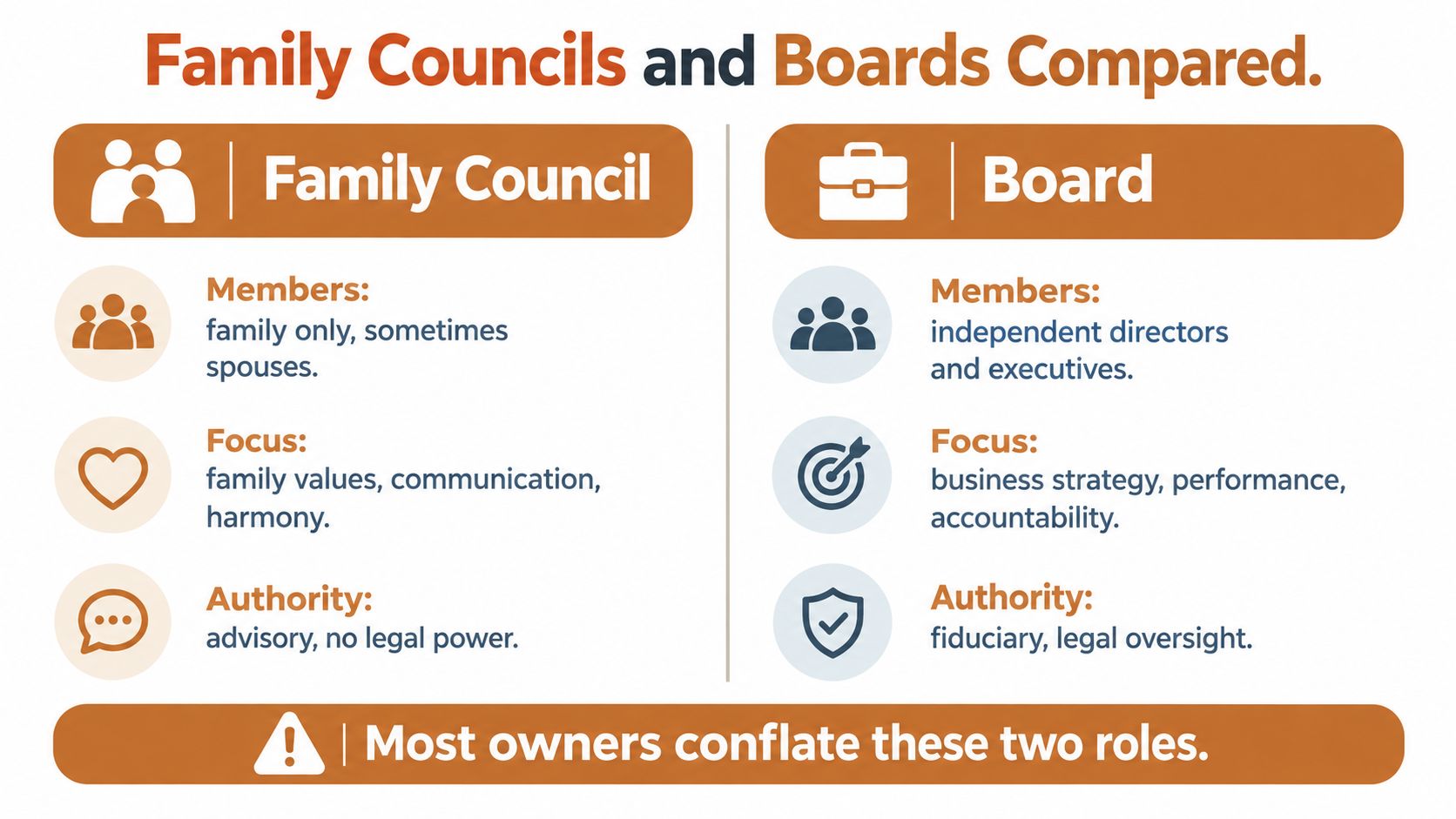
| Dimension | Family Council | Board of Directors |
|---|---|---|
| Purpose | Family expectations, communication, and education | Business oversight and leadership accountability |
| Membership | Relatives, with an explicit policy on spouses and in-laws | Directors selected for relevant capability, including independent perspectives |
| Agenda | Values, family participation, philanthropy, and family protocols | Strategy, risk, capital allocation, CEO evaluation, and succession |
| Authority | Agreed family responsibilities; not automatically corporate decision-making power | Authority established by applicable law and company documents |
| Meeting discipline | Scheduled discussions with decisions and commitments recorded | Fixed calendar, advance materials, recorded minutes, and reserved matters |
| Output | Family commitments and recommendations | Decisions, challenges to management, and assigned follow-up |
Formal boards are associated with stronger performance, not guaranteed to cause it. The 2025 KPMG and STEP Project Global Family Business Report found a 10-percentage-point advantage in formal-board prevalence among high-performing businesses compared with the total sample.
In a hypothetical service company with a small leadership team, the family council might discuss whether spouses can apply for employment. The board would examine whether management applies the resulting policy consistently and whether related-party appointments create business risk.
The council needs a defined remit so it doesn’t become a complaint box. The board needs a route for understanding owner expectations so directors don’t mistake family concerns for interference.
A council representative can submit an agreed summary to the board. That summary should distinguish requests from decisions and avoid disclosing personal details unnecessarily.
An independent director isn’t a substitute parent or a referee for every disagreement. Select someone who can challenge the operating plan, understand financial trade-offs, and remain independent when a family member dislikes the answer.
You don’t need to imitate a public company. Start with a structure small enough to use during a busy season and strong enough to function when the owner is absent.
The minimum is a connected system: ownership rules, a family participation policy, an independent challenge function, reliable reporting, and a leadership-transition process. A folder of documents without meeting habits won’t accomplish that.
Use this checklist as a starting point, then size the arrangements to your business.
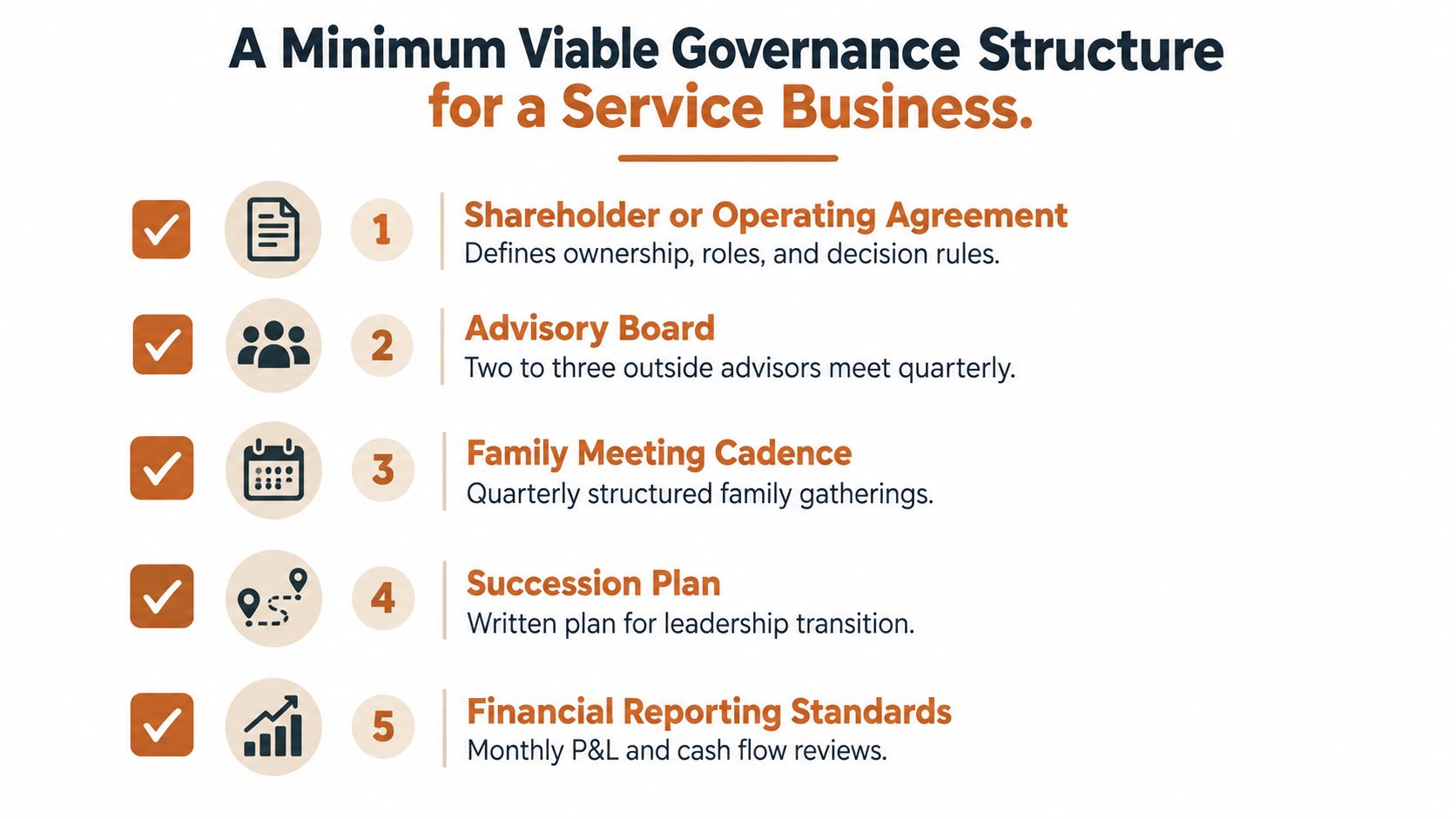
Hold an annual owner meeting to review ownership expectations and record decisions. Schedule structured family discussions separately, and use quarterly advisory-board meetings as a practical starting cadence rather than a claim that every company needs the same schedule.
Prepare a monthly financial and operating pack. Include the profit-and-loss statement, cash position, receivables, debt obligations, customer retention, gross margin, staffing issues, and significant safety concerns. Explain exceptions rather than sending unexplained spreadsheets.
An advisory board recommends; it doesn’t automatically possess a corporate board’s powers. State who has final approval so advice doesn’t get mistaken for authorization.
These decisions are reserved matters. Examples include selling the company, issuing ownership interests, borrowing beyond an agreed limit, making exceptional capital expenditures, and approving related-party employment decisions.
Choose thresholds from your cash position, financing obligations, and risk tolerance. A fleet replacement that fits comfortably within an approved budget shouldn’t require the same process as debt-funded expansion into an unfamiliar market.
For each reserved matter, identify the proposer, required information, approving body, and applicable voting rule. Keep routine operating decisions with management so governance doesn’t become another dispatch bottleneck.
The accompanying video can be used as a discussion prompt after you’ve drafted your own decision list.
Before closing any meeting, confirm what was decided and what remains open. At the next meeting, review completion before accepting new proposals. That’s the habit that turns oversight into something useful.
Naming a successor expresses an intention. It doesn’t demonstrate that the person can lead experienced technicians, challenge an optimistic estimate, or explain why the company can’t afford a distribution.
In PwC’s family-business survey material, leadership development affected 47% of family businesses. Treat development as operating work, not an occasional mentoring conversation.
Successor preparation should include direct examination of the company’s financial and operating decisions.

Give candidates trial roles with defined authority, baseline results, and review dates. Start with responsibility they can fully own, then expand it as their judgment becomes demonstrable.
| Readiness area | Evidence to examine |
|---|---|
| Customer leadership | Retention, complaint handling, and service-recovery decisions |
| Commercial judgment | Gross margin, estimating discipline, and explanations for exceptions |
| Financial control | Cash conversion, collections, and debt discipline |
| People leadership | Employee retention, credible feedback, and difficult performance conversations |
| Operating responsibility | Safety practices and follow-through on corrective actions |
| Governance judgment | Clear recommendations, disclosure of conflicts, and acceptance of challenge |
Use ready, developing, or not yet demonstrated rather than an arbitrary numerical score. Ask for examples supporting each assessment and assign development work where evidence is missing.
Outside employment can provide useful experience, but it shouldn’t become a symbolic requirement disconnected from the role. Decide which capabilities the candidate must gain and whether outside work is the most credible way to gain them.
Invite confidential feedback from non-family managers and have an independent reviewer test the founder’s assessment. Employees need a safe way to identify concerns without appearing disloyal to the family.
A person can remain a valued family member and responsible owner without becoming the CEO.
If the presumed successor isn’t ready, discuss the role requirements and evidence, not their worth as a child. Offer a revised development path, another business role, or an ownership-education pathway where appropriate.
Research on family protocols and succession planning supports institutionalizing preparation through formal rules and recurring family processes. The handover also needs a boundary for the outgoing founder: employees shouldn’t receive competing instructions after authority transfers.
For the ownership-transfer work alongside leadership development, consult the Blue Sage Tax & Accounting succession guide. Coordinate those questions with qualified advisers rather than assuming the employment timetable settles the tax and ownership timetable.
More meetings don’t necessarily produce clearer decisions. Relatives can discuss dividends repeatedly and still lack a rule for choosing between distributions and reinvestment.
The 2025 Pulse of Family Business survey reported that three-quarters of respondents had no formal dispute-resolution process. Communication creates an opportunity to be heard; it doesn’t determine who decides when people remain opposed.
A workable conflict process distinguishes ordinary disagreement, conflicts of interest, and genuine deadlock.
A supermajority requirement can protect owners on major decisions, but it doesn’t automatically break deadlock. It may make approval harder. Likewise, an independent director can cast a deciding vote only where the governing arrangements permit it.
Before emotions rise: Agree how a decision becomes final, not merely how everyone gets a turn to speak.
Owners who don’t work in the company need agreed information access and a route to raise concerns. They shouldn’t have to obtain updates through a sibling, and they shouldn’t convert ownership concerns into instructions to employees.
For dividend disputes, management should present cash needs and proposed reinvestment; the authorized decision-makers then apply the distribution policy. Compensation disputes belong in an employment review, not a comparison of siblings’ household expenses.
Ownership may also spread through death or estate arrangements. Review family inheritance law considerations with counsel before assuming future owners will share today’s expectations.
Don’t make every disagreement a buyout trigger. A forced purchase can strain company cash and create another valuation dispute. Reserve that mechanism for clearly defined circumstances, with mediation and other proportionate steps where suitable.
Good governance doesn’t eliminate conflict. It gives relatives a way to resolve it without threatening the business each time.
Written agreements matter when they capture decisions the family understands and will follow. Copying another company’s documents can produce impressive language without workable answers about authority, affordability, or employee treatment.
Ask your attorney to build a consistent set of agreements. The ownership documents, employment policy, and decision-rights matrix shouldn’t assign conflicting powers.
| Document | Practical provisions to resolve |
|---|---|
| Shareholder or operating agreement | Ownership rights, voting, information access, transfer restrictions, and amendment procedures |
| Buy-sell agreement | Triggering events, valuation method, payment terms, funding, and dispute procedures |
| Family employment policy | Eligibility, reporting relationships, compensation, reviews, discipline, and exit rules |
| Decision-rights matrix | Who recommends, approves, executes, and receives notice |
The buy-sell agreement should address death, disability, divorce, bankruptcy, voluntary departure, and other agreed triggers. Decide how value will be determined and when the methodology will be reviewed, rather than leaving the price to a future negotiation.
Funding deserves equal attention. Life insurance, a reserve fund, and seller financing are options to evaluate with advisers, not interchangeable solutions. Ask what the company can afford under adverse operating conditions and whether the intended purchaser can complete the purchase.
A plain-language explanation of what a buy-sell agreement does can help owners prepare the questions before meeting counsel.
Define the qualifications a relative needs before applying. Tie salary bands to the role and market responsibilities, not to ownership percentage or family seniority.
Specify who conducts performance reviews and who can terminate employment. Use the same standards applied to non-family employees, while making the approval route for sensitive family decisions explicit.
Documents won’t hold if the founder bypasses them. Research on independent directors in family firms identifies governance improvement and succession as principal purposes, while finding that directors underperform when owners lack commitment to an effective board or make major decisions privately outside it.
Treat exceptions as formal decisions requiring reasons and approval. Otherwise, relatives will reasonably conclude that the policy is whatever the founder decides that afternoon.
Use the coming year to establish a working routine, not to perfect every document before anyone meets.
Use a business succession planning checklist to track dependencies, while keeping planned leadership development several years ahead of an intended exit.
An attorney should address enforceability and ownership agreements. A governance facilitator can help relatives develop family protocols; a valuation specialist can test pricing assumptions; a mediator can handle disputes that participants can’t resolve themselves.
Use tax and financial advisers for transfer structure and funding decisions. This article isn’t legal, tax, or financial advice. Qualified specialists should help you design rules that fit the business and family, rather than forcing either into a template.
The Owner’s Shortlist offers plain-language resources on family transfers, business value, and stepping back, plus a free, human-reviewed specialist introduction service currently focused on Florida. Visit The Owner’s Shortlist to explore your options and request a private conversation about the next step for your business.
Tell us your situation. We'll connect you with a specialist who works with owners like you. One conversation, no sales pressure.
Found this useful?
Add The Owner's Shortlist as a preferred source and get our articles highlighted in Google Search results.
Add to Preferred SourcesLearn how family succession planning works, compare transfer options, manage family conflict, prepare for taxes, and build a practical transition timeline.
October 21, 2026
Learn what is a closely held business, how ownership works, and why taxes, valuation, and succession planning look different when a small group controls
October 20, 2026
Navigate family inheritance law for your business. Learn how to structure succession, avoid family disputes, and protect your company's future value.
September 25, 2026
Learn how succession of business works, from choosing a pathway to timing the handoff. A clear guide for owners planning their next chapter.
September 20, 2026