What Is a Closely Held Business and Why It Matters
Learn what is a closely held business, how ownership works, and why taxes, valuation, and succession planning look different when a small group controls
October 20, 2026
By Remi Taffin · October 21, 2026
An owner of a heating and cooling company may picture retirement as a simple handoff: one child takes the reins, customers keep calling, and the business carries on. But the child may not yet be ready to lead, the owner may not have decided who will own the company, and other relatives may expect a share of its value. Employees and customers still need to know who can make decisions on Monday morning.
Family succession planning works best when it tackles two connected transitions: who will run the business and who will own it. Those decisions affect each other, but they aren’t the same. Planning early gives a future leader time to build judgment while the current owner can still coach and correct. It also gives the family time to consider the business’s continuity, each relative’s expectations, and the owner’s life after stepping back.
A longtime plumbing contractor is thinking about retirement. One child works in the office and knows many customers; another has never worked in the business but assumes the family will divide its value fairly. The owner expects the first child to take over, while leaving open whether that means running the company, owning it, or both. The owner also has not settled a future role: available for advice, or still approving estimates and hiring.
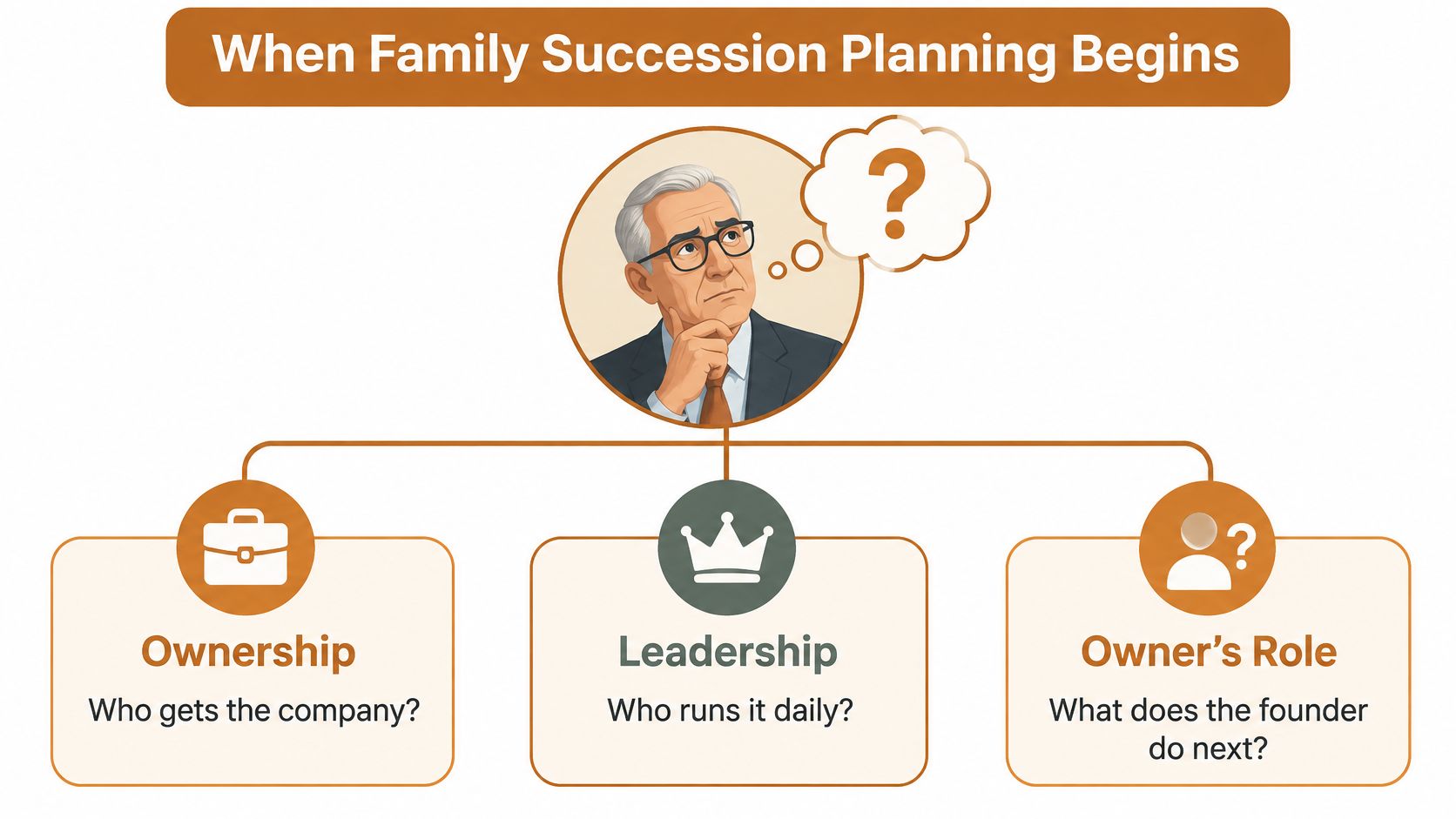
That uncertainty can spill into daily work. A technician may not know whose instructions to follow. A customer may keep calling the founder instead of the next leader. Relatives may read different meanings into the same promise: the child in the office expects authority to match responsibility, while siblings outside the company expect ownership to stay balanced.
Treat the moment as two linked transitions rather than one signature. Management authority covers who can price work, hire, fire, and sign checks. Ownership covers who holds value, votes major decisions, and absorbs risk. Readiness, family equity, liquidity for taxes or buyouts, and control during the handoff pull on each other, so solving one alone can create pressure somewhere else.
This is an operating decision and a family decision, with consequences for employees, customers, lenders, suppliers, and relatives. In Purdue University’s analysis of the 2012 Family Business Succession Survey, more than 55% of businesses expected a family transfer, yet 44% had not begun a management-transfer plan and 54% had not begun an ownership-transfer plan. Fewer than 20% had a written plan covering either transition, according to Purdue’s analysis of family-business succession.
The owner’s first move is to make open questions visible: who may lead, who may own, what the founder wants next, what other family members expect, and which obligations must be paid or guaranteed along the way. Owners in Georgia looking for a local perspective can review this resource on exit strategy planning for Georgia owners.
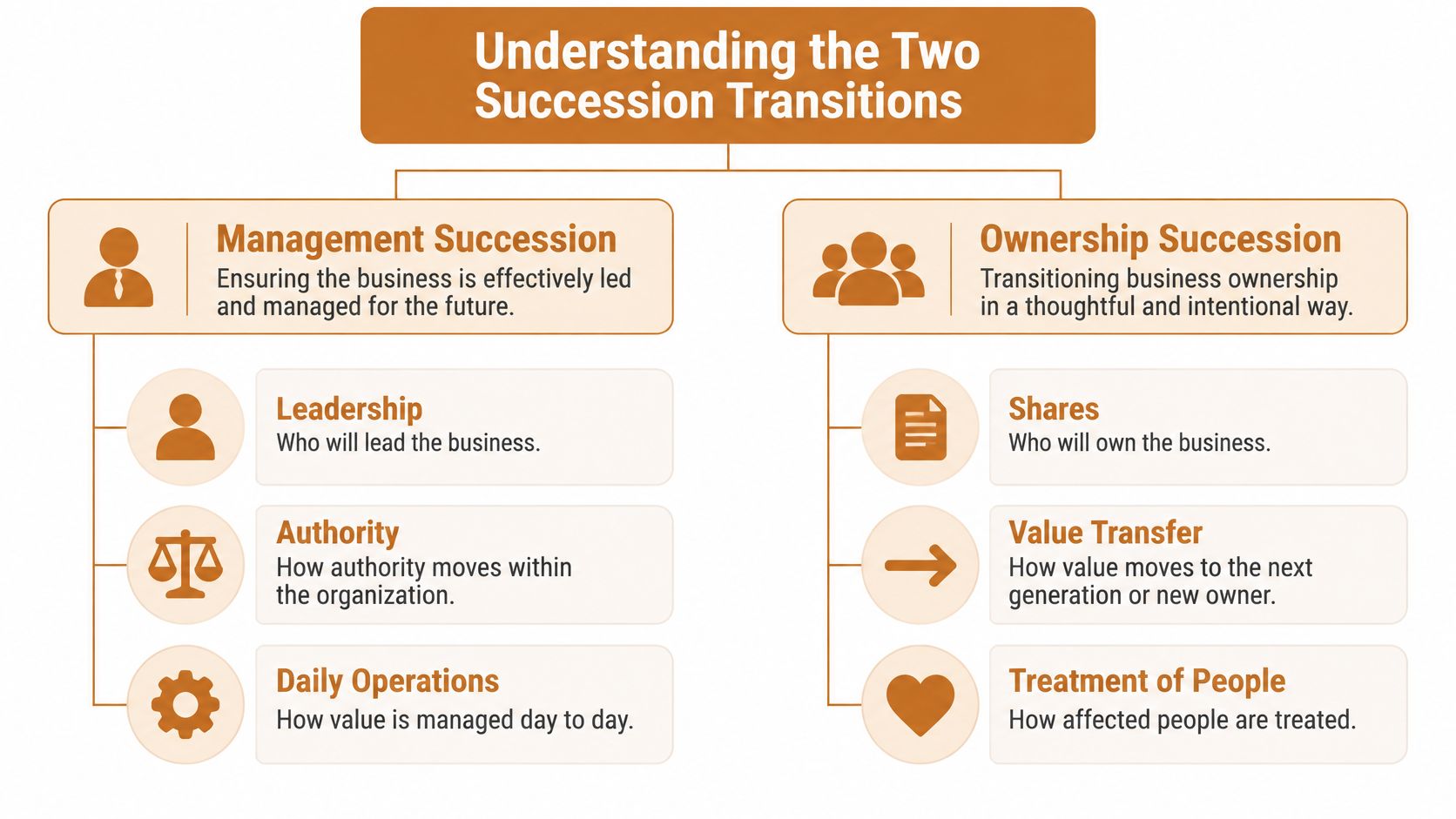
A family transfer involves two different questions. Management succession determines who leads the company and makes operating decisions. Ownership succession determines who holds shares or other ownership interests, receives economic benefits, and has voting rights. One person can take on both roles, but that outcome shouldn’t be assumed.
For instance, a daughter might be the strongest candidate to run a landscaping company because she handles crews, estimates, and customer relationships. Her brother might not want an operating role, but still expect a financial interest in the family business. The daughter’s leadership ability doesn’t automatically settle ownership, just as an inheritance doesn’t automatically make someone an effective manager.
Start by making a separate inventory for each transition:
Write down what’s decided and what isn’t. A child’s name on a page is not a complete plan if no one has clarified what the role includes, how the company will fund a transfer, or what happens if that child changes their mind.
A family business survey covering 1,587 businesses in 35 countries found that 82% reported some form of succession plan, but only 46% described it as broad and well-developed. The same research found that only 37% had high confidence in next-generation preparedness. Its findings, reported by Deloitte, reinforce a practical distinction: having a plan and preparing someone to lead are separate tasks.
The video below offers another introduction to business transitions. Treat it as background for discussion, not as a substitute for advice about your company’s structure or circumstances.
Family governance means the agreed rules for making decisions about the company and the family’s involvement. It helps relatives handle disagreements before they turn into a crisis or disrupt operations. A recurring meeting can give owners, spouses, operating heirs, non-operating heirs, and trusted advisers a structured place to discuss expectations.
Set the meeting’s purpose and boundaries. A sibling who doesn’t work in the company may need information about ownership and family decisions, but shouldn’t automatically have authority over staff. A spouse may have a useful perspective on the owner’s plans, while the operating successor needs space to demonstrate leadership. Clear roles can help each person know when they’re contributing and when someone else is responsible for the decision.
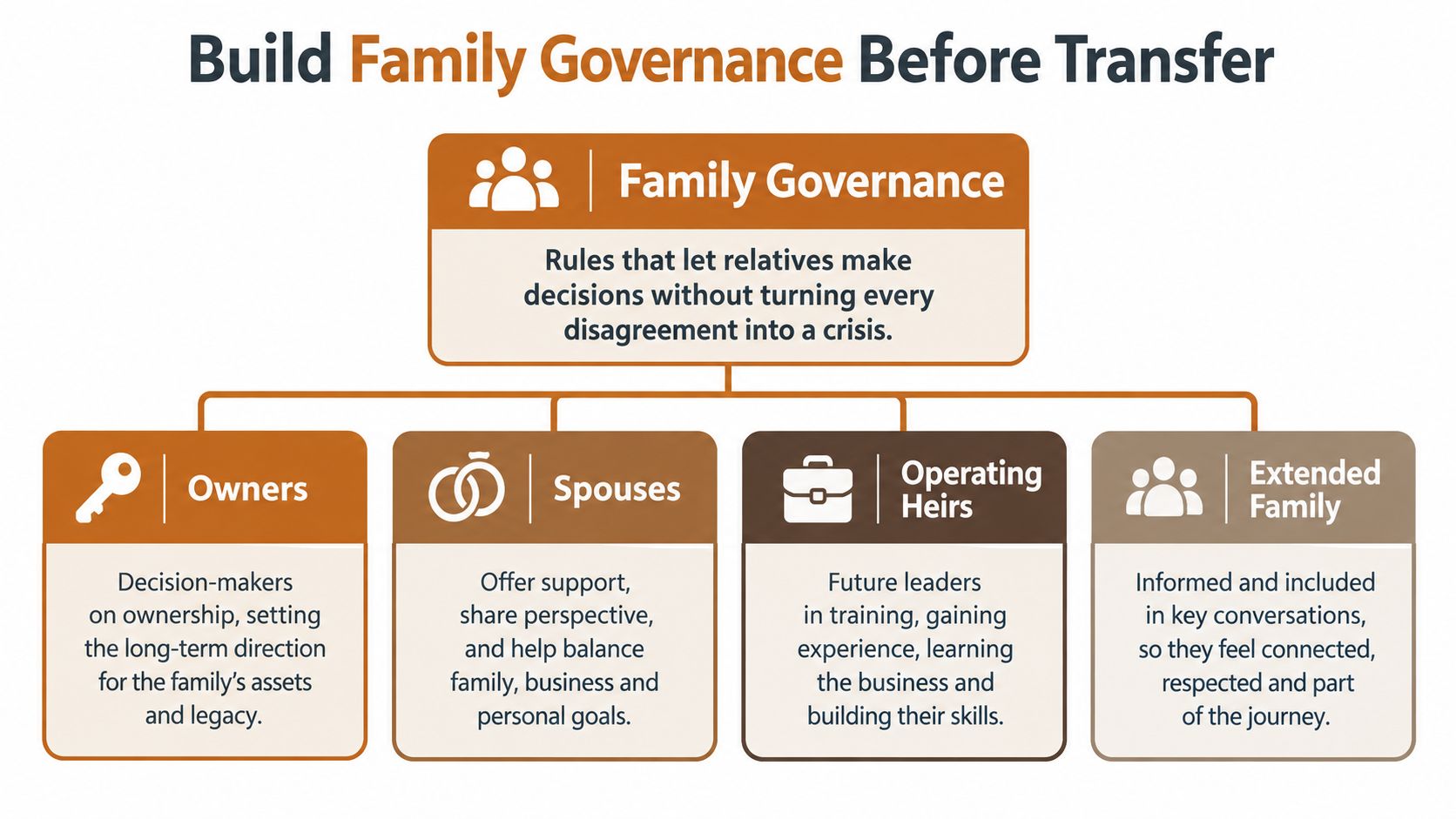
A meeting agenda might address:
To test readiness, give the successor responsibility in stages. They might first lead a customer follow-up process, then manage hiring for a team, oversee estimates within agreed limits, and take responsibility for a defined part of cash management. Agree in advance on what good performance looks like and how the owner will provide feedback. A title alone doesn’t show whether someone can make sound decisions under pressure.
Practical rule: Transfer real decisions gradually, and make the boundaries visible to employees.
A contingency matters, too. If the child in training isn’t ready or no family member wants the role, the family should consider interim management, another employee, or a sale rather than letting the business drift. For more on clarifying roles and decision rights, see this guide to family business governance.
There’s no single transfer method that suits every family. A gift may support continuity but leave the owner without sale proceeds. A sale can provide liquidity, but the successor must find financing and the family must agree on value and terms. A buy-sell arrangement can set a process for a future transfer, but it still needs a realistic funding plan.
| Transfer option | Control and continuity | Liquidity for family | Key planning focus |
|---|---|---|---|
| Gift | Ownership shifts without a conventional purchase; leadership and control still need separate arrangements. | The owner may receive little or no purchase money from the recipient. | Review tax and estate effects, decision rights, and treatment of other heirs. |
| Sale to a family member | The successor may gain ownership over time or under agreed terms. | Payments may provide proceeds to the owner, depending on financing and structure. | Assess value, repayment capacity, debt, and the successor’s willingness. |
| Buy-sell arrangement | Sets rules for how an interest can or must be transferred in specified circumstances. | A buyout can create liquidity if funding is available. | Coordinate triggers, valuation, payment terms, and funding with qualified advisers. |
| Trust-based transfer | May organize how ownership is held or passed, depending on the structure and applicable law. | Timing and access to value depend on the documents and arrangement. | Review control, beneficiaries, administration, and tax and estate treatment. |
These options aren’t interchangeable, and their names don’t determine their legal or tax consequences. For example, a sale to a child could be paid over time, but the owner would need to consider whether the company or successor can support those payments without starving operations. A gift may avoid a large immediate purchase obligation, but the family still needs to decide how to treat relatives who won’t receive an ownership interest.
Ask the family to compare each option against the same questions: Who will control decisions? Where will cash come from? Can the company continue operating? How will the owner’s financial needs be met? What happens to non-operating heirs? A detailed discussion of succession planning for Texas business owners can help owners identify topics to raise with local professionals. For a plain-language overview of the mechanics, review company ownership transfer considerations.
One child has spent years running a roofing company. A sibling works elsewhere and wants cash rather than a job or an ownership stake. The owner wants to treat both children fairly, but the estate may not have enough available funds to buy out the sibling immediately while also providing the operating child with full control.
Fairness doesn’t always mean identical ownership or identical timing. The working child may need decision-making authority and a stable business to run. The other child may need a clear and credible way to receive value. Treating both interests as if they were the same can leave the company unable to finance a buyout or the family unable to explain the difference.
The first step is to talk separately about roles, money, and decision rights. Ask the child who runs the company what they’re willing and able to lead. Ask the non-operating heir whether they want cash, ongoing income, information, or an ownership interest without day-to-day control. Then check whether the owner’s estate and the business can support the family’s preferred arrangement.
Possible approaches include a staged ownership transfer, seller financing, nonvoting interests, insurance proceeds, outside investment, or a sale if family members aren’t prepared to continue. Each involves trade-offs. For example, seller financing may spread payments over time, but it creates repayment obligations that need to be tested against the company’s cash needs. Nonvoting ownership may separate some decision rights from economic participation, but its terms and consequences require professional review.
A fair agreement is one the family understands before anyone depends on it.
Don’t promise an outcome until the family has examined the funding, control, tax, and operational effects. A buy-sell agreement may provide a framework for transfers or buyouts, but it won’t make an unfunded purchase affordable. A guide to what a buy-sell agreement can address can help prepare questions for a lawyer and financial advisers.
A family transfer can involve more than shares in the company. A contractor may own trucks and tools through the business, hold real estate personally, or have a trade name, customer records, and other intangible assets that need separate attention. If ownership, debt, and documentation are unclear, relatives and advisers may struggle to understand what’s transferring and what it’s worth.
Create an asset register and keep it aligned with accounting and legal records. For each item, record the owner, title, acquisition date, original cost, improvements, debt, current valuation approach, and intended recipient. Include vehicles, equipment, real property, intellectual property, shares, and goodwill where relevant. A register won’t decide the tax treatment, but it gives advisers a more complete picture to review.
The Australian Taxation Office advises privately owned groups making family transfers to document structural and operational changes, asset disposals, tax effects, acquisition dates, cost bases, improvements, and valuations, then update their succession plan. Its guidance on transferring a business to family members applies to Australian tax settings, so owners elsewhere should seek advice for their own jurisdiction.
Gather existing company and ownership documents, estate plans, debt agreements, insurance details, prior valuations, and records of significant asset purchases or improvements. Then ask a tax professional and estate lawyer to model possible transfer methods before anyone signs. The outcome can depend on the facts, the company’s structure, and the relevant laws. Owners seeking local estate-planning support may consider speaking with Bryan Fagan Kingwood lawyers, while ensuring all advisers understand the business transfer as well as the estate documents.
A succession plan can start before the owner has chosen a transfer method. First, the owner needs to understand their goals and whether a potential successor wants the role. Later stages can formalize the agreement and move authority and ownership. The process should be paced by evidence of readiness, not by a calendar date alone.
Use five stages as a working outline:
At each stage, ask a practical question: Can the successor handle estimates or hiring without routine intervention? Do employees know who approves commitments? Can the owner step away without customers being redirected back to them? If the answer is no, use that information to adjust training or timing.
Keep a contingency path available. The preferred successor may decide not to take the role, or the family may decide a different option is better for the business. A timeline is useful when it helps people act; it shouldn’t pressure the family into a transfer before the operating and financial details are ready.
General planning can help a family identify its priorities, but it can’t determine the right legal structure, tax treatment, valuation, or financing for a particular company. Bring in qualified specialists when the family is choosing among transfer methods, funding a buyout, moving control, handling business debt, preparing governance documents, or negotiating with relatives and key employees.
The right adviser mix depends on the questions. A business lawyer can explain ownership documents and decision rights. Tax and estate professionals can review transfer and inheritance implications. A valuation specialist can assess the company and relevant assets. A financial adviser can test the owner’s needs and the successor’s capacity to fund a purchase. Insurance and business advisers may help examine funding and continuity concerns.
Prepare for a first meeting by gathering a current ownership chart, company and estate documents, debt information, available asset records, and a list of family members’ roles and expectations. Bring the questions the family hasn’t answered, not just the answers it hopes to document.
Ask each specialist to explain the trade-offs in plain language: What control changes? Who receives cash, and when? What could the company owe? What assumptions should the family verify? Which decision can wait until more information is available? A professional who can’t explain the implications clearly may not be the right person to guide a family through a complicated choice.
A global family-business study reported that about 40% of U.S. family businesses transition successfully into the second generation, approximately 13% reach the third, and only 3% survive into the fourth generation or beyond. Cornell’s family business facts and succession overview describes a difficult continuity challenge, not proof that one planning method guarantees success.
Before moving forward, check that you’ve:
If you’re considering a family transfer, a sale, or another next step, The Owner’s Shortlist offers plain-language articles and a free service that introduces business owners to a specialist whose experience fits their business. You can start by reviewing your options or speaking with a real person, without any obligation to proceed.
Tell us your situation. We'll connect you with a specialist who works with owners like you. One conversation, no sales pressure.
Found this useful?
Add The Owner's Shortlist as a preferred source and get our articles highlighted in Google Search results.
Add to Preferred SourcesLearn what is a closely held business, how ownership works, and why taxes, valuation, and succession planning look different when a small group controls
October 20, 2026
A practical guide to family business governance covering boards, family councils, succession policies, owner agreements, and conflict prevention.
October 18, 2026
Navigate family inheritance law for your business. Learn how to structure succession, avoid family disputes, and protect your company's future value.
September 25, 2026
Learn how succession of business works, from choosing a pathway to timing the handoff. A clear guide for owners planning their next chapter.
September 20, 2026