Succession Planning Meeting Agenda You Can Run
A succession planning meeting agenda, prep list, prompts, and 90-day follow-up for owners of service businesses.
November 3, 2026
By Remi Taffin · November 5, 2026

56% of small-business owners in a 2025 U.S. Bank survey of 1,000 owners worried they would not get a reasonable price, and 37% planned to sell within 12 months. Only 54% had a formal succession plan. In that same survey, owners who already had a plan were more likely to report significant recent growth, 64% versus 50% without one.
A headline price is not the same question as whether you can live on the money after the shop stops paying you. Succession planning for business owners splits into two jobs. One is what the company is worth and who can run it. The other is the income you need once that paycheck ends.
I would write those two numbers on separate lines before you name a buyer, a child, or a manager. Family status does not prove someone can price a commercial job, keep a crew through summer, or produce cash without you. A timed test of authority does.
The whole sequence fits on one page. Each step ends with something you can hold, not a feeling that you “talked about it.”
| Step | What You Decide | Output to Keep | Typical Time |
|---|---|---|---|
| 1. Set goal and value | Target outcome, income need, valuation | Written goal and independent valuation | 1-2 months |
| 2. Choose the path | Sale, family, buyout or ESOP | Shortlist of two routes tested against income need | 1-2 months |
| 3. Map operations | Every recurring function and key relationship | Function map with owner, backup and standard | 2-4 months |
| 4. Build successor readiness | Who can run which functions and when | Readiness scorecard reviewed quarterly | 12-24 months |
| 5. Set governance | Decision rights, ownership, pay, disputes | Signed governance and buy-sell documents | 3-6 months |
| 6. Run the handover | Staged authority transfer and owner withdrawal | Dated transition schedule with milestones | 1-3 years |
| 7. Review each year | Valuation, bench depth, target date | Updated plan signed off annually | Ongoing |
Those ranges are rough and scale with company size. A $2 million residential HVAC shop with one office can move through goals, valuation, and a function map faster than a $30 million commercial electrical contractor with several branches and a bonding line. The readiness window and the handover still take years, because authority has to be practiced, not announced.
Treat the list as a filter. If you already have a target date and a paid valuation, do not restart there. If nobody but you can renew the state license or call the largest property manager, the map is the missing piece, even if a lawyer already drafted a will.
A signed binder that nobody has rehearsed is not a plan. Owners who want a plain view of how a handover plays out can read business handover insights from Everglow Prosperity and then mark which of the seven outputs they do not have yet.
Start this quarter with the first step your current plan lacks. Skip ahead only after that output exists in writing.
A 2026 national survey found that 57% of small-business owners were very or completely reliant on the business, through a future sale or continued income, to fund their next stage of life. Only 15% had a formal written exit plan, 18% had a written timeline or target exit date, and 23% had formally valued the business as part of exit preparation. 33% had taken no steps, 28% had considered exiting but had not acted, and 26% had only an informal or partial plan. On value itself, just 18% had a current professional valuation they had paid for, while 27% relied on their own rough estimate.
Write these before you call a broker or a family meeting.
Then get an independent valuation and set it next to that income number. A high company value that arrives as a long note can miss a modest annual need. A lower cash price can clear it.
Specialists usually look at three pictures, and many weight earnings most heavily for an operating company.
Asset-based value is what the trucks, inventory, and equipment would bring, minus debt. It matters more when earnings are thin.
Earnings-based value uses seller’s discretionary earnings for owner-operated shops and EBITDA once the books look like a larger firm. Buyers pay for profit they can repeat.
Market comparables come from recent sales in your trade, adjusted for size, geography, and how clean the contracts are. Our business valuation guide walks through how those methods get applied.
For residential and commercial service firms, the number moves with how much revenue sits on you personally, customer concentration, recurring maintenance agreements, technician retention, and clean books that match the tax returns. An owner’s rough guess often runs high because it prices relationships the buyer cannot see, or low because it ignores a maintenance book. A buyer prices evidence.
Practical rule: If the independent valuation, after a realistic payment structure, cannot fund the income line on your one-page goal, change the date, the route, or the earnings. Do not argue with the gap.
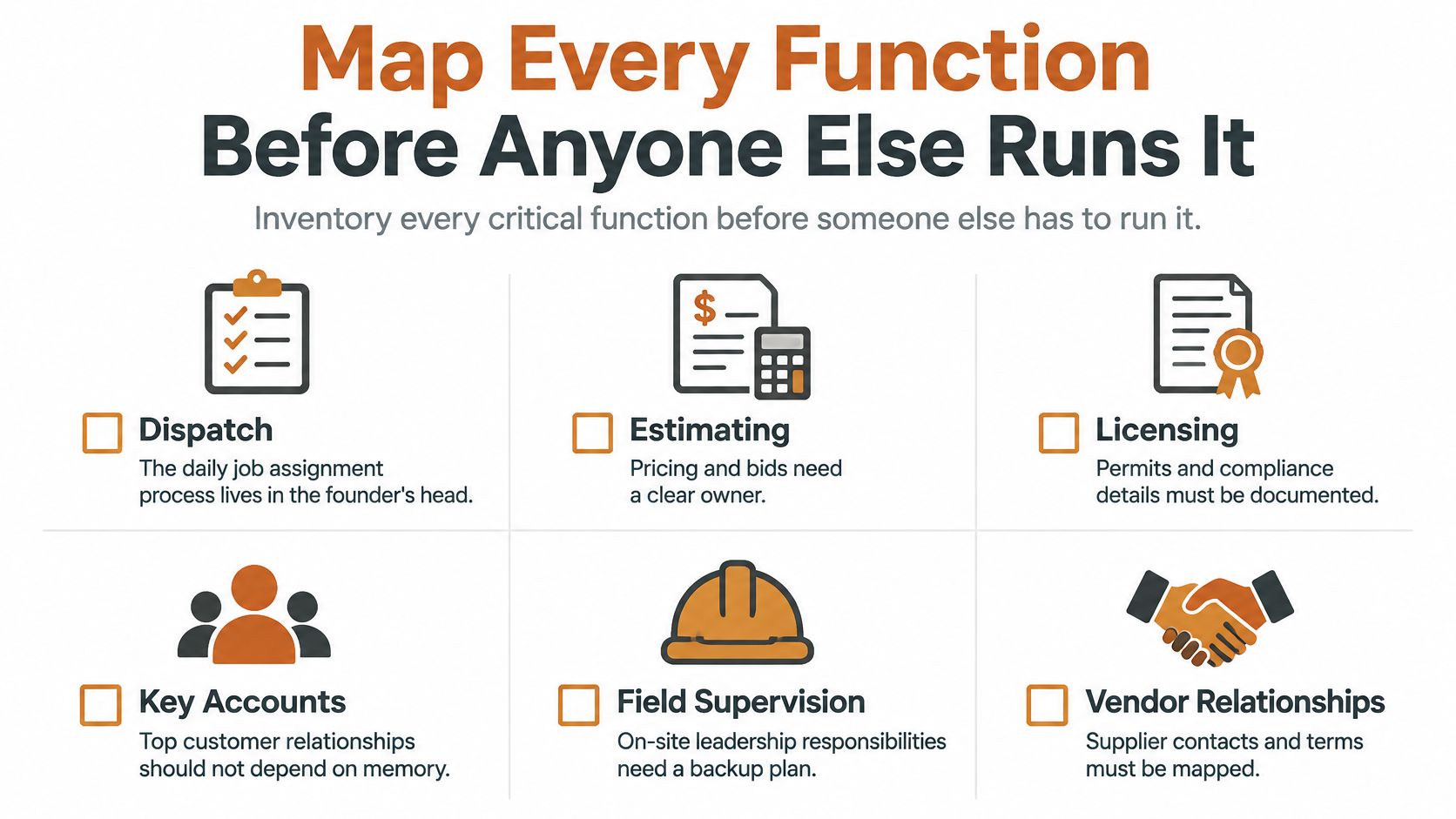
Owners skip this step because the company still runs. Dispatch, estimating, licensing, key accounts, field supervision, and vendor terms often live in one person’s head, and that person is usually the founder.
In a survey of 2,800 firms with annual sales from $5 million to more than $6 billion, only 30% reported having a succession plan, 29% reported resistance to change, and only 51% had a documented vision and written purpose statement. A plan that names a successor without naming the work is one of those thin versions.
List every recurring function, decision, customer relationship, license or permit, and piece of knowledge. Each row needs a current owner, a backup, a written procedure, and a measurable standard. Average callback time, quote turnaround, and first-visit close rate are better standards than “handles it well.”
Build the list in a shared sheet, not a notebook in the truck. If a function has no backup, that row is the gap. Our guide to business systems and processes shows how to write those procedures so a buyer or a manager can follow them.
| Function | Current owner | Measurable standard | Gap fix |
|---|---|---|---|
| Quote sign-off above a set amount | Owner | Quote turnaround | Delegate sign-off with a dollar limit |
| Largest property manager account | Owner | Annual contract renewal kept | Introduce the backup to the account in person |
| State license renewal date | Owner | Renewal filed before the deadline | Calendar the renewal with a second name |
| Dispatch and first-visit scheduling | Owner or lead dispatcher | Average callback time | Write the procedure and test it for two weeks |
Say you run a residential electrical company and you still approve every quote over $2,500, you are the only person the largest property manager will call, and the license renewal date sits in your phone. Three fixes, in order. Give the service manager sign-off up to a written dollar limit and review exceptions weekly. Take that manager to the property account in person and let them run the next quarterly walk-through. Put the license renewal on a shared calendar with a second name who can file it if you are in the hospital.
The test is simple. Can a manager run that function for two weeks while you are unreachable? If the answer is no, the map is not done, and a sale or a family handoff will price that risk.

Four routes show up again and again. The table shows typical patterns, not guarantees. ESOP rules, tax treatment, and loan terms need a tax adviser and an attorney before you treat any cell as a promise.
| Route | Who Usually Buys | How the Price Is Paid | Owner Control After Close | Main Risk |
|---|---|---|---|---|
| Outside sale | Outside buyer or private equity group | Cash at close, sometimes with earnout or seller note | Usually none after close, may stay on as consultant | Price and terms depend on buyer financing and performance |
| Family transfer | Children or relatives | Gift, discounted sale or installment note | Often stays in control until handover is complete | Unprepared heirs and family conflict |
| Management buyout | Key managers | Bank debt plus seller note, sometimes earnout | Gradual, set by the note terms | Managers may lack capital; loan default risk |
| ESOP | Employees through a plan trust | Company cash flow repays a loan, or seller is paid over time | Ownership shifts to the plan trust; owner exits gradually | Higher setup cost and annual valuation requirements |
The deciding question is which route pays the income you wrote down, with the least chance the payments stop. Compare after-tax proceeds, default risk, inflation, healthcare costs, and the income you want. A lower offer paid in cash at close can beat a higher headline paid over five years, because the later dollars depend on results after you leave.
Three terms, in one line each. An earnout is part of the price paid only if results hit targets. A seller note is a loan from you to the buyer, repaid over time. An installment sale is the price paid on a schedule.
Deloitte’s 2025 survey of 1,587 family businesses in 35 countries, each with at least US$100 million in revenue and family control of 51% or more, found that 82% reported some form of succession plan and only 46% called it broad and well-developed. The same research projected that family businesses appointing an external professional as CEO could rise from 13% before succession to 26% afterward. A family route can still need a professional operator. Passing shares to a child who cannot run the P&L is a gift, not a succession.
If an outside sale stays on the shortlist, keep it confidential. Prepare a blind teaser that hides the company name. Sign a non-disclosure agreement before you share financials. Limit detailed talks to two or three qualified buyers, through a business broker or a direct approach.
We are not a broker and we do not sell businesses. Brokers on our list are there because they have a track record with businesses like yours, which matters when the teaser has to stay quiet and the buyer has to understand a service book. If employees are the likely buyer, read how selling a business to employees differs from an outside close before you promise a price.
Keep two routes that can fund the income need. Test both with a tax adviser and an attorney. Drop the other two until those two fail a real constraint.
A last name or twenty years on the payroll is not readiness. Recent family-business research, covered in Deloitte Private’s family business insights, cites unclear decision-making authority as a leading governance challenge for 37% of respondents, and 36% cite leadership-transition succession itself. Separate 2025 research in that series found that building the next generation’s specialized skills and modern business education was the largest preparation challenge for 73% of Australian respondents, compared with 56% globally.
I would rather see a successor miss a pricing call while you are still in the building than discover it after the note is signed.
For a year to two years, the successor makes the decisions and you observe. You do not override in the moment. You debrief on a set day.
Measure four things.
Put approval limits in writing and raise them only after a stage is passed. Introduce them to top customers in person, with you in the room the first time and out of the room the second. Run a financial-literacy check. Can they read the profit and loss and explain the margin on a typical job, including labor burden?
A family successor often needs less coaching on “the legacy” and more proof they can operate. Keeping family harmony usually means separating family status from job authority.
Say a son or daughter runs scheduling cleanly and the techs respect them, but they cannot price a complex commercial job without giving away the margin. Keep pricing authority with you or with a senior estimator. Set a review date, and do not transfer that limit because a holiday is coming. If the scorecard still fails, the options are an outside manager, a key employee in the operating seat, or a longer timeline. Ownership can wait. The trucks cannot.
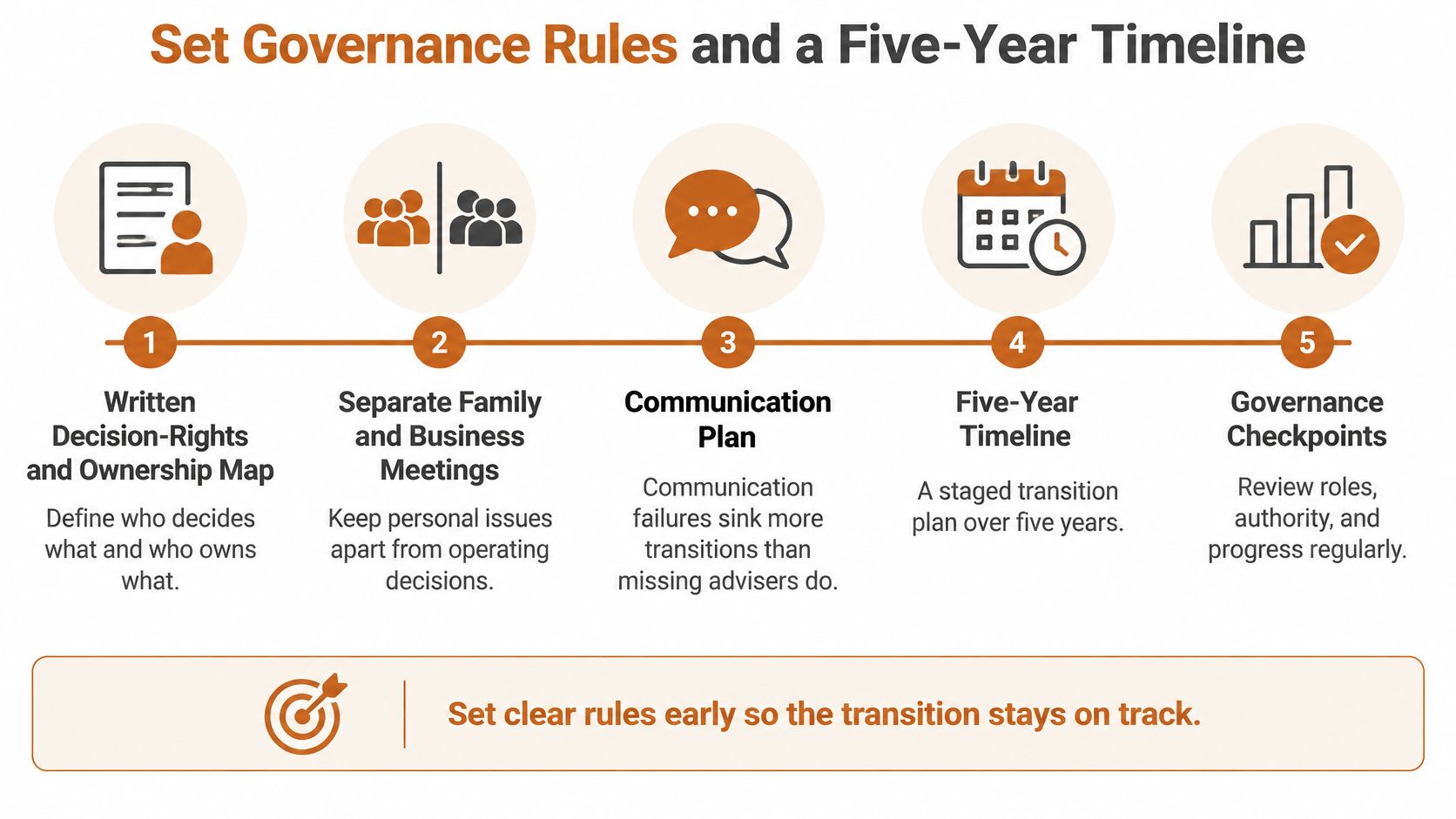
Communication failures sink more transitions than missing advisers. A family-business succession report published by the Association for Financial Counseling and Planning Education estimates that about 30% of family businesses fail in the context of transfer, that communication breakdown accounts for roughly 60% of succession failures, and that fewer than 3% trace to professional errors in accounting, legal, financial, or tax planning.
A signed plan nobody has discussed is operationally incomplete. Write the rules, then rehearse them. In many service companies the plan exists in the owner’s head and nowhere else. That produces a fight over authority, not a transfer of it.
| Year | Focus | Milestone to Check |
|---|---|---|
| Year 1 | Goals, personal income target, valuation and documentation | Written target date, personal income target, independent valuation and decision-rights map |
| Year 2 | Operations and management bench | Function map complete and successor named with backups in place |
| Year 3 | Successor authority | Successor runs day-to-day decisions while the owner observes |
| Year 4 | Financing, legal and tax structure | Buy-sell agreement signed and deal terms chosen with advisers |
| Year 5 | Handover and owner withdrawal | Staged exit completed and plan reviewed for the next cycle |
Put a review date on the calendar every year. A missed milestone means you adjust the year, not that you throw out the file. The governance test is authority: who signs, who spends, who can bind the company. Family status does not answer that question, and a title does not either. If Year 3 shows the successor still cannot hold cash flow, Year 4’s legal documents should wait. Paper that outruns performance is how families end up in the dispute clause they hoped never to use.
You do not need perfect answers to start. You need a dated list. In the next 90 days:
Tax structure, estate documents, and note terms belong with a qualified tax adviser and an attorney. A plan on a napkin does not replace them, and a stack of documents does not replace the 90-day list.
The first useful output is a dated list, not a finished deal.
If you want help finding a person whose past work fits a service company like yours, tell us the situation. We connect you with one specialist in a single conversation. The Owner’s Shortlist was built after we watched owners spend months with advisers who had polished websites and thin track records with businesses like theirs. You can also review plain-language guides and compare relevant specialists on the site before you call. The route, the timing, and the price stay your decision.
The Owner’s Shortlist helps owners of established service companies sort a sale, a family transfer, or an internal buyout without turning the search into a public listing. You describe the business, and we introduce one specialist whose past deals fit that kind of company. When you are ready to put a date on the plan, visit The Owner’s Shortlist.
Who wrote this: The Owner's Shortlist is not a broker and doesn't sell businesses. We get paid the same no matter which specialist we introduce you to. More about how we work.
Tell us your situation. We'll connect you with a specialist who works with owners like you. One conversation, no sales pressure.
Found this useful?
Add The Owner's Shortlist as a preferred source and get our articles highlighted in Google Search results.
Add to Preferred SourcesA succession planning meeting agenda, prep list, prompts, and 90-day follow-up for owners of service businesses.
November 3, 2026
Learn the succession planning process step by step: set a timeline, assess successor readiness, cover tax and legal points, and plan for sudden gaps.
October 26, 2026
Learn how family succession planning works, compare transfer options, manage family conflict, prepare for taxes, and build a practical transition timeline.
October 21, 2026
Learn what is a closely held business, how ownership works, and why taxes, valuation, and succession planning look different when a small group controls
October 20, 2026