Succession Planning for Business Owners: A Practical Guide
Succession planning for business owners, step by step: set your goal, value the company, pick a path, and plan the next five years.
November 5, 2026
By Remi Taffin · November 3, 2026
You’re 62, you still take the after-hours calls, and your son runs a crew but has never priced a big job on his own. Your spouse asks what happens if you stop drawing a paycheck. Your general manager wonders if there’s any future here for him. Nobody’s fighting. Nobody’s decided anything either.
That’s exactly when you need a succession planning meeting. Not a family dinner with better intentions. A timed, written evidence session that separates four jobs most owners blur together: child, employee, owner, and future operator. One person can hold more than one. Nobody should get one automatically because they hold another.
Run it the way you’d run a job. Prep before the joint meeting, score people on the same sheet, write down disagreements, and leave with dated tasks. If you leave with only a good feeling, you’ve wasted the hour.
Don’t start with the whole family around a table and a blank pad. You’ll get feelings, old stories, and no decisions. Start private, on paper, the week before.
Succession is where owners are least ready, even when the rest of the shop runs well. In the Deloitte 2019 Global Family Business Survey of 791 executives in 58 countries, more than half said their businesses were ready in ownership, governance, and strategy, but only 41% said they were ready in succession planning. That gap is normal. It’s also fixable if you prep instead of improvising.
Write one sentence before you talk to anyone. Pick one: stay and train a successor, step back from daily work, sell later, or pass ownership to family. You can change it later. You can’t run a meeting that tries to do all four at once.
Put that sentence at the top of the pack. Every argument later gets tested against it. If your goal is to step back in two years, a discussion about a child’s future shares in ten years is a different meeting.
Don’t build a sale book. Build six short items that show what the business needs from the next operator and what it can pay while you transition.
| Document | Who prepares it | What it is for |
|---|---|---|
| One-line goal | Owner, with spouse if they co-own | Stops the meeting from mixing sale, retirement, and family hopes |
| Trailing-twelve revenue and owner benefit | Bookkeeper or outside accountant | Shows whether the business can pay a successor and the owner at once |
| Top-ten customers and relationship owner | Owner and office manager | Shows which revenue walks if the founder leaves |
| Org chart and open seats | General manager or office manager | Shows roles that are not yet delegated |
| Pay for family and key employees | Owner | Surfaces unequal pay before it becomes the argument |
| Existing buy-sell, will, or estate note | Owner, from the file, not a new draft | Flags what is already signed versus what is only assumed |
Add a one-page note on debt and personal guarantees. If you’ve personally guaranteed a line of credit or equipment loans, say so. A successor who learns that after agreeing to run the place will feel ambushed, because he was.
Send the pack 48 hours ahead, marked confidential. If someone hasn’t read it, they don’t get to slow the joint meeting down asking for numbers that were in it.
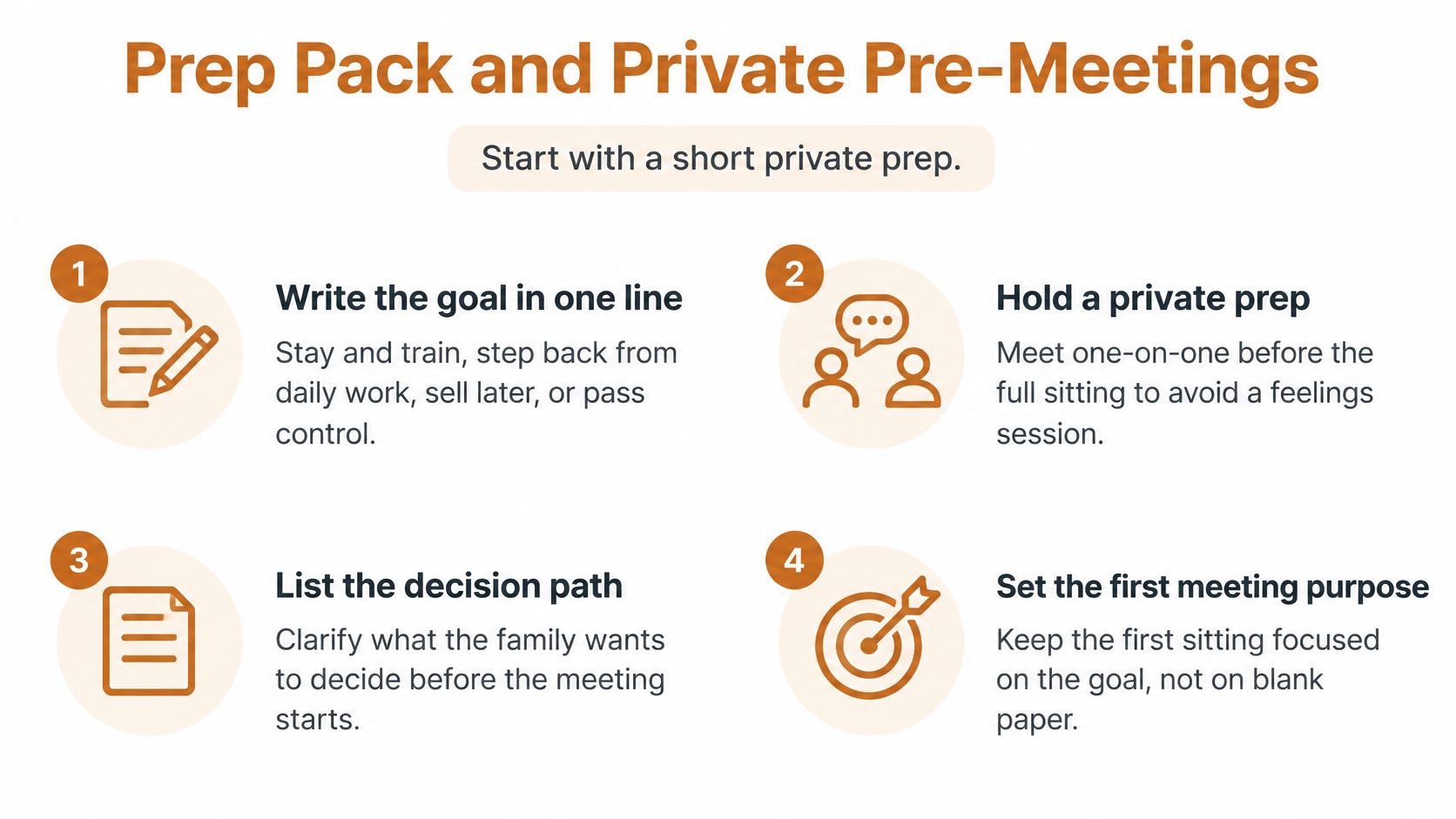
Talk to people alone first. People say different things when Dad, Mom, and a brother-in-law aren’t all listening at once.
Make no equity promises in these talks. You’re collecting assumptions, not handing out shares. Close each one by writing that person’s assumed role, pay, vote, and timing on one page.
Those pages matter because the joint meeting usually breaks on unspoken expectations. The Deloitte 2026 global study of 1,587 family businesses across 35 countries found that 40% are currently undergoing, or expect to undergo, a leadership succession within the next 10 years. Those firms are much larger than most local service companies, so don’t treat that as your benchmark. Treat it as a warning that waiting doesn’t make the conversation easier.
Invite the spouse if they co-own or work in the business. Invite candidates who already know they’re being discussed. Invite the general manager or office manager who runs the week.
Don’t invite adult children who don’t work in the business to vote on who runs crews. They may have an ownership interest later. That’s a separate question, and mixing it in now turns an operating decision into an inheritance fight.
Bring an outside adviser into the first hour only when tax or legal paper is already on the table. Otherwise you’ll pay for an hour of watching your family discover they disagree. If you want outside perspective on who should advise you, look at vetted succession planning experts after you know what question you’re asking. Owners who want language for the human side before the meeting sometimes find succession planning inspiration for HR teams useful for framing, but a quote won’t substitute for your one-page assumptions.
Practical rule: If a person’s pay, vote, and timing assumptions aren’t written down before the joint meeting, you’re not ready for the joint meeting.
Say the purpose out loud at minute one. This meeting produces a documented continuity choice. It’s not a family update, and a verbal “we’re good” doesn’t count as a plan.
Run six timed blocks. Don’t move to the next block until the current one has produced its written sentence. That discipline is the whole point. Owners who want general help keeping any meeting on track can borrow structure from Fluidwave’s guide to better meetings, but succession needs stricter outputs than a normal staff meeting.
| Block | Minutes | Question to settle | Leave with |
|---|---|---|---|
| Purpose and confidentiality | 10 | Who may hear what, and what this meeting is not | Signed note and stated purpose |
| Transfer type and date | 15 | Management, ownership, or both, and by when | Chosen transfer type and dated window |
| Owner-only work | 20 | Which customers, estimates, vendors, and signatures still sit with the owner | Role map with a named backup |
| Same-sheet candidate review | 20 | Who is ready now, who is in training, who is not a candidate | Scores and evidence, not preference |
| Gaps and milestones | 15 | What skill or authority is missing and who coaches it | One mentor and one dated milestone |
| Decisions and review | 10 | What is decided, what is open, and who reports back | Action register and next meeting date |
Read a one-page confidentiality note and have everyone sign it. Crews, customers, and competitors stay out of this. Rumors can cost you a foreman faster than any competitor can.
Then force the choice most families dodge. Are you transferring management only, ownership only, or both? Put a target window next to it, such as 18 to 36 months. Management without ownership means someone runs the shop while you still own it and carry the risk. Ownership without management means shares move but someone else operates. Both at once is the biggest step and needs the strongest evidence.
If you can’t name the transfer type, stop pretending you’re choosing a successor. You’re just talking about the future in general.
List everything only you still do. Estimates over a certain size. Key accounts who call your cell. Vendor terms. Check signing. After-hours calls. Hiring and firing. For each item, name a backup or write “no backup.” Those blanks are your real succession risk.
Say a roofing owner lists twelve owner-only tasks and nine have no backup. He doesn’t have a successor problem first. He has a delegation problem that would sink any successor.
Then score candidates on leadership, technical competence, financial judgment, and commitment. Keep the scoring short here. You’re recording where each person stands today, not debating their character for an hour.
This written output matters because most firms never get there. In PwC’s 2019 survey, only 18% of U.S. family businesses reported having a succession plan that was both documented and communicated. A plan in your head that your manager has never seen won’t help if you’re in the hospital next month.
Pick one gap per candidate. Not five. One. Assign one mentor and one dated milestone. “Get better at financials” is not a milestone. “Lead the monthly job-cost review on the first Tuesday for the next three months” is.
Close by logging decisions, open items, owners, and the next meeting date. Read it back. If someone disagrees with what’s written, fix it in the room.
A decision nobody wrote down will be remembered four different ways by Friday.
Your output is a 90-day action register with quarterly reviews. Succession is an operational risk process, not a single retirement conversation you have once and file away.
Score everybody on the same four tests, on the same sheet, in the same meeting. Include a working child, a key employee, and an empty “not yet” seat. The empty seat matters. It reminds everyone that leaving the operator role open is a legitimate decision, and it’s better than filling it with the wrong person to keep Thanksgiving pleasant.
A lot of owners think they have this handled because they have a plan somewhere. In the Deloitte executive summary covering 1,587 family businesses across 35 countries, 82% reported having some form of succession plan, but only 46% described it as broad and well developed. Having a document isn’t the same as having a decision process that can tell you who’s ready.
| Test | Pass looks like | Fail looks like | Proof to attach |
|---|---|---|---|
| Leadership | Crews and office follow them when the owner is off site | People wait for the owner to settle disputes | A season of delegated authority |
| Technical competence | They can price and deliver the core work | They still hand the hard bids back | Job file or estimate sample |
| Financial judgment | They know margin, cash, and what not to discount | They chase revenue that loses money | A monthly review they led |
| Commitment | They want the operating job, not only the title or the shares | They are unsure, or only staying to keep the peace | Their own written assumption on role and timing |
Evidence that counts is boring and concrete. A season running a branch or a book of work with you off the estimates. A crew that stayed. Customers who didn’t call you when something broke. Payroll that went out while you were gone.
Evidence that doesn’t count: your hope, years in the family, or a calm meeting where nobody raised their voice. A pleasant son who has never carried a bad month hasn’t passed the financial judgment test. He’s just pleasant.
Write the four roles as separate columns in your notes. Child is a family relationship. Employee is a job with pay and duties. Owner holds shares and risk. Future operator runs the work, the people, and the cash.
A child can stay an employee and never operate. An owner can keep shares without running crews. A general manager can be the right operator while your children hold ownership. Saying that out loud, early, prevents the cruelest misunderstanding in family businesses, where a child hears “someday this will be yours” and assumes that means title, pay raise, shares, and final say, all at once.
Ask the simple service-business question for each candidate. Do the phones, bids, and payroll still work without the founder that week? If not, write what breaks first.
If your preferred person fails two of the four tests, don’t promote them anyway and don’t deliver a verdict on their worth. Record a development path with a reassessment date. “Not ready to price commercial work alone. Shadows estimates this season, leads five bids with review, rescored in six months.” That’s a plan a person can act on.
Or name a contingency operator with clear triggers, such as death, incapacity, missed milestones, or an unexpected offer. A fallback isn’t an insult to the first choice. It’s what keeps customers and crews stable if the first choice gets sick, quits, or turns out to hate running the office.
Be direct about the difference. You’re scoring readiness for a specific operating job today. You’re not ranking your children.
Expect stalls. A stalled meeting doesn’t mean your family has failed. It means you’ve found the underlying problem, and now you can name it instead of arguing around it.

The most common stall is agreement in the room and argument in the parking lot. That’s a trust and communication break. In research summarized by Oregon State University from a 20-year dataset of approximately 2,500 family businesses, 60% of transition failures were attributed to breakdowns in trust and communication. If people won’t say the hard thing at the table, your notes are fiction.
The facilitator writes the disagreement in the notes instead of smoothing it over. That can be you, or a neutral sibling who isn’t a candidate. It shouldn’t be the person who most wants everyone to get along.
Harmony is not a succession plan.
Watch this short discussion on family transition pitfalls before your next session, especially if control is the sticking point in your room.
Stop the joint meeting if someone is being ambushed with news they haven’t heard before. Split back into pre-meetings, get the assumptions written down, and return. Ending a bad meeting early protects the process. Forcing a vote to prove you held a meeting destroys it.
The meeting produces one deliverable: a one-page register filled the same day, while everyone still remembers what they agreed to. Four columns are enough: decision, task owner, due date inside 90 days, quarterly review date. Write each line so it separates the child from the candidate and the employee from the future operator. A name in the owner column records an accepted duty, and a vague entry like “keep talking” has no place here.
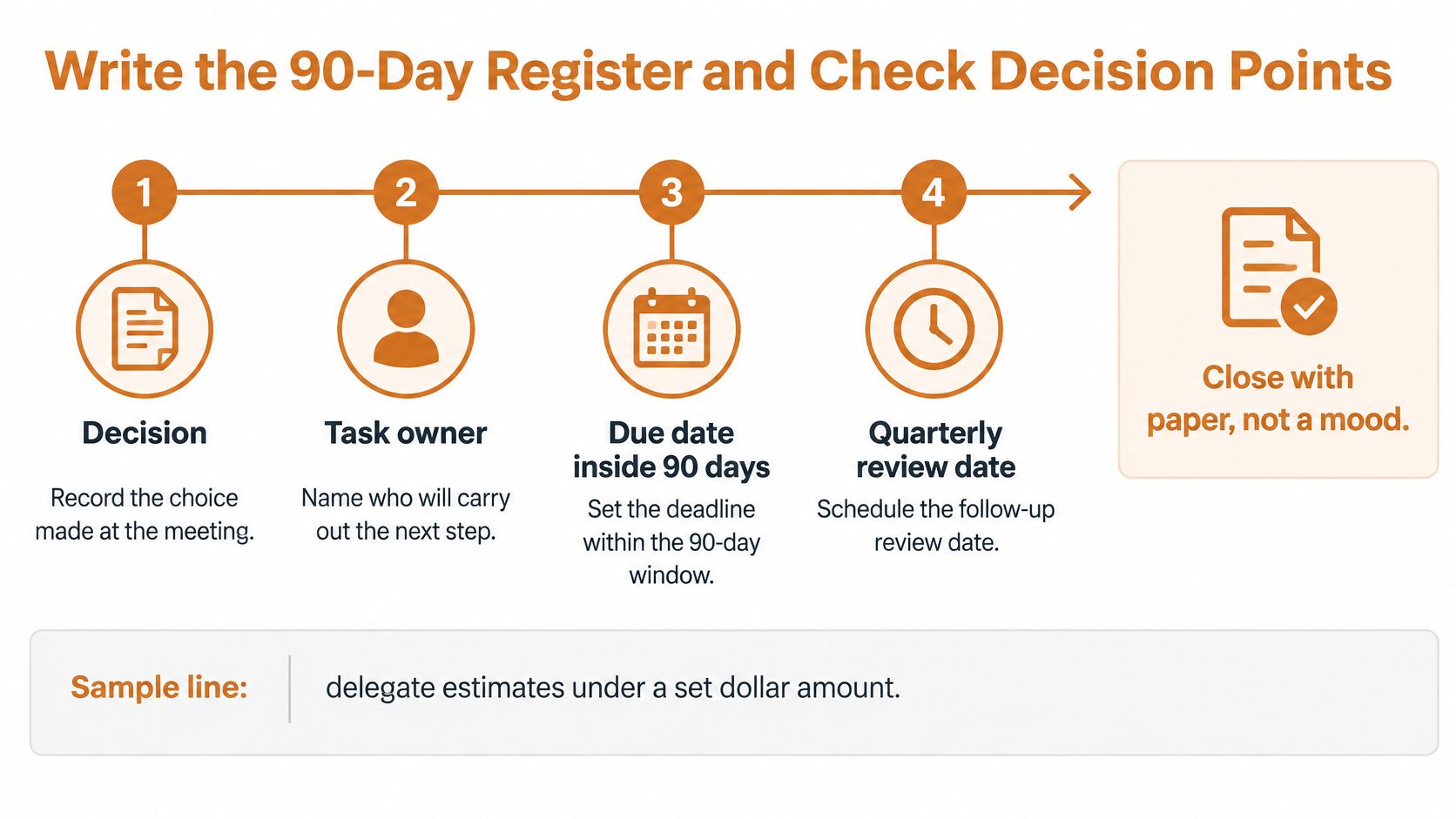
Sample lines keep it concrete:
Each line names a person, a task, and a date the room can check. For a broader structure that turns lines like these into a full handover, use guidance on how to create a business handover plan, then bring it back to your one page. A longer template never replaces your dated register.
Confidentiality note. “This discussion stays with the people in the room. The business is not for sale unless the owner says so in writing. Employees hear news from the owner first.”
Data-pack cover. Date, company name, list of contents, and who may see it. One line each. If a copy shows up where it shouldn’t, you’ll know which version it was.
Timeline strip. Month 1, decisions recorded. Month 3, milestone check. Month 6, authority review. Month 12, full revisit. Put those dates on a real calendar. A written succession planning process holds the review dates in place, because a plan nobody reviews drifts back into a hope.
At each checkpoint, ask one question. Does this path stay internal, or does it point outside the family? If it stays internal, skip the outside call and keep the quarterly review.
If it points outside, schedule one specialist conversation and bring three questions. Have you closed businesses of this type and size? What would a buyer worry about if the owner is still the estimator? What should we not say to the crew yet?
Choose that person carefully. The Owner’s Shortlist was built after the site’s team watched owners spend months talking to advisors who had good websites and confident pitches but thin track records with businesses like theirs. An HVAC company owner in Florida with 28 years in business said he had talked to three advisors before finding a Shortlist specialist who understood what he had built, and it took one conversation. The first conversation with The Owner’s Shortlist comes with no sales pressure, which is how it should be when you’re still deciding.
This meeting has a narrow job: decide who might run the business, what evidence would prove it, and what happens in the next 90 days. Sale price, tax plan, and estate plan stay parked with the advisers who own them. That is enough for one meeting, and more than usually makes it onto paper.
If your register points beyond the family, or you can’t tell whether it should, talk to a specialist who’s handled transitions in businesses like yours before you promise anything to a child, a manager, or a buyer. Visit The Owner’s Shortlist to get matched with one vetted specialist who fits your trade, your size, and your timeline, and start with a plain conversation about where you really stand.
Who wrote this: The Owner's Shortlist is not a broker and doesn't sell businesses. We get paid the same no matter which specialist we introduce you to. More about how we work.
Tell us your situation. We'll connect you with a specialist who works with owners like you. One conversation, no sales pressure.
Found this useful?
Add The Owner's Shortlist as a preferred source and get our articles highlighted in Google Search results.
Add to Preferred SourcesSuccession planning for business owners, step by step: set your goal, value the company, pick a path, and plan the next five years.
November 5, 2026
Learn the succession planning process step by step: set a timeline, assess successor readiness, cover tax and legal points, and plan for sudden gaps.
October 26, 2026
Learn how family succession planning works, compare transfer options, manage family conflict, prepare for taxes, and build a practical transition timeline.
October 21, 2026
Learn what is a closely held business, how ownership works, and why taxes, valuation, and succession planning look different when a small group controls
October 20, 2026