Family Succession Planning for Business Owners
Learn how family succession planning works, compare transfer options, manage family conflict, prepare for taxes, and build a practical transition timeline.
October 21, 2026
By Remi Taffin · October 26, 2026

Naming your successor is the wrong place to start. Before you promise anyone the business, establish what you need from it, whether they can run it, and who takes charge if you’re unavailable tomorrow. A succession plan that works only when everyone stays healthy and follows the retirement calendar isn’t much protection.
Family intentions don’t amount to a process. In the 2012 Family Business Succession Survey published by Purdue, which analyzed 613 businesses, more than 55% expected eventually to transfer ownership to family, yet fewer than 20% had a written management or ownership transfer plan.
Build your succession planning process around separate tracks:
Assign a responsible person and deadlines to each track. The eventual shareholder doesn’t have to be the daily operator, and the emergency operator doesn’t have to become either.
Use the visual as an overview, not permission to treat the share transfer as the whole job.
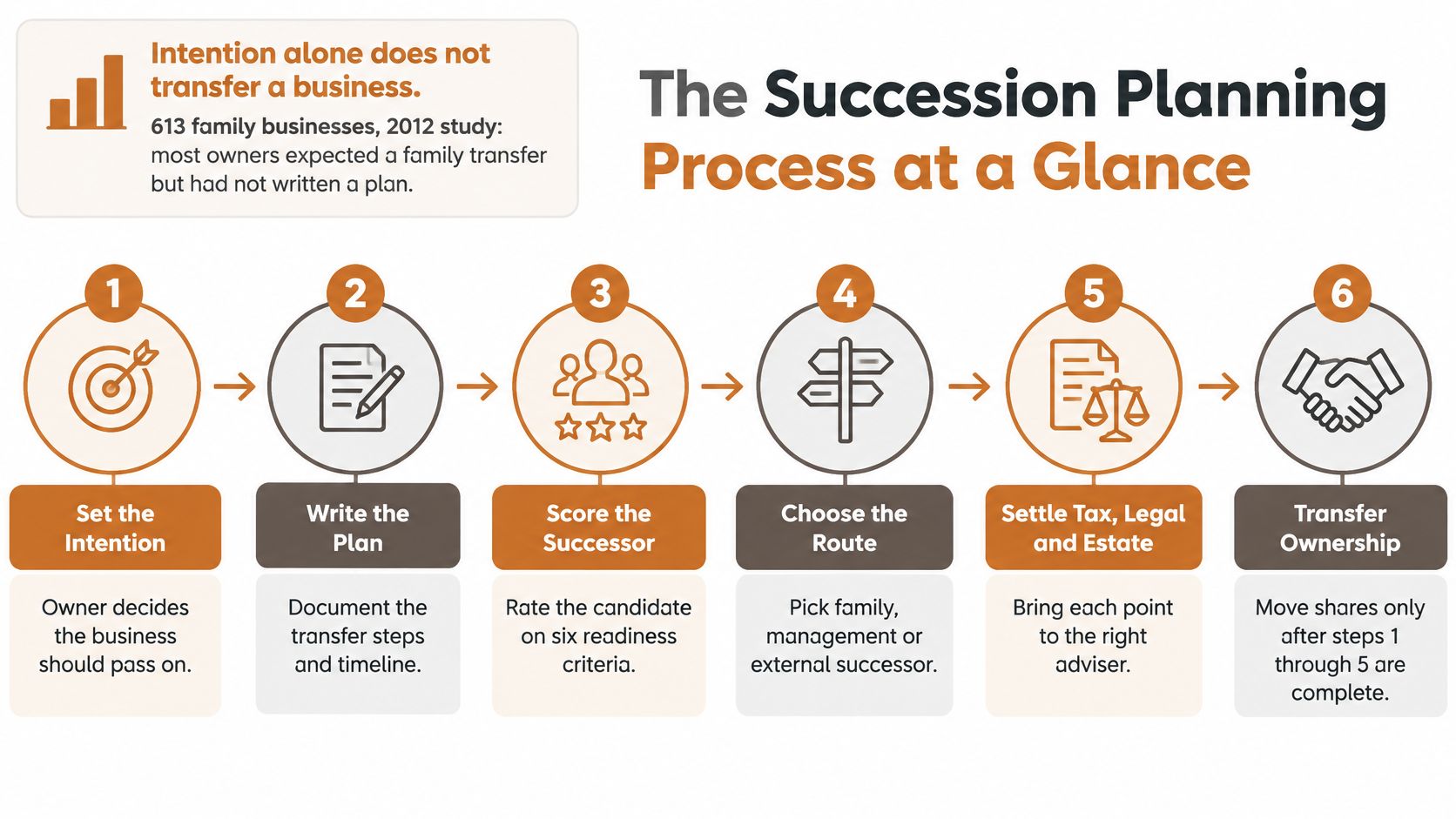
Don’t move ahead to the handover while the earlier written outputs are still missing.
Start with answers, not documents from an attorney. Write down what a successful transition must deliver for you and what you’re willing to give up.
Rank those objectives. An owner who wants maximum cash at closing, permanent control, and guaranteed employment for every relative needs to resolve those competing demands before approaching a successor.
The schedule below is an illustrative planning calendar, not a claim about typical transaction durations. Adopt dates that reflect the development work and approvals your business needs.
| Timing | Milestone | Output | Lead |
|---|---|---|---|
| 5 years out | Define objectives and get a baseline valuation | Objectives memo and value range | Owner with a CPA |
| 4 years out | Run a readiness review and start successor development | Gap list and development plan for each candidate | Owner and senior managers |
| 3 years out | Choose the successor route and draft the written plan | Draft succession plan | Owner with board or outside adviser |
| 2 years out | Complete tax and legal review and draft buy-sell terms | Draft agreements and structure memo | Attorney and CPA |
| 1 year out | Tell key staff and run a tabletop contingency test | Test notes and fix list | Owner and operations lead |
| 6 months out | Move decision authority to the successor | Signed limits for spending, hiring, and banking | Owner and successor |
| Transfer date | Sign agreements and step back from daily work | Executed documents and handover log | Owner, successor, and advisers |
Replace job titles with names. Where the table lists joint leads, designate a single accountable coordinator who chases decisions and records completion.
Work backward because training, financial cleanup, financing, and approvals all consume time. A successor needs actual operating experience, not a farewell-week briefing. Buyers and lenders need records they can reconcile without asking you to explain every adjustment.
A compressed plan should run tasks in parallel rather than omit them. An outside sale may avoid internal leadership development, while a family transition may require an extended management trial. Ask the broker and advisers to establish a transaction-specific schedule instead of promising a closing date yourself.
Never skip the valuation, tax review, or emergency authority arrangements.
Planning test: A milestone without a named owner, a date, and a written output is still a wish.
Start with value because it determines what a successor can afford and whether the transfer can fund your next stage of life. A willing candidate isn’t a workable buyer if the proposed payments leave the company unable to replace vehicles, retain technicians, or survive a slow season.
For a service business, examine these drivers before arguing over a headline price:
Use a CPA with valuation experience or an independent valuation specialist. This business valuation guide can help you prepare the records and questions, but a rule-of-thumb multiple shouldn’t determine a family buyout.
Use a separate scorecard for each candidate. A practical scoring convention is 1 for unable to perform independently through 5 for demonstrated independent competence; treat any score of 2 or below as a development assignment with a coach and completion date. These are proposed assessment rules, not an industry benchmark.
The readiness problem is real: Deloitte’s 2026 global family-business study found that 35% of respondents cited an underqualified or inexperienced next generation, while 33% reported difficulty identifying a suitable successor.
Use the following as a working scorecard. The durations are suggested trial targets to adapt, not universal transfer requirements.
| Criterion | Strong signal | Warning sign | Fix before transfer |
|---|---|---|---|
| Owner dependence | Two or more staff know each key customer and vendor | Owner signs most quotes and holds relationships | Assign account owners and log contacts for a proposed 12-month trial |
| Operating responsibility | Successor has run jobs or a branch independently through a proposed two-year trial | Successor approves decisions the owner already made | Delegate budget and hiring decisions with monthly review |
| Financial literacy | Successor reads the P&L, job margins, and cash forecast | Owner keeps the numbers in their head | Hold financial reviews with the CPA |
| Trust with customers and crew | Crew brings decisions to the successor | Crew goes only to the owner | Let the successor lead the next major customer issue |
| Leading without the owner | Team meets targets during a proposed three-month independence test | Output drops during the owner’s absence | Schedule planned absences as tests |
| Documented value drivers | Recurring agreements, service-line margins, and clean job records | One-off revenue and books that obscure job profitability | Begin reporting cleanup before marketing; use a two-year preparation target where feasible |
A high total score mustn’t conceal a serious weakness. Someone who sells confidently but can’t manage cash needs development before taking unrestricted control.
Set a planned month-long absence as a readiness test. If the business can’t operate without your intervention, begin by reducing dependence on you rather than choosing a name.
Choose the route that can deliver your objectives without weakening the business. Birth order doesn’t establish competence, and long service doesn’t establish the ability to finance a purchase.
Keep the readiness assessment beside the proposed deal terms.

| Factor | Family successor | Management team | External buyer or CEO |
|---|---|---|---|
| Typical successor | Son, daughter, or other relative | General manager, senior foreman, or branch lead | Outside buyer, investor, or hired CEO |
| Main risk | Unequal control and resentment among non-successor family | Insufficient capital to buy the business | Culture change and customer loss |
| Preparation time | Allow for development and an independent leadership trial | Allow for trial leadership and financing approval | Set a broker-led sale schedule or CEO recruitment plan |
| How ownership can move | Gift, sale, or staged buy-sell arrangement | Seller note, earnout, or structured equity award | Full or majority sale; hiring a CEO alone transfers no ownership |
| What the owner can retain | Defined voting rights or a minority stake | Seller note and a bounded advisory role | Negotiated rollover equity or transition consulting; ownership if hiring a CEO |
| Best fit when | A capable relative genuinely wants the job | A proven manager has a credible funding plan | No internal candidate is ready, or ownership and leadership need separating |
Don’t combine an external buyer and a hired CEO in your financial assumptions. A buyer pays for ownership; a hired executive receives compensation to manage a business you still own.
In PwC Australia’s 2025 Family Business Survey, 73% identified building the next generation’s specialized skills and modern business education as a major challenge, and 37% cited resistance from the senior generation.
An outside adviser or independent board member should challenge both the candidate and the founder. The candidate must demonstrate competence, and the founder must stop reversing delegated decisions through private conversations with employees.
Non-successor relatives need a separate arrangement covering compensation, voting rights, information rights, and a fair-value framework. Pay for work through compensation and address inheritance through estate planning. Equal inheritance doesn’t require equal operating control.
Use staged arrangements where readiness is incomplete: a management trial with explicit authority, a minority stake with later transfers tied to milestones, or buy-sell provisions with independently reviewed triggers. Have counsel establish how disagreements are resolved rather than assuming an independent director can break every ownership deadlock.
Use the video as a discussion prompt before settling the route.
For a management buyer, test financing before negotiating titles. Model seller-note payments and any earnout against available cash, including the effect of weaker revenue or margins.
For an external deal, decide whether you want a complete exit or continuing minority ownership. Those choices create different exposure after closing.
Delaying an unready candidate is responsible. Letting the founder retain unrestricted control indefinitely isn’t. Tie the handover to demonstrated capability rather than age, seniority, or family hierarchy.
Bring advisers a common packet: your objectives memo, ownership records, recent business and personal tax returns, financial statements, existing estate documents, and draft deal terms. Don’t let each professional work from a different version of the transaction.
Start with structure and defensible value before anyone moves shares.
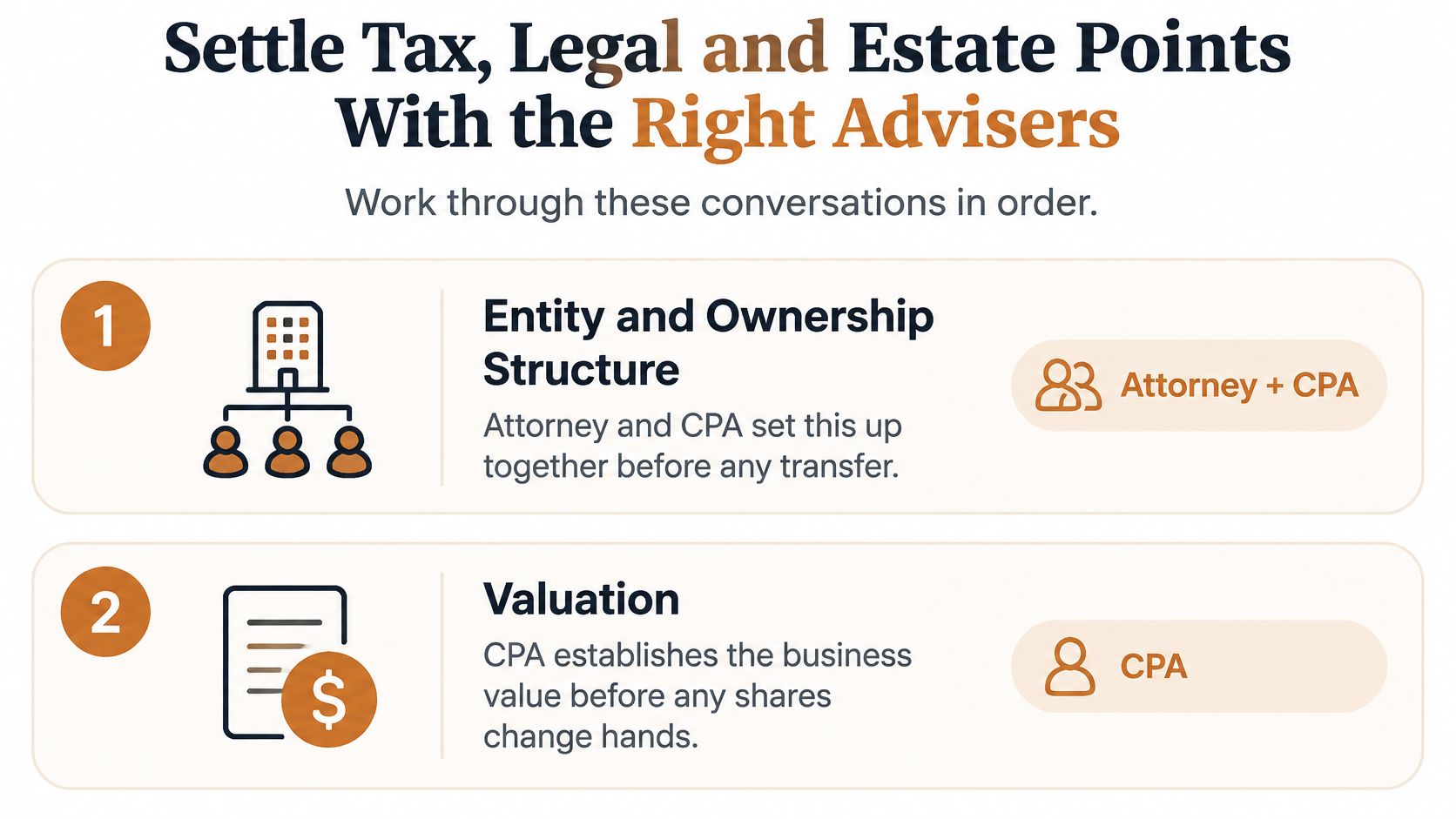
A CPA handles tax modeling and financial analysis. Counsel handles legal documents and transfer requirements. A valuation specialist supports the value conclusion, while a business broker tests buyer interest and transaction positioning for an outside sale.
For background before the estate-tax conversation, you can explore inheritance tax basics from Allied Tax Advisors. Use it to prepare questions, not to assume inheritance, estate, and gift taxes work the same way or apply identically in every jurisdiction.
Ask each adviser for a written scope, deliverables, exclusions, and fee estimate before authorizing work. Name someone to coordinate the professionals and resolve inconsistencies before signing.
Only 23% of private-business owners reported a formal succession plan for key executives that was fully documented and implemented, while 30% had no formal plan, according to BBH’s 2025 Private Business Owner Survey.
A polished exit agreement won’t authorize payroll during a sudden health event. Your emergency operating arrangements need their own approvals, access controls, and test.
Name both a preferred long-term successor and an emergency operator. Give the emergency operator a defined temporary mandate, with written limits for spending, hiring, customer concessions, and borrowing. Have counsel confirm how that authority becomes effective if you’re incapacitated.
Record access without circulating passwords in an ordinary spreadsheet. Use individual authorized accounts, a business password manager such as 1Password Business, and controlled emergency-access instructions.
The table provides a recommended checking schedule, not a statutory requirement.
| Continuity item | Who holds access | Where it is recorded | Check every |
|---|---|---|---|
| Bank signatories and online banking | Owner and trusted successor, authorized by bank | Bank mandate and sealed authority instructions with attorney | Quarter |
| Payroll and tax deposit access | Operations lead and CPA, with appropriate permissions | Payroll provider admin list | Quarter |
| Licences, permits, and bonding | Designated qualifier or licensed manager | Licence register with renewal dates | Month |
| Insurance policies and claim contacts | Office manager and insurance broker | Policy binder with emergency contacts | Year and at renewal |
| Key customer contracts and renewal dates | Account manager | CRM or controlled contract folder | Quarter |
| Supplier accounts and credit lines | Purchasing lead | Restricted vendor register | Six months |
| Vehicles, equipment titles, and leases | Fleet lead | Equipment register | Year |
Confirm permissions directly with the bank, payroll provider, insurer, and licensing authority where relevant. Knowing where a document sits isn’t the same as having authority to act.
Review key-person insurance considerations with your broker, but don’t confuse an insurance payment with an operating replacement.
Reopen the plan after a health event, key-manager departure, major customer loss, new loan, or credible sale offer. Each can invalidate an assumption about authority, cash, or available leadership.
For a tabletop exercise, assume the owner is unavailable for six weeks. Walk the team through these tasks:
As a working discipline, assign fixes for completion within 30 days and repeat the exercise annually. Record what failed in practice, not whether participants thought the plan sounded sensible.
Customers and crews need decisions and payments, not reassurance that a succession document exists.
A plan becomes an operating commitment when the people responsible accept it. The owner and successor should sign the approved plan, a board or outside adviser should challenge its assumptions, and key managers should acknowledge their responsibilities in writing.
Use a family business governance framework to separate ownership decisions from management authority. Record who can change the plan, how disputes escalate, and what happens if the designated successor withdraws.
Set a recurring review date and require additional reviews when an agreed contingency trigger occurs. Keep the approved version in a controlled folder, with an accessible operating summary for those who need it.
Communicate in this order, adjusting for confidentiality and transaction requirements:
For every group, name the messenger, the timing, and the person who answers questions. Don’t make employees interpret a family announcement to understand who approves their work.
This quarter, write your answers to the objective questions, score your strongest willing candidates, and request a scope and fee estimate from a CPA and an attorney. Those actions reveal whether your obstacle is financial, operational, legal, or personal.
For an optional specialist introduction, call (321) 320-7239 or use the site’s short form. A real person reviews the business and seeks a specialist whose past deals fit, without owner cost or obligation; matching coverage is currently Florida-based. Nothing on the site is legal, tax, or financial advice, and your own advisers must guide the final decisions.
The Owner’s Shortlist offers plain-language guidance and personal specialist matching for owners considering a sale or transition. Visit The Owner’s Shortlist to discuss your business privately and explore whether an introduction fits the succession work you need to do.
Tell us your situation. We'll connect you with a specialist who works with owners like you. One conversation, no sales pressure.
Found this useful?
Add The Owner's Shortlist as a preferred source and get our articles highlighted in Google Search results.
Add to Preferred SourcesLearn how family succession planning works, compare transfer options, manage family conflict, prepare for taxes, and build a practical transition timeline.
October 21, 2026
Learn what is a closely held business, how ownership works, and why taxes, valuation, and succession planning look different when a small group controls
October 20, 2026
A practical guide to family business governance covering boards, family councils, succession policies, owner agreements, and conflict prevention.
October 18, 2026
Navigate family inheritance law for your business. Learn how to structure succession, avoid family disputes, and protect your company's future value.
September 25, 2026