Succession Planning for Business Owners: A Practical Guide
Succession planning for business owners, step by step: set your goal, value the company, pick a path, and plan the next five years.
November 5, 2026
By Remi Taffin · November 8, 2026
A roofing contractor spent 20 years building his company, then signed a will and called his estate plan done. When a stroke left him unable to work, his family discovered the will said nothing about who could sign payroll checks, access the business accounts, or keep the company running while he recovered.
That gap is common. For a business owner, the estate planning documents needed go well beyond a will, and each one covers a different risk:
Below, we break down eight documents worth considering, what each one actually does, and why it matters if you plan to sell or pass the business on. Use this list as a starting point for a conversation with your attorney and financial professional. Nothing here is legal, tax, or financial advice.
A will spells out who receives your property after death, names an executor to carry out those instructions, and can appoint guardians for minor children. It normally goes through probate, the court-supervised process of validating the document, paying debts, and transferring assets. For owners, it is the baseline item on the list of estate planning documents needed, since it governs any business interest not already moved through a trust, beneficiary designation, or buy-sell agreement.

A plumbing company owner, for example, leaves the business equally to two adult children through a will, names a trusted operations manager as executor, and later pairs the will with a buy-sell agreement so one child can buy out the other.
Key insight: a will only controls what your other documents have not already assigned, so mismatches between them are where disputes start.
For a deeper look at how these pieces fit together, see our guide on estate planning with wills and trusts.
A revocable living trust is a legal arrangement where you transfer assets into a trust you control during your lifetime, naming a successor trustee to manage and distribute them if you become incapacitated or die. Because the assets are titled in the trust’s name, they often pass to beneficiaries without probate. Among the estate planning documents needed by owners, this one stands out for its ability to hold business stock or membership interests and keep operations running through a health crisis.

An HVAC owner with 28 years in business transfers his company shares into a revocable trust so his designated successor trustee can keep the company operating without a court proceeding if he becomes incapacitated.
Key insight: a trust only protects assets actually retitled into it, so an unfunded trust leaves the business exposed to the probate process it was meant to avoid.
A durable financial power of attorney lets you appoint an agent to handle financial and business matters if you cannot act, and it stays in effect during incapacity. For owners, it belongs on the list of estate planning documents needed because checks, payroll, banking, and account decisions cannot wait for a court process.

A commercial cleaning company owner appoints her spouse as agent with clear authority over business bank accounts and payroll, so operations continue while she is hospitalized for several months. Florida owners should follow Chapter 709 execution rules precisely, since a rejected form can leave the business stuck. For families weighing court oversight instead, resources on legal help with Texas guardianship show how different that path can be.
Key insight: durability is the point; an ordinary power that fails during incapacity leaves the busiest weeks unmanaged.
A health care surrogate designation names a trusted person to make medical decisions when you cannot communicate or decide for yourself. Financial documents cannot cover these choices, so it holds a firm spot among the estate planning documents needed by owners who are often the first person family members consult during a crisis.
A pool service owner names his adult daughter as health care surrogate and signs a HIPAA release with it. That pairing lets her speak directly with physicians and approve treatment during a serious illness, instead of leaving doctors waiting on a court order.
Key insight: a surrogate without a signed HIPAA authorization may have the title but still be blocked from the medical information needed to act.
A living will records your wishes about life-sustaining treatment if you become terminally ill or permanently unconscious and cannot speak for yourself. It works alongside a health care surrogate designation, giving your chosen agent and medical team specific guidance instead of general authority. In Florida, the two are often combined into a single advance directive under Chapter 765, and states use similar documents under different names, as this Texas Directive to Physicians explained shows.
A landscaping company founder records detailed end-of-life preferences in his advance directive and reviews them with his wife and daughter, so no one is left guessing during a critical hospital stay.
Key insight: a living will removes the burden of an impossible decision from the family members you would otherwise leave to make it.
Beneficiary designations name who receives specific assets at death, including retirement plans, life insurance, and payable-on-death bank or brokerage accounts. These forms generally override whatever a will says about the same asset, which is why they belong on any list of estate planning documents needed. For owners, retirement accounts and insurance often hold a large share of net worth.
The infographic below compares updated designations against outdated or missing ones across retirement accounts, life insurance, and payable-on-death accounts.
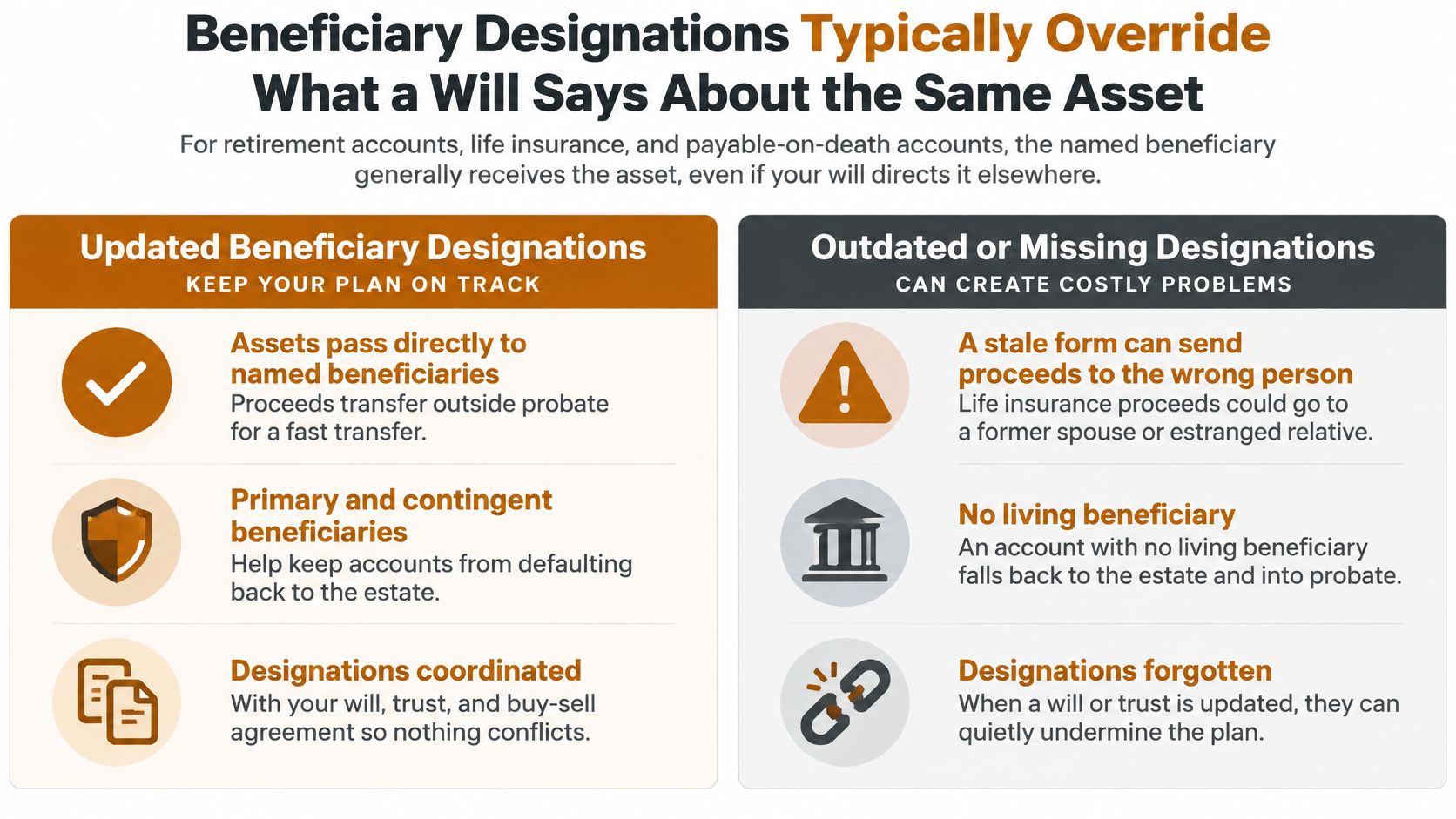
The comparison shows a clear trade-off: current forms move assets directly to heirs outside probate, while stale or blank forms push those same assets back through the estate.
An electrical contractor who divorced years earlier found his life insurance still named his former spouse. After updating the designation, proceeds went to his current spouse and children as intended.
Key insight: the form on file with the custodian wins, not the will, so the newest signature matters more than the best-drafted document.
A buy-sell agreement is a contract among owners that sets when an interest can be bought or sold after death, disability, retirement, divorce, or exit. For closely held companies, it is one of the estate planning documents needed because it decides who can buy, how price is set, and how the purchase is funded.
Two partners in a 25-year-old commercial HVAC company sign a cross-purchase agreement funded by life insurance. When one partner dies, the survivor uses the proceeds to buy the estate’s shares at the formula price, keeping control clear and giving the family cash instead of a forced sale.
Key insight: the funding matters as much as the formula, since a right to buy without cash behind it can still stall the transition.
For mechanics and funding options, see what a buy-sell agreement is and how it works.
An irrevocable life insurance trust is a trust that owns a life insurance policy, keeping the death benefit outside the owner’s taxable estate when properly structured and funded. Once established, the owner generally cannot change or revoke it. For owners with large estates, it earns its place among the estate planning documents needed because it gives heirs liquidity to pay estate taxes or buy out business interests without forcing a sale.
A plumbing company owner with a multi-million-dollar estate sets up an ILIT funded with a life insurance policy. The trust later provides cash to the owner’s children, who use it to pay estate costs rather than selling the company.
Key insight: an ILIT only delivers estate exclusion if the trust, not the insured, owns the policy, so personal ownership defeats the purpose.
For related planning approaches, see our guide on estate planning tax strategies.
| Estate-Planning Tool | 📊 Primary Outcome | 🔄 Complexity and Resources | ⭐ Key Advantage | 💡 Ideal Use Case |
|---|---|---|---|---|
| Last Will and Testament | Directs distribution of assets covered by the will; can name an executor and nominate guardians for minor children | Low to moderate; preparation and signing requirements apply | Clear, relatively affordable instructions for assets without another transfer plan | Establishing a basic estate plan and naming guardians; assets generally go through probate |
| Revocable Living Trust | Holds assets for management during incapacity and transfer to beneficiaries, often outside probate when properly funded | Moderate; setup costs and ongoing asset retitling are required | Can support privacy and business continuity during incapacity | Owners seeking probate avoidance for trust-titled assets and succession management |
| Durable Financial Power of Attorney | Authorizes an agent to handle specified financial and business matters during incapacity | Low to moderate; formal execution and careful agent selection are important | Enables timely handling of banking, payroll, and other financial tasks | Ensuring someone trusted can manage finances if the owner cannot act |
| Health Care Surrogate Designation | Names an agent to make medical decisions when the owner cannot | Low; discuss wishes, select an agent, and complete applicable forms | Gives providers and family clear decision-making authority | Naming a trusted medical decision-maker, often with a HIPAA authorization |
| Living Will | Records preferences for life-sustaining treatment in defined medical circumstances | Low; requires thoughtful instructions and accessible copies | Provides guidance to family and medical professionals | Communicating end-of-life treatment preferences |
| Beneficiary Designations | Directs specific accounts or policies to named beneficiaries, generally outside probate | Low; update forms with each account custodian or insurer | Can transfer assets directly and provide heirs timely liquidity | Coordinating retirement accounts, life insurance, and eligible bank or brokerage accounts |
| Buy-Sell Agreement | Sets terms, valuation, and funding for ownership transfers after specified events | High; legal drafting, valuation reviews, and funding arrangements are needed | Helps maintain business stability and provides a defined transfer process | Closely held businesses planning for an owner’s death, disability, retirement, or exit |
| Irrevocable Life Insurance Trust (ILIT) | Holds life insurance and may provide managed liquidity to beneficiaries; tax effects depend on proper structure | High; legal, insurance, tax, and ongoing administrative support may be needed | Can help provide liquidity and may keep proceeds outside the taxable estate when properly structured | Larger estates or business succession plans needing insurance-funded liquidity and willing to accept reduced control |
A will can say one thing while an old beneficiary form quietly does another. The estate planning documents needed to protect your family and business only work when they point in the same direction.
Review the will, living trust, powers of attorney, health care directives, beneficiary forms, and buy-sell agreement as one package. Beneficiary forms usually control the account they name, even if the will says otherwise, and a buy-sell agreement should match ownership records, insurance funding, and any succession plan.
A signed document is not a finished plan. It is one page in a system that has to hold up on a bad day.
If a move into a 55-plus community is part of retirement, this guide to protecting assets after downsizing in Rockwall shows how housing decisions and estate paperwork can affect each other.
Bring that packet to a business attorney, an estate planning attorney, and a financial professional, then ask each one to look for conflicts rather than reviewing a single document in isolation. Nothing here is legal, tax, or financial advice.
If your documents touch the business, the right specialist should understand both family goals and exit realities. The Owner’s Shortlist can connect you with a professional who has worked with owners in similar situations, with no cost or obligation.
Who wrote this: The Owner's Shortlist is not a broker and doesn't sell businesses. We get paid the same no matter which specialist we introduce you to. More about how we work.
Tell us your situation. We'll connect you with a specialist who works with owners like you. One conversation, no sales pressure.
Found this useful?
Add The Owner's Shortlist as a preferred source and get our articles highlighted in Google Search results.
Add to Preferred SourcesSuccession planning for business owners, step by step: set your goal, value the company, pick a path, and plan the next five years.
November 5, 2026
A succession planning meeting agenda, prep list, prompts, and 90-day follow-up for owners of service businesses.
November 3, 2026
Learn the succession planning process step by step: set a timeline, assess successor readiness, cover tax and legal points, and plan for sudden gaps.
October 26, 2026
Learn how family succession planning works, compare transfer options, manage family conflict, prepare for taxes, and build a practical transition timeline.
October 21, 2026