What Documents Should I Keep and for How Long in 2026
Find out what documents should I keep and for how long, with a retention chart for tax, payroll, contracts, injury logs and estate papers.
October 25, 2026
By Remi Taffin · November 7, 2026
Having an estate plan doesn’t mean your business is ready for a transfer. In a 2025 Brown Brothers Harriman survey of 491 private and family-business owners, 70% had an estate plan or written wealth-transfer strategy, yet many hadn’t shared their plans with family members. Documents alone can’t prepare a successor to run payroll, settle disagreements, or find cash for a tax bill.
For service-business owners, effective estate planning tax strategies connect tax rules with operating decisions. The right plan protects your family without leaving your plumbing, HVAC, roofing, or other service company short of cash or clear leadership.
Federal estate tax generally applies to the taxable value above the available exemption, not automatically to everything you own. Transfer-tax strategies become more relevant when your business interests, real estate, investments, and includible insurance approach that boundary.
Annual revenue isn’t estate value. A company you’ve built over decades may represent most of your personal wealth, even when you still think of it as a local service business. Start with what your ownership interest is worth, then choose a strategy that serves your actual goal.
| Owner goal | Strategy to consider | Main trade-off |
|---|---|---|
| Shift future growth out of the estate | Annual and lifetime gifts of company interests | Gifts above the annual exclusion generally use lifetime exemption; control must be documented |
| Freeze the value of a senior owner’s stake | GRAT, or grantor retained annuity trust | Death during the term can bring trust assets back into the estate |
| Transfer growth while keeping the trust outside the estate | IDGT, or intentionally defective grantor trust | Owner pays income tax on trust earnings; drafting and administration require care |
| Provide cash to pay estate tax | ILIT, or irrevocable life insurance trust | Premiums need funding, and personal ownership rights must be avoided |
| Move a home out of the estate | QPRT, or qualified personal residence trust | Owner must outlive the retained occupancy term |
| Pass value to family or key staff | Family limited partnership or sale to family or employees | Discounts need support; buyers need financing and repayment capacity |
| Reduce capital gains on inherited assets | Holding eligible assets until death for a basis adjustment | Waiting preserves estate exposure and doesn’t provide spending cash today |
The choice isn’t only which technique saves the most tax. Giving away an interest can sacrifice access to future income. Selling it creates a repayment risk. Holding it preserves flexibility but leaves future appreciation in your estate.
Start with the constraint: Decide whether your biggest problem is estate exposure, retirement income, successor readiness, or cash after death.
Documents, valuation, and funding must work together. A trust can direct where an asset goes, but it can’t make an underfunded buyer creditworthy or turn company equipment into immediately available cash.
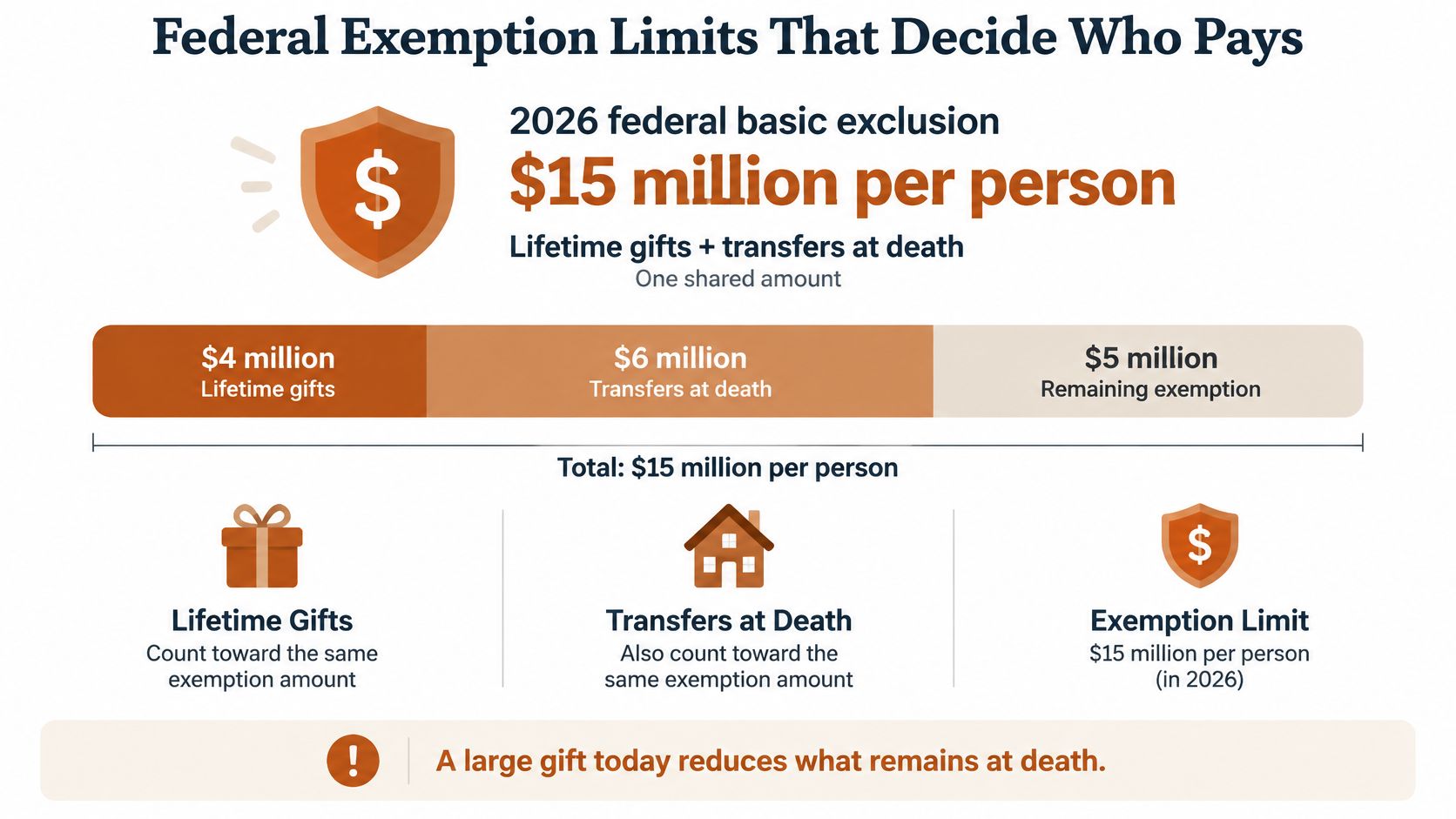
The federal exemption is a shared allowance for taxable lifetime gifts and transfers at death. A substantial gift can use exemption that would otherwise remain available to shelter your estate. Don’t treat the gift-tax and estate-tax allowances as separate accounts.
Current-law review matters because the allowance has changed substantially. The Congressional Research Service reports that the individual exemption reached $13.99 million in 2025, while the federal rate on taxable transfers remained as high as 40%. An old planning memorandum may accurately describe an old rule and still lead you toward the wrong decision today.
Ask your advisors to assemble:
Say an owner’s business dominates the inventory, with a home and retirement savings adding a substantial amount. Even if the initial estimate falls below the exemption, company growth or an overlooked policy could change the result. That’s why a rough calculation is a screening tool, not a tax return.
Insurance causes particular confusion. A death benefit’s income-tax treatment doesn’t by itself determine whether it belongs in the taxable estate. Coveredly’s explanation of estate taxes on life insurance proceeds provides useful context for reviewing policy ownership with counsel.
A federal exemption calculation isn’t a complete estate-tax analysis. Some states impose estate or inheritance taxes under different rules and potentially lower thresholds.
Ask counsel to review your residence, property locations, and beneficiaries rather than assuming federal treatment controls everything. Your planning should also distinguish gross estate value, taxable estate value, and cash available to heirs. Those are different measurements, and each answers a different question.
A completed gift can move an ownership interest, and its subsequent appreciation, outside your estate. The annual exclusion provides a way to make qualifying gifts without using lifetime exemption, but it’s a dollar-value allowance, not permission to give away any percentage of a company tax-free.
The IRS estate-and-gift-tax guidance provides the following per-recipient exclusion schedule; the married-couple column shows the combined amount when both spouses make qualifying gifts, subject to applicable filing and gift-splitting rules.
| Years | Annual exclusion per recipient | Combined amount for both spouses |
|---|---|---|
| 2011-2012 | $13,000 | $26,000 |
| 2013-2017 | $14,000 | $28,000 |
| 2018-2021 | $15,000 | $30,000 |
| 2022 | $16,000 | $32,000 |
| 2023 | $17,000 | $34,000 |
| 2024 | $18,000 | $36,000 |
| 2025-2026 | $19,000 | $38,000 |
Because the exclusion applies separately to each recipient, gifts to different family members can use separate allowances. However, dividing a business interest among more recipients also creates more owners, which deserves operational attention.
Suppose a plumbing-company owner wants to give small interests to several children. The first step isn’t signing transfer documents. It’s obtaining a valuation of the specific interests being transferred, including their voting, distribution, and transfer rights.
Then counsel checks the operating agreement, shareholder restrictions, lender requirements, and any business tax-election concerns. After the transfer, update the ownership ledger and preserve the valuation and executed documents.
A repeatable gifting program needs:
Portability addresses a different problem. A surviving spouse can preserve a deceased spouse’s unused federal exclusion through a timely estate-return election on Form 706. It doesn’t make annual gifting unlimited or remove the need to review future appreciation and state taxes.
For the broader family discussion, our intergenerational wealth-transfer guide helps connect financial transfers with preparation. Families seeking state-specific context can also use the Law Office of Bryan Fagan, PLLC’s legacy planning guidance for Texas families to prepare questions for their own advisors.
The annual exclusion covers present interests, not automatically a beneficiary’s right to receive property years later. The IRS guidance for 2026 identifies a $15 million basic exclusion per person and a $19,000 annual exclusion per recipient, with qualifying gifts above the annual allowance generally requiring Form 709 and using lifetime exemption even when no immediate gift tax is due.
Think of a trust as a container with legally enforceable instructions. The instructions determine who receives income, who controls assets, and when beneficiaries can obtain them. Withdrawal rights can sometimes help gifts qualify as present interests, but drafting the rights isn’t enough, the trustee must administer them properly.
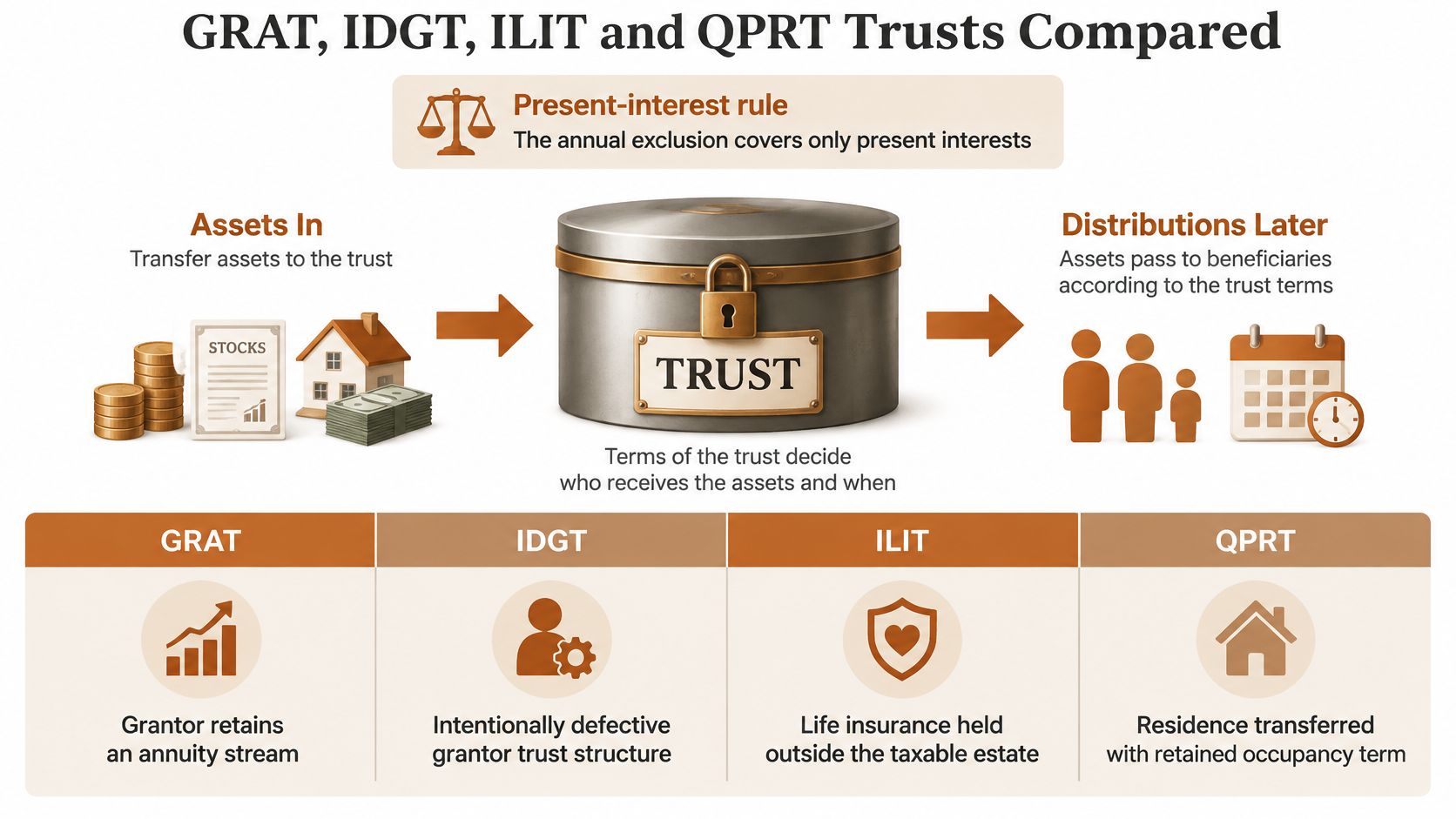
A GRAT accepts assets while paying the grantor a specified annuity for a defined term. If the assets outperform the interest assumption used in the tax calculation, remaining value may pass to beneficiaries with a reduced taxable gift.
For a business owner, the practical question is whether the trust can make its annuity payments without disruptive distributions or transfers. Poor performance may leave little remainder, and death during the term can cause estate inclusion. It isn’t an unconditional estate freeze.
An IDGT separates income-tax treatment from estate-tax treatment. When properly structured, the grantor pays income tax on trust earnings even though trust assets aren’t included in the grantor’s estate.
A common arrangement combines an initial gift with a sale to the trust for an installment note. It needs credible valuation, adequate capitalization, and real payments. If company distributions can’t service the note, the intended transfer becomes a financing problem.
An ILIT holds life insurance under terms designed to keep the proceeds outside the insured’s taxable estate. The trustee may use the proceeds to provide estate liquidity through properly structured loans or purchases.
Policy ownership, premium gifts, beneficiary provisions, and trustee administration all matter. Transferring an existing policy creates additional estate-inclusion risks that counsel must review. The Law Office of Bryan Fagan’s discussion of protecting your family’s life insurance payout offers context for that conversation.
A QPRT transfers a residence while reserving occupancy for a term. Surviving that term is central to the intended estate-tax result; dying during it can bring the residence back into the estate. Continued occupancy afterward generally requires a separate arrangement, often involving rent.
A trust isn’t a tax result by itself. The asset transfer, retained rights, payments, and administration must match the document.
Each structure requires custom drafting. Valuation, interest assumptions, health, and cash flow determine whether the projected benefit is realistic.
A family limited partnership can separate management authority from economic ownership. An owner may retain the general partner interest while transferring limited partner interests to relatives. The relatives receive defined economic rights without automatically receiving day-to-day operating authority.
Limited interests may qualify for valuation discounts reflecting restrictions, lack of control, or limited marketability. Those aren’t automatic reductions that an owner chooses from a menu. An independent appraiser must evaluate the actual rights, and the family must respect the entity’s business purpose and formalities.
Keep partnership accounts separate from personal spending. Follow the agreement’s distribution provisions, record decisions, and don’t assume that retaining unrestricted personal access to transferred property is compatible with removing it from the estate.
For an operating service business, counsel must also review entity eligibility, licensing, existing contracts, and tax elections before inserting a partnership into the ownership structure.
A sale to family follows a different path. The buyer acquires the interest, often using a promissory note with an appropriate interest rate and repayment schedule. Future appreciation can belong to the buyer, but the seller still owns the note, which itself has value for estate purposes.
Say a service-business owner sells to a daughter and stays temporarily as a consultant. If her payments come from company profits, the financial model must cover payroll, taxes, equipment replacement, working capital, her compensation, and debt service before assuming the seller receives reliable retirement income.
A family sale isn’t affordable merely because the family agrees on the price.
A capable employee may be better prepared to run the company than a relative. Seller financing, an earnout, or an employee ownership structure may help address purchase capital, but each creates different legal, tax, and repayment obligations.
Compare prospective arrangements by asking:
Our company ownership-transfer guide provides context for discussing these alternatives. Family meetings and successor training belong beside the transaction documents, not after closing, when disagreements are harder to resolve.
Estate tax and capital gains tax measure different things. Estate tax concerns transferred value. Capital gains tax generally concerns the difference between tax basis and sale proceeds.
Eligible inherited assets generally receive a basis adjustment to their value at death, often called a step-up in basis. A lifetime gift generally carries over the donor’s basis instead. That difference can make giving away an appreciated asset less attractive than the estate-tax calculation initially suggests.
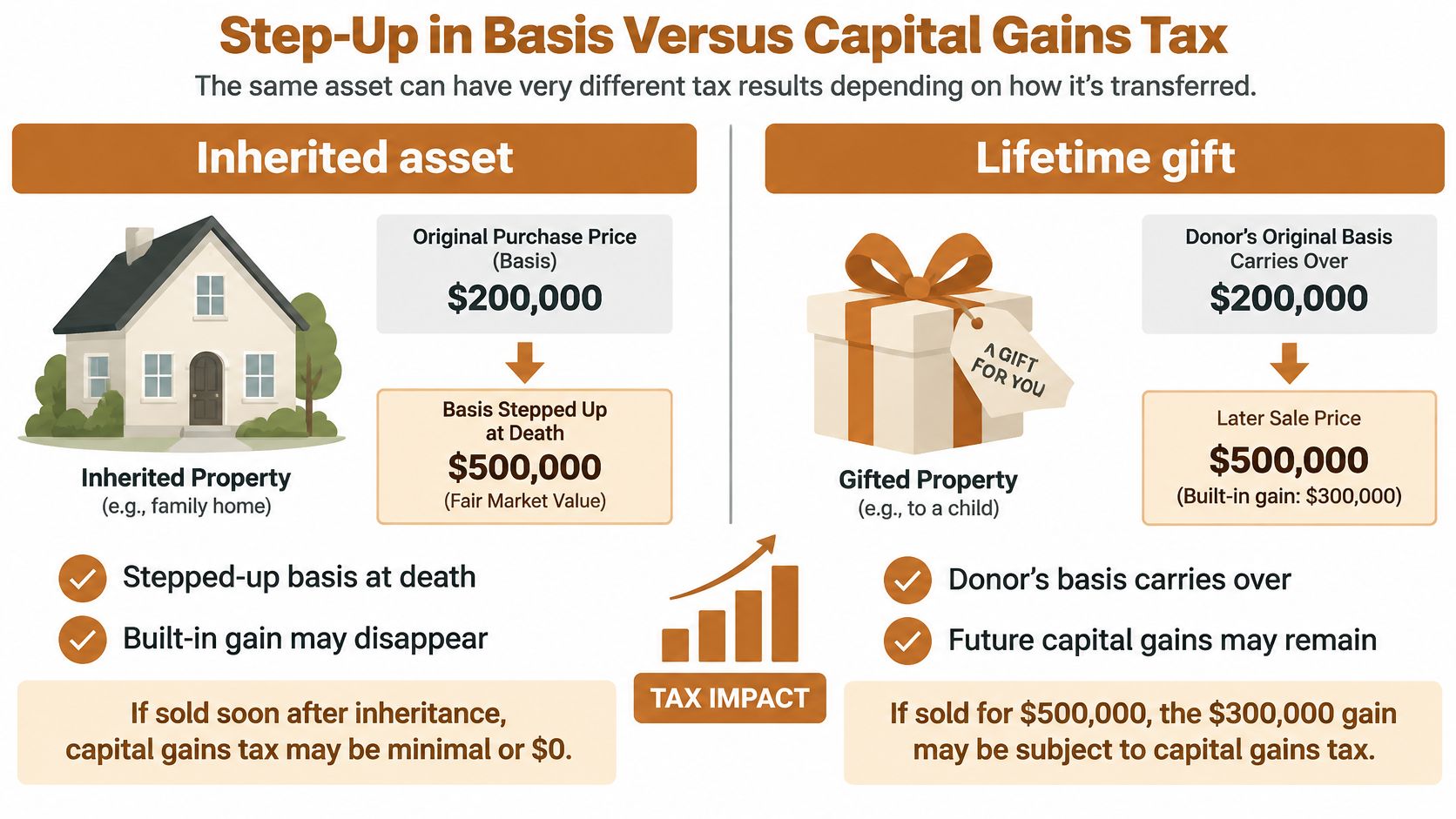
Suppose an owner’s business shares have a low tax basis and a much higher current value. Giving those shares to a child may remove subsequent growth from the owner’s estate, but the child generally receives the existing basis. Selling later can therefore produce a substantial taxable gain.
Holding eligible shares until death may remove that pre-death built-in gain through the basis adjustment. However, the shares remain part of the estate-tax calculation, and appreciation after death can create a new gain.
Step-up in basis versus lifetime transfer outcomes
| Situation | Estate tax result | Income tax result for recipient | Planning focus |
|---|---|---|---|
| Estate below the federal exemption | Generally no federal estate tax | Eligible inherited assets generally receive a basis adjustment | Preserve basis records and address liquidity and control |
| Estate above the exemption, asset held until death | Taxable estate exposure remains | Basis adjustment may remove pre-death built-in gain | Compare estate exposure with income-tax savings |
| Lifetime gift of appreciated shares | Generally uses exemption when not otherwise excluded; subsequent growth may be outside the estate | Recipient generally takes carryover basis | Weigh lost basis adjustment against transferred appreciation |
| Sale during life at high gain | Remaining proceeds still belong to the owner | Seller recognizes taxable gain; buyer generally receives cost basis | Compare cash needs, current tax, and future estate exposure |
A basis adjustment in inherited company stock isn’t necessarily an adjustment to the company’s underlying equipment, real estate, or goodwill. A later asset sale can therefore produce a different result from a stock sale.
Retirement accounts also don’t receive the same general treatment as eligible appreciated investment assets. Ask your CPA to analyze each asset category rather than applying a single assumption across the estate.
The practical decision is whether you need cash now, expect estate-tax exposure, and can afford to transfer the asset permanently. Model estate tax, income tax, and after-tax family cash together, including the likely form of an eventual business sale.
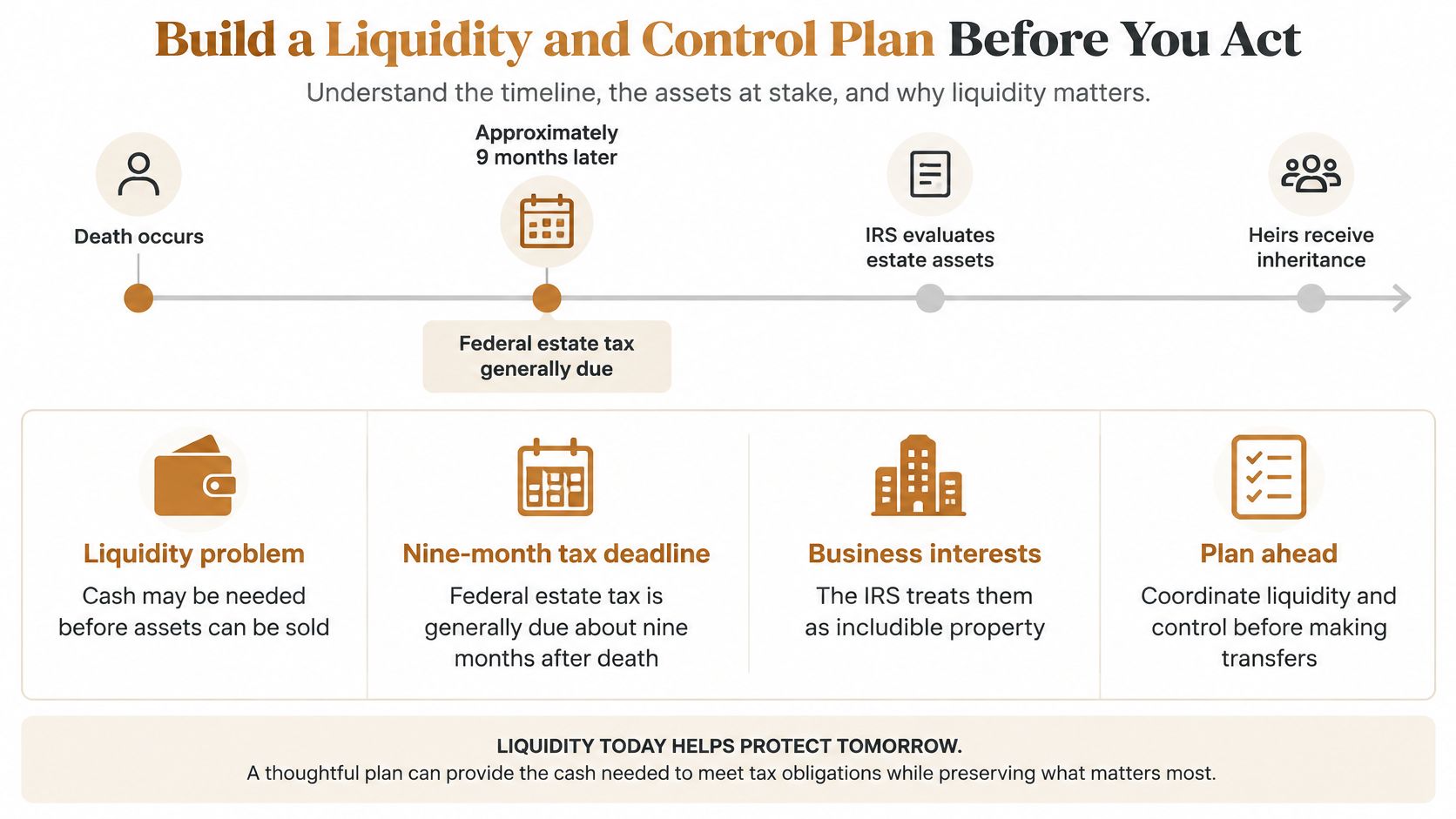
A valuable business can leave heirs with too little spendable cash. The IRS estate-tax guidance treats business interests as includible property and describes the nine-month federal filing window. Plan for cash needs around that deadline, and have counsel confirm payment timing and any available relief rather than assuming a filing extension postpones payment.
The operating question is immediate: who can approve payroll, access accounts, retain managers, and negotiate with lenders while the estate is being administered? Naming an executor doesn’t automatically resolve every company-level authority issue.
A life-insurance-funded buy-sell agreement can provide purchase money when an owner dies. It requires affordable coverage, reliable premium payments, and coordinated ownership and beneficiary provisions. Don’t assume the policy’s face amount still matches the company’s purchase price.
Business reserves provide accessible funding without underwriting, but cash earmarked for heirs can’t simultaneously fund trucks, payroll, and seasonal expenses. Identify what the company can release without weakening operations.
An installment arrangement spreads the buyer’s payments. It doesn’t necessarily supply the estate’s immediate tax cash, and the seller’s estate remains exposed to the buyer’s creditworthiness and company performance.
A sale under pressure may produce cash, but buyers can demand concessions when heirs have limited time. Treat it as a contingency, not the primary funding plan.
An appraisal supports the pricing discussion, but it doesn’t automatically make an agreement binding for tax purposes. Counsel should coordinate the valuation method, funding, purchase obligations, and applicable tax rules.
Start with an estate attorney for trusts and legal authority, a CPA or tax specialist for transfer reporting and income-tax modeling, and a valuation specialist or business broker for value and transaction feasibility. Our wealth-planning guide for business owners provides additional preparation for those conversations.
We list specialists who work with owners on valuation, taxes, legal matters, deal structure, and family transfers. This guide and everything on our site are general information, not legal, tax, financial, or professional advice. Confirm decisions with qualified specialists who can review your circumstances and current law.
The Owner’s Shortlist offers plain-language guidance and a curated network of specialists for Florida business owners. Tell us whether you’re preparing a family transfer, protecting retirement income, or considering a sale, and we can connect you with a specialist suited to that decision. Owners pay nothing for an introduction, and there’s no obligation.
Who wrote this: The Owner's Shortlist is not a broker and doesn't sell businesses. We get paid the same no matter which specialist we introduce you to. More about how we work.
Tell us your situation. We'll connect you with a specialist who works with owners like you. One conversation, no sales pressure.
Found this useful?
Add The Owner's Shortlist as a preferred source and get our articles highlighted in Google Search results.
Add to Preferred SourcesFind out what documents should I keep and for how long, with a retention chart for tax, payroll, contracts, injury logs and estate papers.
October 25, 2026
Tax attorney vs CPA explained for owners planning an exit or succession. See who handles what, where they overlap, what it costs, and which to hire first.
October 8, 2026
Explore business tax planning strategies for small and mid-sized owners preparing for succession or sale, with trade examples and expert guidance.
October 1, 2026
Understand business sale capital gains tax before you sell. Learn short vs long-term rates, asset vs stock sales, and planning strategies to keep more proceeds.
September 30, 2026