Business Tax Planning Strategies: A 2026 Guide for Owners
Explore business tax planning strategies for small and mid-sized owners preparing for succession or sale, with trade examples and expert guidance.
October 1, 2026
By Remi Taffin · October 8, 2026

You’ve owned an HVAC, plumbing, or other service business for years. The books are mostly in order, customers keep renewing maintenance agreements, and then a buyer sends a letter of intent. Suddenly, “Who should I call, my CPA or a tax attorney?” becomes a deal question, not a general tax question.
The practical answer depends on where you are in the transaction. A CPA usually leads the financial preparation and tax modeling. A tax attorney becomes more important when the deal structure, contract language, disputed tax positions, privilege, or litigation risk enters the room. In many exits, the right answer is both, brought in at different moments.
A long-tenured owner often reaches the letter-of-intent stage with one professional already nearby. The CPA has prepared returns, cleaned up the books, and helped manage cash flow. The attorney may have handled employment matters, leases, or estate documents. Neither relationship automatically means that person is the right lead for an acquisition or succession transaction.
The first question isn’t “Which credential is better?” Ask instead: What decision must be made before the next document is signed? If you need to understand normalized earnings, tax basis, depreciation recapture, and likely after-tax proceeds, start with the CPA. If you need to assess the legal effect of an asset sale, equity sale, representations, indemnities, or sensitive disclosures, involve a tax attorney before you commit.
That timing matters because an LOI can establish commercial assumptions that later become expensive to change. A purchase-price allocation, proposed payment schedule, working-capital adjustment, or treatment of liabilities can affect both the financial model and the legal risk. Owners who wait until the purchase agreement is nearly complete often ask their advisers to repair terms that should have been negotiated earlier.
Practical rule: If the LOI is unsigned, call the CPA for the numbers and the tax attorney for the structure. If the LOI is already signed, call both before diligence hardens the deal.
You may also want a broader legal review of the sale process. The practical distinction between ordinary transaction support and legal representation is addressed in this guide on whether you need an attorney to sell a business.
The rest of the decision is straightforward. Match each stage to the professional who owns the underlying work, then bring in the second specialist before the first professional’s work becomes a constraint.
A CPA and a tax attorney are not interchangeable professionals, but the IRS gives both meaningful administrative representation authority. The IRS defines an attorney as a member in good standing of the bar of a U.S. state, territory, possession, or the District of Columbia. A CPA must be qualified to practice as a CPA in one of those jurisdictions, and either professional must be active rather than suspended or disbarred. IRS guidance on practitioner representation explains the authorization framework.

The taxpayer generally grants authority through Form 2848, Power of Attorney and Declaration of Representative. That form identifies the tax type, forms, and periods covered. In other words, representation isn’t an informal promise to “deal with the IRS.” It is authority tied to defined matters.
A CPA’s training centers on financial records, reporting, controls, calculations, and tax-return preparation. That makes the CPA the natural first call when the problem is a messy general ledger, inconsistent revenue recognition, uncertain asset basis, or a business owner who needs a defensible after-tax model.
Public accountants may also perform auditing, tax, and consulting work. Labor-market data reflects the scale of the profession. The U.S. Bureau of Labor Statistics reported approximately 1.6 million accountant and auditor jobs in 2025, projected 5% employment growth from 2025 through 2035, and about 115,300 openings per year. These figures come from the Bureau of Labor Statistics occupational outlook.
Owners commonly call a CPA first because the relationship is already recurring and the work begins with financial facts.
A tax attorney is trained to interpret law, advise on legal rights and obligations, structure transactions, negotiate disputed liabilities, and manage litigation strategy. That doesn’t make the attorney a replacement for a CPA who understands the company’s books. It means the attorney owns questions where the answer depends on legal authority, contract language, contested positions, or escalation risk.
The same BLS source reports lawyer employment growth of about 4% from 2024 through 2034, with roughly 31,500 annual openings. The professions overlap around tax, but their operating disciplines remain different. If you need help building the numbers, choose accounting depth. If you need legal analysis or a defensible position in an adversarial setting, choose legal depth.
For owners who want to understand the business side of the accounting profession, this resource on how to start a CPA firm successfully provides useful context. For exit preparation itself, review a practical guide to tax planning for business owners.
Titles matter less once you look at the deliverables. A buyer, seller, or family successor needs specific work products, and each professional has a clear center of ownership.
The CPA should generally lead the baseline model. That includes reconciling tax and accounting records, normalizing earnings, analyzing basis, modeling depreciation recapture, testing cash-flow assumptions, and estimating the tax consequences of alternative structures.
For a service business, the model should separate recurring maintenance revenue from one-time project work, identify owner-specific expenses, and show which costs will continue after the transfer. The CPA isn’t deciding the legal meaning of a purchase agreement. The CPA is establishing whether the numbers behind that agreement are complete and credible.
A tax attorney can review the tax treatment assumed by the model, especially where the result depends on legal characterization. But asking an attorney to build the financial foundation from incomplete records is usually an inefficient use of time.
The tax attorney owns the legal review of the LOI, purchase agreement, disclosure schedules, indemnities, restrictive covenants, and related documents. The attorney evaluates how the proposed deal allocates risk and whether the language matches the intended tax and business outcome.
The CPA still has an important role. The CPA can test whether the purchase-price allocation is supported by the business’s assets, whether the payment schedule creates workable cash flow, and whether the tax assumptions agree with the accounting records. But the attorney should control legal drafting and negotiations.
Both professionals may represent an authorized taxpayer before the IRS. That authority doesn’t erase the difference in judgment. The CPA is usually strongest when the examination turns on records, reconciliations, schedules, or quantitative support. The tax attorney is usually stronger when the matter turns on statutory interpretation, disputed liability, settlement strategy, privilege-sensitive communications, or legal exposure.
The authorization also has boundaries. It identifies specific tax matters, forms, and periods. A general engagement letter doesn’t give either professional unlimited authority over every tax issue in the owner’s history.
An administrative appeal may be handled by a CPA or tax attorney, depending on the issue. If the dispute is primarily factual, a CPA may reconstruct the books and quantify the position. If the dispute requires legal argument, formal pleadings, settlement strategy, or court admission, the tax attorney should lead.
IRS guidance on court representation and procedural requirements makes the important distinction clear: administrative representation is not the same as authority to practice in federal court. Before hiring anyone, ask who can sign filings, which forums they can enter, and whether the engagement includes an appeal or stops at the examination stage.
Consider an owner of a recurring-revenue plumbing business. The company has service agreements, installation work, several trucks, a long-serving team, and a customer list that a buyer values. The owner wants to sell but also wants to preserve the family’s financial security and avoid a tax result that undermines the headline price.
The CPA enters during preparation. The first assignment is not “prepare for the buyer.” It is to make the business explainable. The CPA reconciles financial statements and tax returns, separates unusual expenses, reviews asset basis, and builds a model showing taxable income and cash flow under possible deal structures.

Before outreach, the CPA should identify issues that a buyer will discover anyway. Missing support for equipment, inconsistent treatment of owner compensation, and unclear treatment of customer deposits can all weaken confidence in the numbers. The owner doesn’t need perfect records, but the owner does need a coherent explanation supported by documents.
The attorney may enter here if the owner is considering a family transfer, a restructuring, or a sensitive disclosure. This is also the point to identify legal constraints in leases, employment arrangements, customer contracts, and ownership documents.
Once an LOI arrives, the attorney reviews the structure before the owner signs. The CPA tests whether the proposed price, working-capital mechanism, earnout, installment arrangement, or allocation assumptions fit the financial model.
During diligence, the CPA answers factual questions and prepares schedules. The attorney controls responses that could create legal admissions, expand indemnity exposure, or reveal a disputed tax position without a clear strategy.
The purchase agreement brings both professionals into the same room. The CPA checks closing statements, payoff amounts, tax allocations, and the flow of funds. The attorney negotiates representations, warranties, covenants, indemnities, escrow terms, and conditions to closing.
For a family succession, the same sequence applies even when there isn’t an outside buyer. The CPA models the transfer’s financial consequences, while the attorney coordinates ownership documents, governance, estate planning, and enforceable obligations between family members.
After closing, the CPA handles filing positions, records, and implementation of the tax model. The attorney addresses surviving obligations, disputes, transfer documents, and estate or governance work that the transaction created. Owners should define this post-close scope before signing, because “closing support” often ends sooner than expected.
The price question is real, but hourly-rate comparisons rarely help an owner budget intelligently. Exit work becomes expensive when the scope is vague, records are incomplete, or the professional is brought in after commercial terms are already fixed.
A CPA engagement often starts with a defined scope for cleanup, tax modeling, return preparation, or diligence schedules. A tax attorney may bill hourly for document review and negotiation, use a fixed fee for a defined legal analysis, or require a retainer where disputes or urgent negotiations are possible. The right fee structure depends on the work, not the title.
For general tax-return context, WP TieOut tax cost benchmarks can help an owner understand why ordinary compliance pricing doesn’t translate neatly to exit work.
| Dimension | CPA | Tax Attorney |
|---|---|---|
| Primary scope | Records, tax returns, financial modeling, basis, schedules, and accounting diligence | Legal structure, transaction documents, disputed positions, negotiations, privilege, and litigation strategy |
| Common fee approach | Fixed scope for modeling or returns, hourly or recurring fees for cleanup and support | Fixed fee for defined advice, hourly billing for negotiations, and retainers for controversy |
| What drives the bill up | Disorganized books, missing support, multiple entities, amended calculations, and repeated buyer requests | Extensive document revisions, urgent negotiations, complex structures, disputes, appeals, and litigation preparation |
| Best budget question | What records and model deliverables are included, and who handles follow-up questions? | Which documents, negotiations, forums, and escalation stages are included? |
| Typical handoff | Financial model and schedules to the attorney and deal team | Legal structure and contract terms back to the CPA for tax and cash-flow testing |
The hidden cost is rework. If the CPA discovers late that the transaction structure produces an unattractive tax result, the attorney may need to renegotiate terms. If the attorney finds late that a representation cannot be supported, the CPA may have to reconstruct records under pressure.
Cost discipline means paying for the right review before the next commitment, not choosing the cheapest professional at the beginning.
Ask for a written scope, assumptions, exclusions, billing rates, retainer requirements, and a clear escalation path. A low initial quote isn’t a bargain if it covers only the first document and leaves every consequential issue outside the engagement.
The static question, “CPA or tax attorney?” produces weak advice because it ignores the deal clock. Use the professional who owns the next irreversible decision, then add the second specialist before that decision becomes difficult to change.
Call the CPA for readiness and valuation. Call the tax attorney for structure and documents. Use both at closing and for post-close compliance.
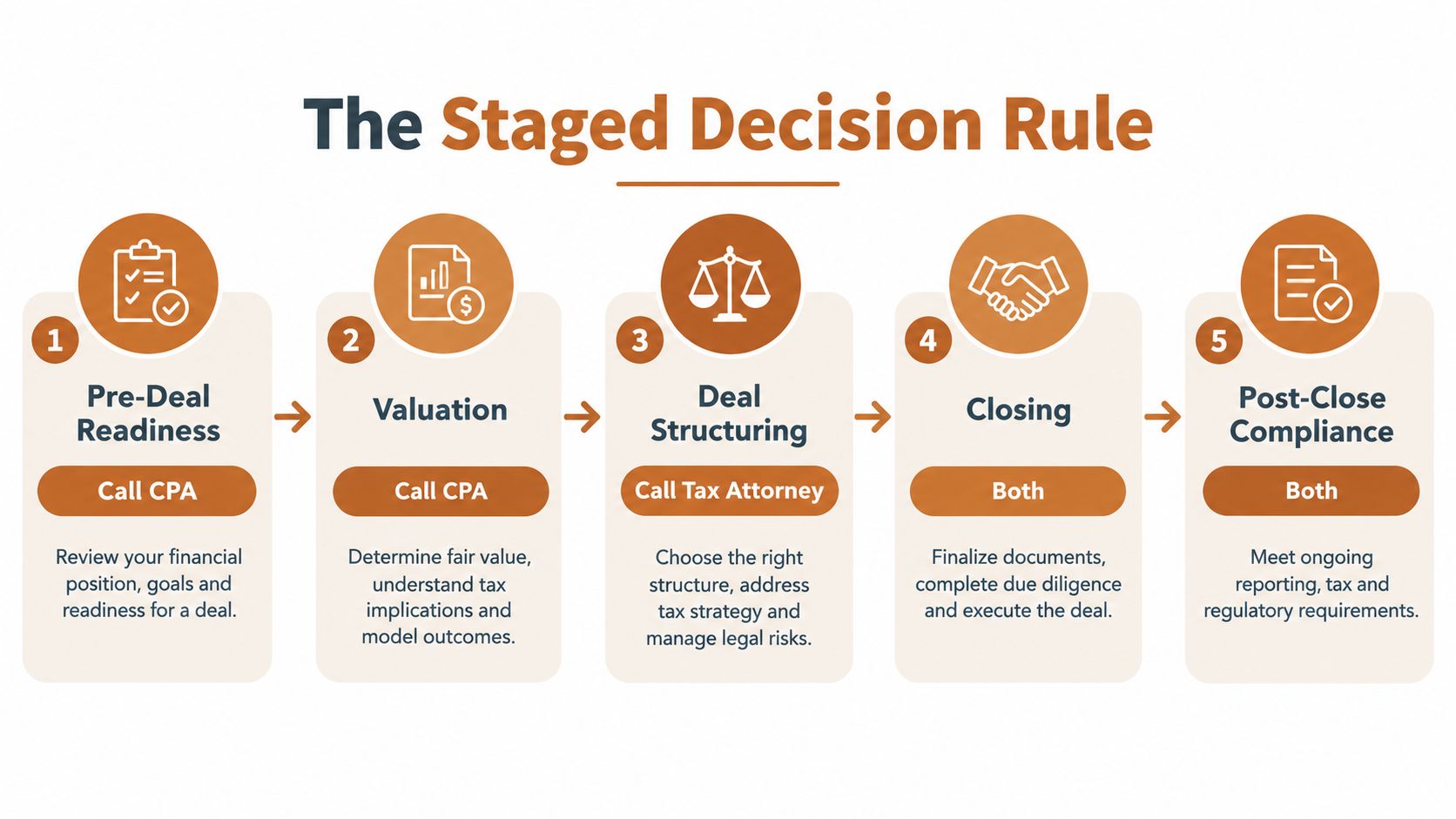
Pre-deal readiness: Start with the CPA. Clean the records, identify basis, normalize earnings, and establish a tax and cash-flow baseline.
Valuation: Keep the CPA involved. The valuation may be prepared by a separate specialist, but the CPA should test the financial assumptions and show what the stated value means after tax.
Deal structuring: Bring in the tax attorney before signing an LOI if the structure is material. The attorney should review asset versus equity treatment, payment terms, indemnities, disclosures, and legal exposure.
Closing: Use both. The CPA verifies the financial and tax mechanics. The attorney controls the legal documents and closing obligations.
Post-close compliance: Keep both available where the transfer creates continuing tax, estate, governance, or dispute issues. A clean closing doesn’t automatically resolve every obligation.
Don’t use aggregate enforcement trends to decide whether your own records are safe. The IRS reported $93.8 billion in enforcement revenue in FY2025, including a 35% decline in examination-related revenue from the prior year, but those aggregate figures don’t establish an individual owner’s audit posture. The figures appear in the IRS enforcement and compliance report.
If the matter has already become adversarial, neither professional should be selected solely because they prepared prior returns. Confirm the representative’s authority, the intended forum, and whether the team can handle escalation.
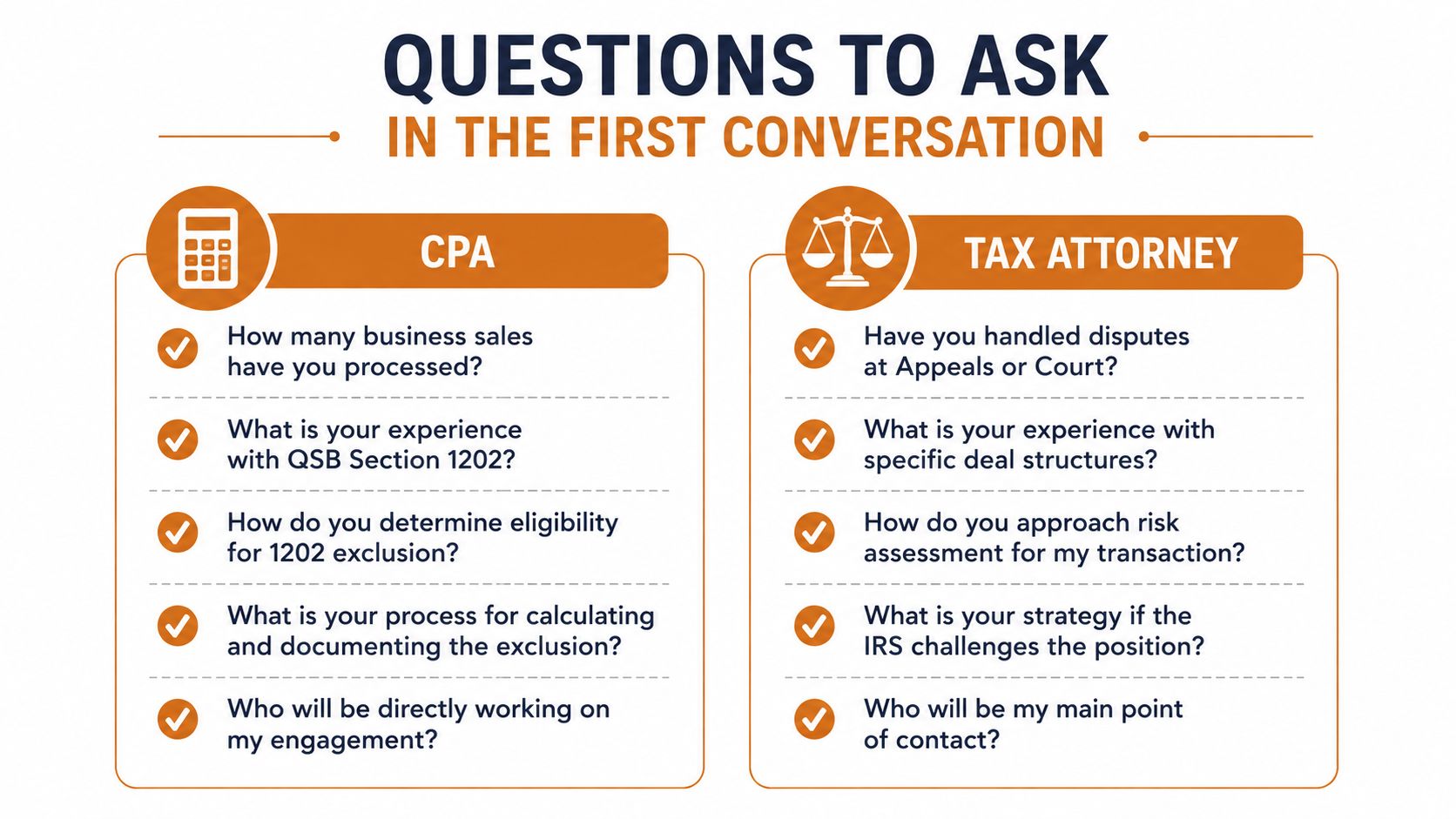
A first meeting should test fit, not invite a polished sales presentation. Ask for examples that resemble your company, your structure, and your stage of the deal. A professional who can explain the limits of the engagement is usually safer than one who promises to handle everything.
Start with the work product.
A strong CPA won’t treat the tax model as a standalone spreadsheet. The model should connect to the proposed deal terms and show the owner what cash remains after taxes, debt, and transaction obligations.
The attorney conversation should focus on legal ownership of the risk.
Also ask both professionals who will perform the work. The partner or named attorney may lead the relationship while a staff member prepares schedules or reviews documents. That arrangement can work, but you should know it before engagement.
Owners often assume the expensive mistake is choosing a CPA when they needed a tax attorney, or choosing an attorney when a CPA would have handled the issue efficiently. That mistake happens, but the larger problem is usually timing.
A CPA brought in early can expose weak records before a buyer does. A tax attorney brought in before the LOI can identify structural and contractual problems before the owner treats them as settled. The two professionals become far less effective when they receive a nearly complete deal and are asked to approve it under pressure.
The rule is simple:
For owners transferring a company within the family, legal and tax analysis should also connect to the wider estate plan. This guide to estate planning for business owners can help frame that conversation before documents are finalized.
The choice isn’t a permanent marriage to one adviser. Start with the professional who owns the next decision, bring in the other before the deal reaches an irreversible point, and require both to state clearly what they will and won’t do.
The Owner’s Shortlist offers a curated directory and practical guides for owners comparing specialists for valuation, taxes, legal matters, financing, and succession. Use The Owner’s Shortlist to review relevant resources or connect with a specialist before your LOI, family transfer, or purchase agreement moves forward.
Tell us your situation. We'll connect you with a specialist who works with owners like you. One conversation, no sales pressure.
Found this useful?
Add The Owner's Shortlist as a preferred source and get our articles highlighted in Google Search results.
Add to Preferred SourcesExplore business tax planning strategies for small and mid-sized owners preparing for succession or sale, with trade examples and expert guidance.
October 1, 2026
Understand business sale capital gains tax before you sell. Learn short vs long-term rates, asset vs stock sales, and planning strategies to keep more proceeds.
September 30, 2026
Learn what is capital gains tax, how short- and long-term rates work, and how the rules apply when you sell a business. Clear guidance
September 22, 2026
Tax planning for business owners preparing to sell or transition. Learn timelines, entity strategy, and how to keep more of your exit proceeds.
August 4, 2026