Tax Attorney vs CPA for Business Exits and Succession
Tax attorney vs CPA explained for owners planning an exit or succession. See who handles what, where they overlap, what it costs, and which to hire first.
October 8, 2026
By Remi Taffin · October 25, 2026
You’re staring at a cabinet that hasn’t been sorted since the last truck was financed, and someone just asked what the company is worth. The 2022 payroll folder is in there. So is a building closing statement, a stack of vendor receipts, and a will nobody has opened since it was signed. The useful question is what documents should I keep and for how long, and the date printed on the paper is the wrong place to start.
The retention clock runs from the last event that still depends on a record, not from the day it was created. A van invoice isn’t finished when that tax year ends. It’s finished when the van is sold and the tax window on that sale closes. A planned sale or a family handover does one more thing. It turns files you treated as temporary into files a buyer, a spouse, or a successor will expect to see.
Use one scan on day one. When two rules touch the same document, keep it for the longer one.
| Document | Keep for | Why it matters |
|---|---|---|
| Federal income tax returns and supporting receipts | 3 years from filing | Standard IRS examination window |
| Records for bad-debt or worthless-securities deductions | 7 years | Longer window for loss claims |
| Payroll and employment-tax records | 4 years after tax is due or paid, whichever is later | Employment-tax limitation period |
| OSHA 300, 300A and 301 injury and illness logs | 5 years after the end of the calendar year covered | OSHA access and update period |
| Employee medical and exposure records | Employment plus 30 years | OSHA medical-record rule |
| Vehicle, equipment and building purchase and depreciation records | Until the limitation period ends after disposal (usually 3 years) | Basis determines the final gain or loss |
| Home and rental property purchase and sale records | Until the limitation period ends for the year of sale | Ownership and basis history |
| Bank and credit card statements | 3 years, or 7 if they support a loss claim | Matches the return they support |
| Customer contracts, warranties and service agreements | Life of the contract plus 6 years | Covers common state written-contract claim windows |
| Personnel files (hiring, reviews, separation) | 7 years after the employee leaves | Common practice for wage and discrimination claims |
| Corporate minutes, stock ledgers, articles and bylaws | Permanent | Proves ownership and authority |
| Sale, purchase and closing documents | Permanent | Ownership and tax basis history |
| Wills, trusts, powers of attorney and certified identity records | Permanent, originals or certified copies with backups | Identity, family and legal authority |
| UK self-employed business records (HMRC) | 5 years after the 31 January submission deadline for the tax year | UK rule; confirm with HMRC |
A bank statement that only supports an ordinary return can follow the three-year row. The same statement that proves a bad-debt write-off stays with the seven-year loss file. Federal income-tax, loss, payroll, and property rows follow IRS guidance on how long to keep records. Injury logs and medical files follow OSHA, not the tax calendar. Contract and personnel rows are common practice across many states, not a single federal number, so confirm them before you shred.
A blanket keep everything seven years policy is easy to explain and wrong in both directions. Ordinary returns often need three years. Payroll needs at least four. Ownership papers don’t expire because a calendar page turned. Short destruction creates a hole. Keeping every receipt forever fills the cabinet and still misses the permanent set if nobody labeled it.
State tax agencies, licensing boards, and trade rules can add years. Treat the table as a planning start, not legal advice. Owners cleaning tax files before a sale can pair this schedule with small business tax planning.
If you’re self-employed in the UK, HMRC’s 2026 guidance says business records must be kept for at least 5 years after the 31 January submission deadline for the relevant tax year. Don’t apply the U.S. three-year row to a UK return.
A warranty doesn’t start when the manufacturer printed the card. It starts on the install date. A retention period works the same way. It starts on the last event that still needs the record.
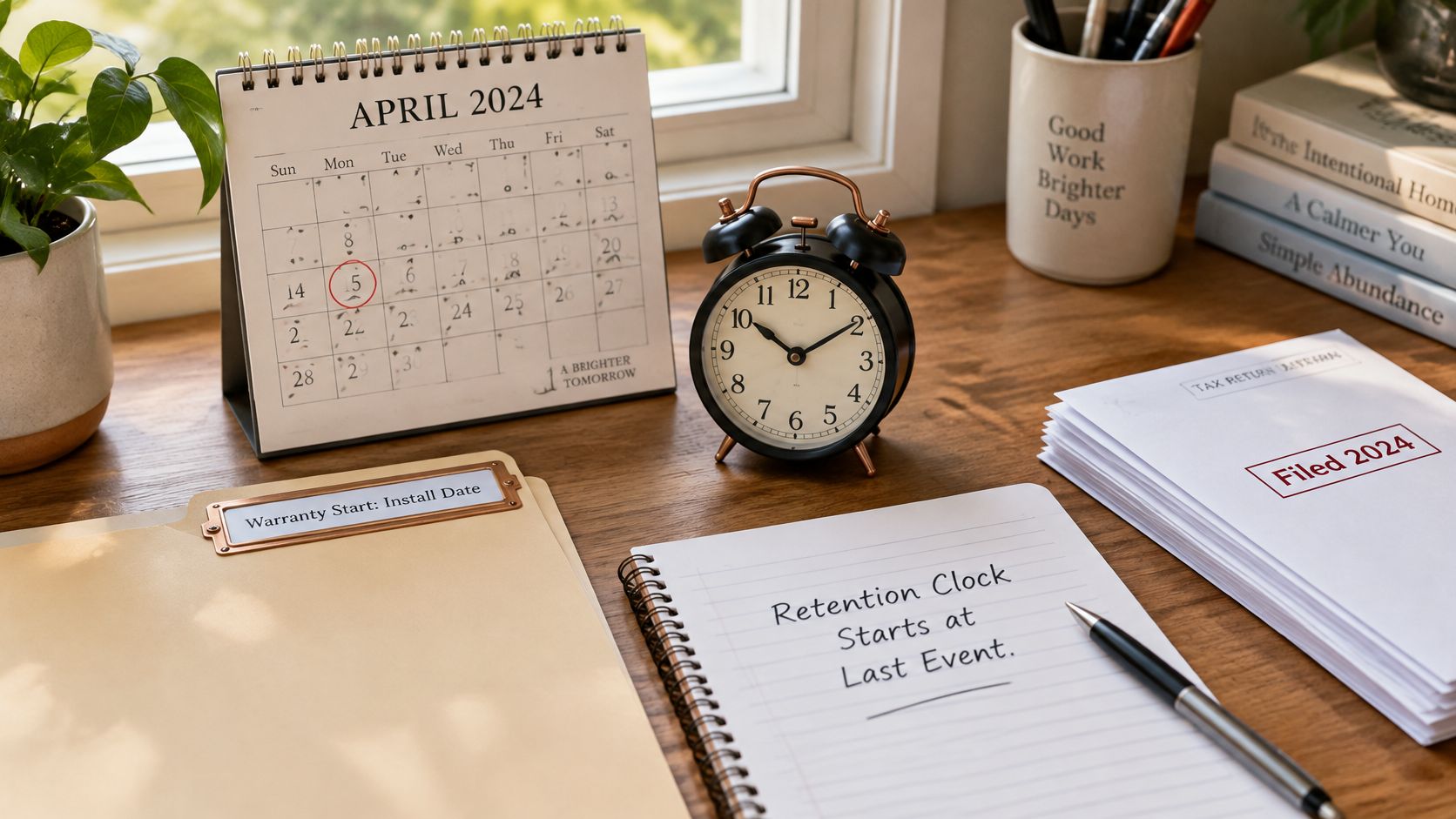
IRS recordkeeping rules don’t ask you to keep paper for a fixed habit. They ask you to substantiate every item of income, deduction, or credit for the limitation period that applies. For a refund claim, that means the later of 3 years from the original filing date or 2 years from the date the tax was paid.
A plumbing company buys a van in 2019 and sells it in 2026. The 2019 receipts aren’t “old” in 2023 just because three tax seasons passed. Purchase papers, the depreciation schedule, and the bill of sale stay until the limitation period closes for the 2026 sale year. Shredding them when the 2019 return felt old is how owners lose the basis they already paid tax on.
Keep each record until the latest event that depends on it.
| Trigger | Keep records until | Add to the file |
|---|---|---|
| Open IRS audit or notice | Written close of the case | All returns, receipts and payroll registers for the years in question |
| Amended return or refund claim | Later of 3 years from filing or 2 years from payment | Original return and proof of payment |
| Bad-debt or worthless-securities deduction | 7 years | Loan records and evidence of the write-off |
| Sale of the business or a major asset | Limitation period closes for the year of sale | Purchase, depreciation, improvement and disposal records |
| Lawsuit, claim or workers’ compensation case | Matter resolved, including any appeal | Contracts, incident logs and correspondence |
| Known OSHA exposure or inspection | Matter resolved | Injury logs, medical files and corrective-action records |
| Pending sale or succession | Closing or handover complete and any indemnity period ends | Several years of financials, contracts, employee and asset files |
A buyer doing diligence doesn’t accept “we think the bookkeeper had that.” Buyers ask for several years of financials, payroll registers, and asset histories. Gaps don’t just slow a deal. They give the buyer a reason to cut the price or to widen an indemnity.
An HVAC owner who plans to sell in 2029 should not shred 2022 payroll files because a seven-year habit feels tidy. Those registers may be the proof behind wages, margins, and who was on the crew.
Before anything goes, run three dates and keep the latest. Use the statutory minimum, the limitation period on the return, and the end of any open audit, dispute, financing, or sale. State and industry rules can sit on top of all three.
Some papers don’t support one tax year. They prove who a person is, who owns what, or who has authority to act. A deed is closer to a passport than to a receipt. You don’t throw out a passport because the trip ended.
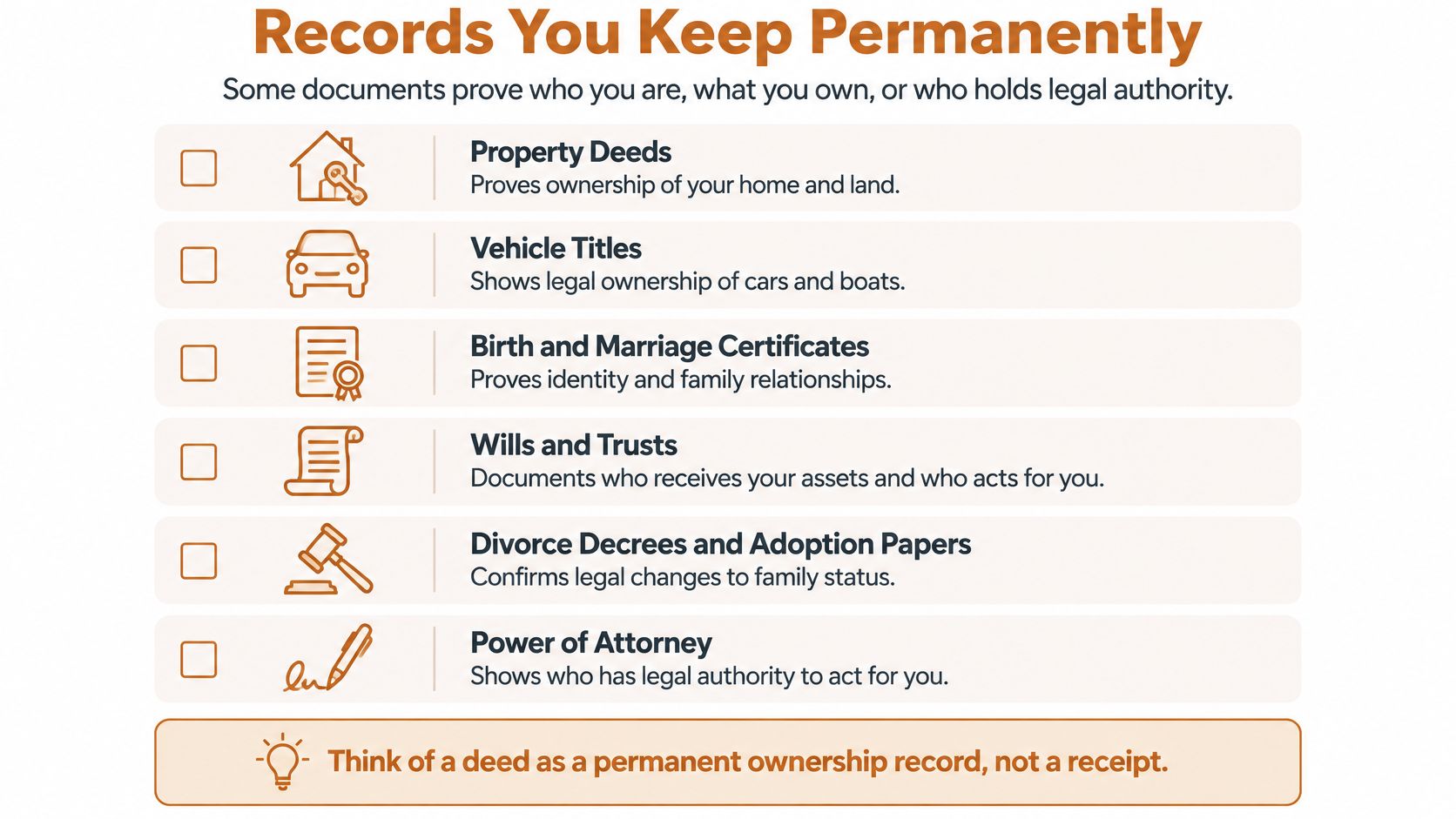
The states permanently maintain vital records of births, deaths, and marriages because those facts don’t expire. The same idea belongs in a family and a company file. IRS guidance on managing records after you file specifically flags home purchase or sale records, stock transactions, IRA documentation, and business or rental-property records as items that may need to outlast the normal 3-year tax period.
Keep these as originals or certified copies, with a backup:
Temporary receipts follow the schedule above. Proof of ownership and authority does not. Keep the originals in a fireproof safe or a safe-deposit box, scan a copy to a second location, and write a one-page index that says where each item sits.
A short walkthrough helps when you’re deciding which family and property papers outlive a tax year.
The spouse, the executor, or the person taking over the routes should know where that file lives. After a death or an incapacity, it is often the first thing a bank or a title company requests, and a locked drawer with no key is the same as a missing deed.
One folder per crew member feels organized until the clocks disagree. A shock report, a clinic note, and a W-2 are not the same record. Mixing them means the short file gets kept too long, or the long file gets shredded with the short one.
OSHA’s recordkeeping position requires Forms 300, 300A, and 301, or an equivalent, for five years after the end of the calendar year they cover. During that window you must update the 300 log if a case was missed or if the classification, description, or outcome changes. Individual medical records generally stay for the duration of employment plus 30 years, with specified exceptions. Payroll and employment-tax records sit on their own minimum, already in the table, and personnel files commonly run from the separation date.
An electrician’s shock incident in March 2026 stays on the 2026 log through the end of 2031, and you update that log if the outcome changes. You don’t start a fresh five years from the day someone rewrites the description.
A litigation hold beats the calendar. A workers’ compensation claim, an inspection, or a known exposure pauses routine destruction until the matter is closed, including any appeal.
When a worker leaves, move the personnel file and the medical file to the archive the same week. Start the personnel clock at separation. Write the planned destruction date in a register. Don’t delete from a laptop because the folder looks old. A buyer checking employment history will notice a missing year faster than you’ll recreate it, which is why those files also belong on a financial due diligence checklist before you talk price.
Scanning isn’t the same as keeping. A photo of a contract that nobody can open in eight years is a picture, not a record.
People do go back to old files. In a 2025 Adobe Japan survey of 400 desk workers, 87.0% said they refer to or reuse digitally stored past business documents in daily work, 32.0% frequently and 55.0% sometimes, according to Adobe’s survey write-up. An archive that only the former office manager can find fails that test.
Split two copies. The working copy lives in the accounting software or the job folder and can be compressed for daily use. The evidentiary copy keeps original metadata, signatures, and the export you could hand an auditor. A cloud export of the general ledger isn’t a substitute for signed contracts, permits, warranties, or proof a customer paid.
Paper goes by year and category in a fireproof cabinet. Digital files live in the books plus one backup that isn’t the same login. Name files so a stranger can search them: year, month, vendor, document type. Write a short access list. When a bookkeeper or office manager leaves, change access the same day and confirm the backup still opens.
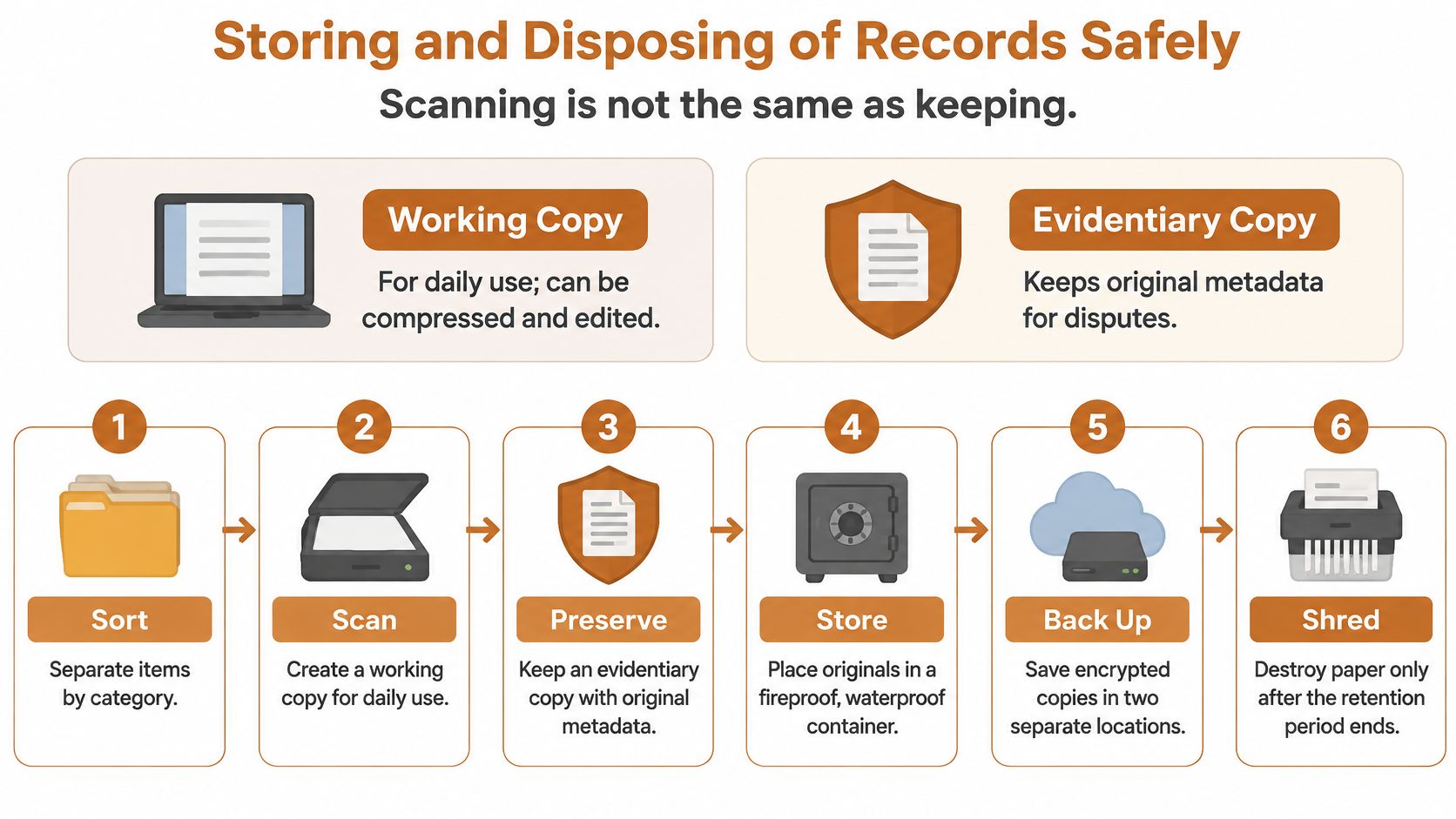
Once a year, restore one archived file from backup and open it. Files you expect to need for five or ten years belong in formats other people can still read, such as PDF and CSV, not in a desktop program only one computer still runs.
A schedule you write after the notice arrives is a reconstruction. Build it while nothing is on fire.
If a sale, a handover, or a succession is three to five years out, have the file reviewed now. A missing depreciation schedule is cheap to rebuild from the vendor and the loan file. It is expensive when a buyer is already in the data room. The operating habits behind that review sit with the rest of your business systems and processes, not in a one-time cleanup.
Keep each record until the latest event that depends on it. Nothing here is legal, tax, or financial advice. Confirm state periods, licensing rules, and UK or other non-U.S. requirements with a CPA, an attorney, or the tax authority that governs the return.
The Owner’s Shortlist publishes plain-language guides for owners of established service businesses who are sorting records before a sale, a step-back, or a family handover. If you want a practical library on taxes, value, and what buyers ask to see, start with The Owner’s Shortlist and read the pieces that match the decision in front of you.
Tell us your situation. We'll connect you with a specialist who works with owners like you. One conversation, no sales pressure.
Found this useful?
Add The Owner's Shortlist as a preferred source and get our articles highlighted in Google Search results.
Add to Preferred SourcesTax attorney vs CPA explained for owners planning an exit or succession. See who handles what, where they overlap, what it costs, and which to hire first.
October 8, 2026
Explore business tax planning strategies for small and mid-sized owners preparing for succession or sale, with trade examples and expert guidance.
October 1, 2026
Understand business sale capital gains tax before you sell. Learn short vs long-term rates, asset vs stock sales, and planning strategies to keep more proceeds.
September 30, 2026
Learn what is capital gains tax, how short- and long-term rates work, and how the rules apply when you sell a business. Clear guidance
September 22, 2026