How to Sell My Plumbing Business: A Practical Roadmap
Ready to sell my plumbing business? Follow a step-by-step roadmap for valuing, marketing, and closing the sale with confidence and clarity.
October 15, 2026
By Remi Taffin · October 27, 2026

The most popular shortcut is still the worst one. Take last year’s sales, multiply by a number you heard at a trade show, and call that what the company is worth. Buyers don’t pay that way. They pay for cash flow they can keep after you leave, on terms that survive debt, working capital, taxes, and whatever piece of the price is delayed. A clean revenue multiple skips all of that, which is why owners walk into a sale surprised by both the offer and the check.
How to value business starts with a harder question than “which multiple fits my trade?” Ask which part of today’s profit a buyer would still collect if you stopped answering the phone, and how far that headline sits from cash in your account. The steps below are the ones I walk an owner through before anyone names a price.
A valuation method is useful only if it fits what a buyer can actually acquire. For a service company, reported profit may not capture customer relationships, reputation, recurring maintenance, trained crews, or the risk that sales depend on the owner. Start with normalized performance, then test it against the company’s assets and relevant sale evidence. The factors commonly considered for closely held stock include company history, economic and industry conditions, book value, earning capacity, dividend capacity, goodwill, prior stock sales, and prices of comparable public companies.
Three approaches answer different questions. Dealmaker Wealth Society on business valuation compares these techniques for smaller companies.
| Method | Core question | Best fit | Main weakness |
|---|---|---|---|
| Asset-based | What would the assets sell for, minus debts? | Asset-heavy contractors with weak or volatile earnings | Often misses customer relationships, reputation, and goodwill |
| Market (comparable sales) | What have similar businesses actually sold for? | Service firms with usable deal data for their size and trade | Few truly comparable sales; size, geography, and owner dependence vary widely |
| Income (DCF or capitalization) | What is future cash flow worth today at a risk-adjusted rate? | Firms with stable cash flow and documented recurring work | Sensitive to discount-rate and growth assumptions |
For an owner-operated service firm, market and income evidence usually deserve the closest attention. Asset-based value can provide a floor when trucks and equipment are the dependable part of the business and earnings swing with weather or a few large jobs. Revenue alone cannot establish value. A large top line may still support a lower price if margins are thin, working capital needs are heavy, or the owner is the salesperson.
Before choosing a lead method, answer four questions: Are sales of genuinely similar businesses available? Is cash flow predictable year to year? Do the assets support more value than earnings do? Is the valuation for a sale, a gift, or an estate? Usable comparable sales and steady cash flow point toward market and income methods. Volatile earnings and substantial equipment make the asset floor more relevant. For a gift or estate, record the assumptions behind the valuation rather than relying on a multiple alone.
These methods produce different views of the business, not interchangeable prices. The headline value still depends on what earnings remain after the owner’s role is replaced, what assets and liabilities transfer, and what terms a buyer accepts. A method that ignores those points may give an owner a number that looks persuasive on paper but does not translate into proceeds.
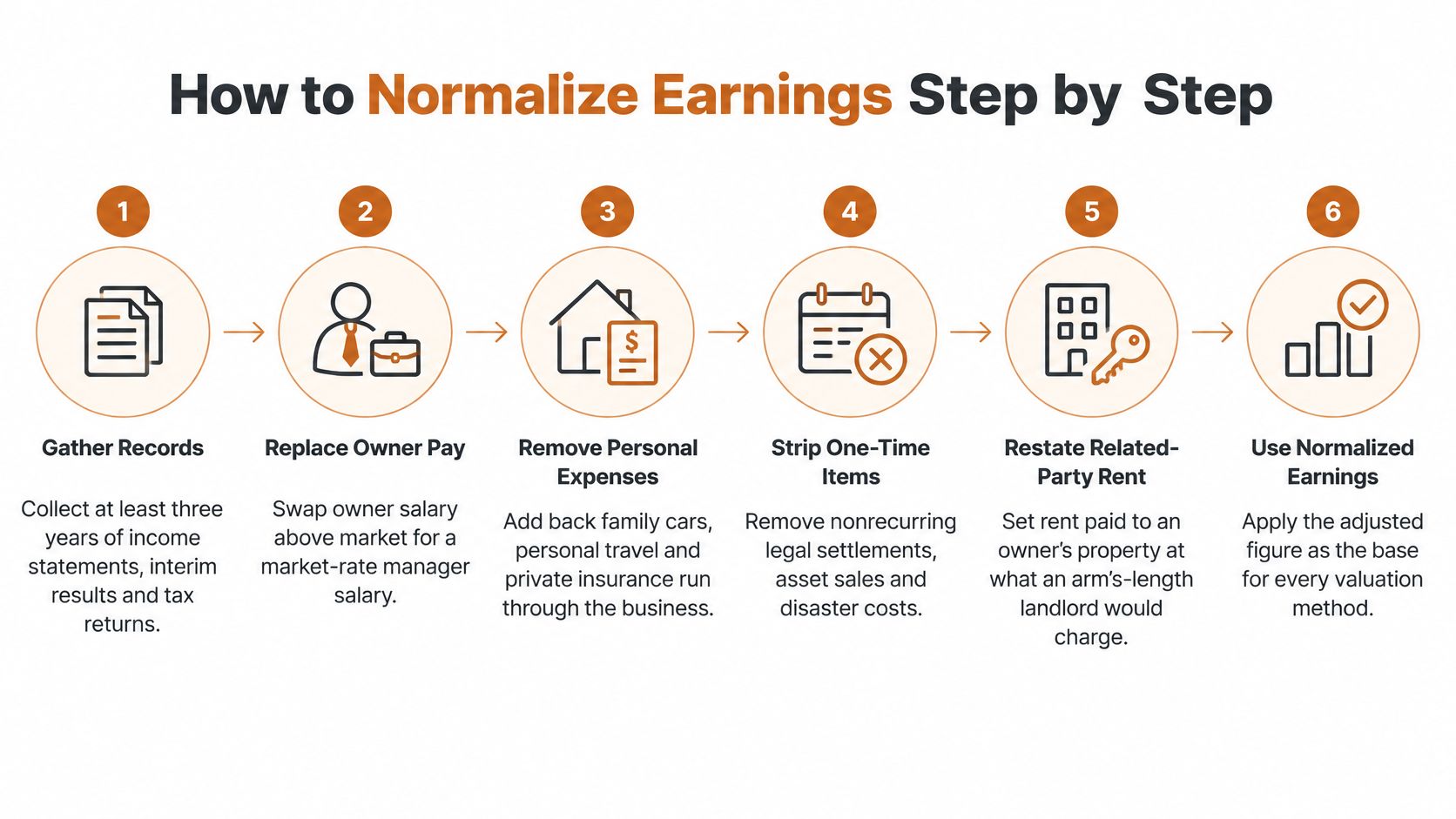
A buyer will not pay a multiple on tax-return profit without checking what it includes. Earnings-based methods start from a normalized earnings base, with unusual items removed and owner-specific costs reset. A practical valuation walkthrough for owner-operated companies explains why this rebuild comes before applying a multiple. An asset-based approach is different: it values the assets and liabilities rather than starting from normalized earnings.
| Adjustment | Example | Evidence a buyer accepts | Usual mistake |
|---|---|---|---|
| Owner pay above market | Owner paid $260,000 against a $150,000 market manager salary | Payroll records and a local salary survey | Adding back all owner pay and leaving no replacement cost |
| Personal vehicles and phones | $22,000 of personal vehicle costs | Mileage logs and card statements | Adding back work trucks the crew needs every day |
| Related-party rent | Rent running $24,000 below an arm’s-length lease | Signed lease and a rent comparison | Ignoring that below-market rent will reset when the owner exits |
| Family payroll | Spouse on payroll with no defined role | Job descriptions and hours worked | Keeping a family salary no buyer would pay for the same work |
| One-time legal settlement | A $38,000 settlement that won’t repeat | Settlement letter and invoices | Calling recurring legal, repair or warranty costs one-time |
| Insurance or fleet overpayment | Premiums above a comparable broker quote | Broker quotes for equivalent coverage | Assuming a cut that the next owner’s coverage will not match |
The strongest add-backs are specific, documented, and tied to costs that will not continue under a new owner. A smaller figure you can defend is more useful than an inflated total a buyer will challenge. Review each proposed adjustment against the buyer’s likely operating costs, especially replacement management, rent, and expenses needed to keep the crew working. Once the earnings base is clean, apply the multiple that fits the company and its evidence. A headline value is only the start of the proceeds calculation: debt, transaction costs, and other obligations affect how much the owner keeps.
A reported multiple is useful only when the earnings measure and business size match the transactions behind it. SDE and EBITDA are not interchangeable, and crossing a revenue threshold does not automatically qualify a business for a higher multiple.
| Earnings band | Earnings measure | Reported multiple | Data year |
|---|---|---|---|
| $2 million to $5 million in transaction value | EBITDA | 3.6x | 2024 market data |
| $5 million to $50 million in transaction value | EBITDA | 6.0x | 2024 market data |
These 2024 figures, attributed to IBBA market data in a Patriot Growth Capital review of small-business acquisitions, are averages for businesses valued within each transaction-value band. They are not multiples for businesses earning $2 million to $5 million or $5 million to $50 million in EBITDA. Apply them only as broad reference points for a comparable transaction size, and do not treat an average as a price a buyer must pay. A comparable company analysis is useful only when the businesses match in industry, scale, and earnings definition.
Size can affect the multiple because a larger company may have management, a broader customer base, and processes that can continue without the owner. That does not make size a substitute for transferability or clean financials. Smaller businesses are often assessed using SDE, while larger transactions may be discussed using EBITDA. This table includes only the sourced EBITDA ranges, so it cannot establish a typical multiple for a smaller SDE-based business.
Use the figures as a reference, not a plug-in formula. First, confirm the transaction-value band and earnings measure fit the comparable deals. Then use normalized earnings from the add-back work, not taxable income, and consider how the company’s risks compare with those businesses. Multiplying earnings by a market average can produce a first-pass estimate, but it does not account for the quality or transferability of those earnings.
A buyer may discount a company with owner-held sales, one or two major customers, project work without contracts, thin records, or a fleet nearing replacement. Documented recurring work, a second-in-command, and results that do not rely on the owner can support a stronger offer. Those factors can matter more than a difference between reported multiples. And a headline enterprise value is not the cash you keep: debt, transaction costs, and other closing adjustments can reduce proceeds. Treat the multiple as one input, then bridge the accepted value to your expected take-home amount.
More revenue doesn’t automatically add value. Another truck, or another million in sales you still estimate, schedule, and collect yourself, can add work without adding anything a buyer can own. The question that changes the check is how much cash flow survives your exit.

Run this transferability audit this week. Six measures, each with a strong signal and a weak one.
Share of sales you personally generate. Strong is under a quarter, with techs or a salesperson originating the rest. Weak is “if I don’t bid it, it doesn’t get bid.”
Share of customers on documented agreements. Strong is maintenance plans with renewal dates in a system someone else can open. Weak is handshake accounts that exist because they like you.
Who holds dispatch, estimating, and pricing authority. Strong is a lead who can price a job without calling you. Weak is every quote waiting on your cell phone.
Whether a second-in-command could run the company for 90 days. Strong is they’ve already done it. Weak is the crew calls you from the job site for parts and permissions.
Employee retention over the last three years. Strong is a stable crew with written roles. Weak is turnover that restarts every time you hire.
Months the business has operated without you in the field. Strong is a full season. Weak is a vacation that turned into a backlog.
If you’re still the person who invoices every job, the billing trail is part of the same problem. Moving that work onto invoicing software for solo contractors is a small operational step that shows a buyer the revenue doesn’t live in your notebook.
Practical rule: Removing yourself from daily sales and decisions often adds more value than adding another truck.
Buyers discount cash flow they have to rebuild. A practical sequence for how to reduce owner dependency is worth more than chasing the next revenue band. Ask this instead of “which industry multiple applies?”: what cash flow would a buyer receive after replacing me?
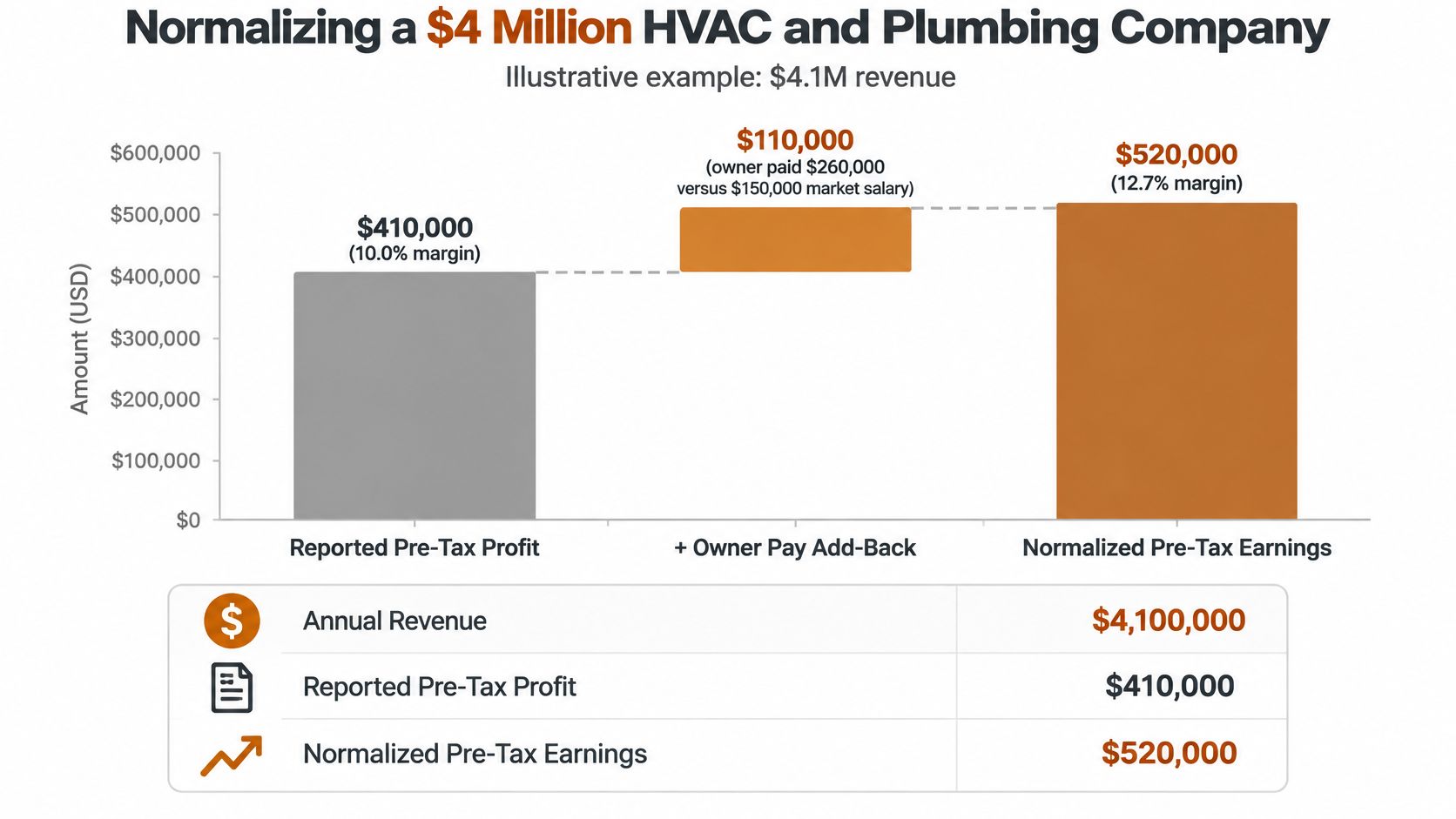
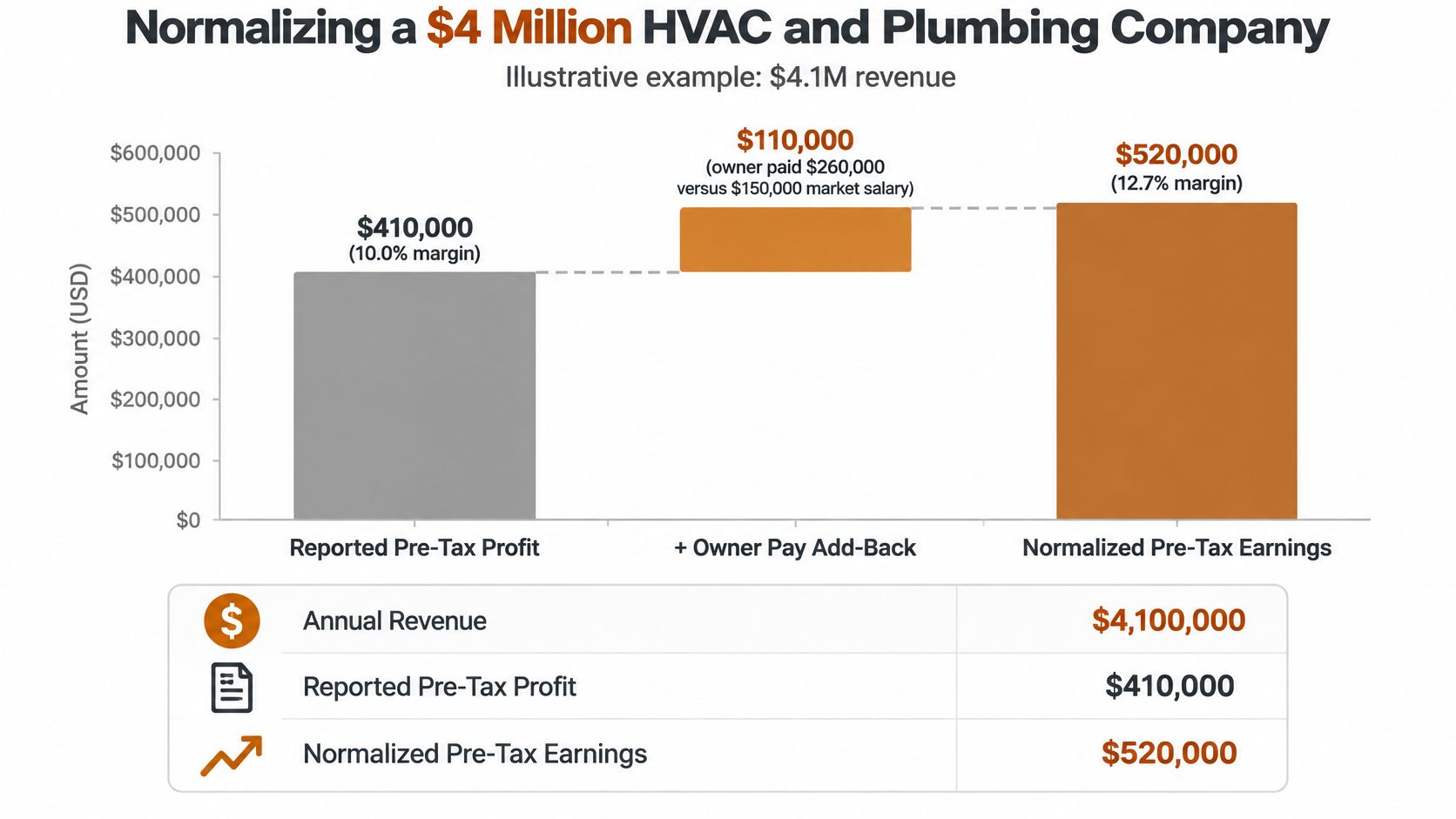
A $4.1 million service company can show $410,000 in reported pre-tax profit and still have a very different value once earnings are normalized. Pre-tax profit is already after interest and depreciation, so add those amounts back from the tax return to reach EBITDA before making owner-specific adjustments. The capitalization formula is value equals next year’s cash flow, divided by the rate minus growth. Next year’s cash flow is current cash flow multiplied by one plus the growth rate.
The chart takes the earnings through the owner-pay adjustment. Adding $110,000 brings earnings to $520,000, based on owner compensation of $260,000 and a market salary of $150,000. Continue the bridge: add $22,000 in personal vehicle costs and a $38,000 legal settlement that will not recur. Then subtract $24,000 to reflect the buyer’s cost of replacing below-market rent on the owner’s building. Adjusted EBITDA is $556,000.
Market. Applying 3.9 times EBITDA to $556,000 gives an indicated value of about $2.17 million. Treat that as a first-pass market estimate for this earnings band, not a guaranteed offer.
Income, base case. Subtract $60,000 in maintenance capital spending from adjusted EBITDA, leaving $496,000 in free cash flow. At 3 percent growth, next year’s cash flow is $510,880. Capitalizing it at 22 percent means dividing by 0.19, for an indicated value of about $2.69 million.
Income, if recurring work is real. Maintenance agreements currently represent 40 percent of sales. If documented agreements rise to 55 percent and the risk rate falls to 20 percent, the same $510,880 supports about $3.0 million, using a 0.17 denominator. That higher case depends on agreements that exist, renew, and support the forecast.
The rate matters: at 21 percent instead of 22 percent, the same cash flow indicates about $2.84 million, roughly 5.6 percent more. Defend the underlying cash flow and documented contracts before negotiating over a small change in the rate.
| Line item | What to check |
|---|---|
| Reported pre-tax profit | Ties to tax return and bank deposits |
| Add back owner pay above market | Payroll records and salary survey |
| Add back personal vehicle costs | Mileage logs and card statements |
| Add back one-time legal settlement | Settlement letter and invoices |
| Subtract below-market rent to owner | Signed lease and rent comparison |
| Adjusted EBITDA | Starting point for the market approach |
| Market approach at 3.9x | Band multiple from the size table |
| Income approach with recurring revenue at 20% rate | Only if agreements are documented and renewing |
These figures are enterprise-value estimates, not the cash an owner keeps. The market approach indicates about $2.17 million; the base income case indicates about $2.69 million. The roughly $3.0 million case depends on documented, renewing maintenance agreements and a lower risk rate. Debt, transaction terms, and other adjustments still separate the headline value from proceeds.
Don’t average $2.17 million, $2.69 million, and $3.0 million and call the middle “the value.” IRS valuation procedures expect all three generally accepted approaches when the information exists, then professional judgment about which result deserves weight. Reconcile. Don’t blend.
Weight the market result when you’ve got usable sales of similar firms. Weight the income result when recurring work is stable and the forecasts aren’t a wish. In this example the market figure of about $2.17 million and the base income figure of about $2.69 million cluster in a range of roughly $2.2 to $2.7 million. The asset floor for trucks and equipment sits lower and keeps you from pricing a volatile contractor on hope alone. The recurring case supports the top of the range only after the contracts are documented. Write down the standard of value, the valuation date, the ownership interest, and whether you’re assuming control. A single headline with none of that is how arguments start with a lender, a partner, or the IRS.
Enterprise value here is a cash-free, debt-free idea of the operations. Your proceeds are a different number. Walk the bridge in order.
The highest nominal price isn’t the best offer if most of it depends on future performance or a delayed payment.
Compare certainty, timing, collateral, and tax treatment, not just the multiple. On a business in the $2.2 to $2.7 million range, a few hundred thousand of equipment debt, a working-capital true-up, and a note that pays over five years can leave you with far less at closing than the number in the teaser. That’s the figure to plan a retirement on.
You can build the range yourself. Bring in a valuer or a broker who has sold firms like yours when the number has to survive someone else’s scrutiny.

Call when a sale, gift, estate, or buy-in is pending. Call when a lender, a tax authority, or a court may read the file. Call when you expect a private equity buyer or a family transfer that has to be affordable for the next owner. Call when add-backs are a large share of adjusted earnings. I treat about a fifth of adjusted earnings as a working rule of thumb for “large,” not a legal line. Call when the offer leans on earnouts or seller financing, because the structure is the deal.
Buyers already price cash flow harder than sales. BizBuySell’s 2025 U.S. transaction data reported a median sale price of $350,000, median revenue of $703,000, and median cash flow of $158,950, implying roughly 0.50 times revenue and 2.20 times cash flow. Those are broad medians, not your multiple. Dallas–Fort Worth deals in the same set had a median price of $305,000, median revenue of $565,938, and an average cash-flow multiple of 2.54. Markets don’t share one number.
A broker opinion is a quick read from someone active in your trade. A formal written valuation documents methods, date, and interest, and a business appraisal is the version that has to hold up in writing. A fairness opinion judges a specific deal. Depth and fees rise in that order. Don’t shop on a quoted fee you can’t compare.
This week, assemble three years of statements, tax returns, the add-back list with evidence, the customer contract list, a map of your role, and the fleet schedule. The Owner’s Shortlist can introduce you to one broker whose past sales fit your trade and size. Ask that person to show comparable deals and how they’d treat your add-backs before you set a price.
The Owner’s Shortlist is a free matching service for owners of established service businesses who want a plain-language read on value before they sell, step back, or pass the company to family. A real person reviews your business and introduces you to one specialist, most often a broker who has sold firms like yours, and you never pay. If you’re ready to see how your numbers hold up against real deals, visit The Owner’s Shortlist.
Tell us your situation. We'll connect you with a specialist who works with owners like you. One conversation, no sales pressure.
Found this useful?
Add The Owner's Shortlist as a preferred source and get our articles highlighted in Google Search results.
Add to Preferred SourcesReady to sell my plumbing business? Follow a step-by-step roadmap for valuing, marketing, and closing the sale with confidence and clarity.
October 15, 2026
Learn how to sell your service business with a practical, step-by-step roadmap. From readiness and valuation to deal structure and closing, get actionable
October 14, 2026
Learn how business valuation EBITDA works for service companies. Discover adjustments, multiples, and owner-dependency tests before you sell.
October 12, 2026
Thinking 'I want to sell my landscaping business'? Learn how to value your company, prepare financials, handle labor risks, and find the right buyer quietly.
October 11, 2026