Business Valuation Meaning for Owner Operated Firms
Explore business valuation meaning for owner-operated firms. Learn valuation methods, drivers, misconceptions, and steps to secure a defensible valuation.
September 28, 2026
By Remi Taffin · August 16, 2026

You’ve decided it’s time to sell, but the business still runs through you. You approve every unusual quote, hold the key customer relationships, know which supplier will bend on terms, and keep the operating instructions in your head. A buyer may like the revenue and profit, but they’re buying a business that could weaken the moment you leave.
That is the central problem in how to sell a small business. Valuation matters, but transferability matters more. A company that produces earnings without its owner gives buyers confidence, attracts more credible offers, and survives diligence with less drama. A company that depends on the founder forces the buyer to price in risk, demand protection, or walk away.
The process is also slower and less certain than most owners expect. A 2025 market summary reported a median 170 days on market for U.S. small businesses, while only about 20% to 30% of businesses that reach the market ever sell, according to small-business M&A market data. Treat the sale as a project that needs preparation, not as an advertisement you post when you’re ready to retire.
The owner who decides to sell usually starts with a personal event, retirement, burnout, a new opportunity, or concern about what happens if they can’t keep working. That decision is only the beginning. A clean exit moves through six distinct phases, and each phase creates the evidence the next one needs.
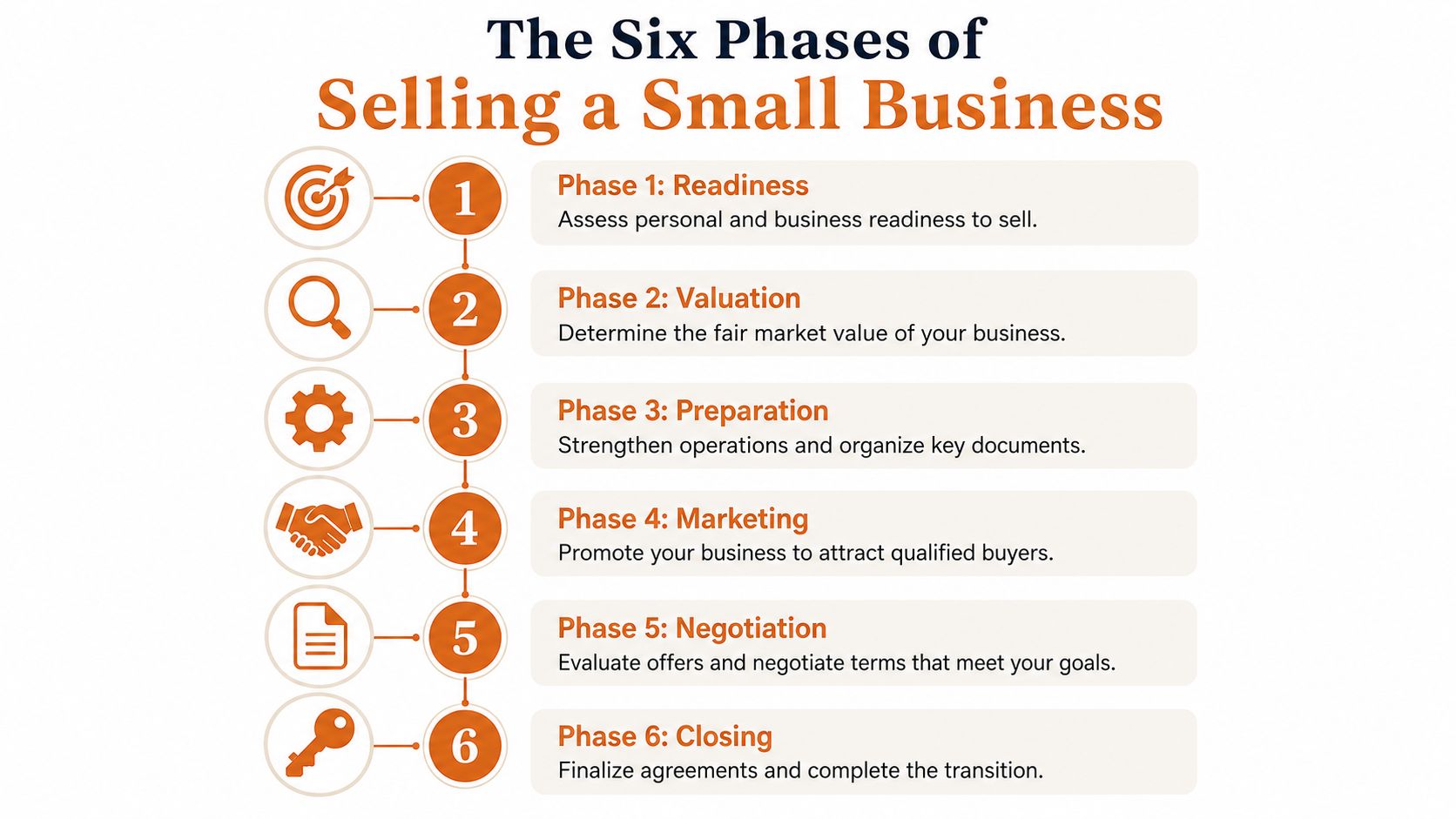
Start by separating your readiness from the business’s readiness. You may be emotionally finished, while the books, contracts, staff structure, and customer relationships still depend on you. If the company cannot operate through a normal week without your direct intervention, listing it early will expose that weakness.
Establish a defensible value using the method that fits the company. Earnings, assets, and comparable transactions each tell part of the story. A broker’s initial estimate can help you decide whether a sale is worth pursuing, but a specialist can provide a more independent foundation when the price will affect retirement or estate decisions.
Clean the financial records, organize contracts, document operating procedures, and reduce owner dependency. This phase often takes several quarters because you’re changing how the company functions, not merely gathering files.
Choose between a broad campaign and a curated buyer search. A larger pool can improve speed, while a focused approach may protect confidentiality and attract buyers who understand the industry. The right choice depends on whether your priority is a faster transaction, maximum price, or certainty.
Price is only one term. Asset versus stock treatment, seller financing, earnouts, holdbacks, rollover equity, and tax allocation can change the practical result. The M&A process for small-business owners should be planned around both proceeds and risk.
The purchase agreement, funds flow, representations, consents, employee communication, and handover all need to work together. Closing isn’t the moment your responsibilities disappear. You may still need to train the buyer, introduce key relationships, or support the business under agreed transition terms.
Timing rule: If you need the business sold urgently, you’re already negotiating from a weaker position.
Owners should expect a multi-quarter project, particularly when the company has weak documentation or heavy founder involvement. The U.S. Bank survey summarized in its 2025 small-business succession findings found that more than half of U.S. small-business owners were over age 55, but only 54% had created a succession plan. Start before fatigue or a personal deadline turns preparation into a forced sale.
A valuation report gives you an analytical range. It doesn’t guarantee a buyer will pay the number. Buyers pay for earnings they believe will continue after the owner leaves, and that belief depends heavily on transferability.
Most small businesses are assessed through one or more of three approaches:
The method matters, but the quality of the earnings matters more. A buyer will examine whether revenue is recurring, whether one customer represents an outsized share of sales, whether margins are stable, and whether a capable manager can run the operation. A plumbing or HVAC company with dependable service contracts is easier to underwrite than a project-based firm that must win every month’s work from scratch. The difference isn’t just revenue. It’s predictability.
Suppose you’re the salesperson, estimator, scheduler, senior technician, and relationship holder. Your reported earnings may look attractive, but the buyer must replace several functions or accept a period of uncertainty. That cost appears through a lower offer, a longer seller transition, seller financing, an earnout, or additional warranties.
The same issue appears in less obvious forms. If only you can authorize discounts, resolve escalated complaints, access important systems, or explain the pricing logic, the company has undocumented operating risk. Buyers notice this during management interviews and customer calls, not only in the financial statements.
Your small-business valuation analysis should therefore include a transferability review. Ask what would happen if you stopped answering calls tomorrow. Then build the answer into the business before you invite buyers.
A broker’s opinion can be useful for an initial market conversation, especially when you’re comparing a sale with continued ownership. Engage a valuation specialist when the result will influence retirement planning, a shareholder dispute, a family transition, or a serious pricing disagreement.
Don’t inflate the number to make the exit feel better. The market will test it through buyer feedback, financing constraints, diligence, and competing opportunities. A defensible range, supported by clean earnings and lower owner dependence, is more valuable than an optimistic figure that collapses after the first serious buyer asks questions.
A buyer doesn’t purchase your confidence. They purchase evidence. If the financial records are disorganized, the contracts are informal, and the team waits for your instructions, diligence will turn ordinary questions into deal risk.
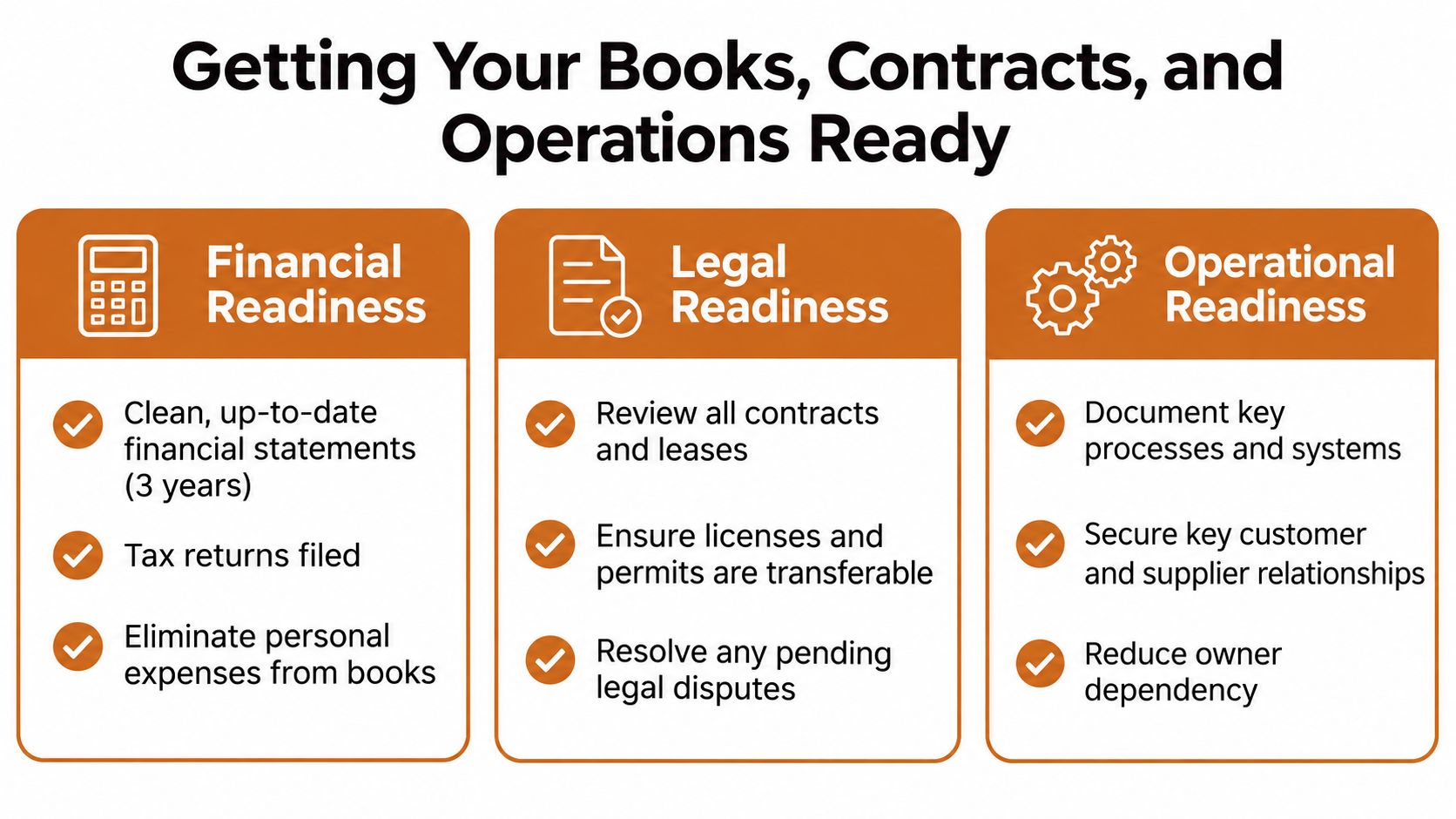
Begin with clean, up-to-date financial statements and filed tax returns. Reconcile bank accounts, explain unusual expenses, separate personal spending from business costs, and keep supporting documents for every proposed add-back.
Normalization is where many sellers lose credibility. An owner may call a recurring operating expense a one-time adjustment because it feels discretionary, but a buyer’s accountant will ask whether the expense will continue after closing. Label each adjustment, provide evidence, and distinguish genuine owner-specific costs from expenses required to operate the company.
Build a data room with:
Review the entity structure, leases, licenses, permits, employment arrangements, intellectual property, insurance, and pending disputes. A handwritten agreement with a major customer may have worked for years, but it creates uncertainty about assignability, pricing, termination rights, and renewal.
Check whether the buyer can legally receive what they’re paying for. A license that can’t transfer, a lease requiring landlord consent, or software owned personally by the founder can delay signing or force a restructuring.
Document the work people perform, not the idealized workflow in an old manual. Record how leads are handled, estimates are approved, jobs are scheduled, inventory is ordered, complaints are resolved, and invoices are collected.
Buyer test: Ask a trusted employee to complete a critical process using the written procedure without calling you. The questions they ask reveal what still lives only in your head.
The independent guidance in business sale failure analysis identifies unrealistic valuation expectations, poor financial documentation, owner dependency, and seller unreadiness as recurring breakdowns. If several of those conditions exist, delay the listing and fix the company rather than hoping a buyer will overlook them. A six-to-twelve-month preparation period can be more productive than months spent defending a weak offer.
Use this business sale preparation guide as a working checklist, then assign every task to a person and deadline. Preparation is complete when the business can demonstrate continuity, not when a folder contains many files.
The wrong buyer can consume an owner’s attention for months. They ask for detailed information, make an attractive preliminary proposal, and then discover that they can’t finance the purchase or don’t understand the operating demands. Qualify early.
A realistic buyer may be a strategic acquirer seeking customers or geography, a competitor wanting capacity, an individual operator looking for a livelihood, a search fund, a family office, existing management, or employees. Each buyer sees a different form of value. A competitor may understand the business quickly but press hard on price. An individual buyer may care about training and owner transition. Employees may protect culture but need a workable financing plan.
The NDA is the first seriousness test. Don’t disclose sensitive customer names, employee compensation, proprietary pricing, or supplier terms before the buyer has identified themselves and accepted confidentiality obligations. After the NDA, request a clear description of acquisition experience, available capital, financing plans, decision-makers, and intended role after closing.
| Buyer Type | Typical Timeline | Price Discipline | Likelihood of Close |
|---|---|---|---|
| Strategic acquirer | Can move quickly when the fit is clear | Often analytical and synergy-driven | Depends on internal approval |
| Individual operator | May need more time for financing and training | Highly focused on affordability and cash flow | Strong when financing is credible |
| Competitor | Often understands operations quickly | Usually firm because they know the economics | Can be high, but conflicts must be managed |
| Search fund or investment group | Structured process with formal diligence | Disciplined about risk and returns | Depends on capital and mandate |
| Management or employee buyer | Requires careful transition and financing work | Focused on sustainable payment terms | Strong when leadership and funding align |
The table isn’t a promise about timing. It’s a screening framework. A buyer who refuses to explain funding, won’t sign an NDA, or demands sensitive records before establishing a credible identity isn’t ready for the next stage.
Independent coverage of selling a small business and the speed-price tradeoff makes an important distinction. A faster sale generally requires a broader pool and a business that can operate without its owner. A higher price requires proof of transferable value and patience during buyer selection.
You can’t maximize every objective at once. If you need speed, prepare a broad but controlled marketing campaign. If you want the strongest price, build a short list of qualified buyers and keep the business performing while negotiations proceed. Confidentiality, buyer quality, and financing certainty should guide access to information.
A headline price can hide a disappointing result. The amount you receive at closing, the amount you may receive later, the taxes attached to each asset, and the promises you make after closing all determine what the deal is worth to you.
In an asset sale, the buyer selects the assets and liabilities they’ll acquire. This can give the buyer more control over inherited risk, while the seller must examine how goodwill, equipment, inventory, contracts, and other items are allocated.
In a stock sale, the buyer acquires the ownership interests and generally takes the company as an existing entity, subject to negotiated protections. The preferred structure often differs between buyer and seller because the parties are managing different legal, tax, and operational risks.
The IRS requires buyer and seller to use the residual method when allocating consideration among transferred assets. The IRS guidance on selling a business explains why goodwill, equipment, inventory, and intangibles can’t be treated as interchangeable. Have your tax adviser model the allocation before you agree to the commercial terms.
Negotiation principle: Never trade certainty for a higher number until you’ve priced the risk of collecting that number.
Tax planning can include installment treatment, eligibility for QSBS where applicable, and state residency planning, but none of these should be assumed to apply to your facts. Ask your CPA to compare after-tax proceeds, collection risk, closing complexity, and post-sale obligations side by side. The cleanest deal may be worth more than a larger headline price that depends on an aggressive earnout or a difficult allocation.
Consider an owner-operated service company with recurring contracts. The buyer likes the customer retention, sees a capable field team, and signs a letter of intent. The owner feels the hard part is over. It isn’t. The LOI sets the commercial direction, but diligence determines whether the buyer still trusts the story.
The buyer requests customer concentration, contract renewal terms, employee records, tax returns, insurance history, equipment condition, supplier agreements, and evidence supporting the normalized earnings. One contract is unsigned, a key technician is paid through an informal arrangement, and several owner add-backs are recurring expenses. None of these issues automatically kills the deal. Hiding them can.
Create a diligence tracker with an owner, status, source document, and explanation for every request. If a customer can terminate on a change of control, say so early. If equipment needs replacement, quantify the operational implication qualitatively and let the buyer assess the cost with appropriate advisers.
Negotiation works best when you defend the business without pretending it has no weaknesses. Explain the facts, show the corrective action, and propose a fair allocation of risk. A buyer can accept an identified issue. They struggle to accept surprises.
The purchase agreement will contain representations and warranties about finances, taxes, contracts, employees, compliance, litigation, ownership of assets, and authority to sell. Read every representation as a future claim against you. Disclose exceptions in the schedules, define knowledge standards carefully, and negotiate caps, baskets, survival periods, and exclusive remedies with your attorney.
The buyer may seek to renegotiate after diligence. Sometimes that’s justified because the evidence changed the risk assessment. Sometimes it’s an attempt to reopen a settled price. Ask which specific fact triggered the request, what protection would resolve it, and whether the proposed adjustment matches the actual exposure.
Walk away when the buyer lacks funding, repeatedly changes core terms without new evidence, demands unlimited post-closing exposure, or treats employees and customers recklessly. A signed agreement with an unreliable counterparty isn’t a successful exit.
The closing checklist should cover funds, lien releases, consents, bills of sale, intellectual property assignments, employee communications, customer notices, passwords, bank authority, insurance, inventory, and transition responsibilities. Your post-closing role should have a defined scope, schedule, compensation if applicable, and endpoint.
Keep operating the business while the deal is pending. A distracted owner can damage the very earnings that support the offer. The transaction closes when documents are signed and consideration is delivered, but the buyer’s confidence is built through every response, disclosure, and operating decision before that day.
Your first adviser should match your immediate constraint. If you don’t know whether the business is transferable, start with a valuation or exit-readiness specialist. If the records are messy, involve a tax-aware CPA before marketing. If a buyer is already engaged, bring in a transactional attorney before signing an LOI.
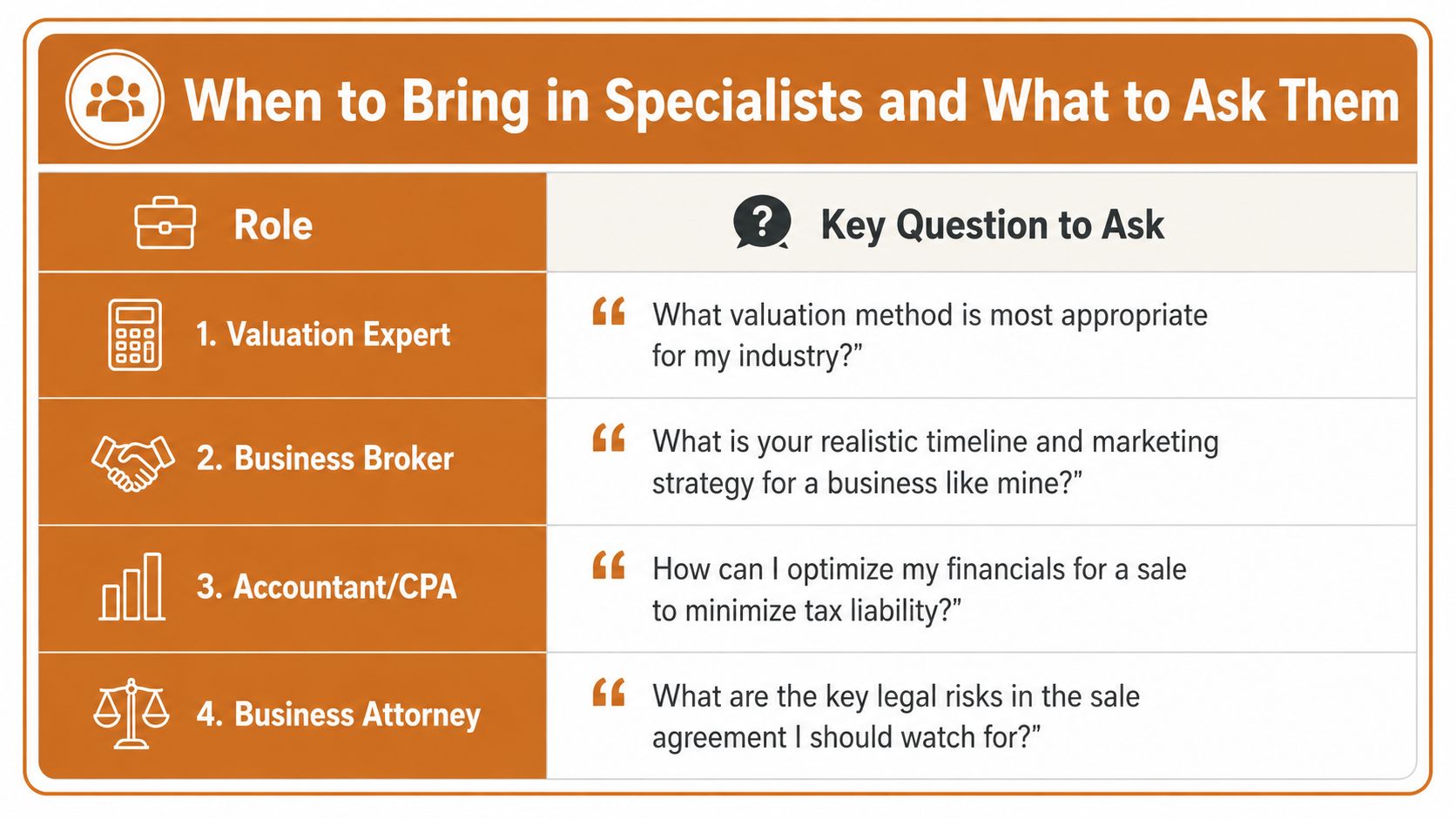
Build the team around decisions, not titles:
Before hiring anyone, ask what they won’t do, how they’re paid, whether they represent buyers in similar transactions, and who will personally handle your file. A referral isn’t a substitute for checking conflicts, relevant experience, and communication expectations.
For the next 30 days, document your owner-only responsibilities and reconcile the books. Within 90 days, organize the data room, review contracts, and test whether managers can run key processes. Within 180 days, obtain a defensible valuation, address the largest transferability risks, and decide whether to launch a buyer search.
The Owner’s Shortlist connects business owners with curated specialists across valuation, taxes, legal matters, succession, financing, and related exit decisions, alongside plain-English guides for understanding the process. Visit The Owner’s Shortlist to review relevant specialists and take the next step toward a business that can transfer without you at the center of every decision.
Tell us your situation. We'll connect you with a specialist who works with owners like you. One conversation, no sales pressure.
Found this useful?
Add The Owner's Shortlist as a preferred source and get our articles highlighted in Google Search results.
Add to Preferred SourcesExplore business valuation meaning for owner-operated firms. Learn valuation methods, drivers, misconceptions, and steps to secure a defensible valuation.
September 28, 2026
What Is Recurring Revenue. Learn what recurring revenue is, how ARR and MRR work, real trade examples, and why this revenue model shapes business value and exit
September 23, 2026
Learn how much to sell a business for with SDE and EBITDA multiples, adjustments, and deal tips to set a defensible price and maximize proceeds.
September 21, 2026
Understand business valuation cost, fee structures, price ranges and what drives fees so you can budget wisely and get accurate quotes.
September 19, 2026