Reps & Warranties in M&A: A Practical Guide for Owners
Learn what reps & warranties mean in M&A deals, why they matter, and how to negotiate them effectively. A clear guide for business owners.
September 27, 2026
By Remi Taffin · August 8, 2026

You’re probably sitting on a business that’s bigger than you think and harder to sell than you hoped. The calls still come in, the trucks still roll, the customers still renew, and the owner’s job is still glued to the middle of everything. That’s exactly where a lot of plumbing, HVAC, and other owner-operated businesses get stuck, because the m and a process isn’t a single event, it’s a chain of decisions that starts long before a buyer shows up and keeps going after the wire hits.
If you want a clean exit, or just want to know what your company is worth in the world, you need to think like a seller, not a hopeful headline reader. Buyers don’t pay for effort, they pay for transferable value, and transferable value comes from clean books, durable revenue, a team that can run without you, and a process that doesn’t unravel the minute lawyers get involved. The owners who do best treat the sale like a project with moving parts, not a mystery.
A plumbing owner with a strong recurring service book usually thinks the sale starts when a buyer asks for financials. It doesn’t. It starts weeks earlier, when someone finally asks, “Can this business run without me?” That question drives the whole M&A process, even if nobody says it out loud.
First comes readiness. Then valuation. Then buyer targeting and outreach. After that comes negotiation, due diligence, closing, and integration. In practice, the seller-side process often takes 4 to 6 weeks of preparation, then another 4 to 6 weeks for the first buyer round, 4 to 6 weeks for a second round, and 6 to 8 weeks for negotiation, so you’re looking at months, not a quick sprint. Wall Street Prep lays out that kind of stage-by-stage seller timeline clearly in its sell-side process overview, which matches what owners experience when documents, bids, and back-and-forth start stacking up. Wall Street Prep’s sell-side process guide
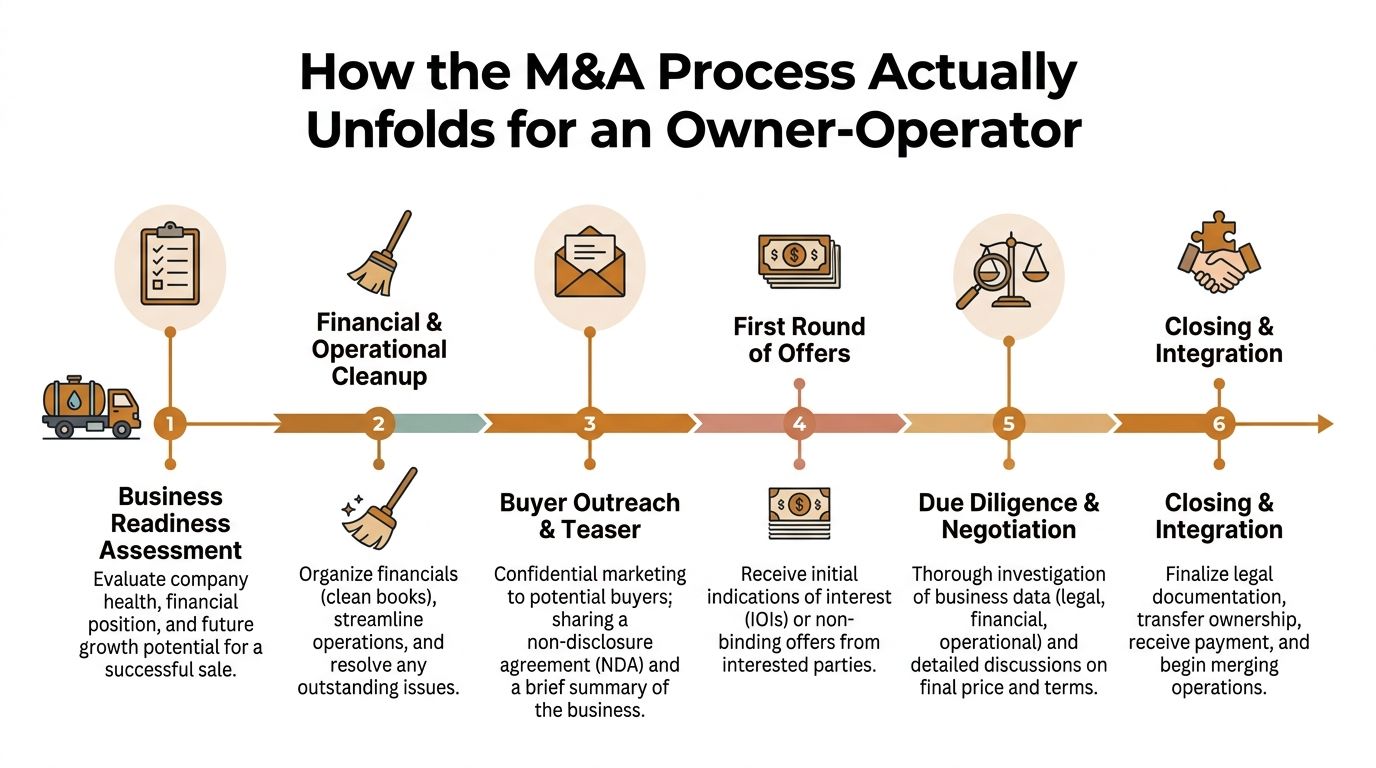
Practical rule: if your business still depends on your voice to approve every estimate, every exception, and every hiring choice, the buyer isn’t buying a company yet. They’re buying a job with a logo on it.
The early stage is mostly about cleanup and decision-making. Later, the buyer starts asking for proof, then more proof, then explanations for the proof. Wall Street Prep notes that early rounds lean on teasers and CIMs, later rounds demand data rooms and management Q&A, and the last stretch turns into diligence and legal drafting. That means your calendar gets eaten by document collection, manager alignment, and repeated decisions on price, role, and risk.
For an owner-operator, that’s the part that surprises people. You don’t just “sell” the business. You spend real time proving it’s transferable, then you keep spending time defending every weak spot. If you understand that now, you’ll stop treating the process like a closing date and start treating it like a sequence of tests.
Most owner-operated businesses are not sale-ready when the owner first thinks they are. The books may be decent, the customers may be loyal, and the trucks may be paid for, but buyers don’t run on optimism. They run on evidence. If you want fewer price cuts and fewer delays, get the business in shape before you start shopping it.
You need clean financial statements, and not just one good year. Buyers want a pattern they can trust, along with a clear explanation of owner compensation, one-time expenses, and anything that distorts normal earnings. If your numbers are messy, the buyer assumes the business is messier than the numbers.
Then look at customer concentration and recurring revenue. A service business with repeat contracts and good renewal behavior is easier to sell than one that depends on a handful of one-off jobs. If the top accounts drive too much of the business, the buyer will either lower the offer or structure more of it as contingent payment.
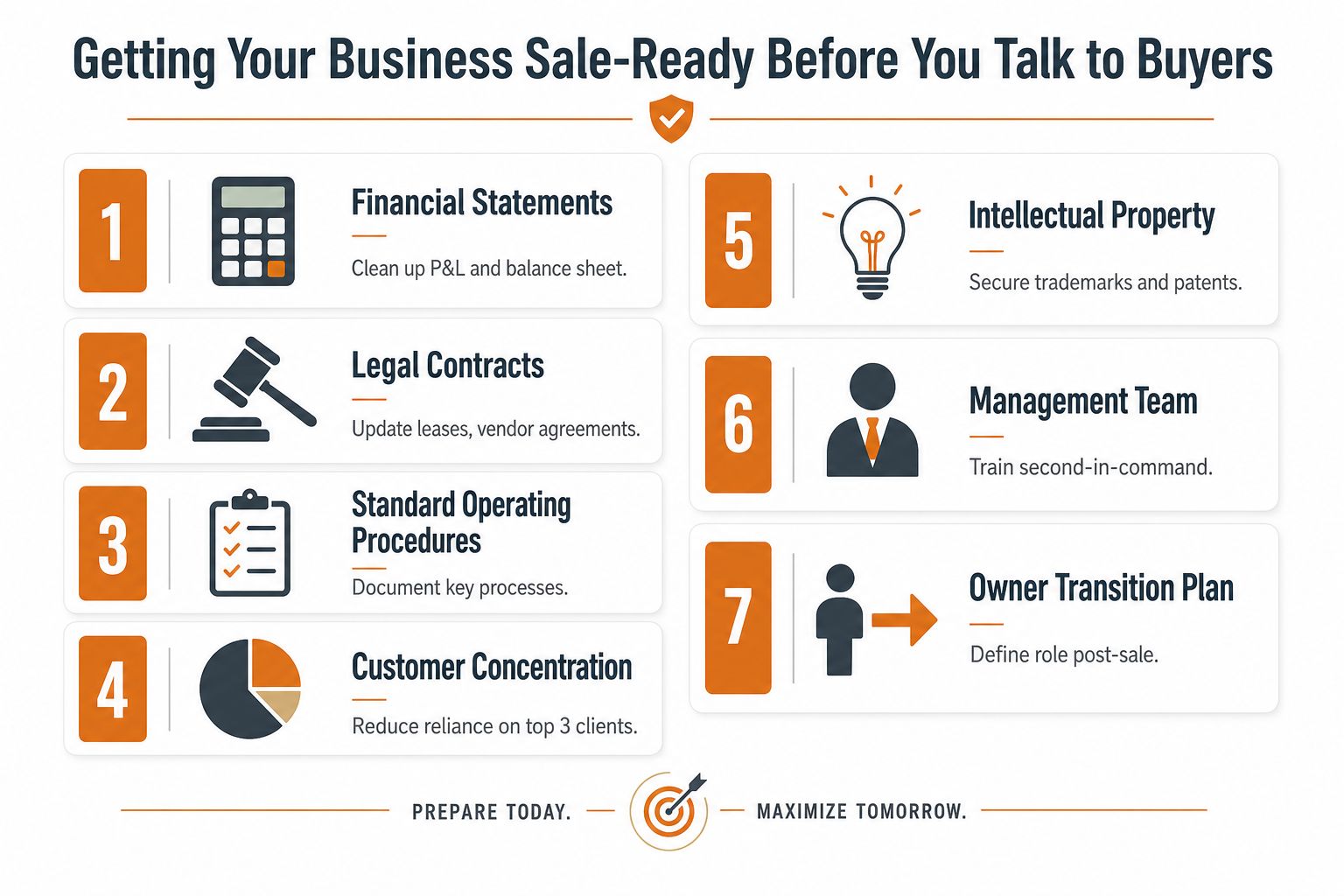
Owner’s rule of thumb: every missing contract, undocumented process, or unclear employment arrangement becomes a buyer question later. Buyer questions usually become either lower price, slower closing, or both.
The biggest mistakes aren’t dramatic. They’re boring. A missing customer agreement turns into a transfer problem. A key service manager who never signed anything turns into retention risk. An owner who can’t explain normalized earnings turns into a discount. If the gap is legal, get a lawyer involved. If it’s financial, get help cleaning it up. If it’s operational, write the process down before someone else prices your silence for you.
A business doesn’t get one magical number. It gets a range, and the range depends on what kind of buyer is looking, how transferable the cash flow is, and how much risk sits under the hood. Owners usually hear a headline number first, then discover the question is whether that number survives diligence, financing, and transition.
The first is earnings multiples. That’s the one most owner-operated service businesses run into, because buyers care about repeatable cash flow more than hard assets. The second is asset-based value, which matters more when the equipment, inventory, or physical assets carry the business. The third is discounted cash flow, which shows up when a buyer wants to model future earnings in detail.
For a plumbing or HVAC business with recurring maintenance contracts, the earnings lens usually matters most. The recurring revenue helps, but it doesn’t override risk. If the owner is the rainmaker, the estimator, and the relationship manager, the market will notice.
If a buyer sees stable renewal revenue, trained technicians, and a business that doesn’t depend on the owner’s personal relationships, the offer range improves. If the buyer sees customer concentration, shaky retention, or systems that only one person understands, the offer range shrinks. That’s not punishment. It’s pricing.
Use this kind of working example. A service company with recurring contracts, good collections, and a second-in-command who can run operations is easier to underwrite than one where every decision still routes through the founder. The first business looks transferable. The second looks fragile.
Practical rule: your walk-away number should be based on what a buyer can defend, not what you need to retire. Those are often different numbers.
If you want a plain-English walkthrough of how a small business gets valued, this overview is worth reading: how to value a small business.
Owners get into trouble when they anchor to a story instead of a range. A defensible range is what a real buyer, with real financing and real advisors, can live with. Your hoped-for price can still matter, but only if the business supports it. If it doesn’t, you’re not negotiating, you’re arguing with arithmetic.
Not all buyers want the same thing, and that matters more than most owners realize. The wrong buyer can pay a fine headline number and still be a bad fit for your people, your customers, and your role after close. The right buyer can protect the legacy and still give you a clean exit.
Strategic buyers are companies already in your world. They may pay more because they can fold your business into theirs, but they’ll also expect synergies and may change your role after closing. Financial buyers, including private equity and search-fund style buyers, usually care about growth, reporting, and operating discipline. Internal successors preserve continuity and familiarity, but they rarely deliver full market value.
The outreach method should fit the buyer type. Strategic buyers often respond best to targeted outreach and a clean teaser that tells them exactly why the acquisition makes sense. Financial buyers often come through curated networks or broker-led processes. Internal successors need a slower, more personal transition plan because they’re buying the business and the responsibility that comes with it.
| Buyer Type | Typical Valuation Impact | Owner Role After Close | Process Style |
|---|---|---|---|
| Strategic buyer | Often strongest on price if synergies exist | Can change quickly, sometimes reduced | Targeted outreach, competitive process |
| Financial buyer | Usually values stable cash flow and growth potential | Often stays involved for a transition period | More formal, reporting-heavy, diligence-driven |
| Internal successor | Usually lower than full market value | Legacy preserved, but owner may stay as mentor | Private, relationship-based, slower |
If you sell to a strategic buyer, you might get the best offer and the least control afterward. If you sell to a financial buyer, you may keep more continuity, but you’ll answer to reporting and growth targets. If you keep it in the family or inside the company, you may protect the name on the truck, but you’ll likely trade off some price.
For owners sorting through those choices, The Owner’s Shortlist is a curated directory and editorial resource that connects owners with vetted specialists across valuation, taxes, legal structure, financing, and related transition decisions. For a broader comparison of buyer logic, see strategic buyer vs financial buyer.
A bad process chases anyone with money. A better process filters for the kind of owner outcome you want. If you care about employees, recurring customers, and a manageable transition, say so early. Buyers self-select fast when they know what matters to you.
The deal doesn’t slow down because people are lazy. It slows down because every sentence in a letter of intent creates follow-up questions, and every follow-up question creates legal and tax consequences. Owners who treat negotiation like a single meeting usually get blindsided by the actual sequence.
A normal seller-side run starts with preparation for 4 to 6 weeks, moves into a first buyer round for another 4 to 6 weeks, then a second round for 4 to 6 weeks, and finishes with 6 to 8 weeks of negotiation before definitive signing, based on the seller-process cadence Wall Street Prep outlines. In other words, the owner spends a lot of time before the finish line even appears. That’s why early organization pays off.
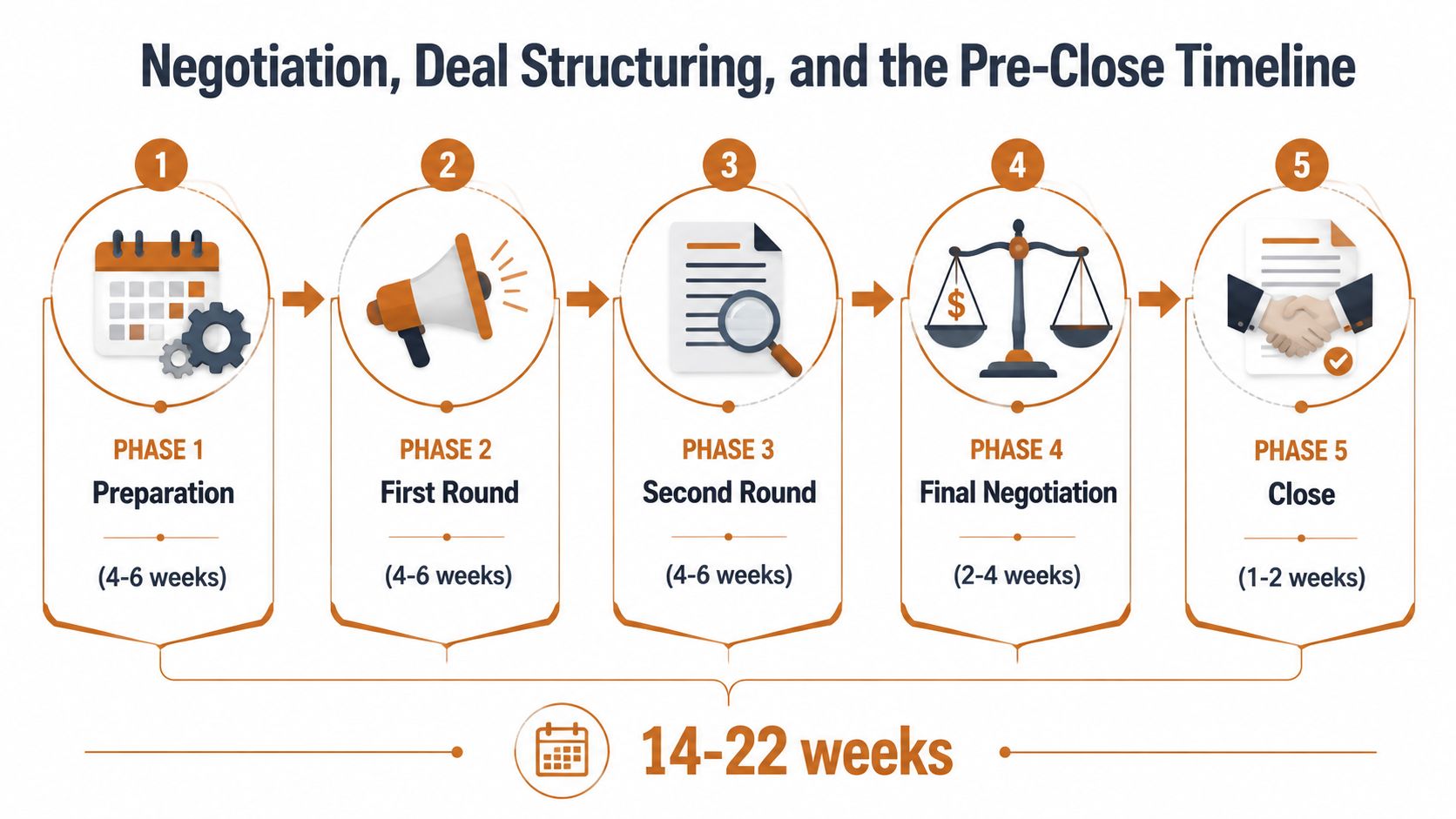
The teaser gets a buyer interested. The CIM gives enough detail to make a first bid. The data room supports diligence. The LOI sets the deal shape. The definitive agreement locks in the legal language. If any of those pieces are sloppy, the buyer will slow down or renegotiate.
The terms that matter most are not fancy. They’re practical. Purchase price tells you the headline. Earnouts tell you how much of that price depends on future performance. Rollover equity tells you whether you’re staying in the ride. Working capital adjustments tell you whether cash on hand is really yours. Reps and warranties, plus indemnity, tell you what you’re promising and what happens if the promise breaks.
Your lawyer should handle the legal language. Your tax advisor should handle the after-tax picture. You should focus on the business consequences, especially what you’ll owe the buyer in information, access, and cooperation after signing.
A clean LOI is not a victory lap. It’s a contract outline that decides where the next fights will happen.
Some owners care most about price. Others care about timing, staff continuity, or staying on for a transition period. Say your priorities early, because every concession has a tradeoff. If you accept a lower base price, you may get a simpler structure. If you chase a higher headline number, you may inherit more risk through earnouts or holdbacks.
You’re not trying to win every clause. You’re trying to keep the structure aligned with the business you own.
Due diligence is not a formality. It’s the buyer’s pricing machine. Every file request is a chance to reprice risk, tighten indemnity, or change how much cash they’re willing to wire at closing.
In technology diligence, the workflow usually starts at the LOI stage with high-level risk screening, then gets deeper during exclusivity with infrastructure, security, and integration review, and then feeds Day 1 readiness and the post-close roadmap. Some frameworks describe a 7 to 10 week diligence cycle that includes document review, technical interviews, architecture assessment, and risk scoring, which is why technical findings affect valuation and go-no-go decisions rather than just post-close housekeeping. Preferred Data’s technology due diligence checklist
That same logic applies to non-tech owner-operated businesses. Buyers want to know where the hidden cost lives. Contract gaps, cybersecurity exposure, key-person dependency, and integration complexity all become financial issues once someone starts pricing the risk.
Get your core documents in shape before diligence starts. That means a clean data room, a sane contract file, a list of licenses and systems, and a clear map of who does what. If the buyer asks a question you can answer in five minutes, you look organized. If the answer takes a week, they assume there are more problems behind it.
For owners trying to separate normal diligence from financial analysis, what is financial due diligence is a useful starting point.
The best use of a specialist here is not panic. It’s triage. If the issue changes valuation, indemnity, or whether the buyer keeps moving, bring in help fast.
Closing day feels like the finish line, but it’s really a handoff. Money moves, documents get signed, escrow and holdbacks get set, and the transition services agreement tells everyone who’s doing what after the wires clear. If the owner thinks the work is done at signing, the next 90 days will be messy.
On Day 1, the basics have to work. Payroll needs to run. Bank access needs to be correct. System logins need to be clean. The new owner needs a clear chain of command, and the seller needs to know what’s still their job under the transition agreement. If those details are sloppy, employees notice first and customers notice soon after.
The first 30 days should stabilize the business, not reinvent it. Keep service levels steady, keep communication simple, and keep people from guessing. After that, the new owner can start aligning reporting, KPIs, vendor contracts, and systems. By days 61 to 90, the focus can shift to consolidation and cleanup.
Recurring revenue is fragile when communication changes. Customers don’t care that the paperwork closed. They care whether service still shows up on time, whether the pricing story makes sense, and whether the relationship they trusted still exists. The same is true for employees. If the technicians, dispatchers, or office leaders feel ignored, they start wondering whether to stay.
McKinsey’s point is blunt and useful. The M&A approach most likely to create value is the one that integrates strategy, deal sourcing, and execution, instead of treating the transaction as the finish line. In plain English, a slightly lower headline price can beat a richer one if the buyer is better prepared to keep the business running well after close. McKinsey on value creation in M&A
Ask one direct question before closing. Who owns integration on the buyer’s side? If the answer is vague, the business will drift. Someone needs to own customer communication, someone needs to own employee retention, and someone needs to own systems migration. Owners who insist on that clarity before close usually avoid the kind of first-90-day chaos that kills goodwill.
Owners lose money when they hire too many specialists too early or wait too long to hire the one they need. The right move is sequencing, not collecting advisors like baseball cards. Each specialist earns their fee at a different point in the M&A process.
The mistake owners make is skipping the category that fits the biggest risk. They hire a broker before they know their tax exposure. They call a lawyer after they’ve already signed a shaky LOI. They wait on valuation help until the buyer has already framed the number. That’s backwards.
The cleanest deals are usually the ones where the owner gets the right help at the right stage, then keeps the process moving. When you treat the sale as a sequence of decisions, you stop paying for guesswork.
If you’re preparing to sell, or just trying to understand where your business really stands, The Owner’s Shortlist gives owner-operators a practical way to find vetted specialists for valuation, taxes, legal structure, financing, and succession. Use it to match the right expert to the right decision before the deal gets expensive.
Tell us your situation. We'll connect you with a specialist who works with owners like you. One conversation, no sales pressure.
Found this useful?
Add The Owner's Shortlist as a preferred source and get our articles highlighted in Google Search results.
Add to Preferred SourcesLearn what reps & warranties mean in M&A deals, why they matter, and how to negotiate them effectively. A clear guide for business owners.
September 27, 2026
Your business's sale price and your retirement number are two different figures. Here's how to build the second one before you rely on the first.
September 21, 2026
Ten straight questions to work through before you set a retirement date, with a short answer to each and where to go deeper on your own time.
September 21, 2026
Being financially ready to sell and having a plan for your time are two different things. Here's why the second one catches so many owners by surprise.
September 21, 2026