How to Finance Buying a Business: A Step-by-Step Playbook
Learn how to finance buying a business using SBA loans, bank debt, seller notes, and earnouts. A practical playbook for buyers of service companies.
October 23, 2026
By Remi Taffin · July 27, 2026 · Updated October 13, 2026

You’re sitting across from two buyers, and both are telling a story you’ve heard before. One says your company “fits strategically,” the other says they “love the cash flow.” Both want exclusivity, both sound serious, and both are trying to make their offer feel like the obvious choice.
That’s where owners get burned. A strategic buyer vs financial buyer decision is not a quiz about definitions. It’s a judgment call about price, certainty of close, employee impact, earnouts, control after closing, and what kind of life your business will have once the wire hits.
| Question | Strategic Buyer | Financial Buyer |
|---|---|---|
| Main motive | Synergies, integration, market position | Return on capital, cash flow, resale value |
| Typical profile | Operating company, adjacent industry acquirer | Private equity, family office, search fund, independent sponsor, holding company |
| Valuation logic | What the business is worth inside their platform | What the business can do on its own |
| Hold period | Long-term integration | Usually a finite exit window |
| Post-close life | Often absorbed into the buyer’s operations | Often kept as a standalone platform |
| Common seller concern | Culture, integration, team overlap | Leverage, earnouts, future exit pressure |
If you’re an owner, the right question isn’t “who’s bigger?” It’s “who’s buying my business in a way that matches what I care about most?”
You’ve got two letters of intent on your desk. One is from a competitor or adjacent operator that knows your market cold. The other is from a financial group that says it likes your margins, your systems, and your management team. The numbers may look close on the first page. The outcomes won’t.
They compare the headline price and stop there. That’s lazy, and it’s expensive. A strategic buyer can justify a higher bid because it expects to capture value through integration, while a financial buyer is underwriting what the business can do on its own and how it can be improved before resale, usually within a finite hold period of about three to seven years L40.
Practical rule: If one offer is “higher” but stuffed with earnouts, rollover equity, or post-close conditions, you don’t have a higher offer yet. You have a more complicated one.
The right comparison is broader than price. You have to look at certainty of close, employee continuity, management control, transaction complexity, and how much of the consideration is guaranteed. Owners who skip that step often discover the “best” offer came with the most friction after signing.
This isn’t a textbook on M&A buyer labels. It’s a decision guide for an owner who wants straight answers. You need to know what each buyer type tends to do after closing, how they build value, and where the traps usually sit.
One more thing. The old shorthand that “strategics always pay more” is too glib to be useful. Strategic buyers can pay more when they can realize synergies, but that premium depends on whether those synergies are real and actionable, not just nicely presented in a deck McKinsey.
If you’re weighing two real offers, you need a framework that gets past the sales pitch and into the mechanics. That’s the part owners usually don’t get from the first buyer conversation.
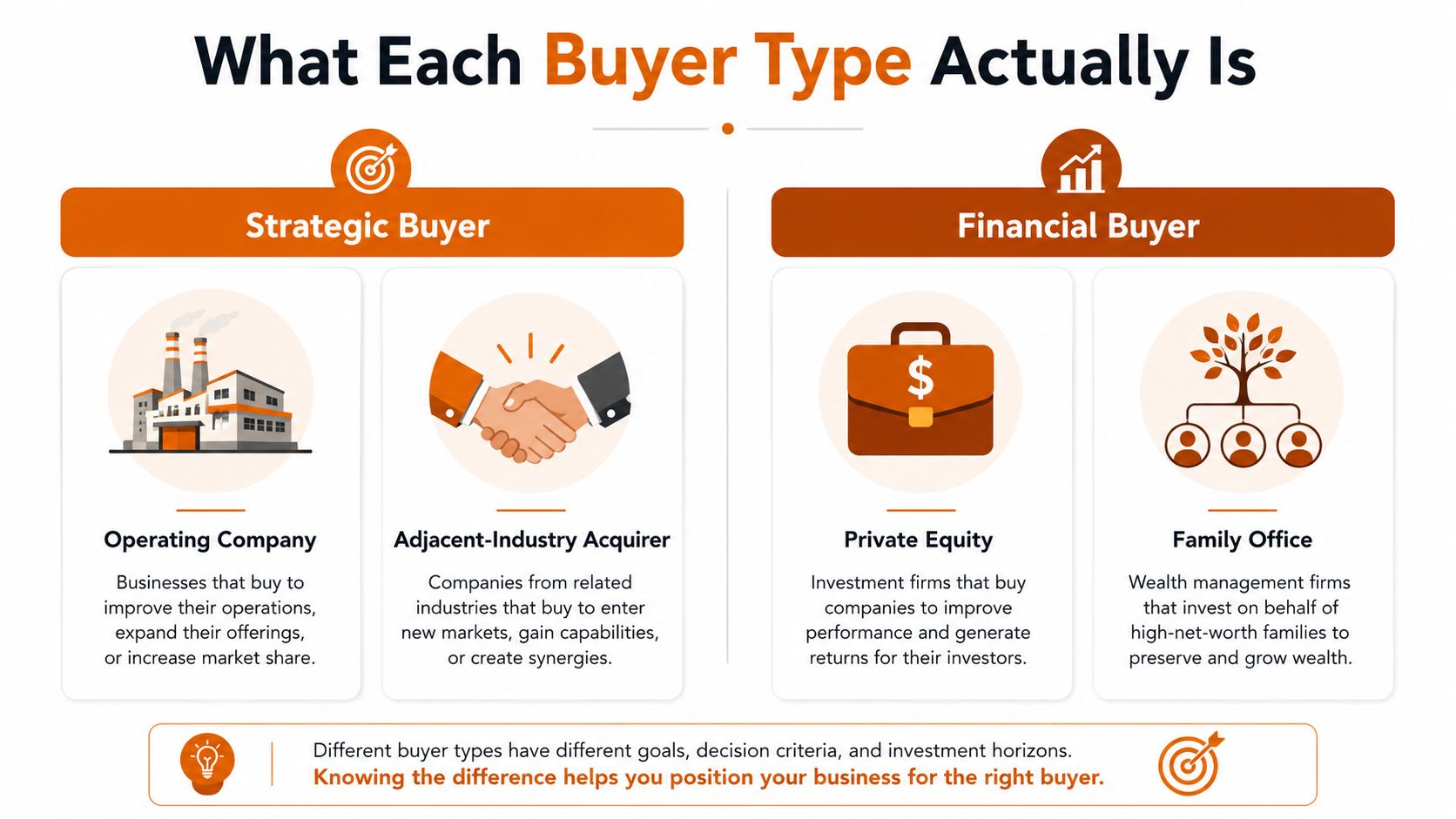
A strategic buyer is usually an operating company, often in the same industry or a closely related one, that buys another business to make its own business stronger. That can mean market expansion, new technology, access to talent, better distribution, or lower costs. In plain English, they buy you because you fit into a machine they already run.
A financial buyer is usually an investor. That includes private equity, family offices, search funds, independent sponsors, and holding companies, not just the old-school PE stereotype. They buy businesses for cash flow, improvement, and eventual resale. They want a business they can own, sharpen, and sell again later.
The label matters less than the motive. A competitor making an offer is usually trying to capture something it cannot build fast enough on its own. That might be customer relationships, local density, route coverage, or a product gap. A financial buyer is looking at your company as a platform and asking whether the numbers work without the benefit of someone else’s operating base.
That difference shows up in the questions they ask. Strategic buyers ask how you fit their footprint. Financial buyers ask how predictable your cash flow is, how durable your management team is, and what else they can do with the asset after closing.
If you want a practical overview of the kinds of buyers who usually contact owners, the range of buyers is clearly laid out in this guide on who may approach you in a sale process. Use that lens before you assume every interested party belongs in the same bucket.
Many buyers blur the lines on purpose. A financial buyer may talk like a long-term partner. A strategic buyer may say it values your team and culture. Both may be sincere, but their incentives are still different.
A buyer’s pitch tells you what they want to sound like. Their capital structure and post-close plan tell you what they actually are.
The biggest mistake sellers make is assuming both sides are using the same math. They are not. A strategic buyer prices your company on what it can create after integration. A financial buyer prices the business on what it can produce on its own, with borrowed funds and a future exit in mind.
Strategic buyers underwrite synergies, meaning value they can create by combining your business with theirs. That can come from cost savings, market-share expansion, talent, technology, or distribution overlap. They are asking what your business becomes inside their platform, not just what it earns today. For a clear definition of synergies in business, see The Owner’s Shortlist on synergies.
That is why strategics can justify a higher price when the fit is clean. The premium is not magic. It comes from a buyer that can fold your operations into something bigger and make money in places a standalone buyer cannot reach. When that synergy case is real, the strategic buyer has room to stretch. When it is weak, the premium shrinks fast and the negotiation turns back to hard economics.
Financial buyers look at your company as a standalone asset. They care about cash flow, borrowing capacity, recurring performance, and whether they can improve the business before exiting. Their hold period is finite, usually three to seven years, and that shapes the valuation they can support L40.
That difference matters in negotiation. A financial buyer usually has less room to pay for vague upside, so it pushes the conversation toward dependable earnings, clean reporting, and a management team that can run the business without the owner. That does not make the offer weak. It makes the offer more disciplined. If your company already stands on its own, a financial buyer can still be a serious bidder, including family offices, search funds, and independent sponsors who do not fit the old PE stereotype.
A bigger number on page one can disappear fast if the assumptions are weak. A strategic buyer may wave a high headline price, then load the deal with integration assumptions, earnouts, or conditions that move the actual value back down after closing. That is why owners should ask where the extra value comes from and how much of it depends on post-close execution.
The right question is simple. Can the buyer explain the source of the value in plain language? If the answer is vague, you are not looking at a premium. You are looking at optimism.
If you want to see how those value claims turn into valuation logic, read the buyer’s case for synergy and ask whether it survives outside the pitch deck.

What owners feel on closing day is not the same as what they see in the LOI. The structure tells you whether the money is real, delayed, or contingent. A clean offer with a lower headline can beat a messy offer with a bigger number on paper.
Start with cash at close, then check for earnouts, then ask about rollover equity. Strategic buyers are often more likely to offer cleaner cash structures, because they’re buying for integration and can sometimes fund the purchase inside a larger operating platform. Financial buyers rely more heavily on borrowed funds and may ask the seller to carry some risk through structure, including rollover equity or other participation Lutz.
That doesn’t make one side “bad.” It just means the seller needs to know what gets paid now, what gets paid later, and what depends on post-close performance.
Earnouts sound fair because they tie part of the price to future results. In practice, they can become a fight over accounting, management control, budget authority, and customer retention. If the buyer controls the business after closing, and your payout depends on hitting numbers you no longer control, the earnout can shrink the deal.
That risk matters more when the buyer plans to change staffing, systems, pricing, or reporting after close. If the operating plan changes, the seller’s ability to hit the earnout changes too. That’s not theory, it’s how deals go sideways.
A buyer can quote a strong price and still fail to close if the financing stack is shaky. Ask where the money is coming from, whether debt commitments are already lined up, and how much of the deal depends on future lender approval. If the answer stays vague, that’s a warning sign.
For sellers who are asked to help fund the transaction or provide seller note support, the terms matter even more. The pros and cons of that support deserve a hard look before you agree to it, and the seller-financing trade-offs are explained clearly in this practical overview.
Practical rule: A buyer with a simpler capital structure usually gives you a cleaner path to closing. Simpler is often worth more than “maybe” money.
After closing, the business doesn’t just keep going with a new logo on the letterhead. The operating model changes, and so do the lives of the people inside it. That’s where the buyer type matters most.
A strategic buyer often integrates the acquisition into existing operations. That can mean shared systems, shared leadership, different reporting lines, and sometimes a rebrand. For employees, that can be a relief if the new parent company brings better tools and broader opportunity, or it can create role overlap if the buyer doesn’t need duplicate functions.
Owners who care about legacy need to ask the hard question: does this buyer want my business as a living unit, or as a piece of a larger machine? That’s not the same thing, and staff usually feels the difference fast.
Financial buyers often keep the business more intact at the start. They usually want continuity in management, customer relationships, and operating rhythm, because the investment thesis depends on preserving what already works while improving what doesn’t. That can be attractive if you want less disruption for your team and more room for a planned transition.
But continuity doesn’t mean passivity. Financial buyers still expect performance, reporting discipline, and progress against a value-creation plan. They just tend to work through the existing business rather than folding it into another operator’s infrastructure.
If you’re staying on after closing, the key issue isn’t only money. It’s authority, reporting cadence, and how much say you still have when decisions start getting made. Rollovers, transition roles, and earnouts all affect that control.
Owners often focus on the sale price and ignore the post-close reality. That’s a mistake. The buyer type determines whether your team is going to feel continuity, pressure, or a little of both.
If your real goal is clean cash at close, stable jobs for your team, or a buyer that lets you step back without getting dragged into daily decisions, the answer is not the same buyer every time. Owners often start by saying they want the highest number. Once they see the LOI, they usually care just as much about certainty of close, employee treatment, and how ugly the earnout looks in real life.
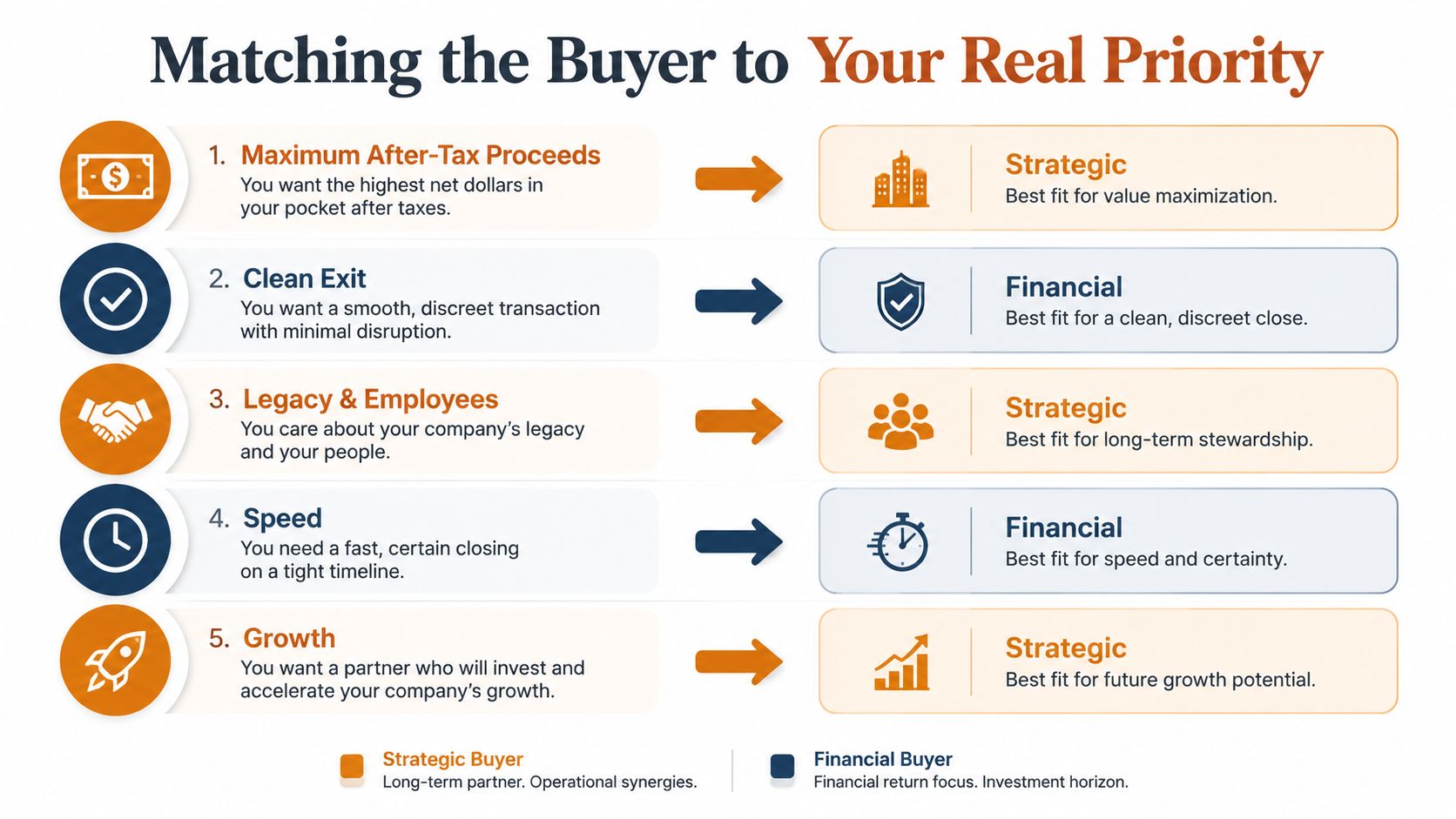
A strategic buyer is usually the first place owners look because the fit can justify a premium when it is real. That is most common in businesses with recurring revenue, dense routes, customer lists, or overlap the buyer can monetize faster than you can on your own. Trades like HVAC and plumbing with service contracts can be especially attractive when the buyer values the customer base and route density, not just current earnings.
Still, do not treat a large headline number as the final answer. If the premium depends on an earnout, seller financing, or a closing condition that can slip, the economics change quickly. A clean-looking offer can become a weak result once the buyer gets control of the levers that decide your payout.
Financial buyers are usually better when you want a steadier handoff and fewer surprises right after closing. They buy businesses as platforms, so they often want the management team to keep the machine running while they improve what is already there. That can reduce disruption on day one and give you a cleaner exit path.
Strategic buyers can close cleanly too, but they are more likely to bring integration work with them. New systems, reporting lines, branding changes, and shared services can show up fast. If you want to leave without a lot of noise, ask what changes in the first weeks after close before you get pulled in by the offer price.
Financial buyers often leave the business identity alone longer, especially when the existing management team is part of the value story. That usually means fewer immediate changes in title, reporting, and day-to-day routines. For owners who care about the people behind the business, that matters more than a few extra points on paper.
Strategic buyers can still be good stewards, but they usually buy with a different end state in mind. They may fold functions together, change the brand, or remove duplicate roles if the larger company does not need them. If you want to protect the team that built the business with you, ask directly what happens to those roles after closing.
A family office often behaves differently from a traditional private equity firm. It may be patient, less aggressive on debt, and more willing to keep a business intact if the fit is right. A search fund is different again, because the buyer is usually an individual operator trying to take over one business and run it, which often means a smaller team, more direct involvement from the owner, and less of the layered PE playbook. Independent sponsors can sit between those two, with more deal creativity and less institutional process than a big fund.
The buyer universe is wider than the old PE stereotype, and owners should judge the actual behavior, not the label. McKinsey discusses how different buyers pursue value in different ways, and the practical point is simple, a financial buyer can mean a patient family office, a hands-on search fund, or a sponsor with a very structured capital stack. Those are not the same buyers, and they will not treat your company the same way after closing.
The fastest way to diminish your negotiating power is to let a buyer stay fuzzy. Vague synergy claims, aggressive earnouts, and last-minute financing changes usually mean you’re taking more risk than the LOI admits.
Ask these in management meetings and diligence:
If the answers are vague, keep your guard up. If the buyer gets defensive, that’s useful information too.
This is the point where an experienced M&A advisor matters. So do the right legal, tax, and financing specialists, because the best answer on price can still be the wrong answer after structure and taxes hit.
Before you pick a buyer, get four things in order. Start with a defensible valuation, then map the tax impact of each structure, then pressure-test the financing, and then have an M&A advisor review the whole package with owner-operated mid-market experience.
Talk to valuation, tax, and legal people before you let any LOI become “the deal.” That sequence protects you from bad comparisons and expensive assumptions.
The Owner’s Shortlist helps owners get clear on the specialist conversations that matter before they sign anything. If you’re sorting through a strategic buyer vs financial buyer decision, The Owner’s Shortlist gives you a practical way to line up valuation, tax, legal, and financing support without wasting time on the wrong advice.
Tell us your situation. We'll connect you with a specialist who works with owners like you. One conversation, no sales pressure.
Found this useful?
Add The Owner's Shortlist as a preferred source and get our articles highlighted in Google Search results.
Add to Preferred SourcesLearn how to finance buying a business using SBA loans, bank debt, seller notes, and earnouts. A practical playbook for buyers of service companies.
October 23, 2026
Explore 5 confidential information memorandum examples for owner-operated businesses, with required sections, practical guidance, and common pitfalls.
October 22, 2026
Partners who disagree on selling usually settle it one of four ways: a buyout, a partial sale, a sale together, or what the agreement forces.
October 20, 2026
What is deal structuring, explained for service business owners. Learn asset vs stock sales, earnouts, seller financing, holdbacks, and the questions
October 19, 2026