Business Valuation in Divorce: How Courts Value a Company
Learn how business valuation in divorce works: income, market and asset methods, goodwill, valuation dates, discounts and how to choose an expert.
October 28, 2026
By Remi Taffin · October 29, 2026
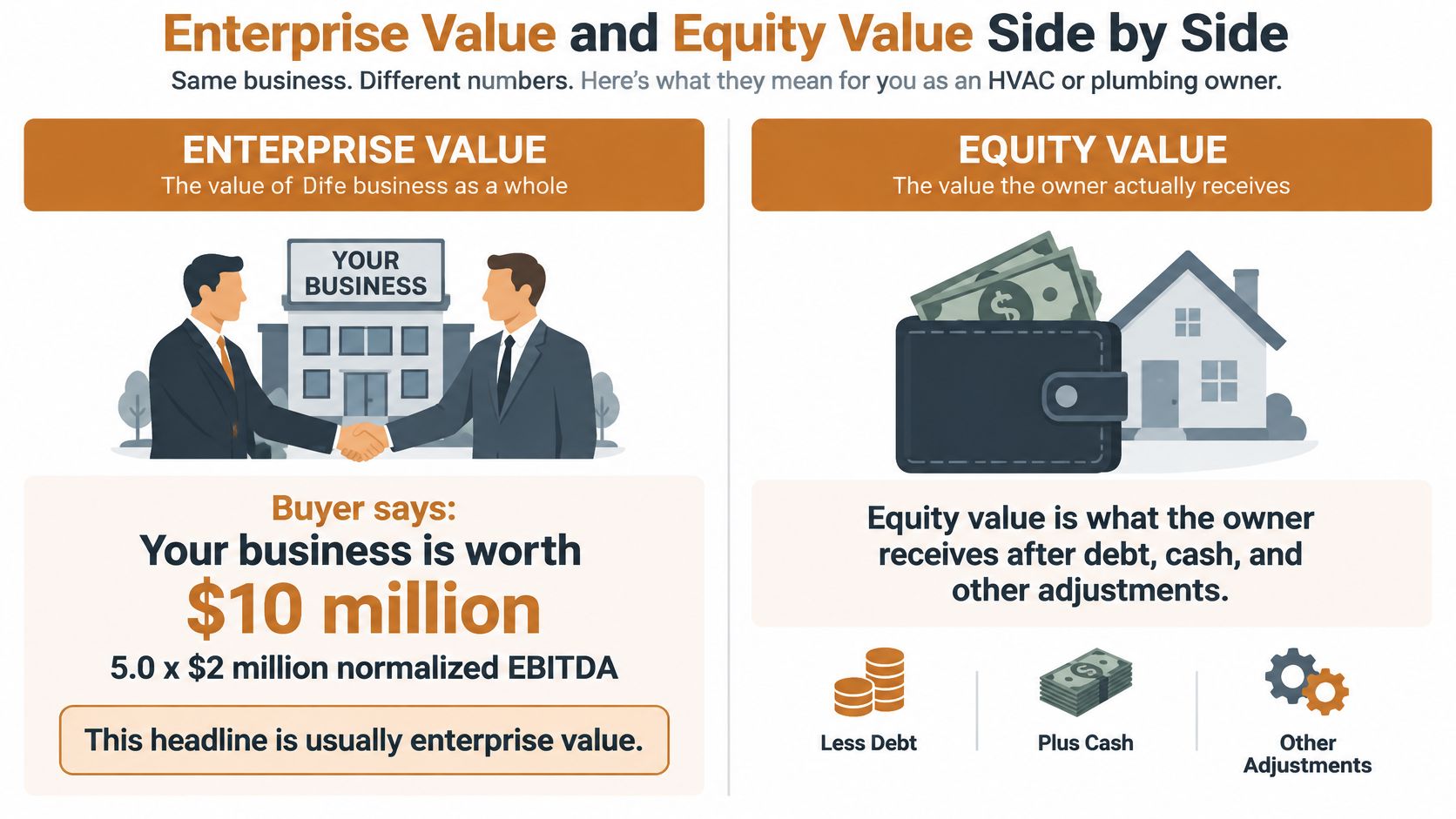
Enterprise value prices the operating business before financing, while equity value is what’s left for the owners after debt and cash, so a $10 million offer can become an $8 million equity figure before taxes and other closing items. If you’ve run an HVAC, plumbing, electrical, or landscaping company for 15 years or more, that gap is where retirement math gets real. You’re not arguing about definitions. You’re trying to work out what reaches your bank account, what pays off the trucks, and whether the number in a buyer’s email is the number you can plan around.
Say a buyer tells an HVAC or plumbing owner, “Your business is worth $10 million.” The math behind it is usually 5.0 times $2 million of normalized EBITDA. That headline is usually enterprise value, not the owner’s check. It’s the price of the operating business, its crews, customers, equipment, and earning power, before anyone asks how that business was financed.
Equity value answers a different question. After lenders and other claim holders are accounted for, what belongs to you and any co-owners? The Damodaran valuation datasets define enterprise value as market capitalization plus debt minus cash and describe it as the market value of the firm’s operating assets. From that, equity value is approximated as enterprise value minus total debt plus cash.
| Measure | Question it answers | Standard build | What it is not |
|---|---|---|---|
| Enterprise value | What are the operating assets worth before financing? | Equity value + interest-bearing debt + preferred equity + non-controlling interests − excess cash | The check the owner takes home |
| Equity value | What is left for the owners after debt and cash? | Enterprise value − debt − preferred equity − non-controlling interests + cash | Cash after taxes, fees, earnouts, or a working-capital true-up |
Enterprise value pairs naturally with EBITDA or revenue because both are measured before interest. A buyer can compare two similar contractors even if one owns its fleet outright and the other financed every van. Equity value matters later, when you sell shares or collect proceeds at closing.
Your private company doesn’t have a market capitalization quoted on a screen. So don’t get stuck on that word. In a private sale, equity value is the figure you and the buyer agree to in the letter of intent and purchase agreement, built from the same ingredients, debt, cash, and any preferred claims ahead of common owners.
It helps to check valuation benchmarks before selling your company so you can see whether a quoted multiple is even in a sensible range for a business like yours. Then ask one plain question before you compare any offers. Is every quoted multiple an enterprise multiple or an equity multiple?
If a buyer won’t say which value the multiple produces, you don’t have an offer you can compare yet.
The bridge is the path from a buyer’s headline to your residual. Walk it in order, and don’t skip steps because a number looks small.
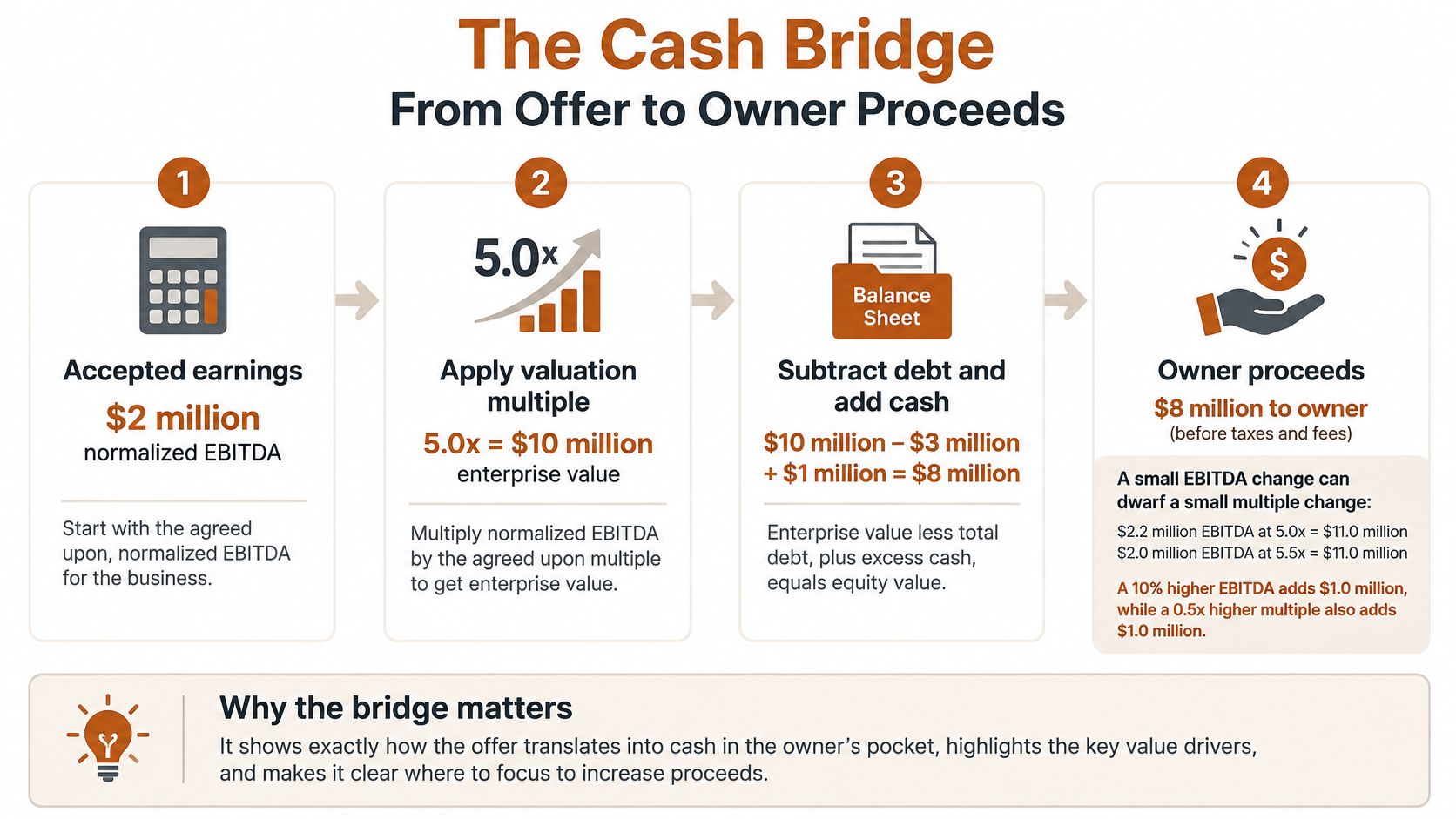
That $8 million is not a promise of cash on closing day. It’s the owners’ residual at that stage of the math. Taxes still sit ahead, which is why it’s worth understanding how the exit tax rate can affect what you keep before you treat equity value as spendable money.
Financing alone can move millions without changing operations at all. A business with a $20 million enterprise value, $6 million of debt, and $2 million of cash has an implied equity value of $16 million. Same crews, same customers, same profit. The owners’ slice is $4 million smaller than the operating value because lenders have a claim first.
A short video walkthrough can help you see the order of those steps before you run your own numbers.
Buyers don’t pay for the EBITDA you report. They pay for the EBITDA they accept after diligence. If diligence cuts accepted EBITDA by 15%, from $2 million to $1.7 million, the same 5.0 times multiple produces $8.5 million of enterprise value, a $1.5 million reduction before debt and cash adjustments, as shown in the Damodaran discussion of enterprise-value multiples.
That sensitivity surprises owners. Arguing a buyer from 5.0 to 5.1 times adds a little. Losing $300,000 of accepted EBITDA to rejected add-backs, a personal vehicle, an above-market salary adjustment done the wrong way, or a one-time job that won’t repeat can cost far more.
EV/EBITDA is useful because enterprise value includes debt and equity capital, while EBITDA sits before interest. That’s why it lets you compare a debt-light contractor with a debt-funded competitor. It isn’t complete. It ignores capital spending, taxes, working-capital investment, lease economics, and add-backs a buyer won’t accept. Reconcile reported EBITDA to accepted EBITDA first, then model net debt separately. Don’t negotiate only the multiple.
Bank debt is rarely the only deduction for a plumbing, electrical, roofing, landscaping, or pool company. The fuller bridge subtracts interest-bearing debt, preferred equity, and non-controlling interests, then adds excess cash and non-operating investments. Damodaran’s multiple-calculation framework sets out that bridge and cautions that market value, not merely book value, should be used for debt when it’s reliably observable, with leases and other commitments treated according to the analysis.
| Item | Usual treatment | Trade-business example |
|---|---|---|
| Interest-bearing bank debt | Subtract | Term loan on the shop or line of credit |
| Equipment and vehicle financing | Subtract as debt | Financed trucks, excavators, or HVAC vans |
| Shareholder or related-party loans | Treat as debt-like and subtract | Owner loan booked as equity |
| Preferred equity and non-controlling interests | Subtract | Outside investor or minority partner |
| Excess cash and non-operating investments | Add | Cash above what operations need |
| Normalized working capital | Shortfall subtracts; surplus can add | Receivables, inventory, payables, customer deposits |
| Accrued bonuses and unpaid taxes | Often debt-like | Year-end bonus pool or payroll taxes |
| Seller note, earnout, or rollover | Not all cash at closing | Part of equity value paid later or kept in the deal |
Shareholder loans cause confusion. You may have booked money you put into the company as equity because it felt like your money. A buyer often treats a repayable owner loan as debt-like, because someone has to settle it. The label in your chart of accounts doesn’t settle the argument. The purchase agreement does.
Operating cash is the other trap. Excess cash gets added to equity value. Cash the business needs to make payroll, cover deposits, and run next month’s jobs doesn’t. If you strip the bank account to zero before closing, expect the buyer to object or to rebuild that need through working capital.
A working-capital peg sets a normal level for receivables, inventory, and payables. Deliver less than the peg and proceeds fall. Deliver more and they can rise. If that mechanism is new to you, read how a working-capital peg is set and trued up before you sign anything that references a target you haven’t seen calculated.
Accrued bonuses, unpaid taxes, and customer deposits for work not yet done can all act like obligations. Deferred maintenance and a worn-out fleet may not appear as debt, but a buyer may cut price or hold back cash for them. Preferred equity and a minority partner’s interest are subtracted because that value doesn’t belong to the selling owners.
Tax treatment adds another layer owners sometimes raise across jurisdictions, including CGT exemption advice from EndureGo Tax for Australian contexts. Wherever you sell, treat tax rules as separate from the bridge. Ask for a written bridge that labels each item as debt, debt-like, cash, working capital, or an excluded asset. If an item has no label, it will get one during diligence, and it may not be yours.
A documented deal shows the gap isn’t theory. In the SEC filing for the Ecker transaction, the reported fair-market enterprise value was $4,554,556, balance-sheet adjustments reduced it to $3,573,878, and after term debt and applicable adjustments the equity value was $2,790,000. The filing states that equity value is derived by subtracting interest-bearing term debt and applicable working-capital adjustments from enterprise value.
| Stage | Amount (USD) |
|---|---|
| Reported fair-market enterprise value | 4,554,556 |
| After balance-sheet adjustments | 3,573,878 |
| Equity value after term debt and adjustments | 2,790,000 |
| Gap from enterprise value to equity value | 1,764,556 |

The $1,764,556 gap is the lesson. A headline valuation was not the seller’s cash proceeds. Balance-sheet items moved the number before debt had its full effect, and working-capital adjustments were part of the final step. That’s why enterprise vs equity value isn’t a vocabulary quiz. It’s the difference between a number you celebrate at the kitchen table and a number you can retire on.
Say a commercial cleaning company and an excavation company each get quoted on EBITDA. Both look strong on profit. The excavation business carries equipment notes, parts inventory, large receivables, and customer deposits tied to unfinished work. The cleaning company has little debt, modest supplies, and steady monthly billing. They can share a similar enterprise value and still produce very different equity checks.
Or compare a debt-free landscaper with a debt-laden electrical contractor. Same EBITDA, same multiple, same enterprise value. The contractor’s owners still have to account for vehicle financing and a line of credit. The landscaper’s owners don’t. Anyone who ranks those offers by headline alone will rank them wrong.
Practical test: Line up a broker valuation, a private-equity indication of interest, and a buyer letter of intent on the same equity-value basis, using the same debt, cash, and working-capital rules.
Documents arrive in different formats for a reason. One quotes enterprise value, another buries assumptions in a footnote, a third names a purchase price without saying what’s assumed or excluded. Put them on one page. If two buyers both say 5.0 times EBITDA, the better offer is the one whose written bridge leaves more cash after the same debt-like items, on terms you can live with.
Read an indication of interest or letter of intent as four separate promises. First, the enterprise-value multiple. Second, the equity value after debt and cash. Third, the cash paid at closing. Fourth, any amount paid later, kept in the business, or tied to future performance. Blurring those four numbers is how owners end up disappointed by a deal they thought they’d won.
Before you sign, work through questions to ask before signing a letter of intent and make the buyer answer in writing. A friendly call is not a bridge.
Say a buyer quotes $5 million. Unpaid transaction expenses can reduce what you keep. A working-capital shortfall can reduce it again if receivables are thin, inventory is low, or payables are stretched at closing. Debt-like items, such as an owner loan the buyer expects to be settled or taxes owed for a pre-closing period, can reduce it further.
The movement isn’t only downward. Excess cash can increase equity proceeds. Surplus working capital can add value. Assets you keep and sell separately, or real estate excluded from the deal, can also change your total outcome, even if they don’t change enterprise value. Each item needs a name and a dollar amount.
In an asset sale, tax rules require purchase consideration to be allocated among categories such as cash, receivables, inventory, tangible assets, identifiable intangibles, and goodwill. That allocation affects the buyer’s tax basis and your gain or loss. For a contractor, vehicles, equipment, customer deposits, receivables, inventory, and deferred maintenance can sit in categories with different tax results. Equity value is therefore not one uniformly taxed check.
This isn’t tax advice, and it isn’t a reason to guess at rates. It’s a reason to discuss the bridge and the allocation together, early, with your own advisers. Ask the buyer directly, “If you say the business is worth $5 million, what amount reaches my bank account at closing, and what part may be taxed differently?”
Your revenue rose. Your profit rose. The buyer’s equity offer barely moved. That feels insulting, but it can happen for reasons outside your shop.
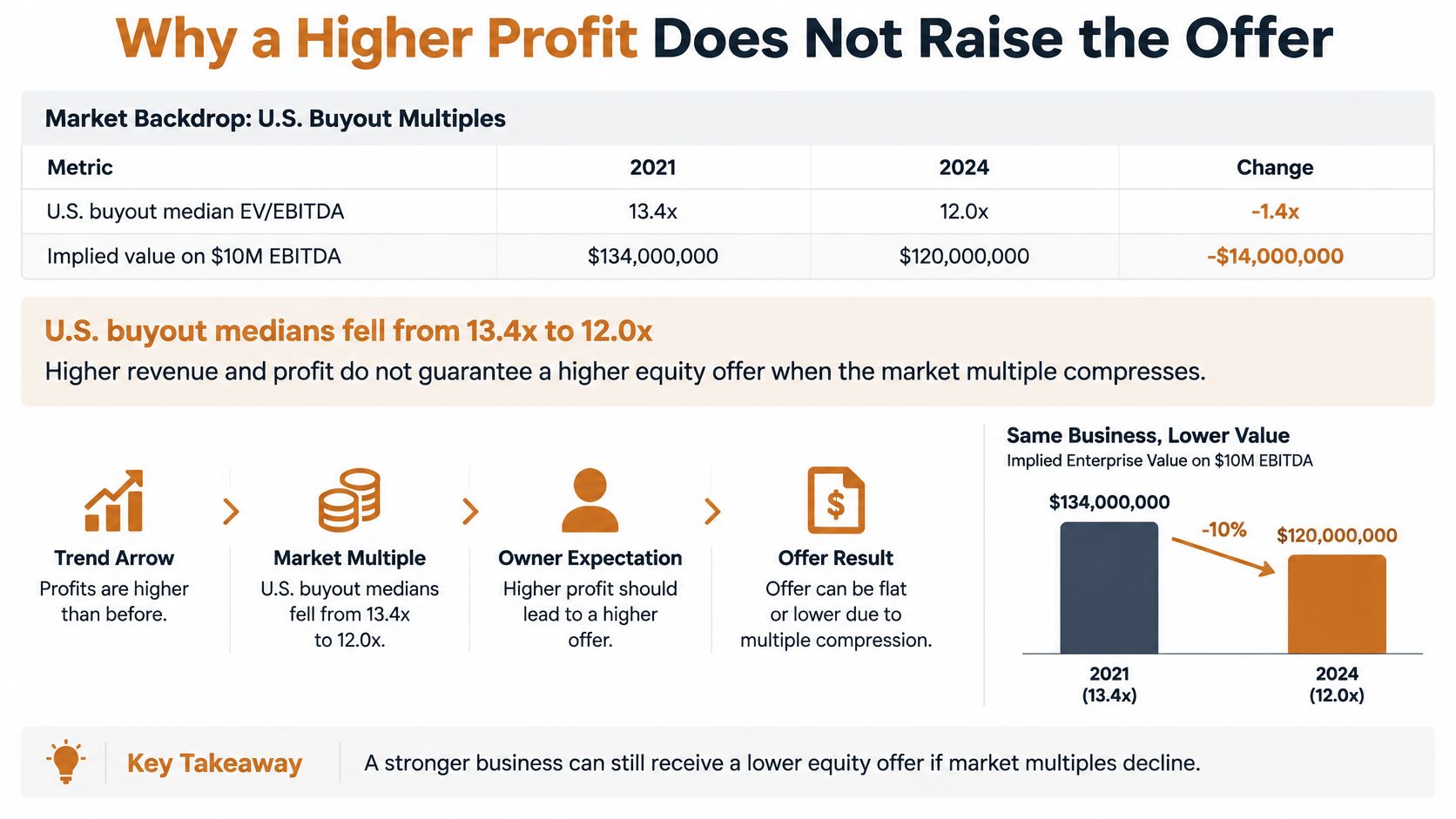
The NEPC quarterly private markets report reports that U.S. buyout median enterprise-value-to-EBITDA multiples declined from 13.4x in 2024 to 12.0x in 2025, while 2025 buyout deal value rose 67% year over year to $255 billion. More dollars chased deals, but the median multiple fell, pointing to concentration in larger transactions rather than a raise for every seller.
| Measure | Earlier point | Later point |
|---|---|---|
| U.S. buyout median EV/EBITDA | 13.4x in 2024 | 12.0x in 2025 |
| Private-company median selling price/EBITDA | 3.5x in late 2024 | 3.8x in Q2 2025, 3.5x in Q4 2025 |
| U.S. buyout deal value | $152.7 billion implied for 2024 | $255 billion in 2025, up 67% year over year |
Private-company medians moved from 3.5x in late 2024 to 3.8x in Q2 2025 before returning to 3.5x in Q4. A local HVAC, plumbing, or landscaping company can therefore sit at a much lower multiple than a large sponsored buyout in the same year. Size, risk, and transferability explain much of that distance.
Enterprise value moves with the quality and transferability of earnings. Equity value then moves with debt, cash, and closing adjustments. If the market multiple compresses while your EBITDA grows, the two forces can cancel out. If you added debt to buy trucks that produced the growth, equity value can lag even further.
Company-specific drags matter too:
A private-equity rollup may quote a higher enterprise multiple yet deliver less cash if you must roll equity or accept an earnout. We publish a guide explaining how PE rollups work, which can help you sort a platform offer from an add-on offer. Tax allocation adds one more separation between price and proceeds, since the IRS guide to basis of assets covers how consideration in an asset acquisition is allocated among asset categories that affect basis and gain or loss. Market multiples set the neighborhood, accepted EBITDA sets enterprise value, and the balance sheet sets equity value.
Neither measure wins. Each has a job. Use enterprise value when you’re comparing operating performance or a buyer’s EBITDA multiple across a debt-free company and a debt-burdened one. Use equity value when you’re deciding whether an offer funds retirement, supports a family transfer, or pays off the notes on the fleet. Don’t treat either figure as after-tax cash.
We publish a guide explaining how a business is valued and the methods specialists use. Read it before a second meeting, then ask the buyer or broker for one page you can hold in your hand.
If two quotes disagree, fix accepted EBITDA and the bridge before arguing over a tenth of a turn on the multiple. Small multiple fights feel productive. Unlabeled deductions cost more.
Get your own advice on the documents. Owners who want counsel on transaction paperwork sometimes look into business purchase and sale legal services as one example of the kind of legal help involved. Nothing here replaces your own tax or legal advice, and a bridge reviewed only by the buyer isn’t reviewed for you.
End every pricing conversation with one decision question. Is the number being negotiated the operating business, the owners’ residual, or the cash that can arrive? Owners pay nothing for an introduction to a specialist through our service, and there’s no obligation after that, so you can get a second set of eyes before you commit to a number.
If you’re weighing an offer and can’t tell whether the headline is enterprise value, equity value, or actual cash at closing, The Owner’s Shortlist can review your situation and introduce you to one specialist whose past work fits a business like yours. You’ll talk to a real person, your business won’t be listed or advertised, and you can decide your next step without pressure.
Tell us your situation. We'll connect you with a specialist who works with owners like you. One conversation, no sales pressure.
Found this useful?
Add The Owner's Shortlist as a preferred source and get our articles highlighted in Google Search results.
Add to Preferred SourcesLearn how business valuation in divorce works: income, market and asset methods, goodwill, valuation dates, discounts and how to choose an expert.
October 28, 2026
Learn how to value business accurately: normalize earnings, choose a method, apply real multiples, and know when to call a valuer.
October 27, 2026
Ready to sell my plumbing business? Follow a step-by-step roadmap for valuing, marketing, and closing the sale with confidence and clarity.
October 15, 2026
Learn how to sell your service business with a practical, step-by-step roadmap. From readiness and valuation to deal structure and closing, get actionable
October 14, 2026