Enterprise vs Equity Value for a Business Sale
Enterprise vs equity value in plain numbers: what a 5x EBITDA offer means after debt, cash, and closing adjustments for a trade business.
October 29, 2026
By Remi Taffin · October 28, 2026

You’ve run the company for fifteen years. A buyer just named a price. Your spouse’s lawyer is using a different number, and neither one matches the cash you take home. That gap is what business valuation in divorce looks like for an owner who thought the company was straightforward: trucks, a crew, and a book of service work.
A sale price and a divorce figure answer different questions. A broker estimates what a buyer might pay on a given day. A court asks which slice of the company is marital, on which date, under your state’s rules. Those answers can sit far apart, and the space between them is where settlements get expensive.
Say you own a plumbing company. Last spring a buyer offered a clean number for the whole business. In the divorce, the other side is talking about a share of a higher figure. Neither number is “the” value by itself.
What the business is worth and what portion is divisible are related, but they are not the same question. Huntington Private Bank is clear that there is no single formula. Courts commonly weigh the asset, market, and income approaches, while the controlling standard of value and the treatment of discounts depend heavily on state law.
Classification comes before any multiple. A company you founded before the marriage may remain separate property. Appreciation that built up during the marriage may be treated as marital property.
The split of that marital piece also changes by state. In community-property states, including Arizona, California, Idaho, Louisiana, Nevada, New Mexico, Texas, Washington, and Wisconsin, marital assets are generally divided equally. Other states use equitable distribution. Courts there weigh fairness, the length of the marriage, and each spouse’s finances. The same company can produce different distributable outcomes based on jurisdiction, date, contributions, liabilities, and whether goodwill is personal or tied to the enterprise.

A divorce figure is not a guess at a sale price. It is tied to a standard of value, a valuation date, and a specific ownership interest. If you live in Texas, a practical walk-through of valuing a business during Texas divorce from the Law Office of Bryan Fagan, PLLC is a useful place to see how those rules show up in one state.
The strain on the company is common, not theoretical. A 2024 Clarify Capital survey of 1,000 Americans, reported by Fortune, found that 57% of business owners experiencing divorce said their company suffered a financial hit.
Pull four facts first: the formation date, the ownership split, your state of residence, and your spouse’s actual role. A written business valuation report should name those facts instead of burying them inside one headline number.
| Approach | What it measures | Typical inputs | Where it fits a service business |
|---|---|---|---|
| Asset approach | Net value of assets minus liabilities | Balance sheet, equipment and vehicle appraisals, receivables, debt | Sets a floor value; matters most when earnings are thin or liquidation is realistic |
| Market approach | Price paid for similar businesses or transactions | Comparable sale data, adjusted industry multiples | Useful cross-check; hard to apply to small private trade companies |
| Income approach | Value of expected future earnings or cash flow | Normalized earnings or cash flow, discount rate, capitalization rate or multiple | Often the primary method for profitable firms with steady recurring revenue |
The asset approach subtracts liabilities from assets. For a trade company that means trucks, tools, inventory, and receivables, minus debt. It matters most when liquidation is realistic, and it sets a floor when earnings are thin. A roofing firm with a yard full of paid-off equipment and a weak year still has something a buyer, or a court, can see on paper.
The market approach looks at what similar businesses sold for, then adjusts the multiple. It is a useful cross-check. It is hard to lean on for a small private trade company, because clean deal data is scarce and the “comps” often differ in size, geography, or how much of the work the owner still does.
The income approach converts expected future earnings or cash flow into a present value, using a discount rate, a capitalization rate, or a multiple. For a profitable plumbing, HVAC, or roofing firm with steady revenue, this is usually the primary method. The earnings have to be normalized first. Owner salary, a personal truck, and family on the payroll are not what an outside operator would keep paying.
The earnings figure and the rate or multiple have to rest on the same assumptions. You can’t pair a high, unadjusted profit number with a low multiple taken from a different kind of company and call the product a value. An expert should pick one primary method, test it against the other two, and write a reconciliation that says why the numbers agree or differ.
Practical rule: If the asset floor sits far below the income result, the gap is mostly intangible value, and that gap is where goodwill arguments start.
A court can reject a method that lacks factual support. Reading how lawyers compare divorce business valuation methods at The Law Office of Bryan Fagan shows why the write-up, not the multiple alone, is what gets tested.
Start with one question. Could a buyer run this company without you?
Enterprise goodwill sits in the company. Customer lists, recurring contracts, brand recognition, trained staff, operating systems, and written processes can transfer with the business, and they are commonly treated as a business asset. Personal goodwill follows you. Your relationships, reputation, skill, and the labor you still perform are commonly excluded from the divisible marital estate in states that draw the line.
The split matters because sale price and divisible value are not the same number. A company can carry a healthy price tag while only part of that price enters the marital estate, once the slice tied to you personally is separated out.

A route company whose customers keep calling after the owner steps back holds transferable goodwill. A restaurant that empties when its chef leaves does not. Strong earnings alone prove neither case. A plumbing, HVAC, roofing, or commercial-services company can post solid profits that still resist conversion into enterprise goodwill when customers stay because of the owner’s personal relationships or technical presence on the job. The same definition of goodwill in business applies to a trade shop, not only to a medical or law practice.
Walk these items with your books open:
Each item answers part of the same question: what would a buyer receive at closing? “The owner does everything” does not, by itself, mean there is no divisible enterprise value. A license held only in your name pulls value toward the personal side. A maintenance plan that renews on its own pushes value toward the enterprise side.
Courts treat this as a fact question, not a label. In Gillum v. Gillum, the Arkansas Court of Appeals said goodwill requires evidence that it is saleable or marketable as a business asset. That standard puts the burden on proof, not on how profitable the company looks on paper.
A short video walk-through of how buyers separate the owner from the company helps before you read a report:
A defensible report shows the bridge. Total business value, minus the personal-goodwill adjustment, equals enterprise value, and the adjustment rests on the same transferability items above rather than a rule-of-thumb percentage. Where that line lands changes what gets divided, so the split can move the marital number as much as the valuation method itself.
Two different ideas hide inside the word discount, and courts apply neither one the same way in every state.
A marketability discount reflects an interest that cannot be readily sold the way public shares can. A lack-of-control discount reflects an owner who cannot direct the company, set pay, or force a sale. A hypothetical buyer pays less for shares they cannot resell quickly, and less again for a stake that carries no real vote. For a service business, the restriction is often practical rather than legal: clients who follow the owner personally do not transfer with the stock certificate.
Whether either discount belongs in your case is the same transferability test from the goodwill analysis, run one level down. The question shifts from whether the business has saleable value to whether this particular interest could change hands, and at what price. Ownership percentage, buy-sell or transfer limits, and the purpose of the valuation all change the answer.
| Discount | Range reported in studies | How courts treat it |
|---|---|---|
| Marketability discount, minority or restricted interest | About 30% to 45% | Applied only when factually supported; courts differ on acceptance |
| Lack-of-control discount, controlling interest | No official empirical dataset; generally lower when other facts are equal | Experts generally view it as lower than for minority interests; courts do not apply it uniformly |
Miller Kaplan reports that empirical studies of restricted stock and pre-IPO transactions have commonly produced marketability discounts averaging about 30% to 45%. Those studies mainly concern minority or otherwise restricted interests. There is no official empirical dataset for an equivalent discount on a controlling interest, and experts generally regard that discount as lower when other facts are equal.
Divorce cases have produced expert opinions far apart on the same practice, often because one expert applied a large marketability discount and the other applied none. Courts can reject a large discount. When the stated percentage is the headline, check the arithmetic underneath it.
A report that cites one discount percentage rarely moves value by exactly that amount. The stated cut sits among other adjustments in the bridge between gross value and the final figure. If the bottom line falls by more than the discount on the page, something else moved too. Asking for the steps, line by line, turns a vague percentage into a list of specific choices you can accept or challenge.
A percentage copied from a study is not evidence about your company. The court wants the restriction, the ownership stake, and the reason this interest is harder to sell.
What makes a discount defensible is specific to the interest: how much of the company you own, what the buy-sell agreement allows, who could realistically buy the stake, and how fast. If you control the company and no real restriction stands between the interest and a buyout, a large marketability cut is the first number the other side will attack.
One company can produce several values because the date moves the inputs. Revenue, margins, debt, and working capital don’t sit still between separation and trial.
| Date | When it typically applies | Why it changes the number |
|---|---|---|
| Date of separation | Often marks the end of marital contributions, depending on the state | Revenue, debt, and working capital can move a lot after separation |
| Filing date | Start of the divorce case in some states | Growth or losses between separation and filing may be disputed |
| Trial or hearing date | Date some courts use for a current value | Market conditions and earnings at trial can differ from earlier dates |
| Distribution date | When the award is actually divided | Used when values shift sharply before the award is paid |
| Court-selected date | A date the court finds just and equitable | Can differ from every other date and must be argued with evidence |
Florida shows the trap in plain terms. As the Haute Lawyer family-law guide explains, the marital-property cutoff and the valuation date are not necessarily the same, and the court may pick a date it considers just and equitable. That guide also notes that the IRS treats asset-based, market, and income approaches as generally accepted, and that the benefit stream, discount rate, capitalization rate, or multiple must be internally consistent. A report should state the standard of value, the effective date, how post-separation growth is treated, and whether discounts are legally permitted.
Appreciation during the marriage may be marital. Growth after separation is messier. If you put new capital in, paid down debt, or personally rebuilt a lost account after you separated, that work can be argued as yours rather than as marital appreciation. Without monthly statements, the expert has to rebuild competing values for more than one date.
The same date problem shows up with other marital assets that aren’t cash. Owners dividing oil, gas, or royalty interests can see how a Texas divorce mineral rights division from the Law Office of Bryan Fagan PLLC turns on timing and records, not on a single snapshot.
Double dipping is the second trap. A court may be asked to count the same future earnings once as business goodwill and again as income for support.
In Roberts v. Roberts, the Mississippi Court of Appeals in February 2025 rejected counting the owner’s reputation and earning ability both as a marital asset and as a continuing income stream. As MJC CPA describes, the court ordered a new valuation after finding insufficient expert evidence of value apart from the owner’s personal reputation.
The question for you is not only “What is my company worth?” It is which value, on which date, with which income normalization, and how that award interacts with support. Compensation in an owner-operated shop often mixes salary, distributions, a personal vehicle, family payroll, discretionary expenses, and debt repayment. If those dollars are already in the support calculation, they should not be capitalized again as if a buyer would receive them free and clear.
Ask for a reconciliation that lists adjusted earnings, the selected date, the split between enterprise and personal goodwill, and any income stream already used for maintenance or support. The records in the next part of this process are what make each date defensible.
The expert can only value what you can document. Missing months force a reconstruction, and reconstructions are where the two sides’ numbers drift apart.
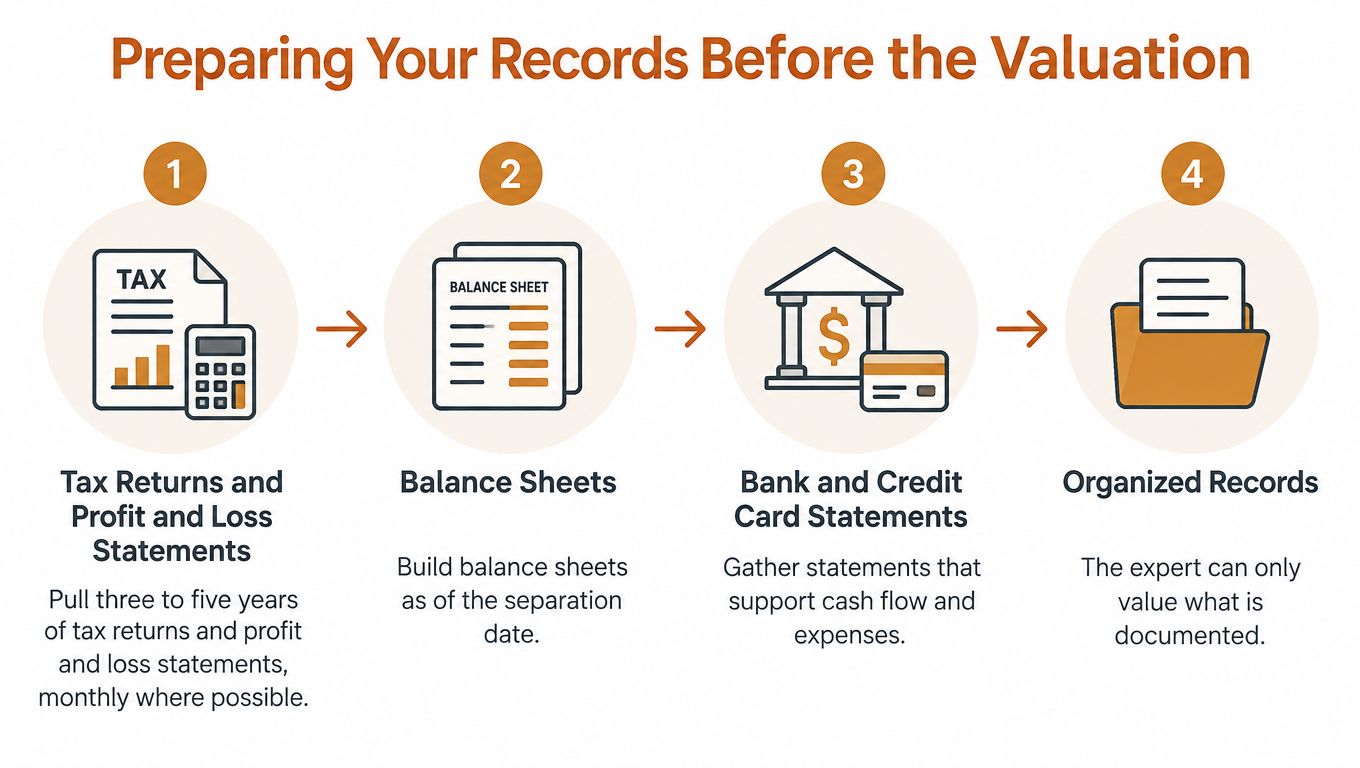
Don’t change bookkeeping methods in the middle of the case. Don’t take a large distribution you can’t tie to a dated record. Keep the monthly statements, tax returns, backlog, and debt schedule in one folder so the expert isn’t guessing which month the debt dropped.
You need someone who can testify and show the work, not someone who hands you a single number. Credentialed business valuators who regularly do divorce work in your state are the right pool. Familiarity with trade and service companies matters, because a route-based HVAC firm is not valued like a professional practice with no trucks.

Use these in the first call, and write down the answers:
A practical guide on how to find a business valuation specialist walks through credentials and fit before you sign an engagement.
Your family-law attorney frames the legal questions. The valuator answers the financial ones. Both need the same records and the same timeline, or you will pay twice to rebuild the file. Rules differ by state, so confirm the approach with counsel before you treat any draft number as the one you’ll negotiate from.
Before you trade offers, get a written valuation that states the standard of value, the valuation date, the bridge from total value to enterprise value, and the reason for every discount. Have your family-law attorney read it before it becomes a settlement anchor.
Check the report against three points:
Then decide how the divisible value gets paid. One spouse can keep the company and buy the other out. The share can be offset against a house or a retirement account. It can be an installment note. Or the company can be sold and the proceeds divided. Each path has a different cash strain on the business you still have to run.
A broker’s market price can tell you whether selling is realistic. It is not a divorce valuation, and it does not set the marital share. A sale also depends on buyer demand and timing, so the price you clear may not match the number a court or a negotiator is using. Confirm your state’s rules with counsel before you rely on any figure.
The Owner’s Shortlist publishes plain-language guides for owners of established service companies who need to separate a sale price from a divorce figure, including how a written valuation is built. If you want a person, not a directory, to point you toward a specialist whose past work fits a company like yours, visit The Owner’s Shortlist.
Tell us your situation. We'll connect you with a specialist who works with owners like you. One conversation, no sales pressure.
Found this useful?
Add The Owner's Shortlist as a preferred source and get our articles highlighted in Google Search results.
Add to Preferred SourcesEnterprise vs equity value in plain numbers: what a 5x EBITDA offer means after debt, cash, and closing adjustments for a trade business.
October 29, 2026
Learn how to value business accurately: normalize earnings, choose a method, apply real multiples, and know when to call a valuer.
October 27, 2026
Ready to sell my plumbing business? Follow a step-by-step roadmap for valuing, marketing, and closing the sale with confidence and clarity.
October 15, 2026
Learn how to sell your service business with a practical, step-by-step roadmap. From readiness and valuation to deal structure and closing, get actionable
October 14, 2026