What Is SDE and How Does It Shape a Business Sale
What Is SDE. Learn what SDE means in business valuation, how to calculate it with common add-backs, how it differs from EBITDA, and why buyers and lenders focus
October 7, 2026
By Remi Taffin · July 8, 2026
If you’ve owned an HVAC company for a long time, you’ve probably had this thought at least once: “My business is worth more than the trucks, parts, and tools in the shop.”
And you’re right.
A buyer doesn’t just see a few service vans, some inventory, and a building lease. A buyer sees the phone that keeps ringing, the maintenance customers who renew without a fight, the dispatcher who keeps the day moving, the Google reviews your team earned, and the trust your name carries in town. That extra value is where goodwill enters the conversation.
The confusion starts because people use the word in two different ways. Some mean “good reputation.” Accountants mean something much narrower. Owners preparing for a sale or succession plan need to understand both, especially if the company still leans heavily on the founder. In owner-operated trades, that split between business value tied to the company and value tied to the owner can directly affect sale price and tax planning.
An owner walks through the yard on a Friday afternoon. He sees six trucks, shelves of motors and filters, recovery machines, laptops, and a warehouse full of parts. He also knows something else. If all of that disappeared tomorrow, the hardest thing to replace wouldn’t be the metal. It would be the trust.
That’s the simplest place to start with the definition of goodwill in business. It’s the value people can feel, but can’t always point to on a shelf.

Most owners use the term in a practical sense. They mean things like:
None of that sits in a truck rack. Yet it often matters more than the truck rack.
Owners get tripped up when they think goodwill is just a soft, feel-good word. It isn’t. Buyers look for evidence that the business can keep producing income after ownership changes. If the answer is yes, goodwill becomes part of the value conversation. If the answer is “only if the owner stays and keeps all the key relationships alive,” then the conversation gets harder.
Practical rule: The more your business runs because of the company, the more valuable its goodwill usually is to a buyer.
A trusted service truck has value. You can price it, inspect it, and transfer title. The phone that keeps ringing has value too, but only if those calls belong to the company and not just to you personally. That’s where many owner-operated firms discover that their invisible asset isn’t one thing. It has layers.
People often hear “goodwill” and think, “Oh, that’s just reputation.” That’s partly true in everyday conversation, but it’s incomplete.
Goodwill in business has two common meanings. One is broad and practical. The other is formal and accounting-based. If you mix them together, every later discussion about value, taxes, and a sale gets muddy.
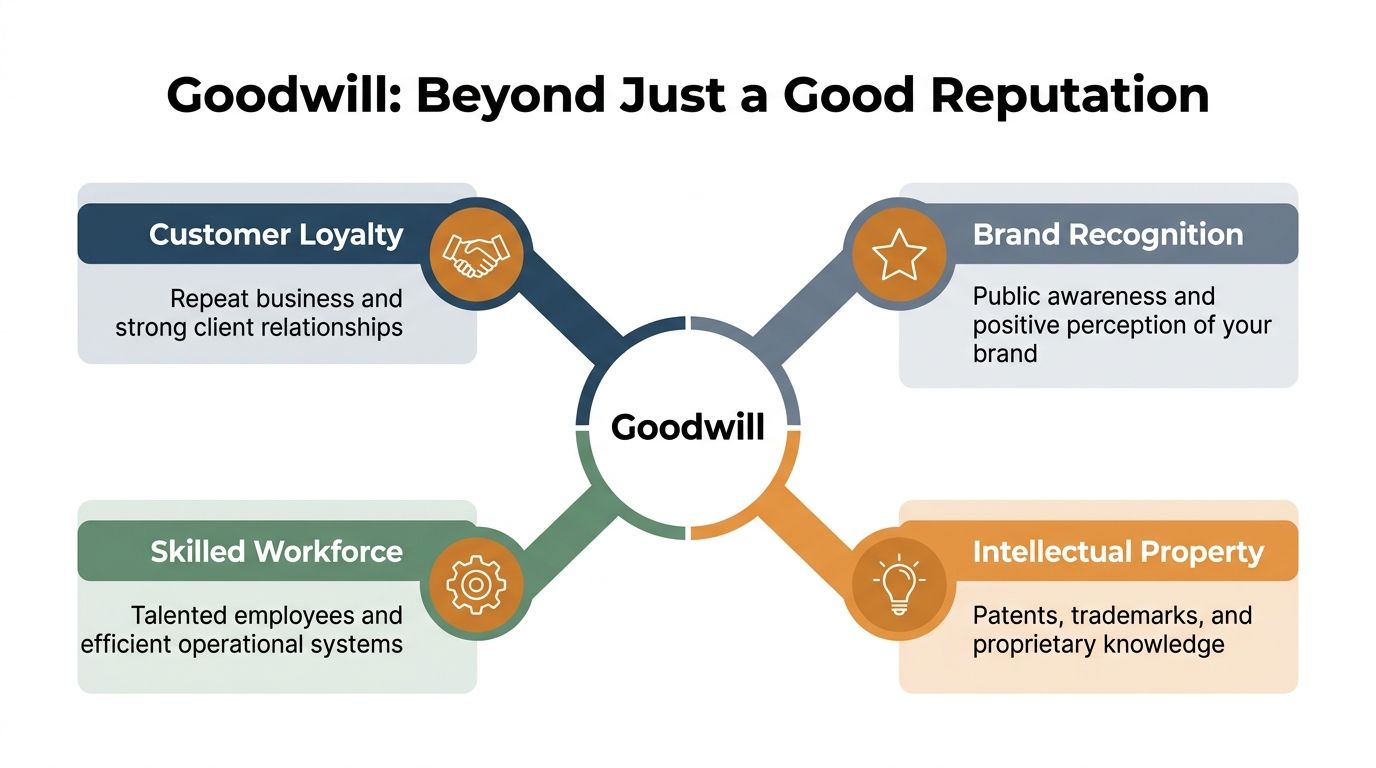
In plain language, goodwill is the extra value a business has because people trust it, know it, and keep buying from it. Think about two coffee shops on the same street. They may have similar tables, espresso machines, and rent. But one has regular customers lined up each morning, a local name people talk about, and staff who know the menu cold. That shop has something extra.
An HVAC company works the same way. Two firms may own similar vans and tools. Yet one has recurring service agreements, a recognizable wrapped fleet, a trained office staff, and customers who ask for the company by name. That gap is goodwill in the practical sense.
Accounting uses a tighter definition. Goodwill is an intangible asset recorded when a buyer purchases a business for more than the fair value of its identifiable net assets, according to this explanation of goodwill in accounting. That same discussion explains that goodwill is measured as a residual after fair value adjustments and that U.S. public companies have not amortized goodwill since 2001, while private companies may elect to amortize it over 10 years under ASU 2013-02.
That sounds technical, but the idea is simple. If a buyer pays more than the value of the equipment, receivables, inventory, and other identifiable assets minus liabilities, the leftover amount gets labeled goodwill on the buyer’s books.
Goodwill, in accounting, is not a compliment. It’s a calculation.
Use this quick distinction:
| Meaning | What it refers to | When it matters |
|---|---|---|
| Practical goodwill | Reputation, loyalty, systems, team know-how, recurring customer behavior | Before and during a sale discussion |
| Accounting goodwill | The residual amount recorded after an acquisition closes | After a deal is completed |
Owners preparing for a transition need both views. The practical view helps you explain why your company deserves a premium. The accounting view helps you understand what a buyer, lender, CPA, or valuation specialist means when the term shows up in financial discussions.
A lot of confusion disappears once you realize that “goodwill” isn’t just one idea. It’s a business reality first, and an accounting entry later.
The conversation gets serious for owner-operated companies.
Not all goodwill belongs to the business itself. Some of it may belong to you. If you own an HVAC company and your best commercial accounts stay because they trust your judgment, answer your calls, and have known you for years, that isn’t the same as a service agreement tied to the company brand and handled by a trained team.
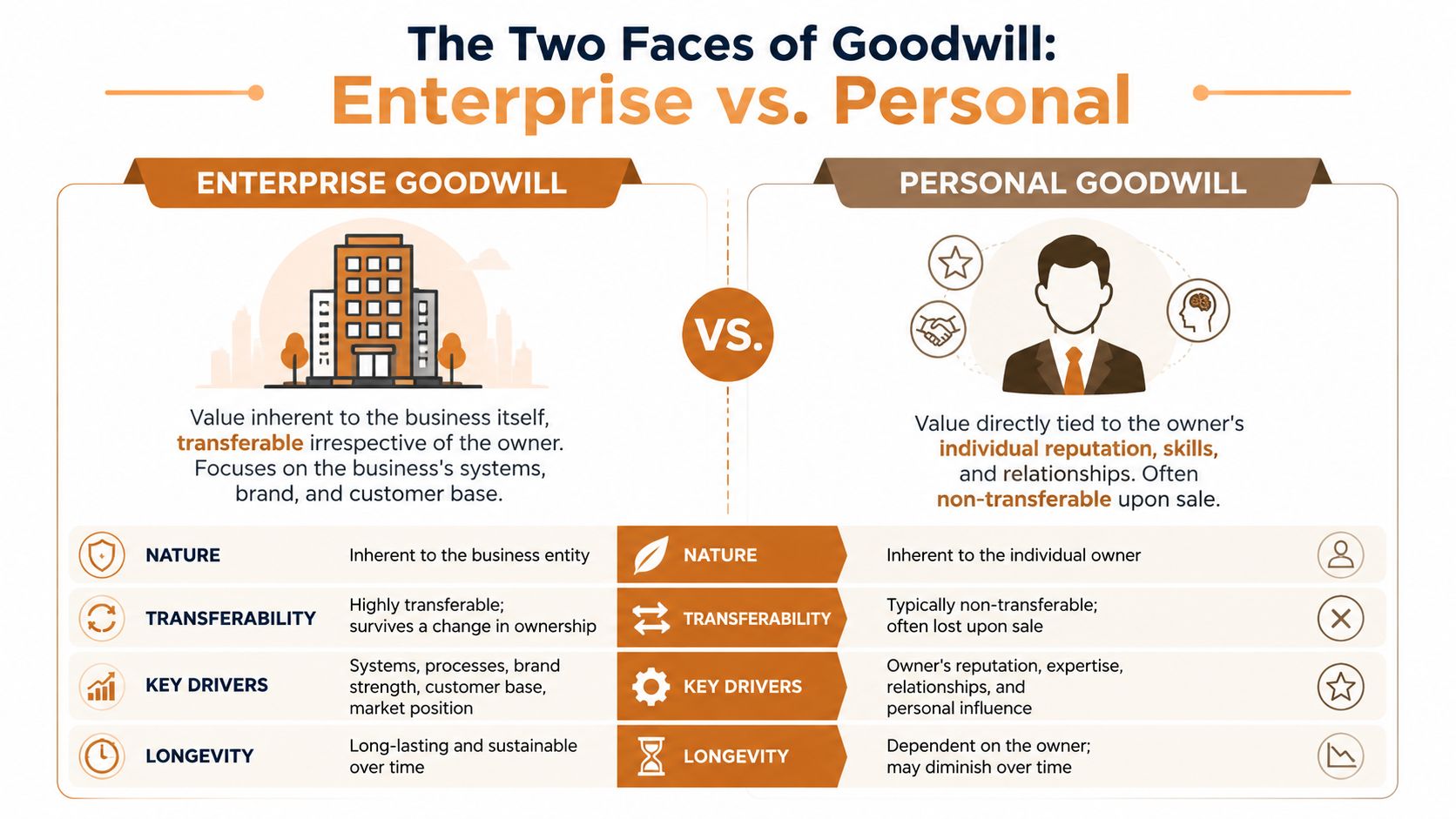
Enterprise goodwill attaches to the business entity. It stays with the company when ownership changes.
Examples include:
A buyer likes enterprise goodwill because it’s transferable. If the owner leaves, the value has a chance to stay put.
Personal goodwill attaches to the owner. It’s built around individual relationships, reputation, technical skill, and trust that may not transfer cleanly.
For an HVAC owner, that can look like this:
That value is real. But a buyer may discount it if they believe it walks out the door when you retire.
To make the contrast easier, here’s a side-by-side view:
| Question | Enterprise goodwill | Personal goodwill |
|---|---|---|
| Who owns the relationship | The company | The owner |
| Can it transfer in a sale | Often yes | Often difficult |
| What supports it | Brand, systems, contracts, team | Personal trust, personal skill, personal contacts |
| What happens if the owner steps away | Business may continue smoothly | Revenue may weaken |
A short explainer may help as you think through that split:
This distinction isn’t academic. It’s often the core issue in a sale.
According to this discussion of enterprise and personal goodwill, value in owner-operated trades such as HVAC and plumbing can be heavily tied to the owner’s personal relationships, with 70-80% of value in some cases linked to that personal element. When that happens, buyers may worry that the value they’re paying for won’t survive the handoff.
If your company gets work because the market trusts the business, that’s stronger enterprise goodwill. If it gets work because people trust only you, a buyer sees more risk.
A lot of seasoned owners have a lightbulb moment here. They thought they were building one kind of value. In reality, they may have built two. One sells well. The other often needs a transition plan, employment agreement, earnout structure, or deliberate handoff to become bankable.
This is the part that surprises a lot of owners. You can’t decide your business has goodwill at will and add it to your own balance sheet because you’ve spent years building a strong name.
Accounting doesn’t allow that.
Under accounting rules, goodwill is recognized only when a business is purchased as a going concern and the buyer pays more than the net fair value of the identifiable assets and liabilities. That’s the strict definition described in the accounting overview of goodwill under IFRS 3 and ASC 350-20).
So if you’ve built a respected HVAC company from scratch, that value may be very real in the market. But it doesn’t become an accounting asset on your books just because you’ve earned it over time.
Formula: Goodwill = Purchase price paid for the business minus the fair value of identifiable net assets acquired
Think of the identifiable pieces first:
If the buyer pays more than that net amount, the excess becomes goodwill on the buyer’s financial statements.
Goodwill isn’t amortized under the accounting treatment described in that same reference. Instead, companies must test it annually for impairment. If events suggest the acquired business is worth less than the carrying amount, they may need an interim impairment test as well.
In plain English, the buyer doesn’t slowly expense goodwill each year in the usual way. The buyer has to keep asking whether that recorded value is still defensible. If the acquired operation underperforms or loses value, the goodwill balance may be written down.
That matters for owners because it clarifies what accounting goodwill really is. It isn’t cash. It isn’t inventory. It isn’t something the seller built and booked over time. It’s a post-acquisition line item that reflects the premium a buyer paid for expected future economic benefits that weren’t separately identified.
Long before any accountant records goodwill after a closing, owners want to know something more practical: “What is my goodwill worth now?”
That question matters because deals aren’t priced by adding up used equipment and calling it a day. Buyers look at earning power. They ask what profits the business produces, how dependable those profits are, and how much of that performance would carry on after the owner steps back.
A buyer usually starts with what can be identified and measured fairly easily. Then the buyer asks whether the business earns more because of factors that go beyond those assets.
For an HVAC company, strong goodwill often shows up through evidence like:
One common valuation idea is the “excess earnings” mindset. You don’t need the math to understand the concept. If the business generates profits above what the trucks, tools, and working capital alone would normally support, that extra earning power points toward goodwill.
The strongest goodwill isn’t just admired. It’s defensible.
A buyer tends to pay more confidently when the owner can show:
| Signal | Why it matters to a buyer |
|---|---|
| Service agreement base | It suggests repeatable revenue tied to the company |
| Documented systems | It lowers transition risk |
| Management depth | It reduces key-person dependence |
| CRM and customer history | It shows relationships live inside the business |
| Consistent brand usage | It makes demand less dependent on one individual |
If you’re trying to understand the broader process, this guide on how a business is valued gives a useful plain-English overview of the larger valuation picture.
Buyers don’t pay a premium for vague potential. They pay for income they believe will continue after the keys change hands.
Owners often overestimate goodwill when they confuse hard-earned personal trust with transferable business value. That’s understandable. You’ve spent decades building both. But a buyer separates them.
A good self-test is simple. If you disappeared for three months, what would still work?
Would service calls still come in because of the company name? Would renewal notices still go out? Would key accounts stay active with your operations manager or lead estimator? If yes, you’re building enterprise goodwill. If not, the value may still exist, but it may be trapped inside your personal role.
That’s why goodwill valuation before a sale is less about one magic formula and more about evidence. The more your business proves it can produce predictable earnings without leaning on your daily presence, the more defensible that goodwill becomes.
A lot of HVAC owners get to the same point. The buyer likes the trucks, the equipment, and the numbers. Then the conversation shifts to the value beyond those visible assets, and the tax questions start.
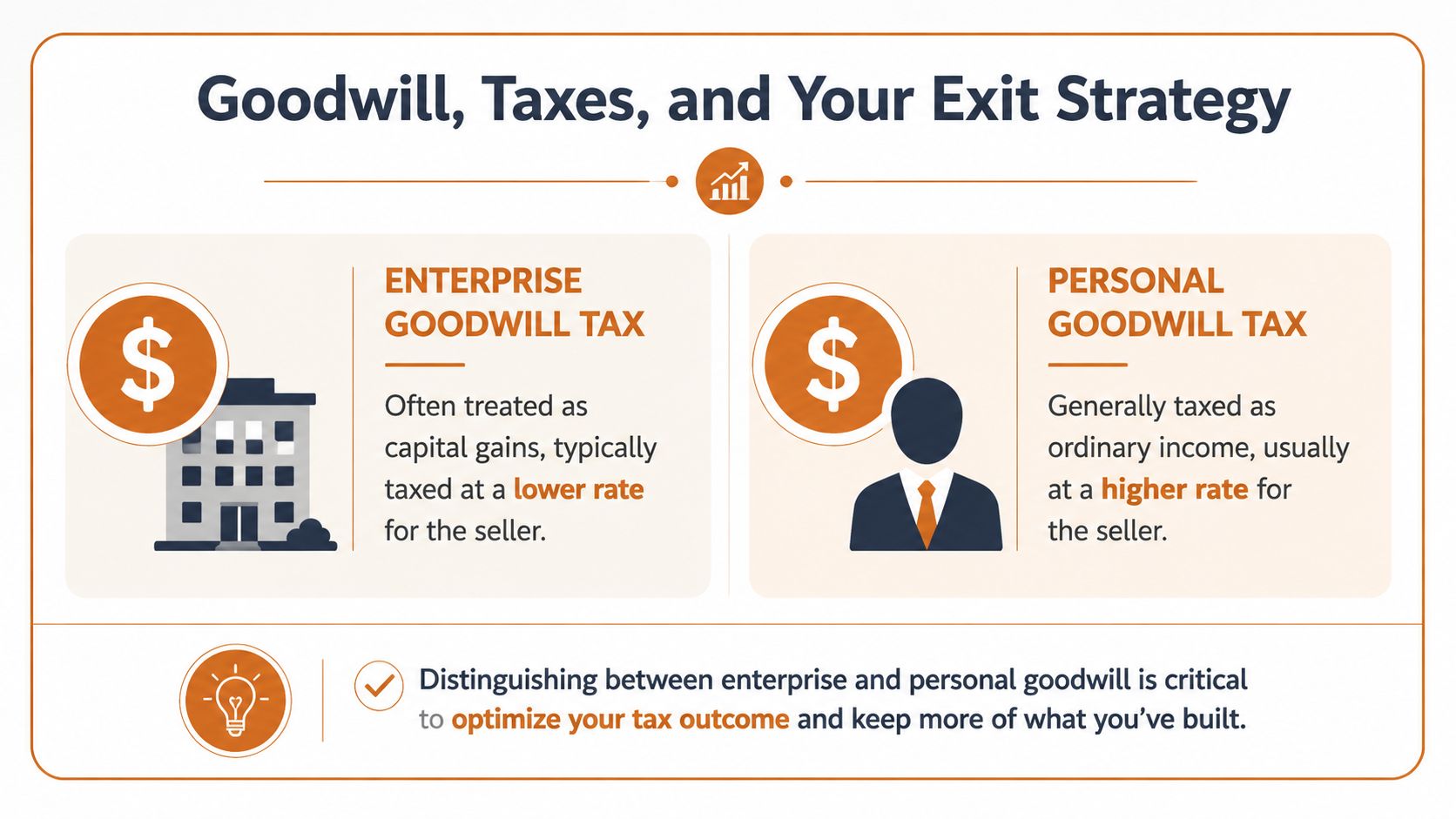
That shift matters because goodwill is not always one bucket. Some of it may belong to the company. Some of it may be tied closely to you as the owner. That distinction can affect deal structure, tax treatment, and what you keep after closing.
Waiting until a letter of intent arrives is late.
By that stage, the buyer may already have formed a view about what is transferable and what depends on you staying involved. If you have not worked through that issue with your CPA, valuation advisor, and attorney, you are reacting under pressure. That usually leads to weaker positioning and fewer options.
For an owner-operated company, the personal versus enterprise split becomes expensive. A trusted service truck has clear value because it can be handed over. The phone that keeps ringing because customers ask for you by name is different. If those customer relationships live mostly in your cell phone, your memory, and your personal reputation, the tax and deal conversation can get more complicated.
Start with practical questions, not abstract ones:
If you want a plain-English overview of the bigger tax picture, this guide to tax on selling a business is a useful starting point.
A strong exit is measured by net proceeds, not just the headline price.
Owners often spend years building revenue and very little time preparing the proof behind their intangible value. Then a buyer asks a simple question: does the goodwill stay with the company after you leave?
If the answer is unclear, you may need time to sort out contracts, customer ownership, compensation arrangements, and legal documents before a sale process starts. You may also need time to reduce tax risk by making the facts match the story. That work cannot be done well in a rushed negotiation.
Goodwill affects sale price. The split between personal and enterprise goodwill can also affect taxes. For an owner-operated business, exit planning works best when you address both early.
If you want goodwill that survives a sale, build more of it inside the company and less of it inside your own head and phone.
If you’re getting your business ready for a future transition, this article on how to increase business value before selling is a good next read.
Goodwill isn’t mysterious once you break it down. It’s the value beyond the visible assets. For owner-operated companies, the primary work is deciding how much of that value belongs to the business, how much belongs to the owner, and what needs to change before a sale.
If you’re starting to think seriously about value, taxes, succession, or who you should talk to first, The Owner’s Shortlist is a practical place to begin. It helps long-tenured owners find vetted specialists in valuation, taxes, legal planning, succession, and related decisions, with plain-English articles that make those first conversations much easier.
Tell us your situation. We'll connect you with a specialist who works with owners like you. One conversation, no sales pressure.
Found this useful?
Add The Owner's Shortlist as a preferred source and get our articles highlighted in Google Search results.
Add to Preferred SourcesWhat Is SDE. Learn what SDE means in business valuation, how to calculate it with common add-backs, how it differs from EBITDA, and why buyers and lenders focus
October 7, 2026
Discover what a business valuation report includes, how to interpret it, and why it matters for your company's financial strategy.
October 6, 2026
Explore the best value drivers that influence exit value, with practical steps owners can take before engaging a valuation specialist.
October 4, 2026
Confused by SDE vs EBITDA? Learn when each metric applies to your owner-operated business, how adjustments change valuations, and which buyers prefer which
October 3, 2026