Confidential Information Memorandum Example: 5 Guides
Explore 5 confidential information memorandum examples for owner-operated businesses, with required sections, practical guidance, and common pitfalls.
October 22, 2026
By Remi Taffin · July 19, 2026

If you’re thinking about selling your business in Fort Lauderdale, you may already feel the tension between opportunity and uncertainty. You know there could be real value in what you’ve built, but you also know a listing alone does not create a successful sale.
That is where many owners get stuck.
A strong exit is not just about finding a buyer. It is about preparing the company so a buyer can understand the numbers, trust the operations, secure financing, and feel confident the business will hold together after ownership changes. In Fort Lauderdale, that preparation matters even more because many listings compete for attention while only a fraction of businesses actually close. One published market observation also notes that 78% of small business buyers in Florida lack a clear plan for exit tax implications in this category, which matters for sellers too because buyer confusion around taxes can slow negotiations or reduce offers (Fort Lauderdale business broker market observations).
A successful sale is a coordinated process involving a broker, CPA, attorney, lender contacts, and sometimes a valuation specialist, all brought in early enough to prevent avoidable problems. Owners who wait too long to build that team often discover that a business can look healthy operationally while still being hard to sell.
Most owners begin with a simple goal. They want to sell at a fair price, protect confidentiality, keep the team stable, and move into the next phase of life with fewer surprises. That goal is reasonable. The mistake is assuming the market will automatically recognize value just because the business has been good to you.
Usually, it will not.
Buyers and lenders respond to documentation, transferability, earnings quality, and risk. If those pieces are not prepared in advance, the business may still attract interest, but interest is not the same as a close. That gap is where price cuts, deal fatigue, and failed exits usually start.
Many owners know their business deeply but have never had to explain it the way a buyer, banker, or diligence team needs to see it. A buyer wants to know more than revenue and profit. They want to understand the owner’s role, customer concentration, payroll reality, lease stability, licensing, and whether earnings will continue after the handoff.
That is why sellers should stop asking only, “What could my business sell for?” and start asking a more useful question.
Practical rule: Do not prepare just the listing. Prepare the numbers, the transfer story, and the advisory team behind the sale.
In Fort Lauderdale, that often means speaking with a local broker early, involving a CPA before the market sees your numbers, and bringing in a transaction attorney before a letter of intent turns into rushed negotiations. If the business is owner-operated in trades or services, the tax side deserves attention sooner than many owners expect.
A simple timing guide helps:
| Stage | Who to involve | Why it matters |
|---|---|---|
| Early planning | Broker, CPA | They help you assess marketability and normalize earnings |
| Pre-market prep | CPA, attorney, sometimes valuation specialist | They clean up records and pressure test value |
| LOI and diligence | Attorney, CPA, broker | They protect terms and keep diligence organized |
| Closing and transition | Attorney, broker, payroll and insurance contacts | They help the handoff stay orderly |
If you are serious about selling in Fort Lauderdale, treat the advisory team as part of the exit strategy. A weak setup can reduce value or drag the process out for months. A strong one helps you present a cleaner, more credible business from the start.
Most business sales start in one of two ways. Either an owner quietly prepares with an advisor before going to market, or they list too early and discover during buyer questions that important pieces are missing.
Fort Lauderdale gives sellers a visible market. There are approximately 250 businesses listed for sale, with a median asking price of about $370,000, median reported revenue of about $660,000, an average asking earnings multiple of 2.5 times, and a revenue multiple of 0.6 times (Fort Lauderdale businesses for sale market data). Those numbers are not a pricing formula, but they are useful context for owners trying to understand how the market frames smaller deals.

Public marketplaces can create visibility, but serious demand usually comes from a mix of channels. Local brokers know which buyers are qualified, which industries are moving, and how to position a business without creating unnecessary noise. Professional referrals can also matter. CPAs, attorneys, and lenders often know buyers or recapitalization candidates before a business is widely marketed.
Three channels matter most:
An owner who relies on only one path may get attention. That does not always translate into the right buyer.
Before a buyer ever signs an NDA, your business should be able to answer a basic marketability test.
Use this short pre-sale screen:
A polished listing can create interest. It cannot make a business transferable on its own.
Serious buyers usually want quick answers to a familiar group of questions:
If you can answer those clearly, the sale process gets easier. If you cannot, buyers start discounting for uncertainty before they ever make an offer.
Owners often focus on the number they want. Buyers focus on the number they can defend. The difference between the two usually comes down to recast earnings, transfer risk, and deal structure.
In Fort Lauderdale, only 20% to 30% of businesses that go on the market sell, and one cited reason is failure to properly recast financials, which obscures true profitability and pushes buyers to discount value (Fort Lauderdale business sale trends and success rates). That fact should matter to every seller. If the numbers are not prepared properly, the market may not reject the business outright, but it will often lower confidence, extend diligence, and pressure price.
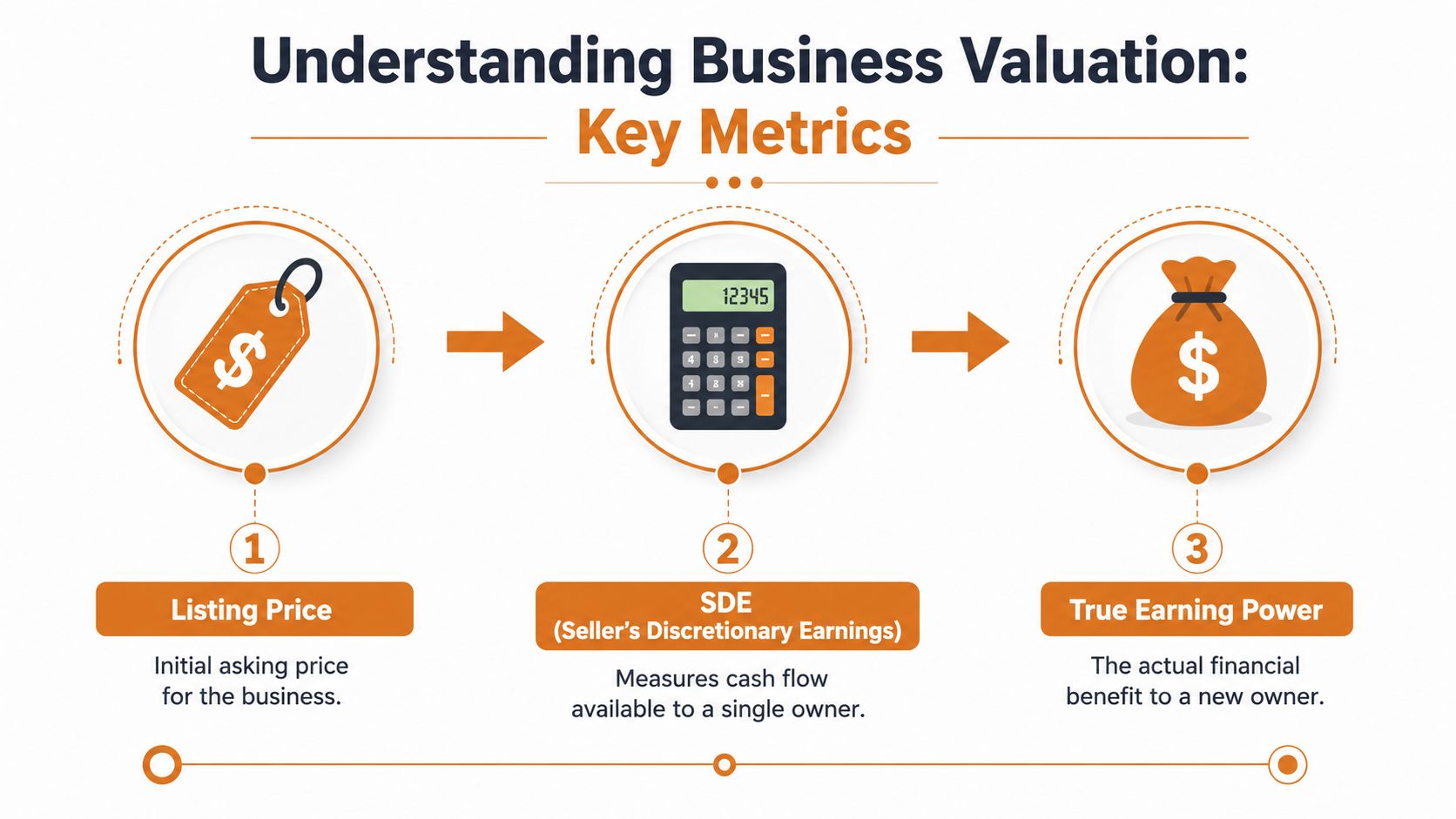
For small owner-operated companies, buyers usually start with Seller’s Discretionary Earnings, or SDE. That means taking reported profit and adjusting for owner compensation, personal expenses run through the business, and one-time costs that are not expected to continue.
This is where many sellers either build credibility or lose it.
A recast must be defensible. Unsupported add-backs may make the business look more profitable on paper, but they tend to break trust once diligence begins.
| Add-back type | Usually reasonable | Needs caution |
|---|---|---|
| Owner salary | Often yes | Only if replacement cost is considered |
| One-time legal or repair cost | Sometimes | Needs documentation |
| Personal vehicle or travel | Sometimes | Must be clearly non-business |
| Family payroll | Depends | Only if role and replacement need are clear |
Owners who want a stronger grounding on the mechanics should review a plain-English guide to how to value a small business.
Many owners think price is the main issue and structure comes later. In reality, the structure can change how attractive the deal feels to a buyer and how much you actually keep after closing.
A slightly lower headline price with clearer terms, a cleaner transition, and fewer liability concerns may produce a better real-world outcome than a higher price paired with friction, holdbacks, or closing uncertainty.
In smaller transactions, buyers often prefer an asset sale. That usually means they purchase selected business assets such as equipment, inventory, customer relationships, trade name, phone numbers, and goodwill. Sellers sometimes resist this structure because it can feel less straightforward, but it often reflects the buyer’s effort to limit assumed liabilities.
An entity sale means transferring the stock, membership interests, or legal entity itself. That can make some contracts or licenses easier to preserve in certain cases, but it can also require more careful diligence and negotiation.
The best structure is not the one that sounds simplest. It is the one your attorney and CPA can defend after reviewing the facts and the tax consequences.
Before the final offer stage, sellers should have these voices involved:
Price attracts attention. Structure often determines whether the deal survives.
Due diligence does not begin when the buyer asks for documents. For smart sellers, it begins before the business goes to market.
If you prepare early, diligence feels like verification. If you prepare late, diligence feels like a fire drill.
A practical overview of the accounting side is worth reviewing even from the seller’s perspective. This guide on what financial due diligence is gives a useful baseline.
Here is a visual checklist to keep the work organized.
Your CPA should lead this work, but owners still need to understand what buyers and lenders will test.
Prepare records that allow an outside party to tie together the story from more than one angle:
If the tax returns, P&Ls, and bank activity do not line up cleanly, expect questions. If you can explain the gaps early and document the reasons, you reduce friction later.
Sellers preserve value when they reduce uncertainty before a buyer has to ask.
Later in the process, use video explanations like this one to brief your team or sharpen your own preparation process.
The attorney’s role is not limited to drafting final documents. A good transaction lawyer helps a seller identify transfer issues before they become negotiation problems.
Review these items carefully:
A lease issue can slow or derail a sale. So can a non-transferable customer contract. Legal preparation is not overkill. It is part of making the business saleable.
Operational readiness is where many owner-led businesses either become more attractive or reveal why transfer risk is high.
Focus on the operating core:
A short operational cleanup before launch can improve marketability more than a rushed cosmetic rebrand. Buyers care less about fresh polish than they do about transferability.
Once a buyer is serious, the process shifts from marketing to execution. This is where preparation starts paying off.
In Fort Lauderdale’s lower-middle-market sale process, the timeline from market launch to close typically runs 6 to 9 months, with a Letter of Intent, intensive due diligence around contracts and licenses, and a defined transition period all part of the process (Fort Lauderdale sale process overview). Even if your company is smaller than a classic lower-middle-market transaction, that range is still a useful reminder. Exits usually take longer than owners expect.

The first serious document is usually the LOI. If you want a grounded primer, review what a letter of intent is. It is not the final purchase contract, but it sets the frame for price, structure, diligence timing, financing assumptions, transition support, and exclusivity.
A good LOI does two things. It keeps momentum with the buyer and reduces the chance that vague assumptions later become legal or economic disputes.
After the LOI, attorneys typically move the transaction into the purchase agreement stage. That agreement should address exactly what assets or interests are being transferred, what representations you are making, what happens if a problem is discovered before closing, and what post-close obligations survive.
Most deals do not fall apart because of one dramatic issue. They wear down under several smaller issues at once.
Common friction points include:
Closings go smoother when both sides solve issues early, in writing, with advisors who know who owns each problem.
The broker helps maintain momentum. The attorney converts understanding into enforceable language. The CPA helps defend the financial story. If those people are not aligned, the process gets harder than it needs to be.
As the closing date approaches, the transition plan should already be taking shape.
Prepare these items in advance:
| Closing item | Why it matters |
|---|---|
| Buyer-facing transition calendar | It keeps knowledge transfer organized |
| Payroll and HR handoff notes | Employees should experience stability, not confusion |
| Vendor and customer communication plan | Continuity depends on timely, controlled messaging |
| Insurance and risk handoff coordination | Responsibility changes at closing |
| Debt payoff and lien release steps | These often create avoidable last-minute delays |
The closing itself is usually quiet. Documents are signed. Funds move. Access changes hands. The quality of the sale is usually determined before that day arrives.
For most sellers, the deal is not truly over at signing. Your transition period can protect value, preserve relationships, and reduce the odds of post-close conflict.
The goal is not to stay forever. The goal is to leave well.
Start with clarity.
Meet with the buyer and key team members early. Confirm how communication will work, which customer and vendor relationships need a warm handoff, and what decisions still run through you during the first weeks.
Good first-month priorities include:
This is usually the period where the buyer starts seeing what was not obvious during diligence. A good seller transition helps them bridge that gap without creating dependence that never ends.
At this stage, focus on practical transfer points. Which employee carries hidden institutional knowledge. Which customer expects owner access. Which exceptions to normal process happen often enough that they should be explained in writing.
For sellers, the first post-close win is a buyer who can operate confidently without discovering avoidable surprises.
By this point, the buyer should be assuming more control while your involvement narrows. This is the right time to wrap up open introductions, finalize documentation, and make sure any promised transition support is clearly completed.
Use this phase to help lock in a clean handoff:
Sellers who treat transition as part of the sale often protect goodwill better. Sellers who treat closing as a hard stop can create turbulence that affects earnouts, retained relationships, or reputation.
If you are buying, selling, or planning around a future acquisition, The Owner’s Shortlist is a practical place to find vetted specialists in valuation, tax, legal, financing, and related owner decisions. It is built for people who want clear explanations first and direct access to the right expert when the deal gets serious.
Tell us your situation. We'll connect you with a specialist who works with owners like you. One conversation, no sales pressure.
Found this useful?
Add The Owner's Shortlist as a preferred source and get our articles highlighted in Google Search results.
Add to Preferred SourcesExplore 5 confidential information memorandum examples for owner-operated businesses, with required sections, practical guidance, and common pitfalls.
October 22, 2026
Partners who disagree on selling usually settle it one of four ways: a buyout, a partial sale, a sale together, or what the agreement forces.
October 20, 2026
What is deal structuring, explained for service business owners. Learn asset vs stock sales, earnouts, seller financing, holdbacks, and the questions
October 19, 2026
Learn how to identify well qualified buyers for your service business. Covers vetting criteria, red flags, sample questions, and next steps
October 17, 2026