
Confidential Information Memorandum Example: 5 Guides
Explore 5 confidential information memorandum examples for owner-operated businesses, with required sections, practical guidance, and common pitfalls.
October 22, 2026
By Remi Taffin · October 23, 2026
A lender tells you it may finance most of the asking price, and the business looks affordable on paper. Then you add closing costs, payroll, receivables that won’t turn into cash right away, and the cash the lender expects you to bring. The gap can be larger than the down payment you first had in mind.
Learning how to finance buying a business starts with the whole project, not a loan product. For a service company, the financing plan has to leave enough cash to keep technicians working, pay suppliers, and serve customers while you take over.
A plumbing company is listed for $2.4 million. The buyer calculates a down payment against the asking price, but that leaves out closing costs, lender fees, and cash to operate after the sale. Lenders assess the full project, and a shortfall in working capital can stall a deal even when the purchase price appears affordable.
Before setting the financing target, review earnings and working capital independently. A quality-of-earnings review tests whether cash flow can support the proposed debt. A working-capital review checks whether the business can cover payroll and receivables through the ownership change. For context on the asking price, consult this business valuation guide, while keeping valuation separate from proof of repayment capacity.
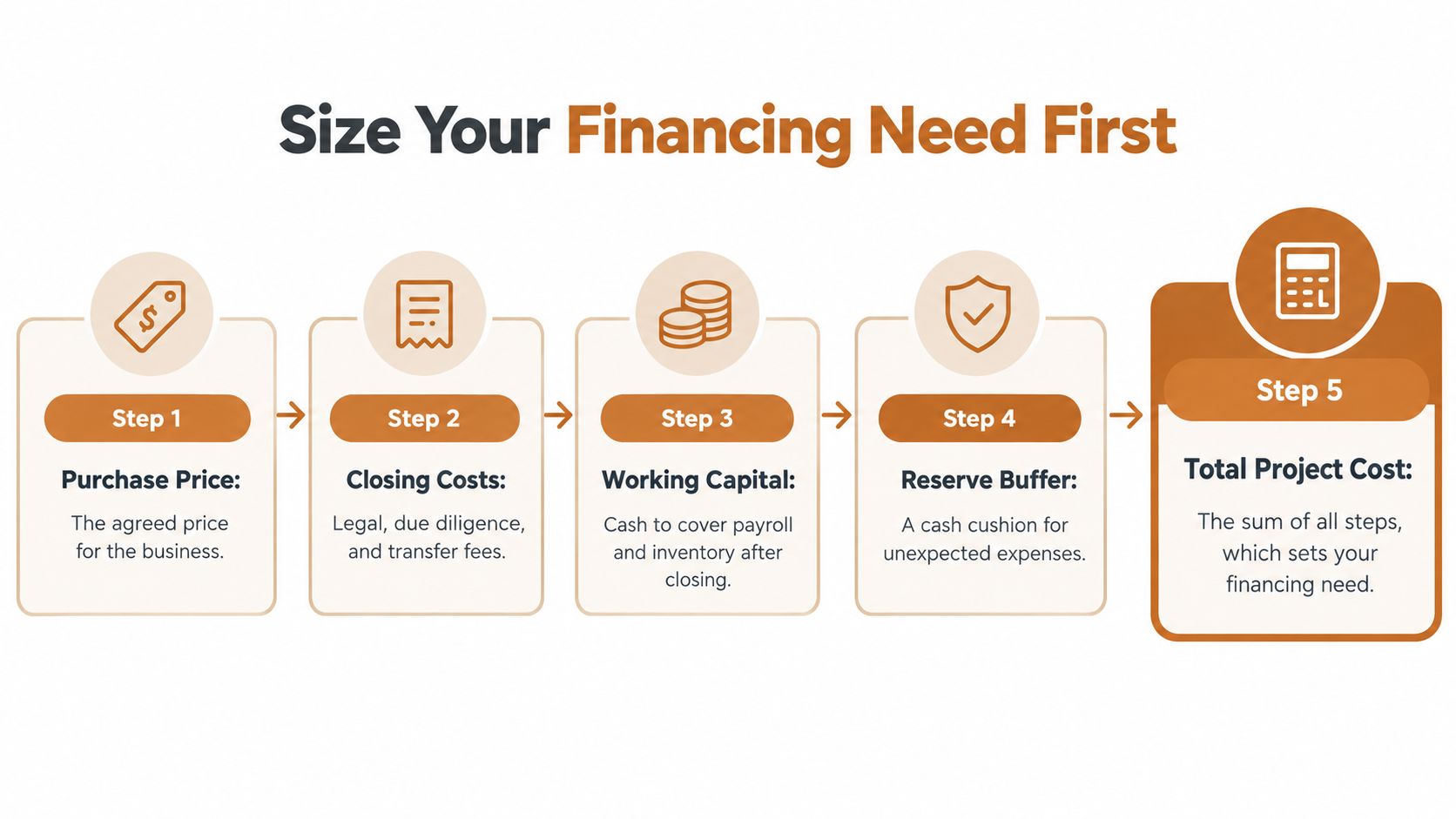
List each cost and each source of funds. These figures are illustrative planning assumptions, not a lender quote or approval.
| Uses | Illustrative amount |
|---|---|
| Purchase price | $2,400,000 |
| Closing costs and lender fees | $100,000 |
| Required working capital | $200,000 |
| Total project cost | $2,700,000 |
For a complete change of ownership, SBA SOP 50 10 8 generally requires at least a 10% equity injection. On this example’s total project cost, that is $270,000. One possible structure is $135,000 in genuine, non-borrowed cash, with a seller note covering the remaining $135,000 only if it meets the SBA’s full-standby rules. The Federal Reserve’s overview of small-business credit availability describes the general equity-injection requirement and notes that the SBA typically guarantees up to 75% of loans above $150,000, leaving lenders exposed to the balance.
The seller note does not automatically count toward the buyer’s injection. Under this structure, it must remain on full standby for the entire SBA loan term, with no principal or interest payments while the SBA debt is outstanding. If the seller needs payments during that period, the note may not qualify, and the buyer could face a cash gap at closing. That is an owner-side trade-off: deferring payment may help the deal close, but ties up the seller’s proceeds and leaves the note dependent on the business’s later performance.
Practitioner tip: Service companies can have payroll and fuel bills due before customer receivables arrive. Model that timing against recurring maintenance revenue, and check whether collections can support operations during the handover.
Keep the sheet to one page, with each use, funding source, and unresolved assumption visible. Update it when diligence changes earnings, working-capital needs, or closing costs. A lender can assess the transaction more clearly when the sources add up to the full project cost and the cash-flow assumptions are documented.
A service company can show solid annual profit and still struggle to make debt payments when payroll is due before customers pay their invoices. Choose a lender by testing the proposed payment against the business’s cash cycle, not just its purchase price. A payment that leaves too little for technician retention, vehicle replacement, or equipment can weaken the operation that supports repayment.
An SBA 7(a) loan comes through an approved lender, not directly from the government. Eligible small businesses may apply through banks, credit unions, some community development financial institutions, and certain nonbank lenders. The Federal Reserve’s discussion of SBA financing notes that SBA products are often lower-cost than nonbank financing for businesses that cannot obtain ordinary bank loans. Confirm eligibility, lender requirements, equity, fees, collateral, and repayment terms for the specific transaction.
| Funding source | Typical strength | Typical constraint | Best fit |
|---|---|---|---|
| SBA 7(a) lender | Can fund an acquisition with long-term financing and a lender-led process | Requires underwriting, documentation, and an eligible structure | Buyers who need acquisition financing and can document repayment capacity |
| Conventional bank term loan | May suit buyers with strong financials, collateral, and a clear repayment source | Bank standards may limit proceeds or rule out a deal without conventional support | Established operators or buyers with a strong banking relationship |
| Nonbank or online lender | Offers an alternative when conventional credit is unavailable | Cost and payment demands can strain operating cash | A specific, carefully sized need the business can afford |
A bank may require more collateral or buyer contribution than the buyer can provide. An SBA lender still assesses both buyer and business, while the guarantee can reduce the lender’s exposure compared with a wholly conventional loan. Neither option makes weak cash flow safe to borrow against.
Nonbank financing may look attractive when a closing deadline is close. Check the payment schedule against the company’s cash cycle. If a large payment falls due before customer invoices are collected, the buyer may have to delay payroll, equipment repairs, or other operating expenses.
For a company with dependable acquisition financing but uneven working-capital needs, one option is to pair an SBA loan with a small bank line of credit. The term loan funds the purchase; the line covers short-term swings, provided the business can repay draws as receivables arrive. Before choosing between them, compare a business loan and a line of credit and match the product to the use. Seller notes and earnouts have different terms and risks, which belong in the negotiation.
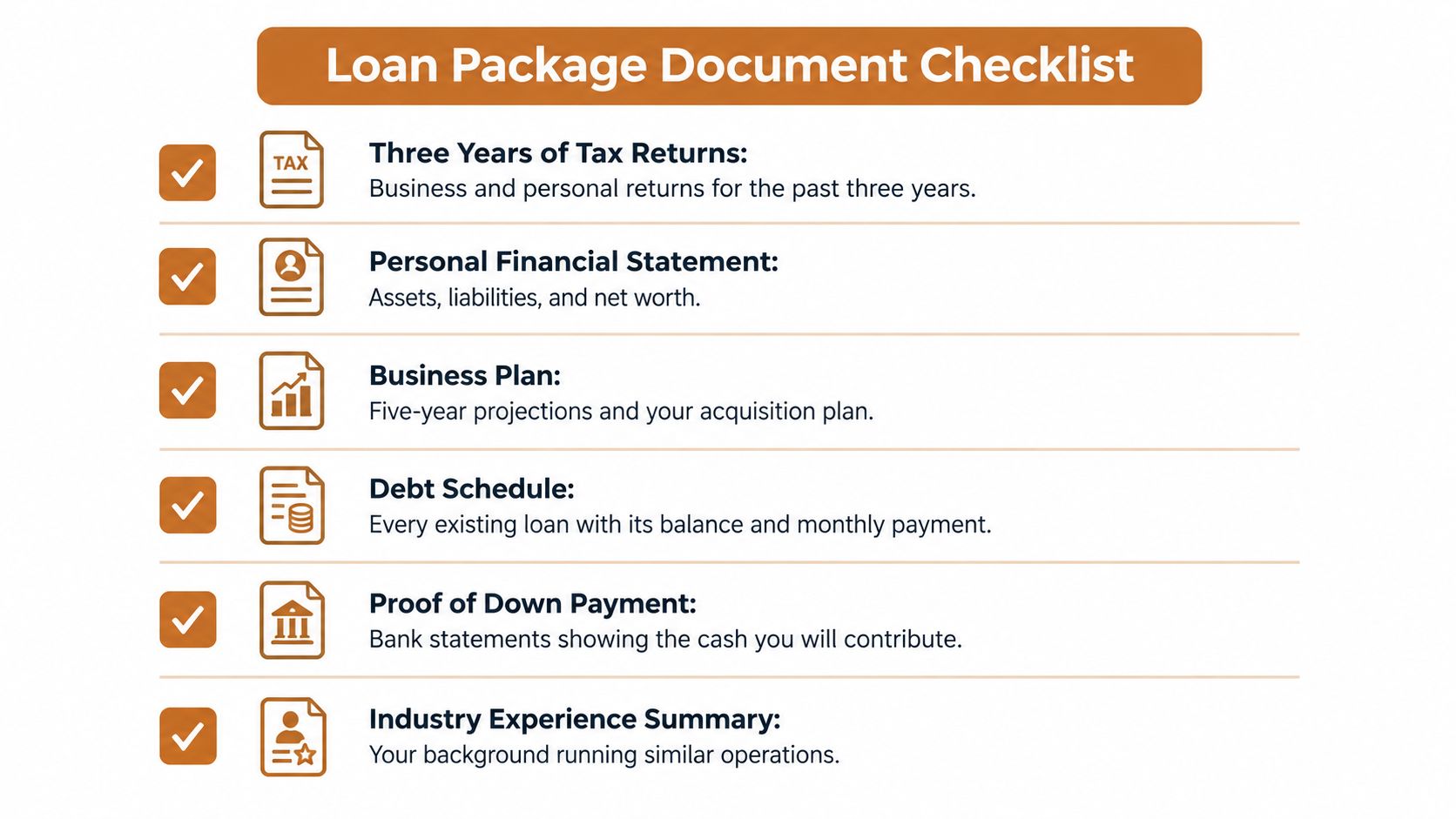
A lender can’t approve what it can’t verify. A persuasive package makes the acquisition’s repayment case clear, explains the buyer’s role, and shows what happens if financing comes in below the requested amount.
Start by organizing the records that let an underwriter compare the seller’s claims with tax filings, current performance, and the buyer’s finances. Don’t wait until the lender asks for each file individually.
Loan applicants shouldn’t assume the lender will approve the full request. In the Federal Reserve’s Small Business Credit Survey, 52% of employer firms that applied for a loan, line of credit, or merchant cash advance in 2025 reported receiving the full amount requested. The survey’s reported approval data is a reason to build a workable alternative, not a forecast for any one deal.
An application often stalls when revenue swings lack an explanation, seller add-backs can’t be substantiated, or projections rely on growth the historical record doesn’t support. Prepare answers with supporting documents. If the seller claims an expense is personal or nonrecurring, show why and provide evidence rather than deleting it from the earnings calculation.
Use a focused preparation schedule: collect the financial records, reconcile them to tax filings, draft the debt-service analysis, write the transition plan, and review the sources-and-uses schedule with your accountant or lender. Before submission, test the deal using lower proceeds and conservative cash-flow assumptions. If that version fails, revisit price or terms before underwriting is underway.
A seller note may look like a routine line in a buyer’s financing stack. To the owner, it is a loan to the buyer, often secured by a business the buyer will control. That difference shapes what each side will accept. According to market data on buyer and owner expectations, about 90% of buyers expect seller financing, while only 29% of owners plan to offer it; nearly half say they will not, and 23% remain undecided.

For an owner, a lower cash-at-close price may be preferable to a higher headline price dependent on a note that is difficult to enforce. A bank may take priority, leaving the seller’s note subordinate or secured by assets already pledged to the senior lender. The owner is also relying on the buyer to report trouble promptly. Evaluate the likely payment stream and collection risk, not just the sale price.
The seller-financing structures used in small-business deals differ, so put the details in writing and have transaction counsel review them. Work through these terms:
An earnout makes part of the price depend on results after closing. It can bridge a valuation gap tied to recurring maintenance revenue, but the agreement needs a precise measurement rule. Define which contracts count, how cancellations and price changes affect the calculation, and what records the seller may inspect. A buyer who controls staffing, pricing, and customer terms can also affect the metric that determines payment. Vague targets leave room for disputes.
The best structure is the one both sides can enforce.
A short video can help frame the discussion, but it cannot replace deal-specific legal, tax, or lender review.
The financing mix that works depends on the buyer’s cash, the lender’s underwriting, and what the seller will accept. These illustrative scenarios show how different combinations can solve different problems. Their figures are planning examples, not promised lender outcomes.
A first-time HVAC buyer has substantial savings but limited assets to pledge. The seller wants a clean exit, yet agrees to carry a portion of the price on full standby to help meet the acquisition structure. The buyer combines personal cash with an SBA-backed loan and a standby seller note, while preserving working capital for payroll, parts, and customer calls.
The sticking point is the seller’s concern about being paid after the bank. The buyer and seller clarify the note’s security, standby period, and reporting terms with their advisers before signing final documents. The buyer would do one thing differently: negotiate the seller-note framework earlier, before both sides anchor on price alone.
Lesson: A standby note can help bridge a structure, but it needs clear terms and lender approval before the buyer relies on it.
An electrician acquiring a competitor has an existing operation and understands the local customer base. A bank term loan funds the core acquisition, an earnout depends on recurring maintenance contracts transferring to the buyer, and a small equipment loan funds specific replacement needs.
The challenge is defining which contracts count toward the earnout and how cancellations are handled. The buyer sets the measurement process and reporting rights in the purchase documents, rather than leaving the definition to an informal post-close discussion.
Lesson: Tie contingent payments to observable performance and spell out how the parties will measure it.
A buyer negotiates a purchase price assuming the lender will fund the requested amount. The lender approves only 70% of the amount requested, leaving a funding gap that the buyer can’t cover entirely in cash. Rather than accept a financing plan that leaves no operating cushion, the buyer renegotiates the price and adds a larger earnout tied to defined post-close results.
The sticking point is the seller’s concern that the earnout will be difficult to monitor. The parties add clear reporting and calculation terms, then confirm the revised structure with the lender and their advisers. The buyer would stress-test the lower-approval scenario before making an offer.
Lesson: A smaller loan approval doesn’t automatically kill a deal, but the price and payment terms must change together. Preserve enough cash to operate after closing.
A financing stack can look sound in a spreadsheet and still fail underwriting or leave too little cash to run the business. Choose advisers by the work your deal requires. A business broker manages the sale process and may coordinate buyer interest, but the lender makes the credit decision. An SBA-experienced lender explains its underwriting requirements. An M&A adviser helps structure and negotiate the transaction, while an accountant who works with acquisitions tests earnings, working capital, and tax considerations.
Ask each specialist about recent closed deals in a similar industry and at a similar size. Then speak with past clients, including about what surfaced late, how the adviser handled it, and whether the financing matched expectations. Ask what the specialist will do and where their role ends. Clear answers matter more than a confident pitch.
For owners of established service businesses, The Owner’s Shortlist is a free service for companies with about $1 million to $50 million in annual revenue. A person reviews the business and introduces the owner to one specialist whose past work appears relevant, usually a business broker. Specialists pay to be listed after a review of their deals and conversations with past clients. The service connects owners with sale advisers, not buyers with acquisition targets, and its site does not provide legal, tax, or financial advice.
The resource focuses on Florida owners, though its articles are written for owners anywhere. Buyers can view the service in this business platform screenshot. Select acquisition lenders and advisers based on the specific needs of your transaction.
Before committing to a financing stack, prepare a sources-and-uses sheet and organize the company’s financial records. Speak with an SBA-experienced lender early, especially if the equity injection or operating cash could determine whether the deal closes. Owners preparing to sell can call (321) 320-7239 or fill out the short form to speak with a person before sharing anything else.

The Owner’s Shortlist offers owners of established service businesses a free, person-led introduction to a specialist whose past work may fit their company. Owners preparing for a sale can start a low-pressure conversation through The Owner’s Shortlist.
Tell us your situation. We'll connect you with a specialist who works with owners like you. One conversation, no sales pressure.
Found this useful?
Add The Owner's Shortlist as a preferred source and get our articles highlighted in Google Search results.
Add to Preferred SourcesExplore 5 confidential information memorandum examples for owner-operated businesses, with required sections, practical guidance, and common pitfalls.
October 22, 2026
Partners who disagree on selling usually settle it one of four ways: a buyout, a partial sale, a sale together, or what the agreement forces.
October 20, 2026
What is deal structuring, explained for service business owners. Learn asset vs stock sales, earnouts, seller financing, holdbacks, and the questions
October 19, 2026
Learn how to identify well qualified buyers for your service business. Covers vetting criteria, red flags, sample questions, and next steps
October 17, 2026