Confidential Information Memorandum Example: 5 Guides
Explore 5 confidential information memorandum examples for owner-operated businesses, with required sections, practical guidance, and common pitfalls.
October 22, 2026
By Remi Taffin · October 19, 2026
You’ve got two offers for the HVAC company you built and ran for years. One shows a higher price, but part of it depends on future performance. The other is mostly cash at closing, with a lower headline number. Your first instinct may be to compare the totals. Don’t stop there.
The terms determine how much money you receive now, what you might collect later, which taxes apply, and what risks stay with you after the sale. Deal structure isn’t a footnote to the price. It’s the arrangement that decides what the price means in practice.
That’s what owners are asking when they ask, “What is deal structuring?” It’s the design of how an acquisition gets paid for, how risk and control are divided, and how the parties handle uncertainty after closing. The right questions start with three trade-offs: certainty now versus possible upside later, cash versus tax basis, and control versus protection.
Two letters of intent can show the same purchase price and leave you with very different outcomes. One buyer may pay nearly all cash at closing. Another may offer seller financing, an earnout, and a holdback, each with its own conditions and risks. A headline number doesn’t tell you how much of the money is certain, when you’ll receive it, or what you’ll need to do to collect it.
Start by separating the offer into payment components. Cash at closing is money you receive when the transaction closes, subject to the agreement’s closing adjustments. A seller note means the buyer owes you part of the price over time. An earnout pays only if defined performance conditions are met. A holdback keeps money aside temporarily to cover agreed adjustments or specified claims.
For every payment that comes later, ask what must happen before you get it. If the buyer controls the business after closing, can you control the factors that determine an earnout? If the buyer promises repayment through a note, what security supports that promise, and what happens if the business can’t pay? If funds sit in escrow, what claims can draw on them and who decides whether a claim is valid?
The tax treatment needs its own review. Two offers with the same gross price may allocate that price differently among equipment, inventory, goodwill, and other assets. That allocation can affect the seller’s tax result, so “What’s the price?” is an incomplete question. Ask instead, “What do I receive after debt, closing adjustments, delayed payments, and taxes, and which parts are at risk?”
Practical rule: Treat each payment component as a separate promise. Identify its amount, timing, conditions, security, and the person who controls whether those conditions are met.
Your decision isn’t whether to accept the larger number. It’s whether the terms fit your need for certainty, your willingness to stay exposed to the company, and the tax outcome your advisers can model. Before you compare offers, turn each one into a clear picture of cash at closing, possible future payments, and obligations that continue after closing.
Deal structuring is the design of a transaction’s economic, legal, tax, and risk-allocation terms. It covers more than how the buyer funds the purchase. It also determines what the seller receives, when payments are due, who controls the business after closing, how liabilities are handled, and what happens if the company performs differently than expected.
The building blocks can include cash at closing, buyer shares, debt, seller financing, rollover equity, earnouts, escrow, and working-capital adjustments. Each one answers a different question. Cash transfers value immediately. A seller note leaves the seller waiting for repayment. Rollover equity keeps the seller invested in the continuing business. A contingent payment ties some proceeds to future results.
For owners looking for plain-language guidance on preparing for a sale, an exit plan for a profitable business can help frame the decisions that deserve attention before negotiations become urgent.
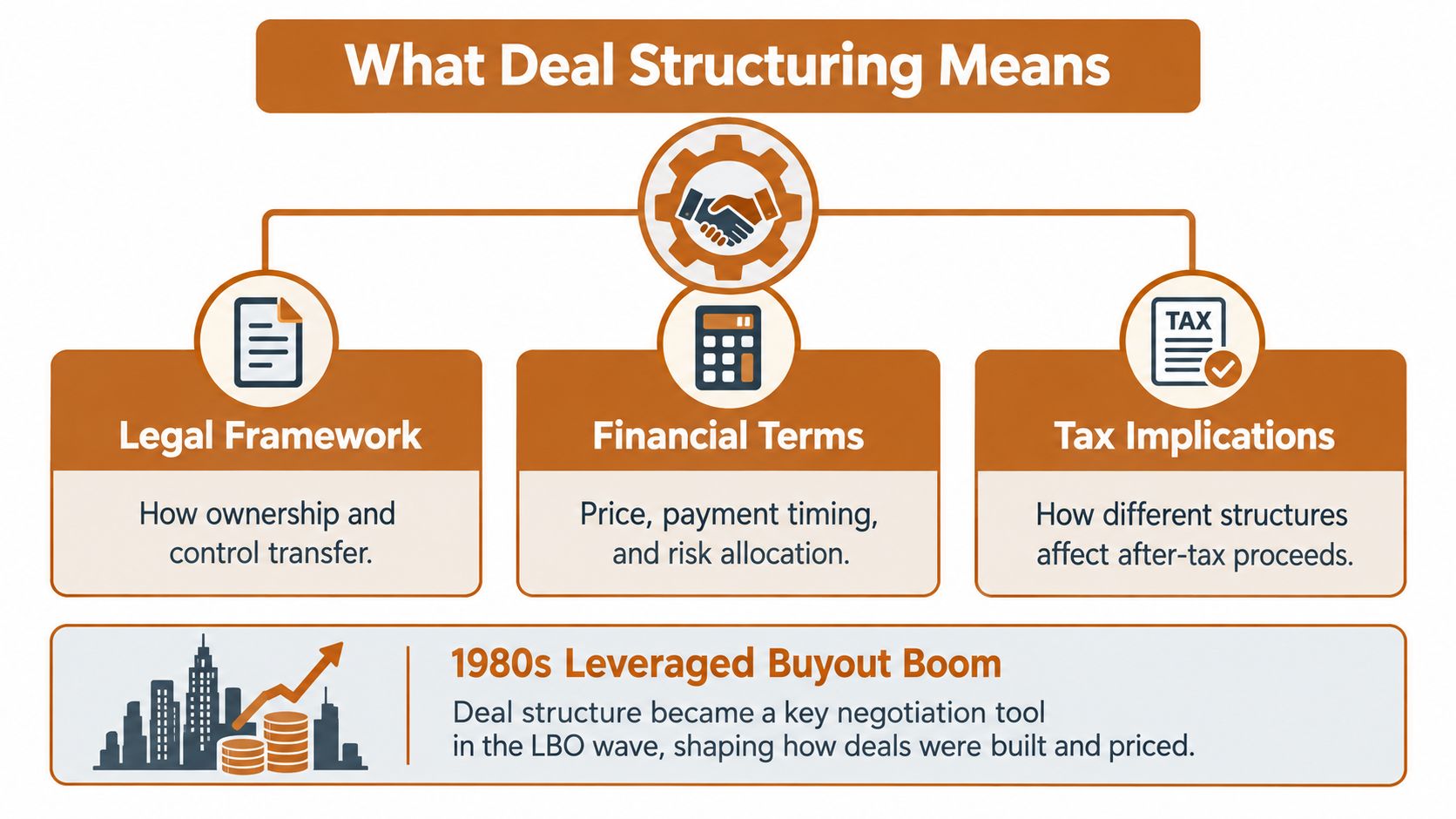
The importance of structure became especially visible during the buyout expansion of the 1980s. Annual LBO activity grew from less than $3 billion in 1983 to more than $30 billion in 1987, according to historical analysis published by the American Bankruptcy Institute. By the late 1980s, many transactions were financed with as much as 90% borrowed money, secured by the acquired company’s assets. In studied LBO transactions, the Chicago Federal Reserve reported that average long-term debt increased by 262% and the average debt-to-equity ratio rose above 5-to-1, as described in the same historical reference.
The point isn’t that a sale of a local plumbing or landscaping company resembles a large buyout with heavy debt. It doesn’t. The lesson is that the purchase price alone hides the financing burden, the company’s obligation to generate cash, and the lender’s priority if the business struggles.
Structure decides who bears the consequences when the plan changes. An owner who understands those mechanics can ask sharper questions than one who treats the offer’s first page as the whole deal.
In an asset sale, the buyer purchases specified assets of the business, such as equipment, inventory, contracts, or goodwill. The seller generally retains the legal entity and any liabilities not assumed under the agreement. In a stock sale, the buyer purchases the ownership interests in the entity, which continues to own its assets and obligations. The contracts, liabilities, consents, and tax consequences can differ substantially, so neither label tells you by itself which option is better.
For an owner, the practical comparison is less tidy than “asset sales are better for buyers, stock sales are better for sellers.” A buyer may prefer selected assets and a tax basis based on the purchase allocation. A seller may value transferring ownership of the entity and avoiding the work of transferring individual assets, subject to the particular contracts, liabilities, and tax facts. The agreement and the company’s circumstances matter.
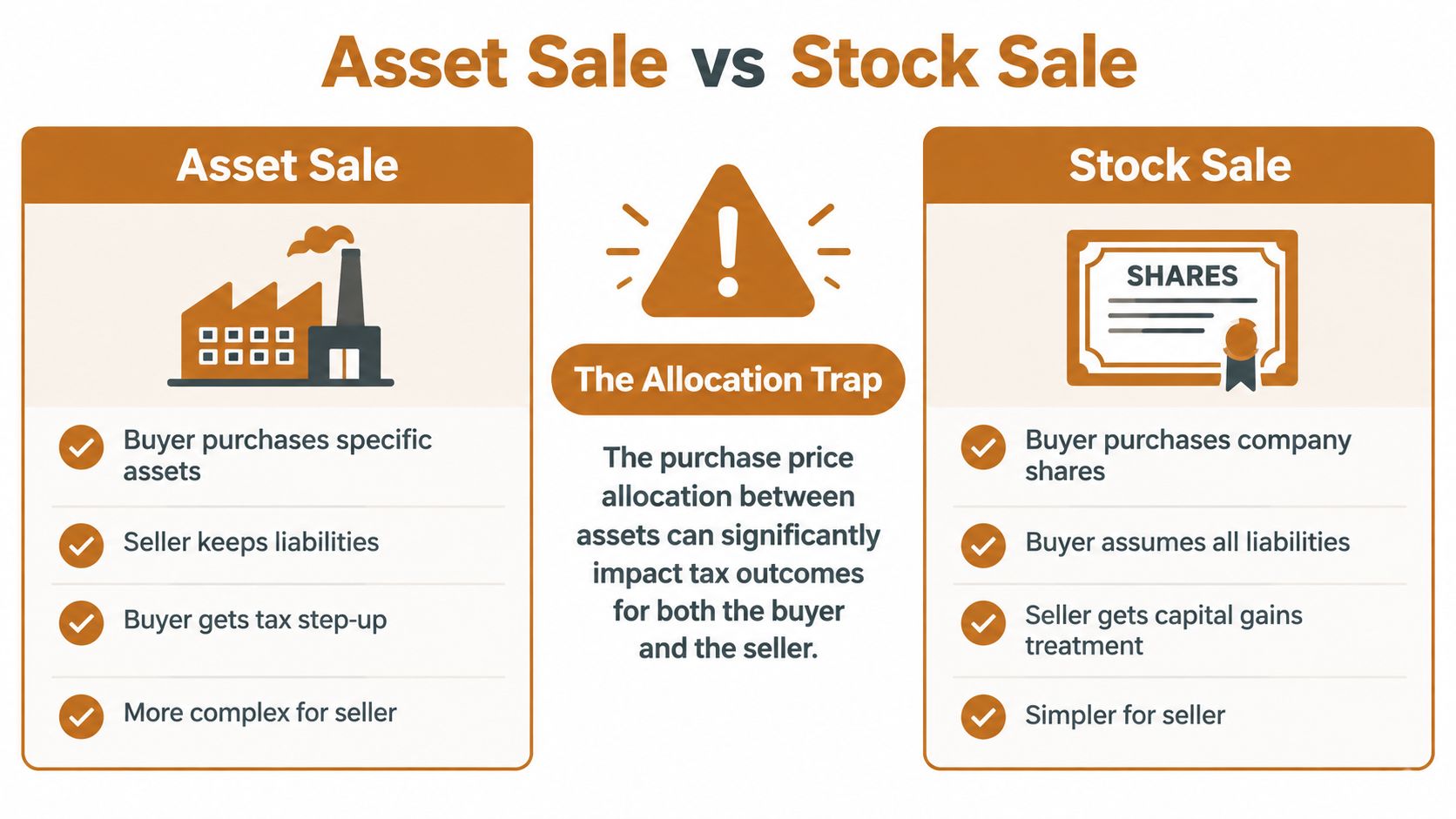
In a U.S. acquisition of a business’s assets, the purchase price is allocated asset by asset under the IRS residual method. The sequence begins with cash and other Class I assets, then proceeds through Classes II to VI, with the residual generally assigned to Class VII goodwill and going-concern value. Amounts assigned to assets outside Class VII generally can’t exceed their fair market value at closing. The IRS requires both parties to report qualifying asset acquisitions on Form 8594, and the allocation should be recorded in the purchase agreement or another signed document. The IRS instructions for Form 8594 explain the reporting requirements.
That makes the allocation a real negotiation, not paperwork to leave until after the price is settled. A service company may have vehicles, tools, equipment, inventory, customer contracts, a trade name, noncompete rights, and goodwill. Assigning more value to depreciable or amortizable assets may create future deductions for the buyer, while the allocation can change the seller’s tax result. Depreciation recapture and ordinary-income treatment can also affect proceeds.
A higher gross price can be a worse deal if the allocation, debt payoff, working-capital adjustment, and taxes leave you with less.
Ask which assets are being valued, who proposes the allocation, whether your tax adviser agrees with it, and how it interacts with deferred payments. The difference between an asset and stock sale is specific to the entity, contracts, liabilities, and tax profile. Have a qualified adviser compare the options before you sign. For a general comparison of asset sales and stock sales, review the issues with someone who can apply them to your transaction.
An earnout, seller note, holdback, and rollover equity aren’t interchangeable ways to fill a gap between buyer and seller. Each shifts a different risk, and each leaves the seller with a different kind of exposure.
An earnout is a contingent payment. You receive it only if the business reaches agreed targets during a defined period. Earnouts can help when the buyer and seller disagree about value or future performance, but the seller may lose control over the business that determines whether payment is earned. Research on earnouts describes them as a way to reduce information asymmetry and as a source of acquisition financing. One review reported that earnout transactions rose from approximately 4% of deals in research covering the 1990s to 16% in a more recent study, and separate research found that each additional month in an earnout period was associated, on average, with a 0.6% higher takeover premium. Those findings don’t mean a longer earnout is automatically better. The contract’s terms matter. (Research on earnouts and acquisition financing)
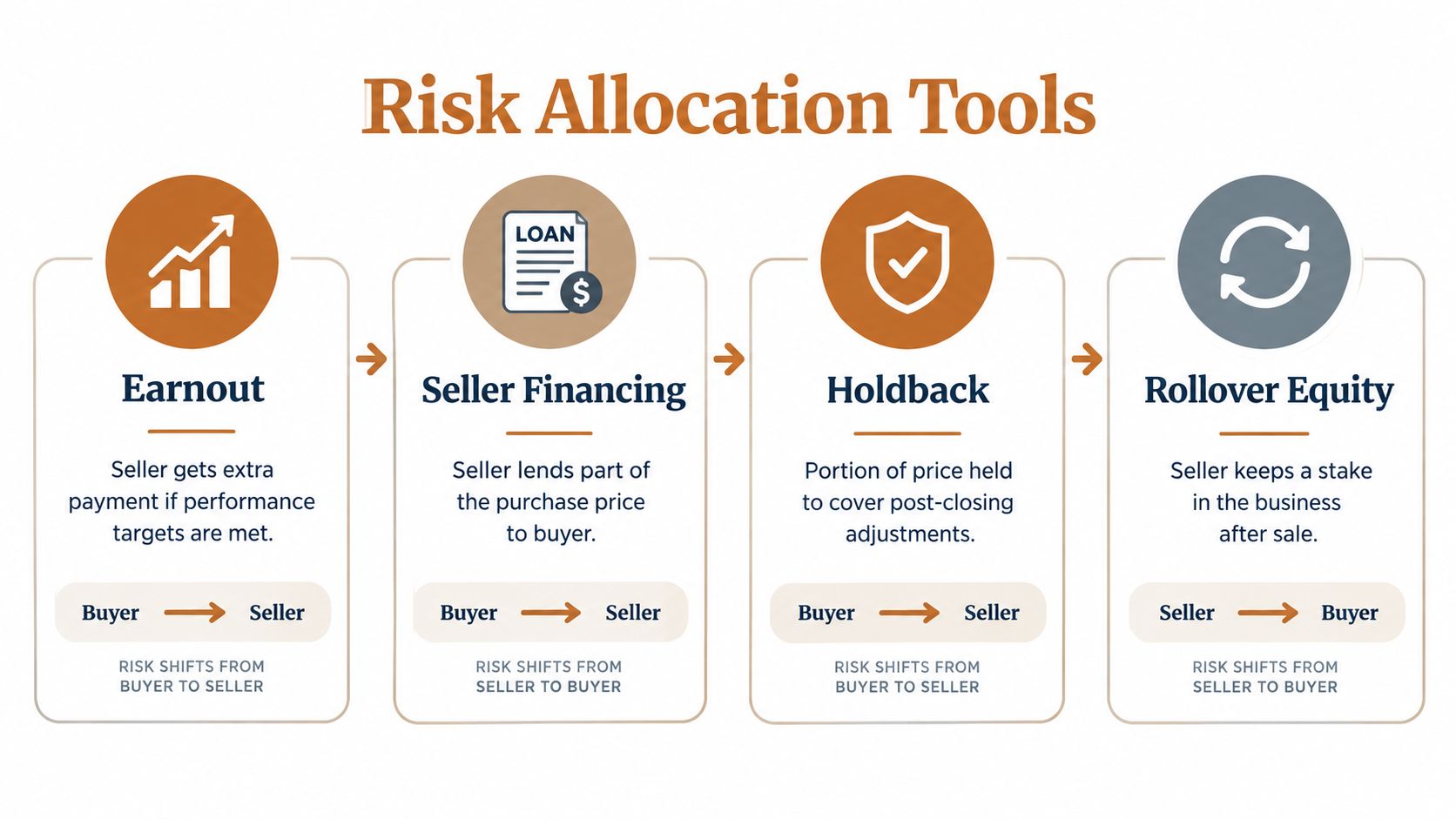
A seller note is a loan from you to the buyer for part of the purchase price. You’re relying on the buyer’s ability to repay, and a senior lender may have priority rights over business assets. Ask what collateral secures the note, whether the senior lender must approve it, and what happens after default. For an overview of seller financing, focus on the repayment and security terms, not just the promised interest or schedule.
A holdback is a portion of proceeds retained for a defined purpose, such as a working-capital adjustment or specified claims. It can protect the buyer against agreed risks, but the seller needs limits on how funds may be withheld and a clear process for release or dispute.
Rollover equity means you retain an ownership stake after closing. It can preserve a share of future value, but it also keeps you exposed to the company and to the rights of other owners. Don’t treat it like cash. Review the governance, transfer, information, and exit terms with your lawyer.
The metric is where a seller can get trapped. Revenue may be easier to verify, but it can reward unprofitable growth. EBITDA may better reflect earnings, yet it can move with decisions about owner compensation, vehicle costs, overhead allocation, and integration expenses. For a field-service business, recurring-service revenue or customer retention may be worth considering if ordinary-course records support the calculation.
A usable earnout clause specifies the measurement period, accounting principles, reporting rights, permitted business changes, dispute process, payment timing, and what happens if the buyer changes staffing, pricing, territory, or capital spending. An independent reviewer should be able to calculate the result from named records, not guess at what the parties meant.
The IRS installment-sale guidance is relevant when sale proceeds arrive over time, but tax reporting and contractual collection rights are separate questions. Ask your tax adviser to review the timing, and ask your lawyer to make the promise enforceable.
An HVAC owner receives two offers with the same headline price. One is a stock sale; the other is an asset sale with a different allocation. The higher-looking number may leave less cash after taxes, debt payoff, closing adjustments, and the treatment of continuing liabilities. The headline price does not settle the comparison.

A landscaping owner faces a different trade-off: accept a lower price with an allocation reviewed by a tax adviser, then take a secured seller note and a short earnout tied to recurring-service revenue. That offer may produce a better result after taxes and debt, but only if the note can be collected and the earnout risk is acceptable. Treat contingent payments as uncertain, not as cash in hand.
These are illustrative scenarios, not actual company results. They show why sellers should compare net proceeds and risk, rather than rank offers by headline price alone.
Compare both offers against the same terms:
The metric and duration of an earnout can materially affect its value. A recurring-service revenue measure may suit a service business better than EBITDA in some deals, but the contract must define the calculation and address changes the seller cannot control. Have your lawyer test those terms against the buyer’s operating discretion.
Don’t take a letter of intent to your advisers with only one question: “Is this a good price?” Bring the structure, payment terms, and proposed allocation. Ask each specialist to assess the part of the deal they’re qualified to handle, and get the important answers before you sign terms that may be difficult to change.
Don’t sign first and expect your advisers to fix the structure later. Ask them to review the proposed terms while you can still negotiate.
A buyer may draft the first proposal, but that doesn’t mean the buyer owns every decision. You can ask for a different payment mix, negotiate how assets are valued, narrow an earnout, seek security for a seller note, or reject terms that leave you carrying risks you can’t control.
The useful questions are straightforward: What’s certain at closing? What can change the tax result? Which future payments depend on buyer-controlled decisions? What liabilities, adjustments, or duties remain after the sale? Those answers won’t guarantee a particular outcome, but they’ll give you a better basis for judging an offer than the headline price alone.
This article is general information, not legal, tax, or financial advice. Ask a specialist who has handled transactions like yours to review the actual documents and your company’s facts. The article can improve the questions you bring to the table. It can’t calculate your deal for you.
The Owner’s Shortlist is a free, plain-language resource for established service-business owners considering a sale, with a person who can review your business and introduce you to one specialist whose past work fits. If you’re weighing an offer or trying to understand who can help with its structure, visit The Owner’s Shortlist to explore its resources or start a conversation.
Tell us your situation. We'll connect you with a specialist who works with owners like you. One conversation, no sales pressure.
Found this useful?
Add The Owner's Shortlist as a preferred source and get our articles highlighted in Google Search results.
Add to Preferred SourcesExplore 5 confidential information memorandum examples for owner-operated businesses, with required sections, practical guidance, and common pitfalls.
October 22, 2026
Partners who disagree on selling usually settle it one of four ways: a buyout, a partial sale, a sale together, or what the agreement forces.
October 20, 2026
Learn how to identify well qualified buyers for your service business. Covers vetting criteria, red flags, sample questions, and next steps
October 17, 2026
A financial due diligence checklist for buyers and sellers of owner-operated trades businesses, covering earnings, debt, taxes, payroll, and equipment.
October 13, 2026