Confidential Information Memorandum Example: 5 Guides
Explore 5 confidential information memorandum examples for owner-operated businesses, with required sections, practical guidance, and common pitfalls.
October 22, 2026
By Remi Taffin · October 17, 2026

You’ve run the company for years, built a crew customers trust, and started wondering what comes next. Then a message lands from someone you’ve never met: they’re interested in buying your business. Another follows. A caller says they have capital and want to move quickly.
It’s tempting to treat a busy inbox as evidence that a sale will be easy. It isn’t. Many people like the idea of owning a business, but far fewer can finance a purchase, do the work required to evaluate it, make decisions on time, and take responsibility for the people and customers who make it valuable.
For an owner-operated service company, a buyer’s bank balance is only part of the answer. A credible prospect needs financial capacity, transaction readiness, and the ability to operate or responsibly oversee the business after closing. That’s the standard worth using before you share sensitive information or start picturing your next chapter.
An owner who has spent years building a plumbing or HVAC company may recognize the pattern. The business is profitable, the schedule stays full, and the owner is tired of being the person everyone calls when a truck breaks down or a customer has a problem. Before there’s even a formal decision to sell, inquiries begin arriving through email, LinkedIn, or an intermediary.
Some prospects ask sensible questions. Others lead with a flattering message, vague claims about available capital, and a request for revenue details. A few say they want to buy quickly, but can’t explain who will approve the purchase, how they’ll fund it, or what they’ll do with the team afterward.
That volume can mislead an owner. Interest is cheap; execution takes work. A person may be curious about acquiring a company without having lender support, enough equity, a realistic understanding of the business, or the time and experience to manage a transaction. A first conversation doesn’t make someone a buyer, and a confident tone doesn’t make them ready to close.
Practical rule: Treat every inquiry as unverified until the person can explain how they’ll fund, evaluate, and operate the business.
The distinction matters especially in a service company. A buyer isn’t just purchasing equipment, customer lists, or a name on a truck. They’re stepping into relationships with employees, customers, suppliers, and often the community. If the transition goes badly, the owner’s reputation may be the first thing damaged.
Before sharing records or granting access, test a prospect against a clear standard. Can they demonstrate financial capacity? Are they ready to make decisions and complete diligence? Can they protect the people and operating knowledge that make the company work? If one answer is missing, keep the conversation preliminary.
A well qualified buyer is someone who can fund the deal, is prepared to pursue it on a credible timeline, and has a realistic plan for taking responsibility after closing. A proof-of-funds document or lender pre-approval can help establish financial capacity, but it doesn’t answer every question. It won’t tell you whether the buyer understands the company, can make decisions, or has a plan for retaining key staff.
Use three pillars to judge the prospect. Each covers a different risk, and strength in one doesn’t make up for weakness in another.
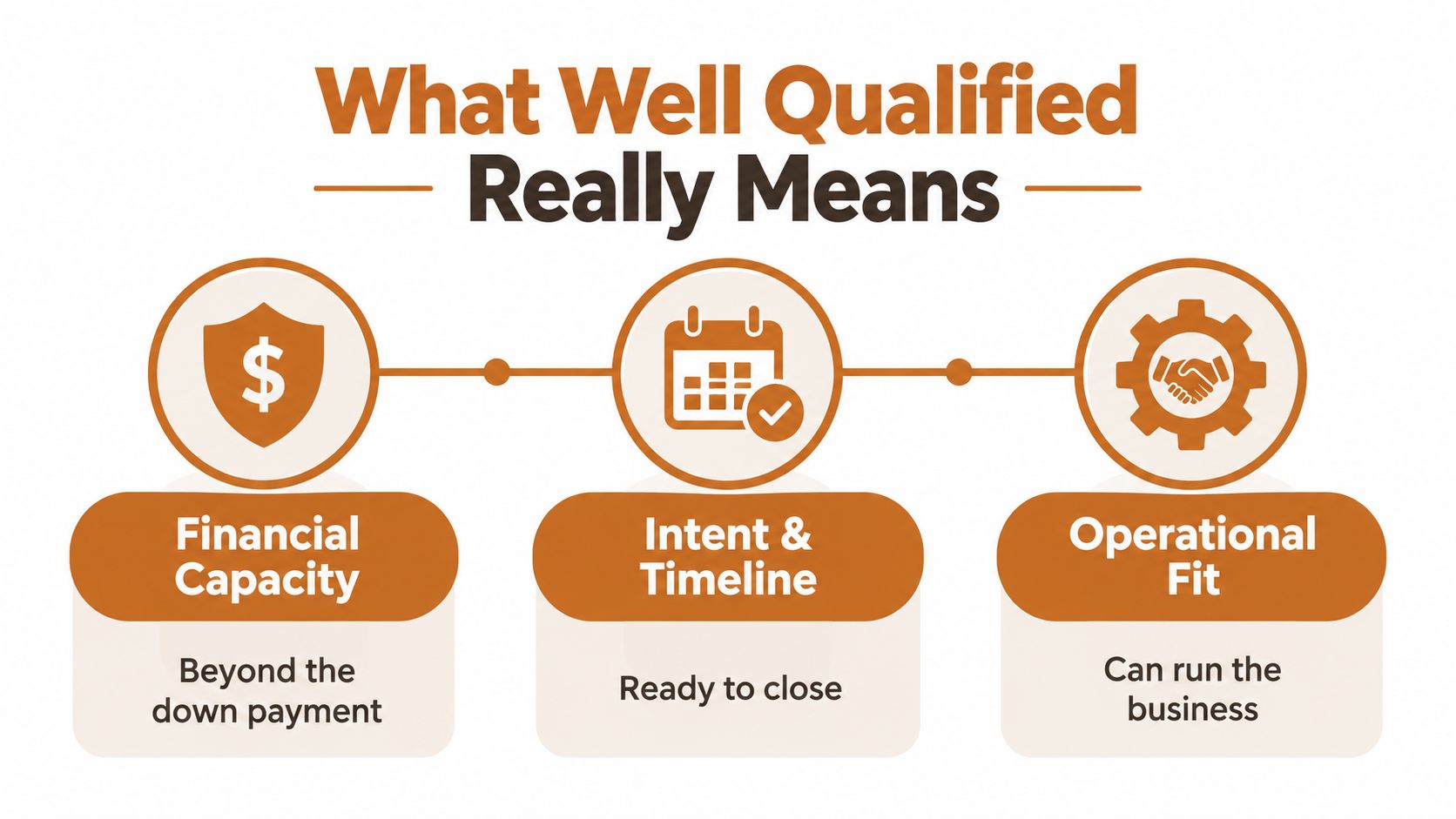
Ask how the buyer plans to fund the purchase, what equity they can contribute, whether a lender has reviewed the opportunity, and what cash they expect to retain after closing. A pre-approval is a starting point, not a guarantee. The buyer still needs to show how the full transaction will work.
Survey data highlights why financing deserves a direct conversation: 78% of prospective small-business buyers expected to use SBA financing, and 64% said SBA eligibility was extremely or very important when assessing a purchase. Seller financing was considered by 70% of buyers. Those buyer preferences make it sensible to ask about funding structure early, not after you’ve shared confidential records (BizBuySell’s buyer survey).
A serious prospect can explain why this company fits, who is involved in the decision, what must happen before an offer, and how they expect to proceed. They should be able to discuss diligence without treating it as an inconvenience and respond to reasonable next steps.
The buyer should show they’ve thought about the actual work of owning the business. That includes employees, customer relationships, licensing, service quality, and any essential knowledge still held by the owner. A buyer doesn’t have to be a technician, but they do need a credible plan to lead people who are.
For a practical primer on the review work buyers should expect before committing, see this guide to avoiding costly surprises when buying. Apply the same standard to a prospect’s process: do they welcome verification, or do they want you to take their confidence on trust?
Don’t assess a buyer by asking only whether they can produce a down payment. Acquisition financing is based on the full project, not just the agreed purchase price. The project may also include funded working capital, equipment, transaction fees, and other eligible costs.
For an SBA-backed acquisition, the equity injection is generally 10% of total project cost, not necessarily 10% of the headline purchase price. Consider a business priced at $2.0 million with $150,000 in working capital and $50,000 in eligible costs. The project totals $2.2 million, so a 10% injection would be $220,000, not $200,000. Those figures are a worked example of how total project cost changes the equity calculation, not a universal estimate of every buyer’s transaction (FNB’s overview of SBA acquisition lending).
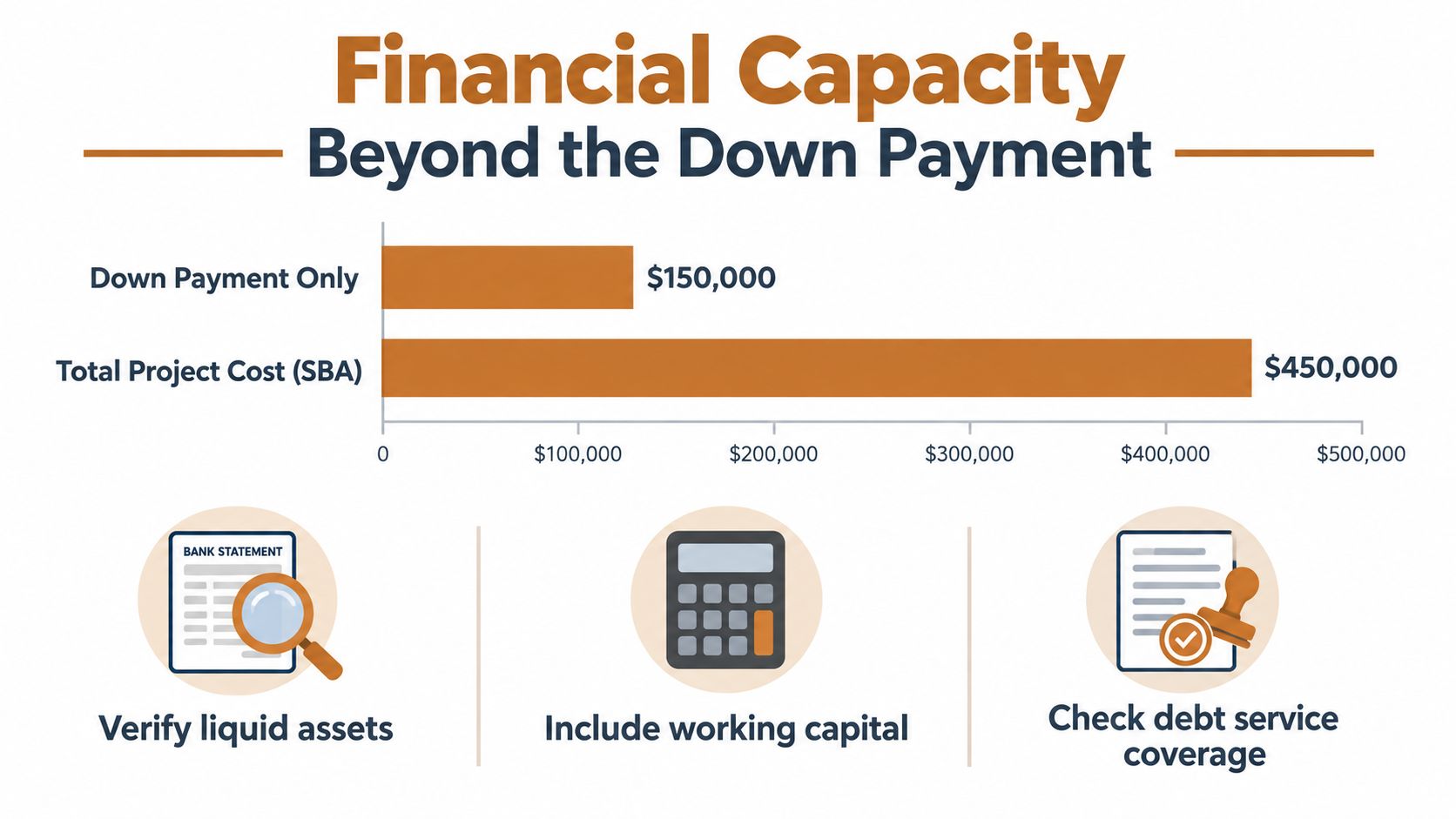
The chart image uses a separate illustrative comparison. For an actual offer, ask the buyer and their lender to show how their own project cost is calculated. The point is to look beyond a single number.
A buyer who can fund the equity injection but has little cash left may be exposed from the first unexpected expense. Payroll, equipment replacement, seasonal changes, and debt payments don’t pause while a new owner gets settled. Post-close liquidity is part of the buyer’s readiness, not a bonus.
Lenders also assess whether the company’s cash flow can support debt repayment and the buyer’s living expenses. Ask whether the buyer has reviewed the business’s cash generation and built a plan that accounts for costs the seller may have handled personally. Strong answers include clear assumptions, not just an optimistic estimate of future growth.
Ask for a credible outline of sources and uses: the purchase funding, planned equity, working capital, and other costs. The buyer should be ready to discuss lender feedback and show how the company will continue operating after closing. A seller note may form part of a sensible structure, but it shouldn’t be used to hide a funding gap or leave the business short of operating cash.
If seller financing is on the table, understand how it fits with the rest of the offer and what risks it leaves with you. This overview of seller financing for a small business can help frame the questions before you negotiate terms.
A buyer can have a sound reason for wanting your company and still be far from closing. Transaction readiness shows up in preparation and follow-through, not declarations of enthusiasm. Search-fund data offers a useful, though not identical, benchmark: acquisition rates were 86% for funds launched from 2007 to 2010, compared with approximately 48% for funds launched from 2021 to 2024. Recent successful searchers signed an average of 2.5 letters of intent before closing one transaction, while nearly 79% of failed letters of intent were attributed primarily to diligence findings (Calder’s analysis of the 2026 Stanford search-fund study).
Those results point to a practical lesson: a buyer needs enough time, preparation, and judgment to get through scrutiny. The same analysis reports that buyers who signed an LOI within their first six months acquired a company at a 74% rate, compared with 48% for the broader recent cohort. That benchmark doesn’t predict the outcome of your sale. It does reinforce that momentum and disciplined execution matter.
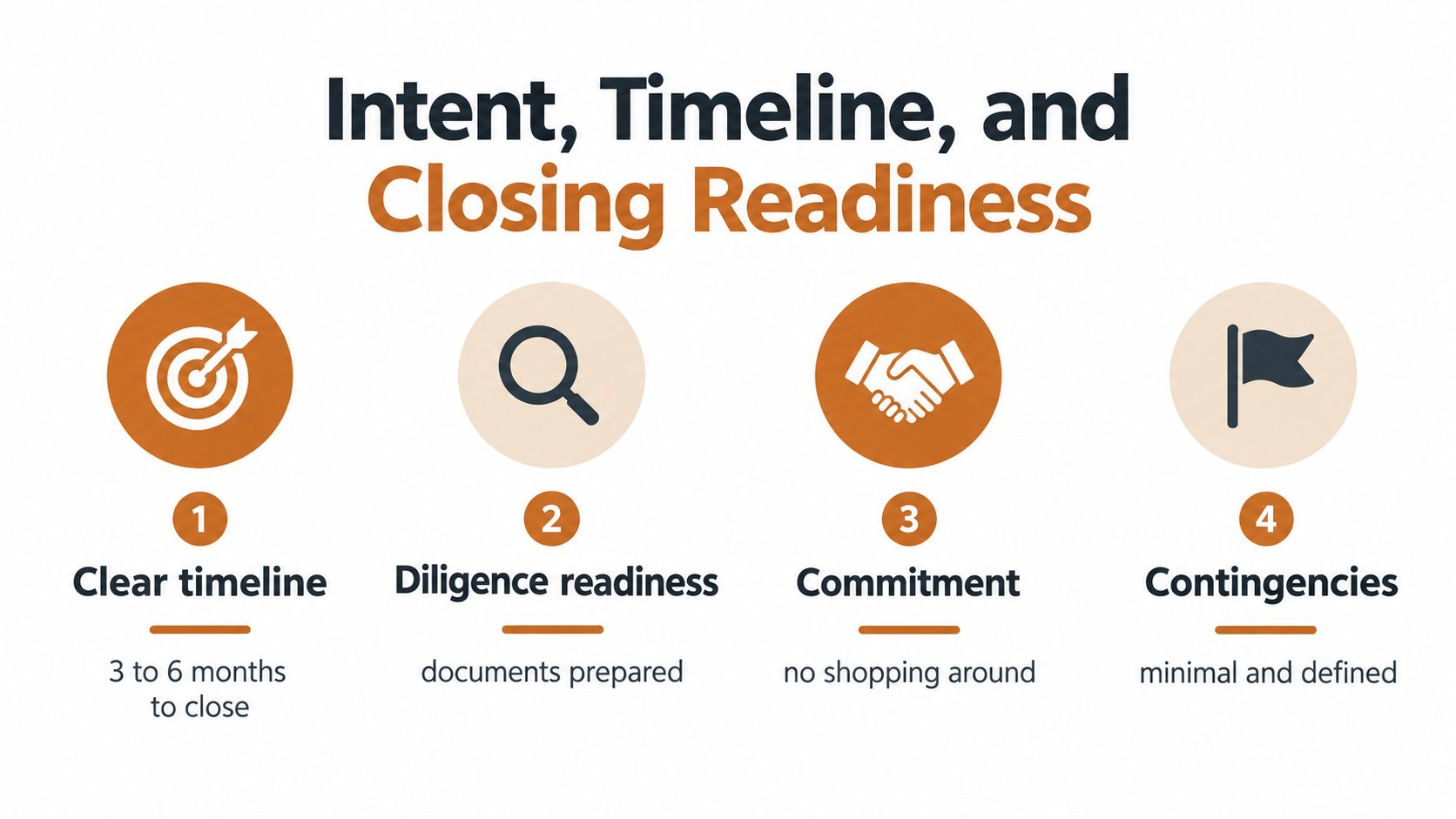
Before discussing sensitive information, ask whether the buyer can provide:
These are reasonable requests, not an attempt to make the buyer jump through arbitrary hoops. A prepared buyer should understand why a seller needs evidence before opening the books or pausing other conversations.
The timeline question matters, too. Ask what remains between the current conversation and a signed agreement, and what could delay the process. A buyer who can name the next steps and take responsibility for them is more credible than someone who repeatedly asks for time without explaining what they need. For a sense of the broader sale process and its moving parts, consult this guide on how long it takes to sell a business.
A buyer can have capital and transaction experience and still be a poor successor. In a plumbing, HVAC, electrical, roofing, landscaping, or commercial-service company, value often depends on people and routines that never appear neatly in a spreadsheet. The dispatcher knows which customers need careful handling. A service manager keeps technicians productive. The owner may still handle estimating, licensing, or difficult customer relationships.
A buyer doesn’t need to personally perform the trade. They do need to explain how the work will continue without damaging service quality or pushing essential employees out.

Ask how the buyer plans to retain the people who hold important customer, scheduling, estimating, and technical knowledge. Find out whether they’ve considered licensing requirements, service agreements, customer handoffs, and the owner’s role during a transition. A useful answer identifies responsibilities and risks. “We’ll figure it out after closing” isn’t a plan.
Customer relationships deserve the same attention as employee retention. If customers rely on the owner’s personal reputation, ask how the buyer will introduce themselves, preserve service standards, and prevent avoidable disruption. The buyer should be able to describe what they’ll learn before taking over, not promise that nothing will change.
An individual buyer may bring relevant management experience, an operating partner, or a willingness to work inside the company. A strategic or private-equity buyer may bring acquisition experience and capital, but may also plan consolidation, new reporting systems, or staffing changes. Neither category automatically means a good or bad outcome. What matters is whether the buyer’s intended operating model fits the company and your priorities.
Owners often focus on protecting the sale price and overlook what happens to the people who made the business valuable. Ask plainly: What will stay the same after closing, what do you expect to change, and who will decide? A buyer who answers directly and discusses trade-offs is easier to assess than one who offers polished assurances without a practical plan.
You don’t need to interrogate a prospect on the first call. You do need to establish enough to decide whether another conversation is worthwhile. Keep your questions conversational, then listen for specific answers and a willingness to provide support for them.
For another perspective on how diligence can surface deal risk, see this buyer’s guide to Israeli M&A risks. The jurisdiction differs, but the underlying reminder is useful: buyers should test what they’re acquiring before they commit.
A buyer doesn’t have to have every answer on the first call. They should be candid about what they don’t know, clear about how they’ll find out, and willing to make a reasonable next step.
Don’t let a large offer or polished presentation excuse avoidable uncertainty. The wrong buyer can cost you time, expose sensitive information, and create disruption even if no deal closes. Stop and verify when a prospect can’t explain the basics.
Use these as reasons to pause, not as a script for assuming bad faith. A serious buyer should be able to answer reasonable questions and accept sensible safeguards.
Prepare a basic information package before conversations turn serious. Start with a high-level overview and organize financial and operating records, but don’t send tax returns, customer-level data, employee information, or other sensitive records to an unverified contact. Share information in stages, after you’ve confirmed who the buyer is, how the purchase may be funded, and who has decision authority.
A qualified broker or other adviser can screen prospects, coordinate introductions, and help control what gets shared and when. The Owner’s Shortlist is one option for owners who want a person to match their business with a specialist based on relevant past transactions; its guide to what a good business broker does can help clarify the role. For additional context on deal-making in business process outsourcing, you can browse BPO deal-making insights.
Keep confidentiality in your hands. Work with a vetted adviser, release records only when there’s a clear reason and appropriate safeguards, and don’t let anyone advertise the business without your authorization. Start by writing down what a successful transition must protect, then use that standard to judge every prospect.
The Owner’s Shortlist is a free service that connects established service-business owners with one specialist whose past work fits their business. If you’re weighing buyer interest and want a confidential conversation before sharing records, visit The Owner’s Shortlist.
Tell us your situation. We'll connect you with a specialist who works with owners like you. One conversation, no sales pressure.
Found this useful?
Add The Owner's Shortlist as a preferred source and get our articles highlighted in Google Search results.
Add to Preferred SourcesExplore 5 confidential information memorandum examples for owner-operated businesses, with required sections, practical guidance, and common pitfalls.
October 22, 2026
Partners who disagree on selling usually settle it one of four ways: a buyout, a partial sale, a sale together, or what the agreement forces.
October 20, 2026
What is deal structuring, explained for service business owners. Learn asset vs stock sales, earnouts, seller financing, holdbacks, and the questions
October 19, 2026
A financial due diligence checklist for buyers and sellers of owner-operated trades businesses, covering earnings, debt, taxes, payroll, and equipment.
October 13, 2026