Confidential Information Memorandum Example: 5 Guides
Explore 5 confidential information memorandum examples for owner-operated businesses, with required sections, practical guidance, and common pitfalls.
October 22, 2026
By Remi Taffin · September 8, 2026 · Updated October 12, 2026

Most small to mid-sized owner-operated businesses take 6 to 12 months from listing to closing, while the full effort, including preparation, often spans 12 to 24 months. If you’re asking only about the time after a buyer sees the business, you’re already leaving out the work that determines whether the sale moves quickly or drags.
You may be in the familiar position of an owner who has decided it’s time to sell, but hasn’t yet gathered the records, tested the valuation, reduced personal dependence on the company, or spoken with the right advisors. The business may be profitable and well known in its market, yet a buyer won’t see those strengths clearly if the books are inconsistent or key processes exist only in your head.
The honest answer to how long does it take to sell a business depends on which clock you mean. The first clock covers preparation before the business reaches the market. The second runs from marketing and buyer outreach through negotiation, diligence, documentation, and closing.
Consider an owner of a profitable service company who wants to retire. The owner expects to hire a broker, publish a listing, meet a buyer, and hand over the keys. Six months sounds reasonable because it’s often presented as the standard answer. Then the advisor asks for financial statements, tax filings, customer concentration details, employee agreements, leases, licenses, equipment schedules, and a clear explanation of how the company operates without the owner.
That conversation changes the timeline. The owner isn’t ready to market yet. The company may need months of cleanup before a buyer can evaluate it confidently.
The preparation clock starts before any buyer receives a confidential memorandum or signs a nondisclosure agreement. It includes organizing records, resolving legal and tax questions, documenting operations, clarifying the owner’s role, and establishing a defensible valuation. Some preparation tasks move quickly. Others, such as building a management layer or demonstrating that customer relationships don’t depend entirely on the owner, require sustained operating changes.
The active sale clock starts when the business goes to market. It includes buyer identification, initial conversations, offers, a letter of intent, due diligence, purchase agreement negotiations, financing, and closing. BizBuySell’s benchmark places median days on market at around 200 days, or a little over six months, while general guidance commonly places a business sale at six to twelve months overall. The BizBuySell timing benchmark and transaction guidance also emphasizes that business quality, industry, preparation, and pricing can materially change the schedule.
That means a business can spend six months listed and still require more time for diligence and closing. The listing period is not the same as the period from first inquiry to transferred ownership.
Practical rule: Plan your personal finances and post-sale life around the full timeline, not the optimistic listing period.
For larger or more complicated transactions, the schedule stretches further. McKinsey reported that the median time between signing and closing reached about 6.4 months in 2024, compared with roughly 5 months in 2005, a 25% increase over that period, as summarized in this overview of modern business sale timelines. Ideals’ anonymized M&A data placed average deal completion time at 255 days in 2024, compared with 266 days in 2023, which still represents roughly eight to nine months from start to finish.
The owner who prepares early has more control over the active sale period. The owner who skips preparation often pays for that decision through slower buyer responses, tougher price negotiations, repeated information requests, or a failed transaction.
A business sale moves through several handoffs, and each one can add time. For Main Street and lower-middle-market transactions, a practical benchmark is about 7 to 10 months from advisor engagement to closing. Roughly 3 to 4 months may follow a signed letter of intent for due diligence, according to this Main Street and lower-middle-market transaction benchmark.
The sale usually starts before the business reaches the market. You and your advisors gather financial records, normalize earnings, review contracts, identify liabilities, and decide how to present the company. You also determine which buyer profile fits best, such as an individual operator, strategic acquirer, private equity-backed platform, or another purchaser.
This phase has no standard duration. Clean records and an independent management team can put a company close to market-ready. Incomplete books, undocumented obligations, or heavy owner dependence require correction first. Owners who address those issues six to twelve months before launch give themselves a better chance of keeping the active sale process on schedule.
Your advisor prepares confidential marketing materials, identifies likely buyers, manages nondisclosure agreements, and screens prospects. The target is a qualified buyer with financial capacity, operating fit, and a clear intention to proceed.
A niche company may require a longer search because fewer buyers understand its industry. Strong demand helps a well-priced company attract attention, but interest is only the beginning. The advisor still has to convert that interest into a credible offer from a buyer capable of completing the transaction.
The letter of intent, or LOI, sets out the proposed price, deal structure, payment terms, working-capital expectations, exclusivity period, and other major points. It is not the final purchase agreement. It establishes the framework for the most demanding work that follows.
Negotiations move faster when both parties understand the business and the proposed terms reflect its risks. They slow when the seller fixates on headline price while the buyer concentrates on financing, conditions, liabilities, asset treatment, or other protections.
Due diligence tests whether the business matches the story presented during marketing and negotiation. Buyers may examine financial statements, tax returns, bank records, contracts, employee matters, customer relationships, insurance, compliance, technology, and operating procedures.
For many ordinary transactions, diligence creates the largest bottleneck. The benchmark above places 3 to 4 months after an LOI, so treat this phase as a major workstream, not a brief formality. Fast answers, organized files, and consistent financial explanations directly reduce avoidable delay.
After diligence, attorneys negotiate the definitive purchase agreement and related documents. The parties resolve remaining issues, confirm financing, satisfy closing conditions, transfer ownership, and plan the transition.
Closing can appear sudden because the visible event happens at the end. The underlying work is cumulative. Missing signatures, unresolved landlord consent, tax questions, financing conditions, or unclear inventory treatment can keep the transaction open after the commercial terms seem settled.
Two businesses with similar revenue can follow completely different sale schedules. One may have repeat customers, reliable managers, organized records, and a price supported by comparable transactions. The other may depend on the owner for sales, carry unresolved legal questions, and use financial statements that require extensive reconstruction.
A business serving a broad, active buyer market can attract qualified conversations more readily than a highly specialized company. Demand helps, but it doesn’t remove diligence or documentation requirements. A buyer still needs to understand the earnings, risks, customer relationships, and transferability of the operation.
Buyer type matters as well. An individual buyer may need personal financing and more time to obtain approval. A strategic buyer may understand the industry but conduct extensive internal review. A financially capable buyer who already knows the sector can move more efficiently, provided the business is ready for examination.
Owner dependence is one of the clearest timeline risks. If you personally approve every estimate, maintain the most important customer relationships, solve technical problems, and control vendor decisions, the buyer isn’t acquiring a fully transferable operation. The buyer is acquiring a job with a transition risk.
A trades company with recurring service contracts and capable field or office management may be easier to explain than a company whose revenue depends on the owner’s personal network. The issue isn’t whether you’re important. The issue is whether the business can continue producing results after ownership changes.
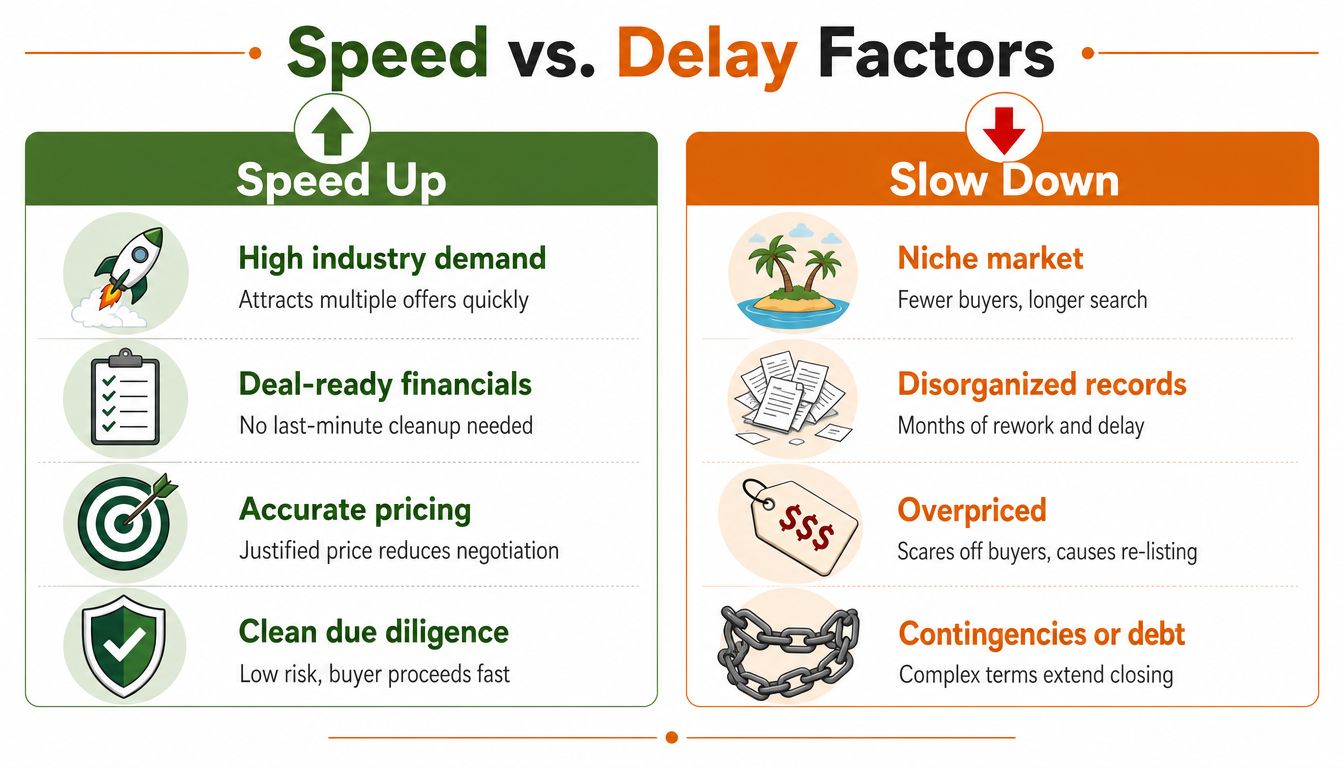
An accurate price attracts serious buyers. An inflated price creates silence, weak offers, or a later relisting after momentum disappears. Buyers may accept a complex structure when the underlying business is compelling, but seller financing, earnouts, contingencies, and unusual payment terms create more points to negotiate and document.
Legal, tax, licensing, lease, and regulatory complications can also lengthen the process. These issues aren’t automatically fatal, but discovering them late gives the buyer an advantage and forces the advisory team to work under pressure.
The practical comparison is simple:
You can’t control every buyer decision or market condition. You can control the quality of the information the buyer receives and how quickly your team answers reasonable questions.
Preparation should start before you sign a listing agreement. The work isn’t cosmetic. It gives buyers fewer reasons to doubt the earnings, operations, and transferability of the company.

Start with financial statements, tax returns, bank records, payroll information, debt schedules, and explanations for unusual items. Separate personal expenses from business expenses where appropriate, document owner add-backs, and make sure reported results reconcile across records.
A buyer doesn’t need a perfect business. A buyer does need a financial picture that can be followed without guesswork. Ask your accountant to create a concise summary that explains revenue sources, margins, seasonality, major expenses, and one-time events.
Write down the responsibilities you handle and assign repeatable processes to managers or employees. Document pricing authority, customer handoffs, vendor relationships, scheduling, quality control, and escalation procedures.
This may take longer than assembling documents because the business must demonstrate the change through normal operations. Start early, then monitor whether employees can make decisions without pulling you back into every issue.
Review leases, customer contracts, supplier agreements, employment arrangements, intellectual property, permits, insurance, and compliance matters. Ask counsel and tax advisors which issues could affect the structure of a transaction or the proceeds you keep after taxes.
Don’t wait until a buyer has signed an LOI to discover that a contract requires consent, an entity structure needs review, or a past filing needs correction. Buyers become less patient when sellers disclose avoidable issues late.
A valuation isn’t just a number. It’s a position supported by earnings quality, customer concentration, recurring revenue, assets, growth prospects, industry conditions, and comparable transactions. Use an advisor who can explain the assumptions rather than provide a flattering estimate.
If your expected price differs sharply from market evidence, decide whether you’ll adjust the expectation, improve the business, or accept a longer search. Pricing is a strategic decision, not an emotional reward for years of effort.
Coordinate your M&A advisor or broker, accountant, transaction attorney, tax specialist, and lender or financing contact where needed. Give each person a defined role and a shared schedule. A buyer should never receive three conflicting answers about the same financial or legal point.
Preparation is also the time to decide what confidentiality means for employees, customers, landlords, and vendors. A controlled communication plan protects the business while allowing serious buyers to receive the information they need.
Selling time depends on what a buyer can verify and how much of the business depends on you. The active sale may take months, but the timeline often starts 6 to 12 months earlier, during preparation.
A service company has recurring customer relationships, documented procedures, capable supervisors, and financial records that reconcile. The owner engages an advisor, confirms valuation expectations, prepares confidential materials, and begins outreach.
This business can move through buyer qualification and diligence without rebuilding its records. A practical differentiator is owner transition support. If supervisors already run daily operations, the buyer may need only a defined handover period rather than continued involvement in sales, estimating, and scheduling.
Preparation takes the initial months, followed by a focused search. After an LOI, the owner keeps operations stable and answers diligence requests promptly. Closing can fall within the ordinary active-sale range when no major issue appears.
A larger service company has solid demand but inconsistent expense classification, informal employee arrangements, and limited documentation around customer retention. The owner must clean the financial presentation, formalize agreements, and clarify which responsibilities can transfer.
The cleanup has a direct timeline cost. Reclassifying expenses, matching customer contracts to revenue, and documenting employee terms can create extra diligence questions and revisions. Buyers may also rely on acquisition financing, which requires clearer earnings support and can lengthen lender review.
Marketing may begin on schedule, but diligence usually runs toward the longer end of the ordinary range. The owner should not treat buyer interest as proof that the company is ready to close.
The owner remains the primary salesperson, estimator, relationship manager, and operational decision-maker. Records are available but uneven, and the company has not shown that revenue will remain stable without the owner’s daily involvement.
Preparation becomes a transferability project. A buyer will want to see who can sell, price work, retain customers, and make operating decisions after closing. Building management depth and proving that those people can perform without constant owner intervention often takes longer than organizing a data room.
Going to market too early can reduce buyer confidence and produce a fragile process. An owner-dependent company may need seller transition support after closing, with the scope determined by how quickly responsibilities can be transferred.
| Scenario | Preparation Phase | Active Sale Phase | Total Timeline |
|---|---|---|---|
| Prepared trades business | Focused readiness work before outreach | Efficient marketing, diligence, and closing | Around the normal 6 to 12 month active range, plus preparation |
| Service company needing cleanup | Financial, legal, and operational cleanup | Longer diligence and negotiation | Toward the longer end of the ordinary range, plus preparation |
| Owner-dependent business | Extended transferability and management work | Slower buyer confidence-building and diligence | Often longer than the ordinary range, with total effort potentially reaching 12 to 24 months |
Business size is only part of the timeline. The question is whether the buyer can verify earnings and see a credible operating future after you leave.
Start with the bottleneck most likely to stop your deal. Don’t spend weeks polishing marketing copy while your financial records, contracts, or ownership structure remain unclear.
Hire the advisory team early. Engage the broker or M&A advisor, accountant, attorney, and tax professional before marketing. Early coordination identifies problems while you still have time to fix them.
Create a diligence room before buyers ask. Organize financial statements, tax returns, bank records, leases, contracts, employee information, licenses, insurance, debt details, and operating procedures in a secure data room. The buyer should receive a coherent file, not a stream of disconnected attachments.
Test your valuation. Ask for the assumptions behind the valuation and compare them with actual business performance and transaction evidence. If the price is too high, decide before launch whether to revise it or accept a longer search.
Screen buyers firmly. Confirm financial capacity, acquisition experience, industry fit, decision authority, and financing plans before granting deep access to sensitive information. A curious prospect can consume management time without improving your chance of closing.
Resolve structure questions before the LOI. Ask tax and legal advisors how entity ownership, asset allocation, debt, leases, licenses, and payment terms may affect the transaction. The LOI should identify major structural issues, not create the first discussion about them.
Keep running the company. Maintain service quality, customer relationships, staffing, and financial discipline during the sale. A buyer who sees performance deteriorate may reopen price or walk away.
Use a simple decision rule. If your records are clean, the business operates without constant owner intervention, and your valuation expectations are realistic, going to market may make sense. If those conditions aren’t true, invest the preparation time first. A delayed launch is usually less damaging than a failed process that exposes the sale, consumes management attention, and forces you to start again.
A buyer inquiry is not a pending transaction. Interest becomes meaningful only after a qualified buyer reviews the company, submits credible terms, and commits to diligence. Until then, you have a prospect, not a deal.
A business does not sell like a house. Buyers verify earnings, liabilities, contracts, employees, taxes, operations, and transferability. That review takes months, not weeks, and the hidden preparation often begins 6 to 12 months before the business reaches the market.
A broker cannot fix missing information. An experienced advisor can improve positioning, buyer outreach, and process control. Incomplete records, unresolved legal questions, and unrealistic pricing still slow the process.
Due diligence is not a closing formality. As noted in the transaction timeline benchmark cited earlier, diligence commonly consumes 3 to 4 months after an LOI. Treat it as the central workstream, not an administrative footnote.
Ask, “What must be true for a qualified buyer to close confidently?” That answer gives you a timeline you can manage.
The Owner’s Shortlist is a free service that helps owners find a business broker or other specialist. You talk to a real person, who introduces you to one specialist whose past work fits your business. Before you take the business to market, tell us about your business. Owners pay nothing.
Tell us your situation. We'll connect you with a specialist who works with owners like you. One conversation, no sales pressure.
Found this useful?
Add The Owner's Shortlist as a preferred source and get our articles highlighted in Google Search results.
Add to Preferred SourcesExplore 5 confidential information memorandum examples for owner-operated businesses, with required sections, practical guidance, and common pitfalls.
October 22, 2026
Partners who disagree on selling usually settle it one of four ways: a buyout, a partial sale, a sale together, or what the agreement forces.
October 20, 2026
What is deal structuring, explained for service business owners. Learn asset vs stock sales, earnouts, seller financing, holdbacks, and the questions
October 19, 2026
Learn how to identify well qualified buyers for your service business. Covers vetting criteria, red flags, sample questions, and next steps
October 17, 2026