Confidential Information Memorandum Example: 5 Guides
Explore 5 confidential information memorandum examples for owner-operated businesses, with required sections, practical guidance, and common pitfalls.
October 22, 2026
By Remi Taffin · September 5, 2026 · Updated October 12, 2026
You’ve found a towing business for sale that appears straightforward. The listing shows a fleet, a storage yard, regular phone calls, and an owner who says the company has served the area for years. The asking price seems to reflect the trucks and recent profit. It’s tempting to treat the deal like buying equipment and taking over the keys.
That approach can miss the most valuable parts of the operation, and the most expensive risks. A tow truck sitting idle, a motor-club agreement that can’t transfer, an owner who personally handles every difficult dispatch, or an insurance policy that doesn’t meet local requirements can change the economics after closing.
This guide is for buyers evaluating an acquisition and owners preparing an established, often owner-operated company for succession. It starts with how towing revenue is created, then moves through utilization, contract quality, valuation, insurance, people, and post-close costs. The aim is practical clarity before you involve a broker, lender, attorney, tax adviser, or valuation specialist.
A towing company isn’t just a collection of trucks. It’s a live response operation built around availability, geography, dispatch access, driver judgment, storage capacity, and compliance. Two businesses can have similar revenue and the same number of vehicles, yet produce very different cash flow because one keeps its fleet moving through reliable dispatch relationships while the other waits for sporadic calls.
The market is large enough to offer frequent ownership-change opportunities. IBISWorld estimates 40,065 U.S. automobile towing businesses in 2026, with an industry size of $12.0 billion and a 0.9% compound annual growth rate from 2021 to 2026, according to market coverage of the U.S. towing industry. That combination points to a mature, fragmented service market with many independent operators, not a small group of dominant national chains.
For a seller, fragmentation can create a realistic succession path. A retiring owner may have valuable local relationships but no obvious internal successor. For a buyer, it can mean more local targets, but also more variation in recordkeeping, fleet condition, licensing, and owner dependence.
The practical question: Don’t ask only, “How many trucks am I buying?” Ask, “How reliably can those trucks generate paid calls under new ownership?”
A sound review separates three things. First, determine where revenue comes from and whether it repeats. Next, measure how effectively the fleet and team serve that demand. Finally, test whether the reported earnings survive insurance, maintenance, staffing, technology, and equipment needs after the owner leaves.
A towing operation usually combines several income streams. Accident recovery may come through police or emergency dispatch. Breakdown assistance serves motorists with mechanical failures. Private-property work can involve impounds from apartment complexes, retail lots, and other businesses. Municipal agreements may place the company on a city or police rotation, while motor-club networks can route roadside calls to approved providers.
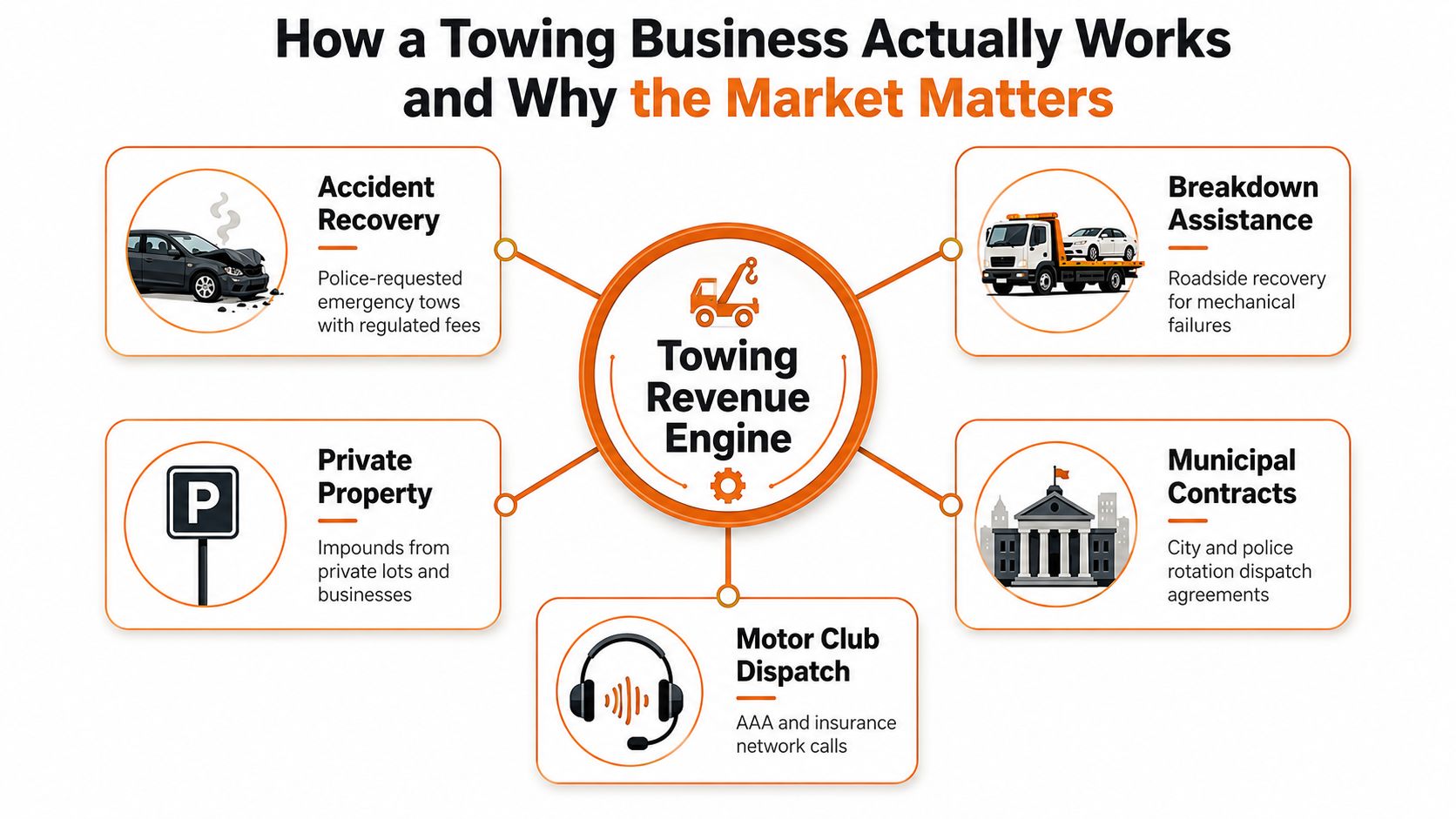
Start by mapping the listing to those categories. A company that handles accident recovery and municipal rotation work may have a different operating rhythm from one focused on private-property impounds. A rural operator may travel farther between calls, while an urban company may benefit from dense routes but face tighter yard, traffic, and compliance constraints.
Think of a spot-towing operation as a taxi fleet. The driver gets a call, completes the trip, and waits for the next customer. Revenue depends on call flow, response time, pricing, and the distance between jobs.
A contracted operation is closer to a shuttle service. A dealership group, fleet operator, municipality, or motor club sends work through an established relationship. The company still has to perform well, but the dispatch channel gives management a more dependable base to plan around.
That distinction affects utilization, which is the portion of available truck and driver capacity producing work. A truck can be mechanically sound and fully insured yet contribute little if it remains parked, lacks qualified coverage, or sits outside the useful service area.
Before discussing price, mark the yard, major highways, police jurisdictions, customer locations, and typical recovery distances. Then ask whether the existing route pattern is efficient or whether trucks spend too much paid time repositioning.
Working rule: Revenue quality begins with the dispatch map. A busy phone line doesn’t automatically mean a profitable route.
Historical industry revenue also provides context for buyers who want to understand whether towing represents a durable service line. Federal Reserve data for Motor Vehicle Towing, All Establishments reports $7,606 million in 2018 and $8,338 million in 2019, as presented in the historical towing revenue series. Those figures describe the broader sector, not the individual listing, so they should support context rather than replace company-level diligence.
A towing company’s value usually has two connected layers. The first is the hard-asset base, including trucks, specialized equipment, tools, and sometimes the yard or leasehold improvements. The second is the earnings power created by contracts, dispatch volume, pricing, route density, and management systems.
A quick screen may estimate serviceable tow trucks at roughly $20,000 to $40,000 each, depending on age, condition, and equipment type. Revenue multiples around 0.3x to 0.5x can also serve as an initial check, but those are not final valuation conclusions. The ranges come from industry rules of thumb for towing companies, and a buyer still needs verified financial statements, normalized owner compensation, working-capital analysis, and equipment inspection.
Suppose two businesses each advertise several trucks. One fleet has documented maintenance, suitable lift equipment, dependable drivers, and enough recurring work to keep vehicles dispatched. The other has older equipment, irregular records, an owner who handles most calls personally, and trucks that sit unused during slow periods.
The first company may justify stronger earnings-based pricing because its cash flow is more transferable. The second may be worth closer to its equipment value, particularly if the buyer must fund replacements, recruit drivers, rebuild dispatch relationships, or renegotiate the yard.
Utilization is the bridge between those two layers. A truck that generates regular work can support labor, insurance, maintenance, and debt service. An idle truck still consumes capital and may deteriorate while producing nothing.
| Utilization Signal | Low Utilization Fleet | High Utilization Fleet |
|---|---|---|
| Dispatch pattern | Irregular calls and long idle periods | Repeated calls supported by established dispatch sources |
| Asset economics | Capital tied up in underused trucks | Fleet investment connected to productive routes |
| Staffing | Coverage may depend heavily on the owner | Drivers and dispatchers can cover normal operations |
| Buyer concern | Immediate need to prove demand or reduce fleet | Need to verify maintenance discipline and capacity limits |
| Valuation signal | Greater emphasis on hard assets and risk adjustments | Greater support for normalized earnings |
A buyer shouldn’t assume that adding trucks will solve a utilization problem. More equipment can increase insurance, maintenance, storage, and financing obligations before dispatch volume improves. The better question is whether existing demand can support the current fleet and whether a modest operational change could put idle capacity to work.
Review the profit and loss statement with adjustments for owner-specific items. Separate personal expenses, unusual repairs, nonrecurring legal costs, owner labor that a replacement manager would need to perform, and any expenses that disappear or increase after closing.
Then compare the adjusted earnings with the physical evidence. Dispatch records, fuel purchases, repair invoices, driver payroll, storage revenue, and bank deposits should tell a consistent story. When the truck count looks impressive but dispatch activity and cash flow don’t align, treat that mismatch as a diligence issue rather than a negotiation detail.
Predictable dispatch relationships can matter more than headline revenue. Commercial accounts, municipal rotations, dealerships, fleet operators, and motor clubs may send repeat work, while one-off calls depend more heavily on daily demand and the company’s ability to win each job.
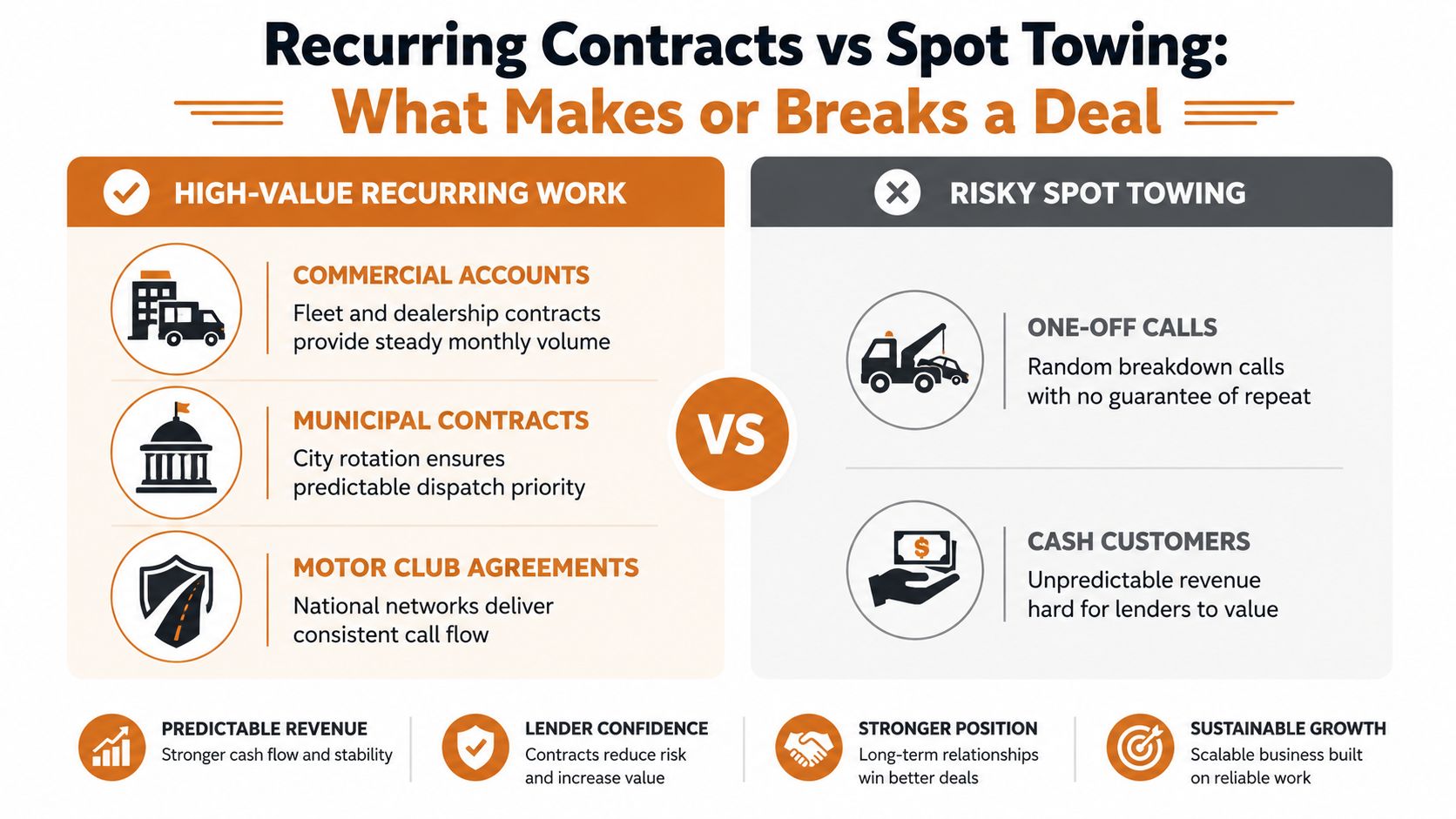
Current industry guidance places towing-company valuations at approximately 2.5x to 4.5x SDE, with the range influenced by contract diversification, fleet condition, owner dependency, and whether agreements with motor clubs such as AAA, Agero, or Allstate can transfer. The discussion appears in this towing-industry M&A overview. Treat the range as a screening reference, not a price quotation for a specific company.
Ask for a revenue schedule by customer and dispatch source. Identify the largest sources, then examine what happens if one changes its provider, reduces volume, or refuses assignment to the buyer.
A practical review should cover:
A contract that can’t transfer may have little immediate value to a buyer, even if it appears prominently in the seller’s revenue summary. A relationship that renews informally can still be useful, but it deserves a more conservative assumption than a written agreement with clear assignment language.
| Contract Position | What It Suggests | Buyer Response |
|---|---|---|
| Diversified accounts with clear assignment terms | Revenue is more transferable | Confirm consent process and service obligations |
| Strong account, renewal depends on seller approval | Relationship has value but execution risk remains | Make closing or transition support a condition |
| Several accounts, one dominates revenue | Concentration can weaken financing and price | Stress-test the loss or reduction of that source |
| Mostly spot calls with no repeat agreements | Earnings may be less predictable | Value conservatively and verify call history |
| Contract requires specialized capability | Revenue may depend on equipment or training | Price the required investment into the offer |
Don’t confuse repeat invoices with durable contracts. A customer can send recurring work without providing a binding commitment. Buyers should value the documented, transferable operating relationship, not merely the pattern of past deposits.
A buyer’s inspection should begin before the test drive. Request a complete asset list, vehicle identification numbers, titles, liens, maintenance records, inspection records, equipment details, and repair history. Then compare the paperwork with the trucks on the lot.
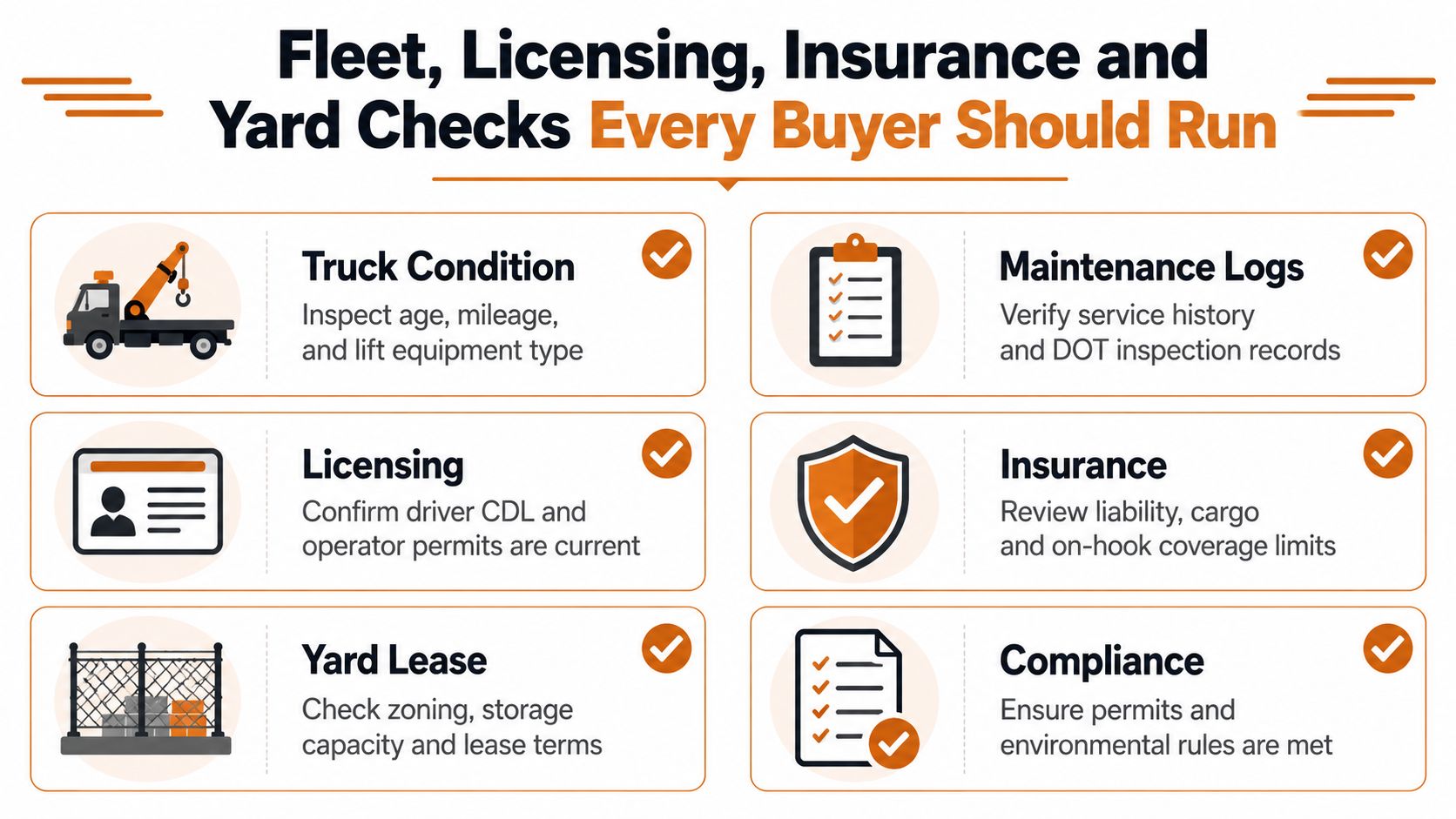
Look closely at frame condition, hydraulics, winches, wheel lifts, flatbeds, warning systems, tires, lights, and storage compartments. A truck may start easily yet need expensive work before it can safely perform the jobs represented in the sales materials.
Ask for service records rather than accepting verbal assurances. Match major repairs to invoices and mileage. If the company claims that a truck is ready for heavy recovery, confirm that its equipment configuration supports that work.
Review driver credentials, permits, licenses, inspection records, parking approvals, and environmental requirements. Confirm that the company can continue operating from the same yard after closing. A lease with limited assignment rights, a zoning restriction, or insufficient secure storage can disrupt the business even when the trucks are sound.
The yard deserves a physical walk-through. Check access for large vehicles, lighting, fencing, drainage, customer pickup procedures, evidence handling, and the practical capacity for stored vehicles. Also compare the stated storage revenue with signed arrangements and actual occupancy.
Insurance limits vary by jurisdiction and can materially affect pricing, premiums, and lender confidence. For example, Texas requires at least $300,000 of liability coverage per tow truck for private-property towing and $500,000 for incident-management towing, plus $50,000 of cargo or on-hook coverage, while Ontario requires at least CAD 2,000,000 in liability coverage, CAD 100,000 for vehicle damage in care, custody, or control, and CAD 50,000 in cargo liability, according to the jurisdictional insurance requirements referenced in the available legal material.
Those examples aren’t a substitute for local advice. They show why truck count alone is an inadequate underwriting measure. Request certificates, full policies, endorsements, deductibles, loss runs, open-claim details, and confirmation that coverage can be placed under the buyer’s ownership.
This short video can help frame the operational questions you’ll ask during a site review.
Inspection standard: If a document affects the company’s legal ability to tow, store, insure, or dispatch vehicles, verify it independently before treating it as part of the deal value.
A towing company often carries more know-how in its people than in its equipment. The owner may know which police contacts to call, how to handle difficult recoveries, which customers pay slowly, and how to schedule drivers when several emergencies arrive together. If that knowledge leaves at closing, reported earnings can fall even when every truck remains parked in the same yard.
The staffing review should identify who dispatches, who handles after-hours calls, who manages claims, who maintains licenses, and who understands the specialized equipment. Ask employees how work is assigned, how incidents are documented, and which tasks only the owner can perform. A buyer needs a transition plan, not merely a list of payroll costs.
Heavier vehicles and electric vehicles can change the equipment and training profile. Recent industry coverage points to demand for EV towing specialization, updated flatbed equipment, high-voltage safety training, telematics, and mobile dispatch tools, while also identifying fuel, liability insurance, and maintenance as margin pressures. Industry discussion of automobile towing operations and emerging requirements provides useful context, but the buyer should convert that context into a company-specific capital plan.
Ask which vehicles the company already handles and which calls it declines. Check whether drivers have suitable training, whether the fleet includes equipment for the service mix, and whether dispatch software records vehicle type and recovery requirements. An operation that depends on older trucks or owner know-how may need investment soon after closing.
Review several operating periods, not just the strongest recent month. Compare call volume, average ticket, labor, fuel, repairs, insurance, storage revenue, and owner-related expenses. Then create a forward-looking schedule for known needs, including truck replacements, equipment upgrades, training, software, yard work, and insurance changes.
The historic sector figures provide a useful backdrop, with Federal Reserve data showing revenue for Motor Vehicle Towing, All Establishments at $7,606 million in 2018 and $8,338 million in 2019 in the previously cited series. That broad continuity doesn’t guarantee the earnings of a particular seller. It reinforces why buyers should distinguish durable demand from the expenses required to serve changing vehicle and dispatch conditions.
A seller can reduce uncertainty by preparing clean loss runs, maintenance files, contract records, employee information, and a written transition plan. A buyer can protect the post-close result by making these materials part of the underwriting process rather than waiting for problems to appear after signing.
Move in an order that exposes deal-breaking risks early. Start with the revenue schedule and dispatch-source breakdown. Confirm which agreements repeat, which can transfer, and which depend on the seller personally. Then reconcile those figures to bank deposits, invoices, payroll, fuel, and dispatch records.
Next, inspect the fleet and yard with a qualified mechanic or equipment specialist. Verify titles, liens, maintenance, permits, licensing, storage rights, and local insurance requirements. Have an insurance professional review coverage and loss history before you rely on the seller’s current premium as a future operating assumption.
After that, build a normalized earnings model. Include replacement labor for the owner, realistic repairs, insurance adjustments, training, software, and equipment upgrades. A valuation adviser can help separate asset value from transferable earnings, while a tax professional and attorney can address structure, liabilities, allocation, contracts, leases, and succession terms.
Sellers should prepare the same evidence before listing. Organize contracts, assignment provisions, customer concentration, fleet records, loss runs, employee roles, permits, and owner-specific expenses. Clear documentation won’t eliminate negotiation, but it can help a serious buyer and lender understand what they’re acquiring.
The Owner’s Shortlist is a free service that helps owners find a business broker or other specialist. You talk to a real person, who introduces you to one specialist whose past work fits your business. Read the guides to get the questions straight first. When you’re ready to talk to someone, tell us about your business. Owners pay nothing.
If you’re evaluating a towing business for sale, visit The Owner’s Shortlist to review practical guidance and browse vetted specialists for valuation, legal, tax, financing, and succession decisions. Use the directory to prepare your questions, organize your records, and choose the right professional before you commit to the deal.
Tell us your situation. We'll connect you with a specialist who works with owners like you. One conversation, no sales pressure.
Found this useful?
Add The Owner's Shortlist as a preferred source and get our articles highlighted in Google Search results.
Add to Preferred SourcesExplore 5 confidential information memorandum examples for owner-operated businesses, with required sections, practical guidance, and common pitfalls.
October 22, 2026
Partners who disagree on selling usually settle it one of four ways: a buyout, a partial sale, a sale together, or what the agreement forces.
October 20, 2026
What is deal structuring, explained for service business owners. Learn asset vs stock sales, earnouts, seller financing, holdbacks, and the questions
October 19, 2026
Learn how to identify well qualified buyers for your service business. Covers vetting criteria, red flags, sample questions, and next steps
October 17, 2026