What happens when business partners don't agree on selling?
Partners who disagree on selling usually settle it one of four ways: a buyout, a partial sale, a sale together, or what the agreement forces.
October 20, 2026
By Remi Taffin · October 22, 2026
You’re sitting with a glossy confidential information memorandum example that looks complete. It has photos, a growth story, and a confident earnings number on page one. It doesn’t show you whether that number ties to a tax return, who runs the crews, or what happens if you step away for a month.
That’s the gap a serious buyer sees immediately. A strong CIM doesn’t just market the company. It reconciles financial claims, exposes owner dependence, organizes evidence, and gives a buyer a credible basis for pricing before anyone signs anything binding. Buyers who skip that discipline end up learning the hard lessons covered in HireAccountants on avoiding bad acquisitions.
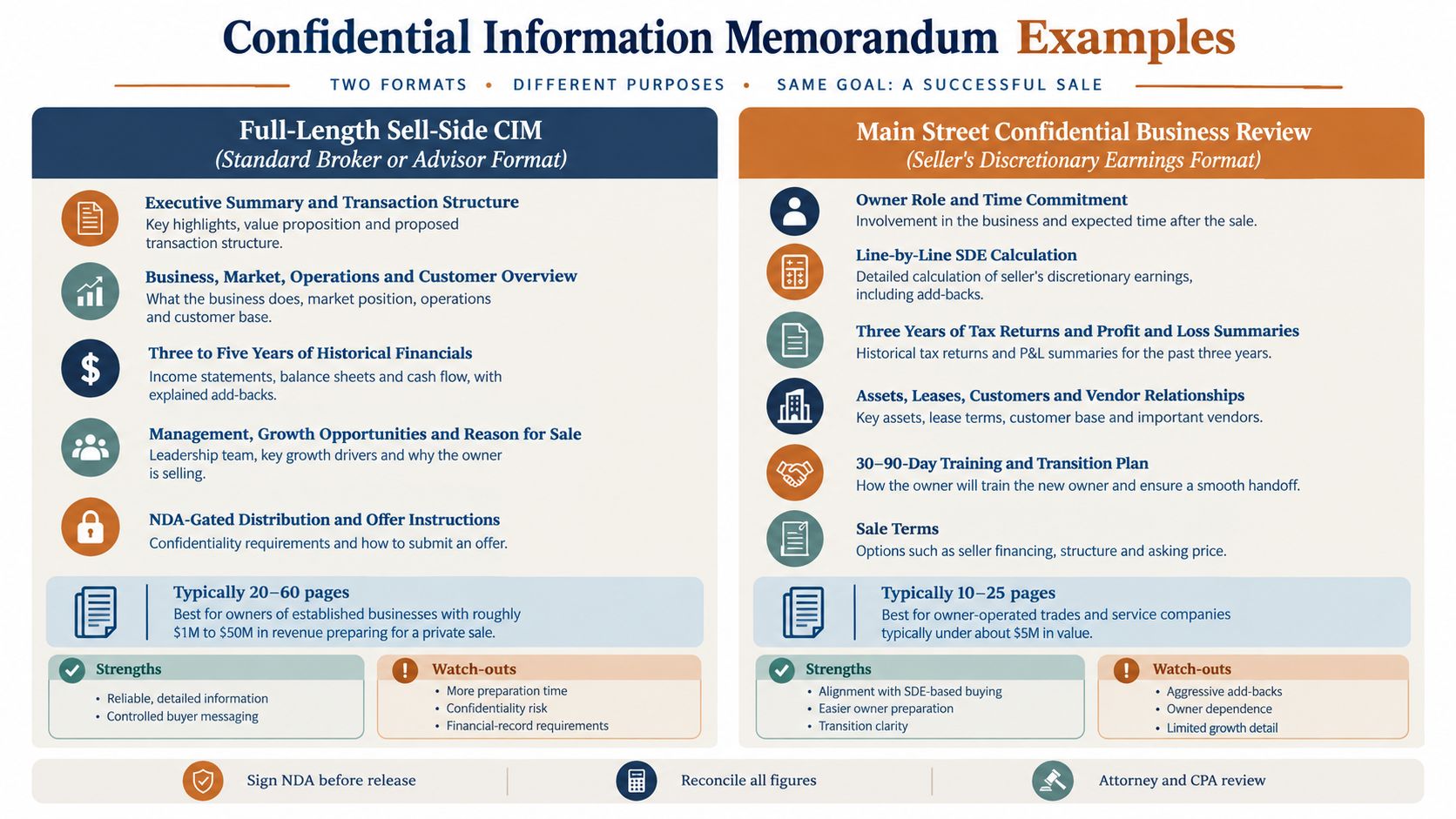
The five models below aren’t templates to copy word for word. They’re practical starting points to adapt. You’ll see a full-length sell-side CIM, a Main Street business review built around seller’s discretionary earnings, a teaser plus CIM sequence, a recurring-revenue service business CIM, and a succession memorandum for family or employee transfers. Each one answers a different transaction question.
This is the classic format most owners picture. A broker or advisor prepares it with your input, and it goes only to qualified buyers after they sign a nondisclosure agreement. One published professional description places the usual length at approximately 50 to 150 pages, which tells you how much more detailed it is than a short teaser.
A complete version covers company history, products and services, markets, competitive position, management, historical performance, normalized earnings, projections, assets, and liabilities. To see how this differs from real estate materials, it is worth understanding what is an OM and why a business CIM carries far more financial reconciliation.
Take a long-established residential HVAC company packaged for private sale. The CIM emphasizes its maintenance agreement base, service fleet, and technician structure, but buyers don’t stop at the narrative. They check whether revenue, gross margin, and adjusted EBITDA in the executive summary match the financial section exactly.
A commercial cleaning example works the same way. Recurring contract revenue and route structure sound attractive, but they only support value if renewal history, labor costs, and supervision transfer to a new owner. That’s why your preparation should follow a disciplined financial due diligence checklist for sellers before the document leaves your office.
Practical rule: If a claim can’t be traced to a source document, it doesn’t belong as a headline in the CIM.
This format suits a conventional private sale where several buyers need the same information at the same time. Its weakness is cost and effort, and a long document built on weak records only creates more questions.
Smaller owner-operated companies rarely need a bank-style CIM. Brokers often use a shorter Confidential Business Review, sometimes called a CBR, built around seller’s discretionary earnings, or SDE. That’s pre-tax profit with owner compensation and certain personal or one-time expenses added back.
The focus shifts from corporate structure to transferability. What does the owner do each week, what will the buyer need to replace, and does the cash flow survive that replacement? If you run estimates, dispatch, and key accounts yourself, a buyer is pricing that risk whether you disclose it or not.

Consider a plumbing company where the owner handles most estimates and commercial relationships. A credible review shows the SDE bridge first, then documents those accounts generically and lays out a specific transition plan with tasks and dates. The buyer can see how relationships move, not just hear that they will.
A pool service example takes a different angle. The document centers on route structure, supply arrangements, and seasonal revenue patterns so a buyer can judge monthly cash flow, not just an annual total. Seasonality hidden in an annual number will surface in diligence anyway, so showing it early protects your credibility.
This format is faster and more practical for Main Street deals, but it’s also easier to abuse. Unsupported personal add-backs are the fastest way to lose a buyer and a lender at the same time. Keep the document short, but keep the evidence behind every adjustment ready to show.
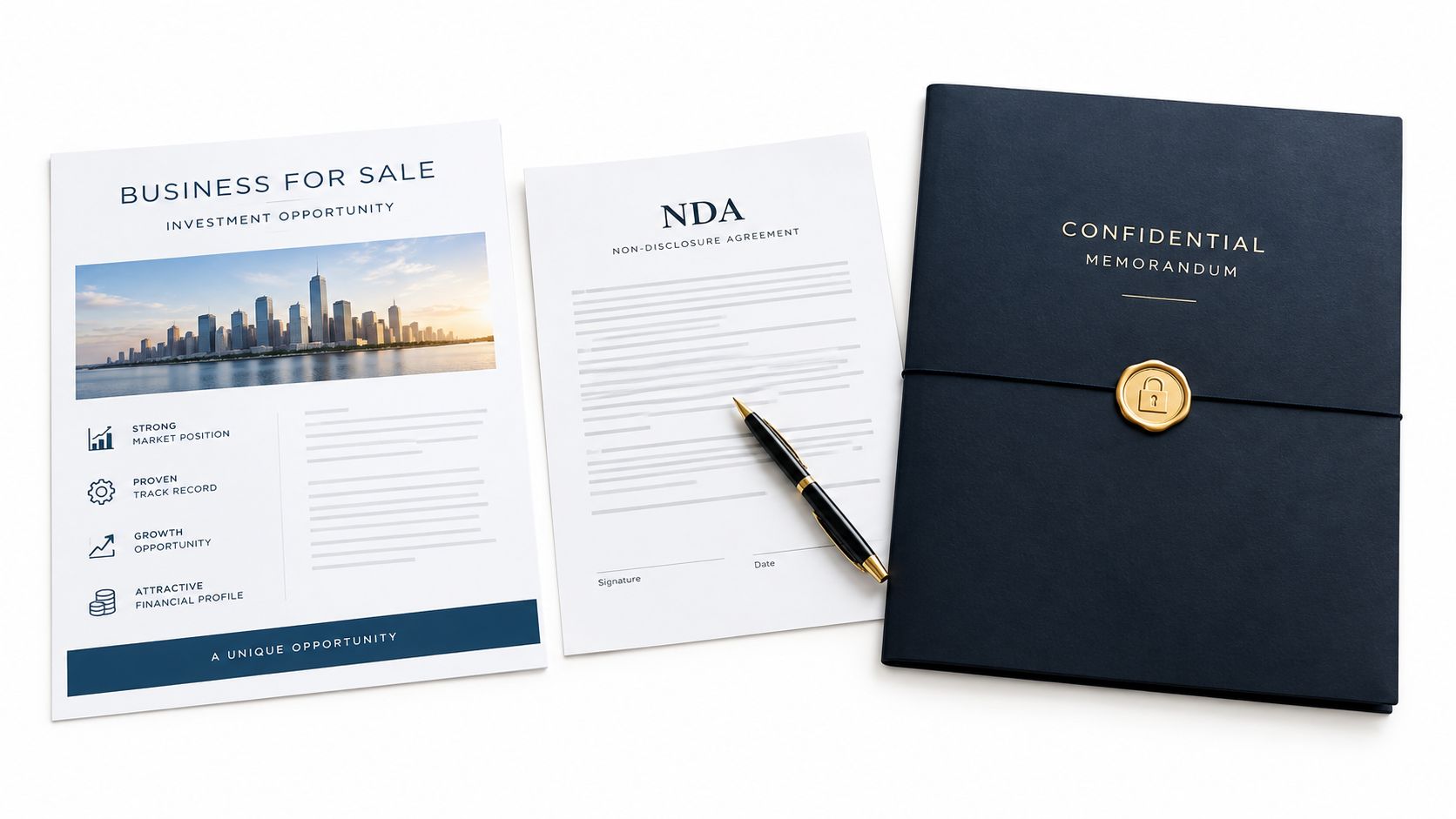
Sometimes the smartest confidential information memorandum example isn’t a document at all. It’s a sequence. You start with an anonymous teaser, screen responses, and release the named CIM only after an NDA is signed and the buyer is qualified.
That staged approach matters when employees, customers, or competitors can’t learn you’re exploring a sale. A common sequence uses a secure virtual data room with access control, activity logs, and watermarking after buyer screening and NDA execution. Those controls let you revoke access when a bidder exits and see who viewed what.
A Florida landscaping company can test interest with a profile that describes service mix and scale without naming the business. Regional operators and platform buyers can respond, and only screened parties move forward. A commercial electrical contractor can do the same through a broker’s buyer list, releasing the CIM only to strategic buyers who pass financial qualification.
The teaser has to be specific enough to attract real buyers and vague enough that competitors can’t identify you. In a small market, a recognizable municipal contract or unique territory can give you away. Review your protection carefully against a proper business sale confidentiality agreement before anything circulates.
A signed NDA doesn’t solve confidentiality by itself. What you withhold, and when you release it, does most of the work.
This approach protects negotiating position and privacy, but it moves slower and depends on disciplined screening. If you release the CIM too widely at stage two, you’ve lost the benefit you created at stage one.
For HVAC, pest control, pool service, and commercial cleaning companies, value often lives in recurring revenue. This CIM variant puts agreement counts, renewal behavior, pricing, and technician productivity at the center instead of burying them in a general operations section.
Buyers pay attention to predictable revenue, but they’ll verify it. A foundational CIM structure calls for three to five years of historical profit-and-loss statements and two to three years of projections with stated assumptions. In a trades business, those projections need to connect to agreements, backlog, and crew capacity, not just a sales target.

An HVAC example should present its maintenance agreement base with a documented renewal rate and revenue per technician over several years. A pest control example should break out recurring service plans from one-time treatments so the recurring share is unmistakable. If you need the underlying concept clarified first, review what recurring revenue means for valuation before you draft a single exhibit.
Export the data from your field service software, such as ServiceTitan or Housecall Pro, before writing the narrative. Software exports beat summaries built from memory, and buyers will ask for them in diligence.
Owner test: If your best technician left, could a buyer still deliver the agreements you’re selling? Your CIM should answer that honestly.
This format can support a stronger price when the data holds up. When it doesn’t, it exposes churn and staffing risk faster than a generic CIM would, which is painful but useful before you go to market.
An internal transfer needs a different document. When a child, spouse, or key employee is the buyer, you’re not marketing to strangers. You’re documenting value, payment terms, and transition so family members, lenders, and advisors can evaluate whether the structure works.
That distinction changes what belongs in the memorandum. A technically complete sell-side document normally separates historical facts from management projections and reconciles each adjustment to source records. In a succession version, that same discipline protects relationships, because disputed numbers inside a family do more damage than disputed numbers with a stranger.
A commercial roofing company passing to the owner’s son might use an installment structure supported by a written valuation summary, training plan, and timeline for the owner’s exit. A plumbing company selling to a long-time service manager with seller financing needs the payment schedule, customer transition, and decision authority spelled out before money changes hands.
Don’t assume familiarity replaces documentation. The successor may know operations but not cash flow after debt payments, tax obligations, or working capital needs. A lender will ask those questions even if your family doesn’t.
Confidentiality still matters, but differently. Even after an NDA, the Business Development Bank of Canada recommends generic labels such as Client #1 and Employee #2 in early materials. Inside a succession, staged disclosure protects employees who aren’t part of the transaction yet. The trade-off is emotional as much as financial, and a clear memorandum lowers both risks.
| Memorandum Format | Core Focus & Typical Length | Key Value ★ | Watch-outs | Best For 👥 |
|---|---|---|---|---|
| Full-Length Sell-Side CIM | Broad business, market, operations, and financial overview; typically 20–60 pages | 🏆 Gives qualified buyers a detailed, consistent basis for offers | Time-intensive; needs organized financials and careful NDA controls | Established businesses preparing for a private broker-led sale |
| Main Street Confidential Business Review | Owner role, SDE, assets, and transition; typically 10–25 pages | ✨ Buyer-friendly view of owner-operated businesses and what transfers | Add-backs need strong support; owner dependence can weigh on value | Trades and service companies where the owner is central |
| Two-Stage Teaser Plus CIM | Anonymous teaser first, full CIM after NDA and buyer qualification | ✨ Tests interest while limiting early disclosure | A teaser may still identify a business in a small market | Owners seeking a quiet sale process and qualified buyer interest |
| Recurring-Revenue Service Business CIM | Agreements, renewals, churn, technician productivity, and service metrics | 🏆 Makes predictable revenue and operating strengths visible | Requires reliable data; buyers scrutinize retention and key-person risk | HVAC, plumbing, pest control, pool, and other contract-based services |
| Succession or Family/Employee Transfer Memorandum | Valuation, payment terms, transition, and transfer planning | ✨ Clarifies expectations and can reduce misunderstandings | Financing, tax, and family considerations require professional review | Owners transferring the business to family or key employees |
The best confidential information memorandum example isn’t necessarily the longest one. It’s the one matched to your buyer, your size, and your need for privacy. Choosing the wrong format wastes months and can expose information you can’t take back.
Use a full sell-side CIM for a conventional private sale to outside buyers who need complete, comparable information. Use an SDE-focused business review when you’re a smaller owner-operator and the buyer is really buying your job plus cash flow. Use a teaser plus CIM sequence when confidentiality and buyer testing matter most, especially in a tight local market where details identify you quickly.
Choose the recurring-revenue version when maintenance agreements, service plans, or contracts drive value and you can prove renewal and technician stability. Choose a succession memorandum when the buyer is already known and the key questions are valuation, financing, tax structure, and who decides what after closing.
If you’re organizing your next steps and want a structured way to submit your intake details, do that preparation first so the conversation starts with evidence, not estimates. Owners who want help matching with a broker who has relevant industry and transaction experience can use The Owner’s Shortlist, which offers free, plain-language matching in Florida without charging owners or advertising their businesses. A person reviews your business and introduces you to one specialist whose past work fits it.
Start by deciding what a buyer must prove to you before seeing more, and what you must prove to a buyer before asking for a price. That discipline, more than design or page count, determines whether your CIM helps a sale or harms it.
If you’re weighing which CIM format fits your sale, succession, or quiet market test, The Owner’s Shortlist can match you with one Florida broker whose past deals fit your trade and size, at no cost to you and without advertising your business. Visit The Owner’s Shortlist to talk with a real person before you share any confidential information.
Tell us your situation. We'll connect you with a specialist who works with owners like you. One conversation, no sales pressure.
Found this useful?
Add The Owner's Shortlist as a preferred source and get our articles highlighted in Google Search results.
Add to Preferred SourcesPartners who disagree on selling usually settle it one of four ways: a buyout, a partial sale, a sale together, or what the agreement forces.
October 20, 2026
What is deal structuring, explained for service business owners. Learn asset vs stock sales, earnouts, seller financing, holdbacks, and the questions
October 19, 2026
Learn how to identify well qualified buyers for your service business. Covers vetting criteria, red flags, sample questions, and next steps
October 17, 2026
A financial due diligence checklist for buyers and sellers of owner-operated trades businesses, covering earnings, debt, taxes, payroll, and equipment.
October 13, 2026