Reps & Warranties in M&A: A Practical Guide for Owners
Learn what reps & warranties mean in M&A deals, why they matter, and how to negotiate them effectively. A clear guide for business owners.
September 27, 2026
By Remi Taffin · August 3, 2026

You’re at the kitchen table or in the office after hours, and the buyer has finally asked for the numbers. Not the glossy summary, the detailed files, customer lists, margin detail, maybe even a walk-through of how the team runs the place. That’s the point where a business sale confidentiality agreement stops being paperwork and starts being a control point. If you share before the agreement is signed, you’ve already given away an advantage you may never get back.
The call usually starts with something casual. A buyer says they love the business, they’d like to understand the books, and they want a better look at the customer concentration. That sounds encouraging, but it’s also the moment to stop and ask for a signed business sale confidentiality agreement before anything else leaves your control.
In M&A practice, that timing isn’t optional. The 2025 American Bar Association Private Target Mergers and Acquisitions Deal Points Study found that 100% of sampled deals were preceded by a confidentiality agreement, and 67% used a mutual structure once both sides were exchanging non-public information, with a median term of 2 to 3 years and 24 months the most common single duration (ABA Deal Points Study summary). That lines up with what owners need in the world, a signed agreement first, then disclosure.
A seller should usually raise the NDA before the buyer sees financial statements, customer names, employee data, vendor contracts, deal pricing, or even the fact that the company is in play. The document is a process-control tool, not a decorative formality. It gives you a legal basis to slow disclosure, define the purpose of the review, and reduce the odds that the buyer uses your own information to shop the deal, pressure employees, or signal the market.
Practical rule: if the buyer is asking for anything that would hurt you if it leaked, the NDA should already be signed.
Who drafts it? Usually the seller’s advisor or attorney does, especially if the process is quiet and the seller still has a strong position. In some competitive processes, the buyer sends a form first, but that doesn’t mean you accept it as-is. You read it like a seller, not like a hopeful operator trying to keep the conversation alive.
| Structure | Who Discloses | Best Fit For | Leverage Implication |
|---|---|---|---|
| Unilateral | Only one side mainly discloses | Early seller-led outreach, teaser review, quiet market testing | Stronger for the seller when the buyer hasn’t disclosed anything meaningful yet |
| Mutual | Both sides may disclose sensitive information | Strategic buyers, financing discussions, reciprocal diligence, integration talks | Better when the buyer will also share financing, structure, or operating details |
A seller-friendly NDA does more than ask for silence. It sets the rules for why the buyer gets the information, who can see it, how far it can travel inside the buyer’s organization, and what happens if the process breaks down. That matters because the data room is where the pressure points sit, customer lists, pricing, financial statements, employee records, trade secrets, and the seller’s future bargaining position.
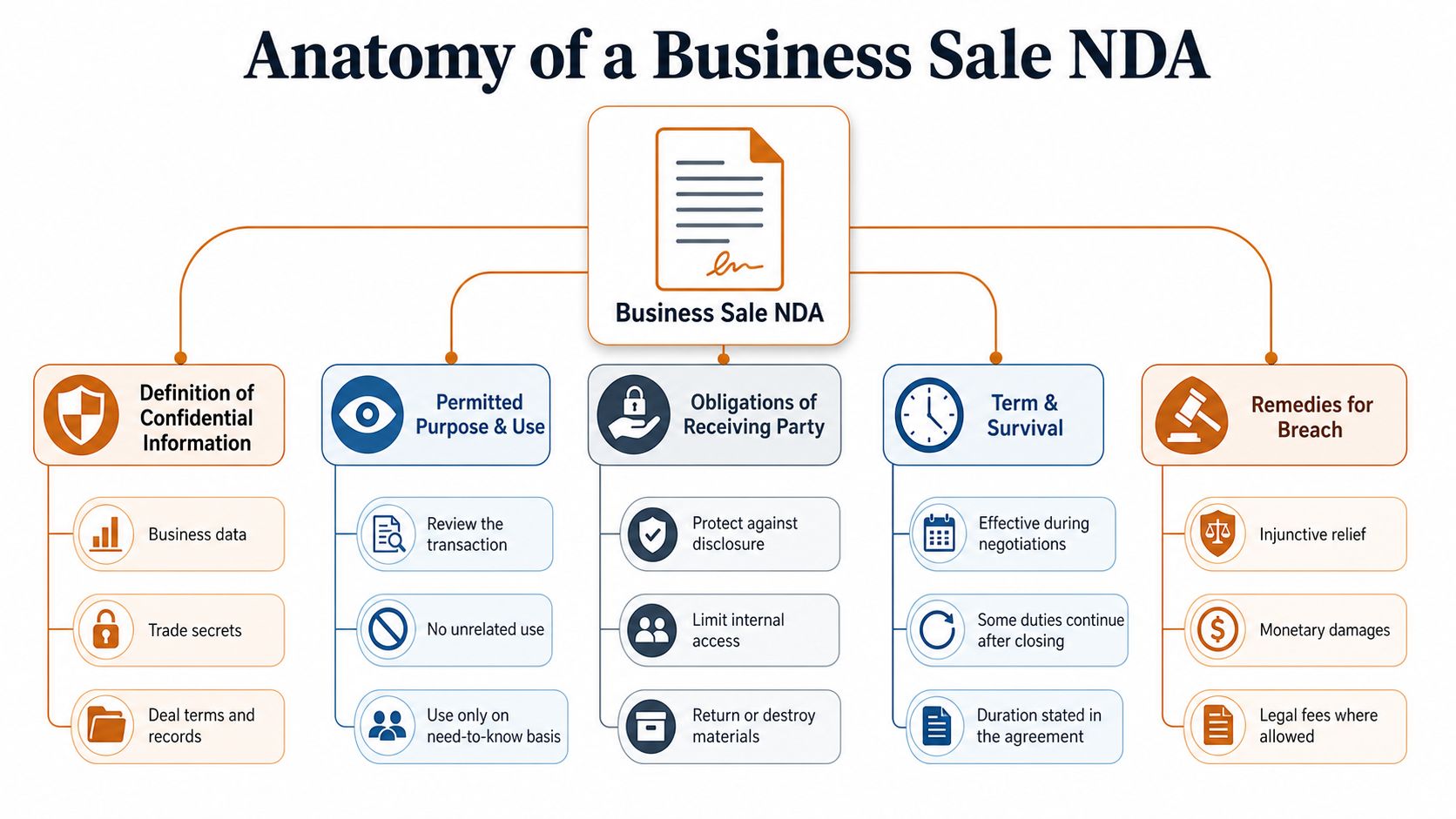
The strongest drafting starts with a narrow permitted purpose, usually evaluating the transaction and nothing else. That gives the buyer access to assess whether to proceed, but not to recruit your employees, call your customers, or use your pricing to sharpen a competitor’s playbook. The cleanest NDA also limits disclosure to a strict need-to-know group and requires reasonable safeguards, which is the point of the seller-side approach described by Morgan & Westfield on confidentiality agreements.
The logic is simple. Wider access creates more ways for information to leak. Tight purpose limits, downstream confidentiality duties, and return or destruction obligations keep the buyer inside the lane and reduce the chance that your own material gets used against you.
Many sale NDAs keep information confidential for a fixed period, while trade-secret obligations are often written to last indefinitely or until the information no longer qualifies as a trade secret. That distinction matters. Ordinary deal information should expire on a clock. Trade secrets should not. The same point shows up in practical summaries of transaction practice and deal-protection drafting, including CT Acquisitions summary of ABA study and the seller-oriented treatment in Morgan & Westfield on confidentiality agreements.
A serious agreement also gives the seller remedies that work in practice, especially injunctive relief. Once sensitive information leaks, money after the fact rarely fixes the problem. That is why professional transaction documents also stress no-contact restrictions, no-copy rules, permitted-law disclosures, and independent verification by the buyer, as reflected in SEC exhibit example.
For a seller, the point is straightforward. The NDA should protect the process, not just create a paper trail. Use it to control disclosure before the buyer sees the material that can move a sale, and make sure your own advisors treat a change of control process like a controlled release, not an open invitation.
A seller does not need to become a lawyer, but you do need to spot the clauses that look harmless and shift control to the buyer. The same weak drafting choices show up again and again in NDAs, and they usually favor the side with more time, more staff, and more room to fish through your data room.
The definition of Confidential Information should be broad enough to cover financial data, budgets, projections, forecasts, business plans, operating methods, customer and supplier lists, employee data, IP, trade secrets, software, pricing, and the fact that the business is for sale. That last point gets left out more often than it should. It matters because early talk gets around fast, and once employees, vendors, or customers hear that the company is in play, the process gets harder to control.
A seller should also expect standard exclusions for information that is already public, already known to the buyer, or independently developed without using the seller’s materials. Those carve-outs are fair, but they need tight drafting. If they are sloppy, the buyer gets an easy excuse to say, after a leak, that they “already knew it” or got there on their own.
The clauses that matter most are the ones that control movement. A serious NDA should name the authorized recipients, restrict use to a need-to-know group, require security protocols, and force return or destruction if the process stops. It should also keep the buyer from pushing your information into tools or systems that train on uploaded content, because that is a modern way diligence materials get reused without anyone noticing.
The seller should also control the timing and order of disclosure. A buyer-side team that wants full access before the process is framed is usually trying to gather more than it is willing to give. That is exactly why a disciplined change-of-control process matters. It keeps disclosure tied to the deal stage, not the buyer’s appetite.
Here’s the blunt version:
If the buyer can circulate the file freely inside a large team, the NDA is already too loose.
The last weak point is what happens after the buyer walks. If the draft says materials can sit in the buyer’s files forever, push back hard. The seller should want a clear return-or-destroy obligation, a written certification if possible, and survival of confidentiality duties for the agreed term. If the buyer resists that language, they are signaling that process control is not a priority.
The same caution applies to buyer type. A strategic buyer, a financial buyer, and an owner-operator buyer do not come to the table with the same internal controls or the same incentive to keep a quiet sale quiet. Strategic acquirers often have larger teams and more internal sharing. Smaller buyers may have less infrastructure, but they can still mishandle sensitive files if the NDA gives them too much room. Structure the agreement for the weakest link, not the buyer’s sales pitch.
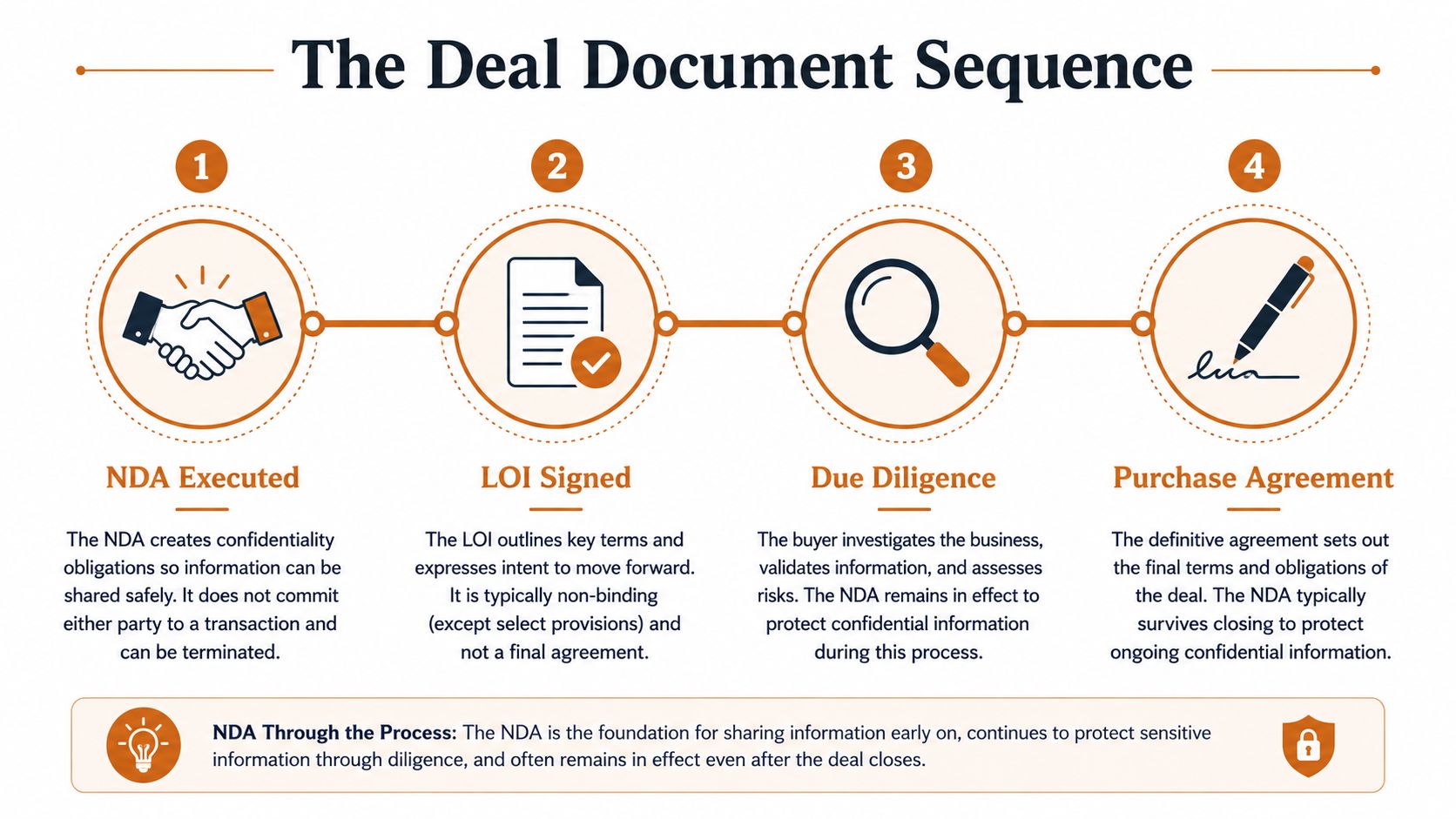
The NDA comes first, the LOI comes later, and the purchase agreement comes after that. Sellers get into trouble when they treat the LOI as a substitute for the confidentiality agreement. It is not. The LOI may repeat some confidentiality language, but the original NDA still controls how the buyer can use seller information during diligence and what happens if the process falls apart.
The NDA opens the door. The LOI signals seriousness, sets price and structure, and often creates exclusivity. The NDA still tells the buyer what they can do with the materials already shared. If the deal stalls or dies, the NDA is the document that gives the seller the right to demand return or destruction of records and to stop further use.
That sequence matters because the seller’s risk does not disappear when the LOI lands. A buyer can still walk away after seeing financials, customer names, and margin detail, and that is when the protection has to hold.
The right order is simple. Sign the NDA before any disclosure. Use the LOI only once both sides are serious. Keep diligence inside the original purpose limitation. If the deal dies, the buyer returns or destroys what it received and stops using it.
Morgan Lewis notes that M&A confidentiality agreements should address whether the parties are more likely to receive or disclose information and whether the NDA is unilateral or mutual, which is exactly why sellers should not assume a standard form covers every stage of a deal (Morgan Lewis confidentiality agreement guidance). The key issue is not just what gets shared, but what survives when the buyer changes course.
A useful filter is simple. Ask whether the document still protects you after the buyer stops negotiating. If the answer is no, the draft is too weak.
For a separate look at how letters of intent fit into the process, see this LOI overview. It keeps the sale sequence in the right order, which is where many owner-sellers lose negotiating power.
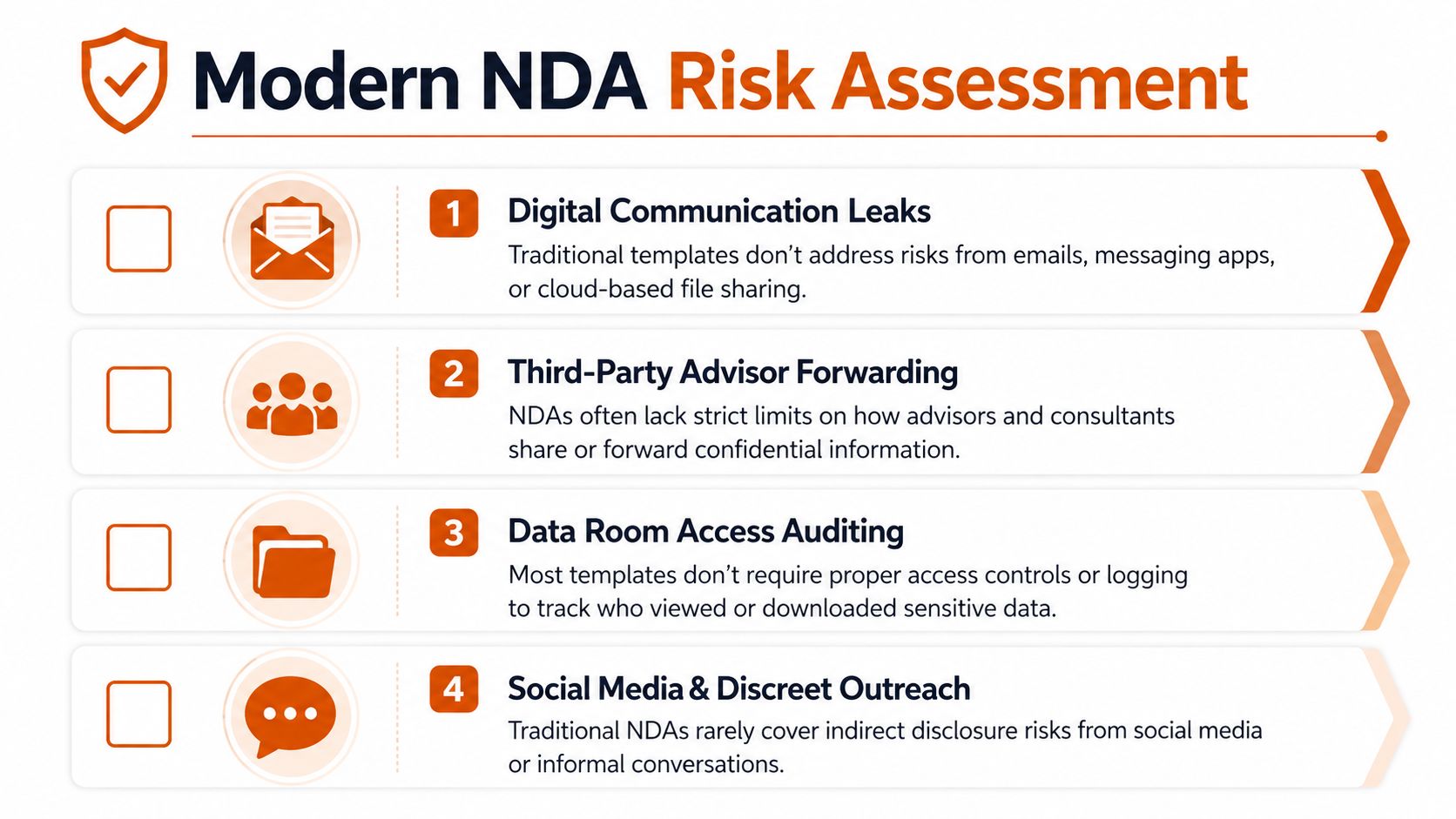
Traditional NDAs were built for a world where documents moved slowly and only a few people touched them. That world is gone. Today the leakage risk often comes from forwarding a PDF to an advisor, keeping a copy in an outsourced work folder, or running seller materials through a generative AI tool that can summarize, extract, or retain data in ways the owner never intended.
The problem isn’t only bad actors. A buyer’s banker forwards a deck to another team member. A consultant downloads a data-room file and keeps it after the process pauses. A junior analyst watermarks a document and still lets it circulate. None of that looks dramatic in the moment, but each step expands exposure.
IBM’s 2024 Cost of a Data Breach Report put the global average breach cost at USD 4.88 million, the highest in the report’s history (IBM 2024 Cost of a Data Breach Report). That number is broader than M&A, of course, but it shows why tighter access controls are no longer optional thinking. Sellers should treat sale confidentiality like a data-protection issue, not just a legal form issue.
A seller should press for named advisor lists, data-room audit trails, and a direct prohibition on uploading confidential materials into AI systems unless the seller explicitly allows it. The agreement should also address cross-border transfers, because once documents move across multiple teams and jurisdictions, controlling downstream use gets harder fast.
Use this checklist before the data room opens:
The buyer doesn’t need unlimited access to make a decision. They need enough access to evaluate the deal, and nothing more.
For sellers, old templates fall short. If a draft never mentions AI ingestion, delegated advisors, or audit logging, it’s not current enough for a modern sale process.
Buyers often try to weaken the NDA in the same few places. They push for an overly broad permitted purpose, a short confidentiality term, loose remedies, soft return-or-destroy language, or an indemnity that only runs one way. Each of those shifts risk back onto the seller while pretending to be “market standard.”
A seller doesn’t need clever drafting. You need clear, direct wording that keeps the information inside the transaction. A clean starting point looks like this, in substance, not as final legal drafting: the buyer may use the information only to evaluate the transaction, may share it only with named advisors and employees who need to know, must keep it confidential for the agreed term, and must return or destroy all materials if the process stops.
If the buyer objects to injunctive relief, that’s a red flag. If they want unlimited circulation to advisors, that’s a red flag. If they refuse to destroy records after a failed process, that’s a red flag. Those positions tell you the buyer either doesn’t understand confidentiality discipline or doesn’t care about it.
The seller should negotiate with three principles in mind.
If a buyer is strategic, financial, or owner-operated, the advantage shifts a bit in each case. Strategic buyers often want the most detail because they can use your data to inform broader corporate planning. Financial buyers may ask for more process discipline but still want deep diligence. Owner-operators often have less infrastructure and can be more informal, which is exactly why the NDA needs to be tighter, not looser.
A standard template can work for an early inquiry when no sensitive data has moved yet. It stops being enough once the buyer wants customer concentration, pricing, employee data, regulated records, or anything that could trigger poaching or competitive harm. At that point, a custom agreement reviewed by counsel is the right move.
If you’re wondering whether you need legal help to sell, the short answer is that the moment real diligence starts, the answer gets a lot closer to yes. This attorney guide is a good companion read if you’re deciding how much of the process you can safely handle in-house.
My advice is direct. Use the template for light screening, but don’t trust it for a live deal unless counsel has sharpened the weak spots. A seller trying to save time by skipping legal review usually spends more time later cleaning up a bad clause than they would’ve spent fixing it up front.
This week, do three things. Confirm the buyer signs before any disclosure. Write down every advisor team that will see the data. Decide whether the process involves enough sensitivity that the NDA should be reviewed before the data room opens.
The Owner’s Shortlist helps business owners make smarter sale decisions before they hand over sensitive information or hire the wrong advisor. If you want practical guidance on deal prep, legal sequencing, and the specialist support that keeps a quiet sale quiet, visit The Owner’s Shortlist.
Tell us your situation. We'll connect you with a specialist who works with owners like you. One conversation, no sales pressure.
Found this useful?
Add The Owner's Shortlist as a preferred source and get our articles highlighted in Google Search results.
Add to Preferred SourcesLearn what reps & warranties mean in M&A deals, why they matter, and how to negotiate them effectively. A clear guide for business owners.
September 27, 2026
Your business's sale price and your retirement number are two different figures. Here's how to build the second one before you rely on the first.
September 21, 2026
Ten straight questions to work through before you set a retirement date, with a short answer to each and where to go deeper on your own time.
September 21, 2026
Being financially ready to sell and having a plan for your time are two different things. Here's why the second one catches so many owners by surprise.
September 21, 2026