Confidential Information Memorandum Example: 5 Guides
Explore 5 confidential information memorandum examples for owner-operated businesses, with required sections, practical guidance, and common pitfalls.
October 22, 2026
By Remi Taffin · July 20, 2026

You’re probably closer to this issue than you think.
A buyer calls. The conversation is serious. Maybe it’s a competitor, maybe a private buyer, maybe a larger regional player that wants your customer base, your technicians, your contracts, or your route density. You start thinking about price, taxes, timing, and whether you want to stay on after closing. Then your attorney opens a customer agreement, a bank document, or a lease and says, “We need to look at the change of control language first.”
That’s the moment many owners realize the business they thought they fully controlled is tied together by contracts that can react badly when ownership changes. If you run an HVAC company, plumbing business, field service firm, agency, distributor, or family manufacturing company, this matters more than the headline purchase price. A strong offer can weaken fast if key agreements let other people vote on your deal after you’ve already found a buyer.
A change of control clause is contract language that says, in plain English, “If the people in charge of this business change, I get rights.”
That’s it. Strip away the legal phrasing and that’s the business meaning.
Say you own a commercial cleaning company. You sign a major facility management agreement with a hospital group. Years later, a buyer wants to acquire your company because your contract book is attractive and your supervisors have a solid reputation. You assume the buyer is purchasing the company, so the contracts stay put. Then you find a provision that says the customer can terminate, refuse assignment, or require advance consent if ownership changes.
The buyer hasn’t even done anything wrong. The customer just wants a say in who ends up servicing its buildings.
Practical rule: Your company may be yours, but your contracts often are not fully portable.
That’s why I tell owners not to treat change of control language as legal fine print. It’s a value lever. In a service business, your real asset often isn’t the truck fleet, the office, or the equipment. It’s the set of customer relationships, recurring agreements, bank facilities, licenses, landlord permissions, and employee arrangements that make the cash flow believable to a buyer.
A well-drafted clause protects the other side from waking up in business with someone they didn’t choose. A badly understood clause traps an owner who thought a sale would be simple.
Here’s the practical takeaway. If a buyer is buying your future earnings, and those earnings depend on contracts that can wobble during a sale, then change of control isn’t a side issue. It sits close to the center of your deal.
Some owners think change of control only means a full sale. That’s too narrow, and it’s where surprises happen.
This visual shows the events that commonly set these clauses off.
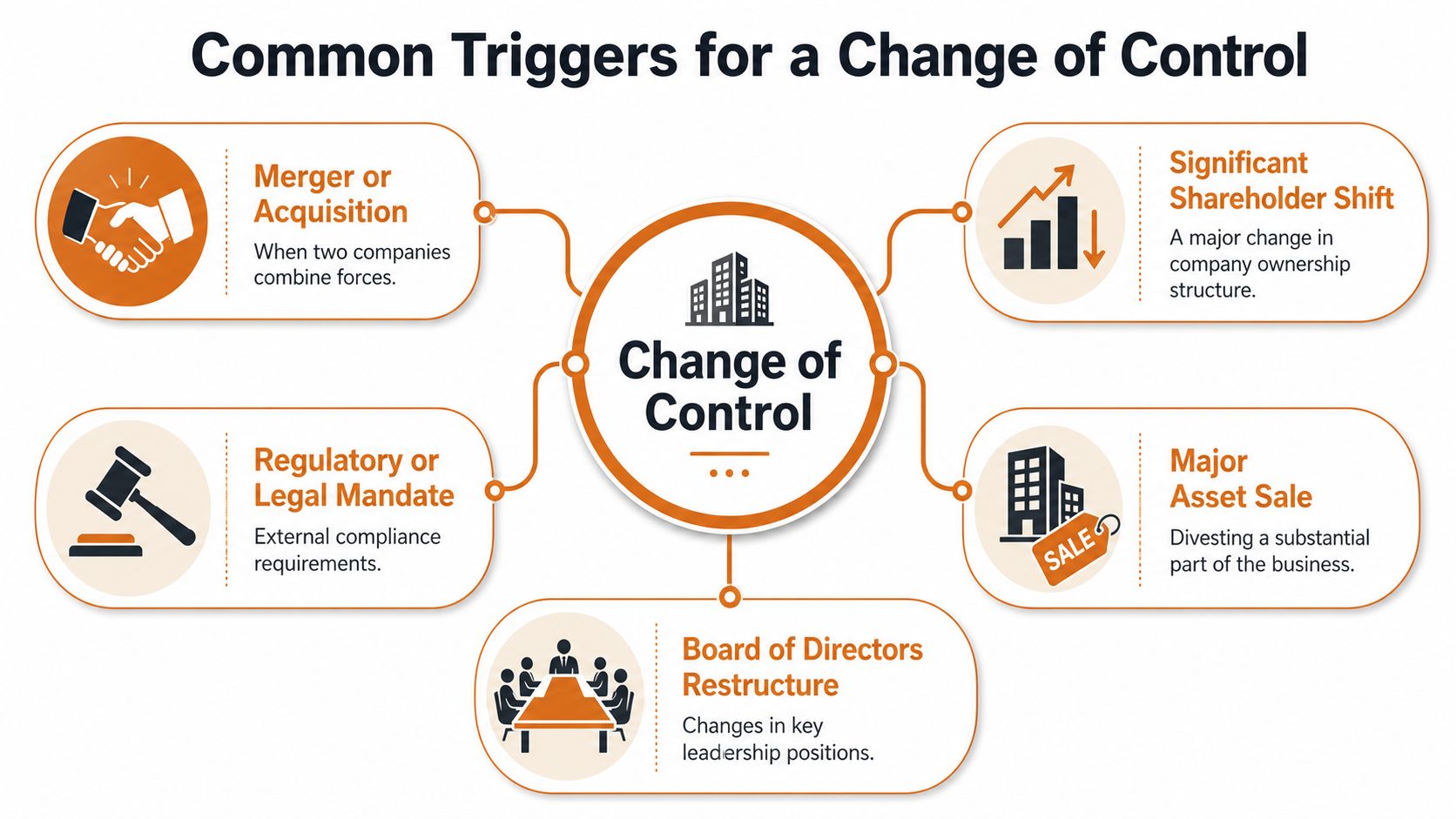
The cleanest example is a sale of the company. If you sell a controlling ownership stake, most contracts will treat that as a change of control. If a buyer ends up with the power to direct the business, the clause is usually live.
That can happen through a stock sale, membership interest sale, merger, or consolidation. Different legal forms. Same commercial result. The driver of the car changed.
Owners also miss the difference between selling equity and selling assets. You might think an asset sale avoids the issue because the legal entity remains with you. Sometimes that helps. Sometimes it doesn’t. Many agreements define change of control broadly enough to catch a sale of substantially all business assets because, from the other party’s perspective, the business they relied on has still changed hands.
A lot of trouble comes from events that don’t feel like a sale.
The section deserves a short reality check:
If one person signs the checks, manages the customer relationships, and controls the board today, and someone else can do that after the transaction, assume the contract may care.
Later in a deal, buyers often use these triggers as a diligence focus. They’ll ask for every agreement that could require notice, consent, or a waiver. That’s one reason this topic shows up early in transaction videos and owner education materials.
Here’s a useful overview to pair with your contract review:
Once a change of control happens, the question is what the other side can do about it. That’s where the teeth are.

Some clauses give the other party a consent right. You can still do the deal, but you need their permission first. In practice, that means timing risk and bargaining power risk. A customer, landlord, or lender can ask questions, delay, or push for revised terms because they know you need an answer.
Others create a termination right. That’s harsher. The contract can end if control changes, or the other side can choose to walk away. In a small business with concentrated revenue, one termination right in one important contract can shake buyer confidence fast.
Another common protection is an anti-assignment restriction. This language blocks you from transferring the contract without approval. Owners often assume selling the company is different from assigning a contract. Sometimes that’s true. Sometimes the agreement says a merger, equity sale, or direct transfer all count the same.
Then there are acceleration provisions. These show up often in debt documents, earnout arrangements, deferred compensation, and some executive agreements. Once triggered, payments that were spread out can become due sooner. That can create a cash squeeze right when you need flexibility.
If you’re sorting through these issues before a sale, this practical guide on whether you need an attorney to sell a business is worth reading. Change of control language is one reason the answer is usually yes.
A lender wants to know who will be steering the business that owes the money. That’s sensible. A landlord wants confidence that the tenant after closing will still maintain the property and pay on time. A major customer wants to avoid getting stuck with an acquirer that cuts service quality, replaces managers, or changes pricing discipline.
Employee agreements deserve special attention too. Senior people may have severance rights, bonus triggers, or equity vesting tied to a sale. Owners often focus on customer contracts first and only later realize management agreements can also alter the economics of a transaction.
The clause isn’t there to annoy you. It’s there because the other side underwrote a relationship with a specific owner, team, or balance sheet.
My opinion is simple. Don’t waste energy arguing that these protections are unfair in principle. Focus on whether they’re broad, narrow, manageable, or dangerous. That’s what matters when a deal is live.
A triggered change of control clause rarely stays contained. It moves through the business like a wiring problem behind the walls. One contract issue leads to buyer concern. Buyer concern changes deal terms. Deal terms change employee behavior. Then everyone is reacting under time pressure.

In owner-operated companies, value often sits inside a handful of agreements. Commercial service contracts, distributor terms, software subscriptions, territory rights, leases, lending arrangements, and key supplier deals all affect how predictable the business looks.
If a buyer sees that your largest customer can terminate on a sale, that revenue no longer feels secure. Even if the customer probably won’t leave, uncertainty alone can reshape the conversation. Buyers may ask for holdbacks, delayed payments, special indemnities, or pre-closing consents as conditions to closing.
That’s why diligence on this issue matters so much. A buyer isn’t just checking legal boxes. They’re asking whether the business they think they’re buying will still be intact after the ink dries. This is a core part of the broader due diligence process when selling a business.
A quick view of the pressure points:
| Area | What can happen | Why it matters |
|---|---|---|
| Customer contracts | Consent required, renegotiation, or termination right | Revenue reliability weakens |
| Vendor agreements | Pricing or service terms may change | Margin assumptions get less stable |
| Real estate lease | Landlord approval may be needed | Occupancy continuity becomes a closing issue |
| Loan documents | Default or acceleration language may apply | Cash and closing mechanics get tighter |
Owners often underestimate the human side. Your managers hear rumors. Your top technician gets a recruiter call. Your controller wonders whether the buyer will bring in their own finance lead. If executive agreements contain sale-related payouts or severance rights, the financial effect and the morale effect can land at the same time.
Employee equity plans can get messy too. If options, phantom equity, or bonus plans vest on a sale, the closing statement changes. If they don’t vest, key people may feel cheated at the exact moment you need them steady and cooperative.
Here’s the business reality. Buyers don’t just buy customer revenue. They buy execution. If your dispatcher, operations lead, estimator, plant manager, or service manager bolts during the process, the risk profile changes.
Strong teams hold value together during a transaction. Unclear communication pulls value apart.
Owners often encounter frustration. They negotiate a price, then the legal and contractual review starts changing the structure around that price.
A buyer may prefer an asset deal to avoid inheriting certain liabilities. You may prefer an equity deal for simplicity or tax reasons. Change of control restrictions can push the parties one way or the other, but there’s no universal winner. In some cases, an asset deal creates more consent work because contracts must be assigned. In others, an equity sale triggers broad control-change language. You have to map the actual agreements, not rely on general rules.
Tax issues can surface too. If compensation accelerates, if deferred obligations become payable, or if transaction steps change, your advisors may need to remodel the after-tax outcome. Owners who focus only on topline price usually regret it.
Watch for these common ripple effects:
The cleanest deals I see aren’t always the biggest. They’re the ones where the owner knew exactly which contracts could twitch when control changed.
An HVAC owner built a solid commercial service company around maintenance agreements with office, medical, and light industrial clients. One customer stood above the rest. It wasn’t the only contract in the business, but it was the agreement every buyer asked about because it anchored route density, technician utilization, and recurring work.
A regional buyer made an attractive offer. The owner thought the deal would move quickly because the financials were clean and the buyer understood the industry. During legal review, counsel found a change of control clause in the major customer agreement that gave the customer consent rights if the company changed hands.
That clause changed the balance of power in one afternoon.
The customer wasn’t hostile. They wanted comfort that service quality, response times, and account management wouldn’t slip after closing. The buyer worried that if the customer hesitated, the expected value of the deal would soften. The owner now had two jobs. Keep the buyer engaged and get the customer comfortable without spooking the broader team.
He handled it the right way. He didn’t bluff, and he didn’t bury the issue. He worked with counsel to prepare a clean explanation of the buyer, the post-close operating plan, and the continuity of the service team. He kept the account manager central to the discussion because relationships matter more than legal memos in service businesses. The customer gave consent, but only after everyone treated the clause as a real business issue rather than an annoying legal technicality.
The lesson is blunt. If one contract carries outsized weight, review that contract before you ever go to market.
A family-owned manufacturing company planned what looked like a simple internal transition. The founder wanted one child active in the business to take control over time, while other family members would be treated fairly through separate planning. No outside buyer. No flashy auction. Just succession.
The family assumed change of control was a sale problem. It wasn’t.
The bank documents tied credit support to the founder’s ownership and oversight. The primary equipment lease also restricted transfer or assignment tied to ownership changes. Once the attorney mapped the planned transfer, it became clear that the succession plan could trigger the same contractual review as a third-party deal.
That forced a reset. The family needed lender conversations earlier, lease review earlier, and governance clarity earlier. They also had to make the incoming leader look credible on paper, not just inside the family. Titles, authority, signing rights, and operational control all mattered.
Internal succession still counts as a transaction if your contracts say control is changing.
They solved it by staging the transition, aligning lender communication with the legal transfer steps, and cleaning up management authority before ownership fully shifted. The founder kept the plan intact, but only after accepting that “keeping it in the family” doesn’t exempt a business from contract mechanics.
You don’t need to wait for a buyer to start this work. In fact, waiting is the expensive version.
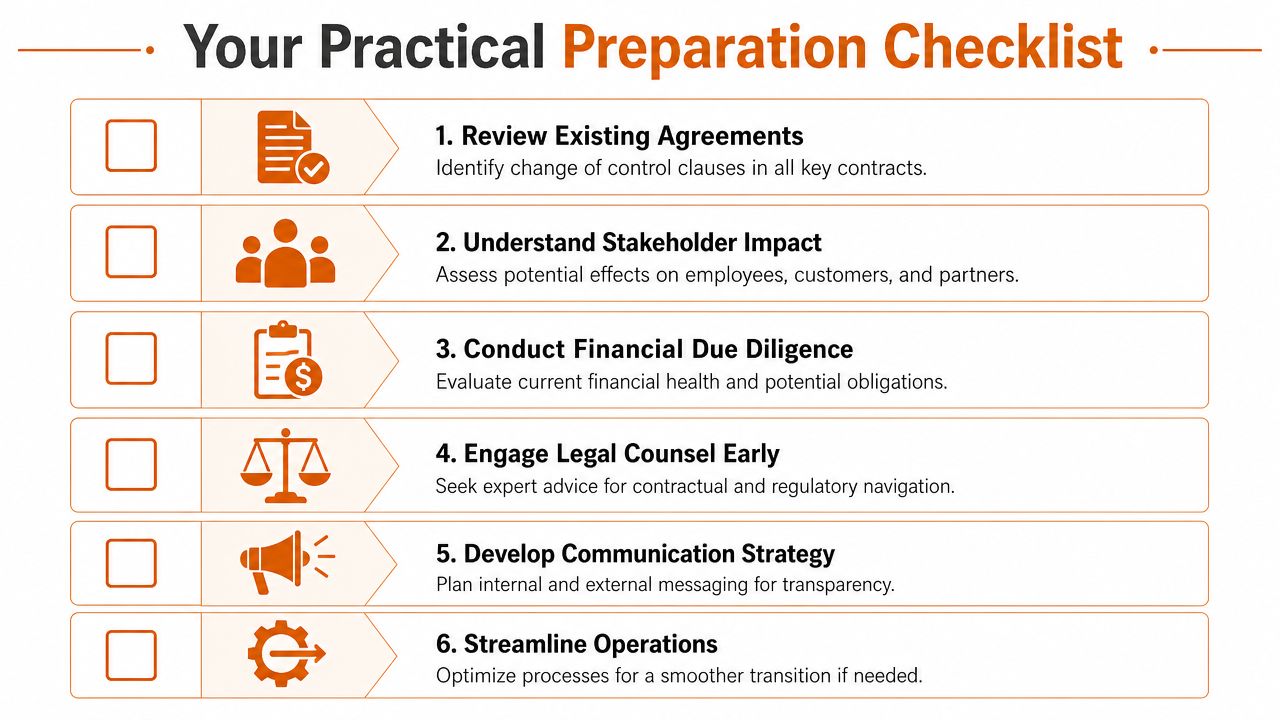
Start with a contract sweep. Pull your customer agreements, vendor agreements, bank documents, real estate leases, equipment leases, franchise documents, shareholder agreements, operating agreement, equity incentive plans, and senior employment contracts. If the agreement matters to cash flow or continuity, review it.
Then create a working list.
If you’re thinking ahead about transition readiness more broadly, this guide on exit planning for business owners fits well with this review.
Bring in your transaction attorney early. Not when the letter of intent is signed. Earlier. You want interpretation before negotiation pressure shows up. Bring in your CPA or tax advisor once you know which payments, bonuses, debt obligations, or structural alternatives could be affected.
Use this sequence:
My advice is simple. Treat this like preventive maintenance. Owners in trades understand that mindset better than anyone. A small issue caught early stays small. A hidden issue discovered during a live sale becomes everyone’s problem.
Usually not by itself. Borrowing money isn’t the same as changing control. But the loan documents you sign may contain their own future change of control restrictions. Read them before you sign, not when you’re trying to close a transaction.
It depends on the wording. A small transfer that doesn’t shift actual control may not trigger the clause. But some agreements define change broadly enough to capture ownership transfers even when day-to-day control appears unchanged. Don’t guess.
Sometimes, yes. More often, you can narrow them. Push for clear definitions, reasonable notice periods, consent not to be unreasonably withheld, and exceptions for internal estate planning or affiliate transfers. Broad language is lazy drafting. Don’t accept it without a fight.
An ESOP can trigger the same questions as any other ownership transition if control shifts in a way the contract covers. Lenders, customers, and landlords may still care who holds decision-making authority after the transaction.
No. It’s legal, financial, operational, and personal. That’s why owners who treat it as a document-review exercise alone usually get blindsided.
If you’re preparing for a sale, succession, recapitalization, or just want a clearer view of the contract risks inside your business, The Owner’s Shortlist is a practical place to start. It offers plain-English articles for owners and a curated way to find specialists in legal, tax, valuation, succession, and related decisions without the usual noise.
Tell us your situation. We'll connect you with a specialist who works with owners like you. One conversation, no sales pressure.
Found this useful?
Add The Owner's Shortlist as a preferred source and get our articles highlighted in Google Search results.
Add to Preferred SourcesExplore 5 confidential information memorandum examples for owner-operated businesses, with required sections, practical guidance, and common pitfalls.
October 22, 2026
Partners who disagree on selling usually settle it one of four ways: a buyout, a partial sale, a sale together, or what the agreement forces.
October 20, 2026
What is deal structuring, explained for service business owners. Learn asset vs stock sales, earnouts, seller financing, holdbacks, and the questions
October 19, 2026
Learn how to identify well qualified buyers for your service business. Covers vetting criteria, red flags, sample questions, and next steps
October 17, 2026