Family Inheritance Law for Business Owners
Navigate family inheritance law for your business. Learn how to structure succession, avoid family disputes, and protect your company's future value.
September 25, 2026
By Remi Taffin · August 17, 2026

Succession doesn’t begin when an owner announces retirement, receives an offer, or suffers a health event. By then, the business may already depend too heavily on one person, key knowledge may be undocumented, and family or management expectations may be unclear. The popular advice to “start early” is correct, but incomplete. The harder question is whether the plan is detailed enough to work under real operating conditions.
A practical succession sequence connects planning, valuation, documentation, people, governance, ownership, tax, and the owner’s eventual handoff. It starts by defining the transition path, then tests whether the business can operate without its current leader. It prepares successors and key employees through real responsibility, not titles alone. It also gives specialists enough time to coordinate legal documents, ownership structures, financing, and tax consequences.
That distinction matters. The 2026 Deloitte Private succession planning report found that 89% of families and 82% of family businesses report having some form of succession plan, yet only about half describe it as thorough and well-developed. A plan on paper isn’t automatically a transition framework.
Use the following list as a readiness sequence. The Owner’s Shortlist can help owners understand specialist categories and connect with vetted valuation, tax, legal, financing, succession, and team advisors before engagement. This article is informational, not legal, tax, or financial advice.
An informal promise such as “the children will take over” isn’t a succession plan. A workable plan identifies who will lead, what ownership will change, when responsibilities will move, and how decisions will be made if circumstances change. It should cover both an expected transition and an emergency vacancy.
Historical evidence shows why written planning deserves priority. A Deloitte family-business succession summary reports that about 30% of family-owned businesses survive into the second generation, 12% into the third, and about 3% reach the fourth generation or beyond. The same source says only one-third of closely held business owners have a formal plan to sell, transfer, or hand down their company. These figures describe a continuity problem, not merely an estate-planning problem.
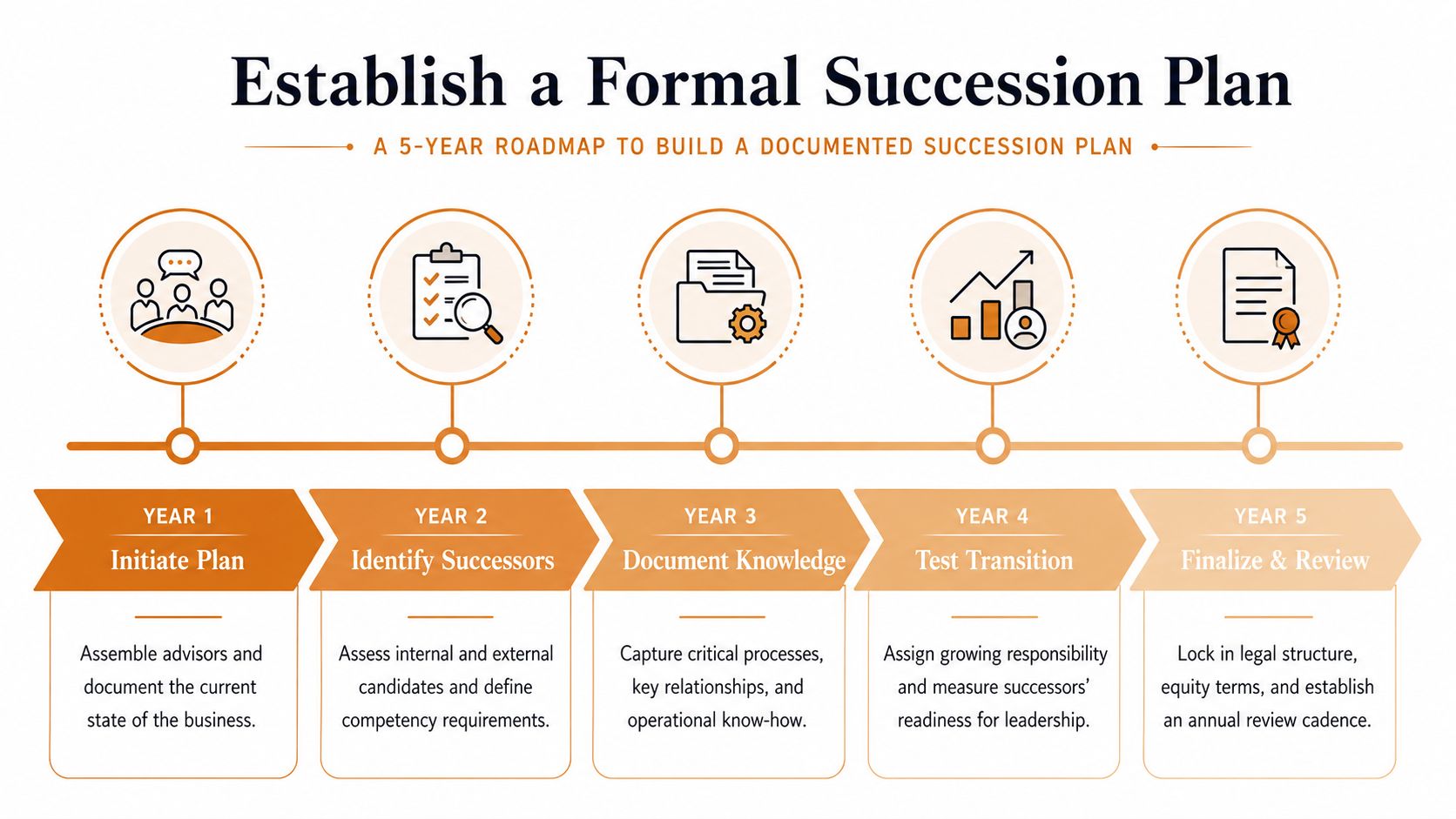
Start with a written working document. It doesn’t need to be elegant, but it must assign responsibility and contain dates.
For an HVAC company, the plan might assign customer relationship handoffs, licensing preparation, technician development, and management authority over a staged transition. A plumbing business may need a written schedule for dispatch, supplier negotiations, safety oversight, and financial review. Review the plan annually with your lawyer, accountant, and business advisor.
Owners often begin succession conversations with an assumed value. That creates friction when the successor, lender, tax advisor, or outside buyer sees the business differently. An independent valuation gives the transition a defensible reference point and shows which characteristics support value or create risk.
The valuation should answer more than “what is the business worth?” Ask the valuer to identify value drivers, weaknesses, normalization adjustments, owner dependency, customer concentration, recurring revenue, management depth, and transferability of operations. A service contractor may have strong customer relationships but weak documentation. Another company may have recurring maintenance work but rely on the owner to quote every job. Those differences affect readiness even when current earnings look similar.
A valuation also exposes trade-offs. A high value can help the owner’s retirement plan, but it may create a financing burden for a family successor. A lower current value may be disappointing, yet it can reveal an opportunity to improve systems before transfer. The point isn’t to produce a flattering number. It’s to understand what a buyer, lender, tax authority, or family member could reasonably challenge.
Owners should learn how business worth is calculated before commissioning a report, then select a valuation professional familiar with the company’s industry and transaction context. A valuation prepared for estate planning may not answer every question relevant to a sale or management buyout.
Use the report as an operating tool. If the owner is central to sales, assign customer relationships to managers. If records are inconsistent, standardize reporting. If a few customers represent a material concentration risk, develop a retention and diversification plan without assuming that new accounts will arrive automatically.
Update the valuation after major changes and at regular review intervals appropriate to the business. Share conclusions strategically. The successor doesn’t need every sensitive detail immediately, but they should understand which capabilities and risks will shape the eventual transition.
A successor can’t lead what only the owner understands. In owner-operated businesses, the most valuable information often sits in memory: why a particular customer receives special scheduling, how a difficult estimate is priced, which supplier resolves emergencies, or when a technician needs additional supervision.
Documentation reduces that dependency while improving the current business. Begin with processes that consume the owner’s time, create safety or compliance risk, influence customer retention, or would be difficult to reconstruct after an unexpected absence. Don’t try to document everything at once.
A practical system might include:
An HVAC company could document seasonal workflows, maintenance procedures, customer-specific notes, and dispatch decisions. A plumbing company may need troubleshooting trees, emergency protocols, supplier relationships, and customer communication templates. These records should live in a searchable, permission-controlled system that the successor and relevant employees can use.

Use documentation as a training instrument, not an archive. Have the successor follow a procedure without the owner present, then revise the material when confusion appears. Owners can also reduce owner dependency before a transition by transferring authority gradually and measuring whether the business continues to function.
The mentoring process can be supported by practical demonstrations and competency reviews:
A document that no one tests will become stale. A process that employees use and improve becomes part of the company’s transferable value.
Family connection, technical skill, or strong performance in a current role doesn’t prove readiness to lead the whole business. A successor must demonstrate judgment across customers, employees, cash flow, safety, suppliers, and strategy. The assessment should be direct enough to reveal whether the person is a genuine fit.
Start by defining the requirements of the future role. An HVAC successor may need to manage customer retention, technician utilization, hiring, pricing, and compliance. A plumbing successor may need to oversee dispatch, crew performance, safety, supplier negotiations, and financial reporting. Separate current performance, future potential, and present readiness. They’re related, but they aren’t interchangeable.
Development works best through expanding responsibility:

A successor who handles a service line well may still struggle with conflict, capital decisions, or long-term planning. Test those areas before transferring control. Give feedback frequently, including uncomfortable feedback, and let the successor make decisions while the owner is still available to coach.
Practical rule: Treat readiness as demonstrated behavior under real responsibility, not as family status, seniority, or completion of a course.
The owner must also accept that the best successor may be an internal manager, an external executive, or a buyer outside the family. Protecting continuity sometimes means choosing the right leader rather than preserving an expected family narrative.
A successor doesn’t inherit customer trust automatically. In trades and home services, lead technicians, dispatchers, estimators, office managers, and field supervisors often hold relationships and operational knowledge that customers notice immediately. If those people leave during uncertainty, the business can lose capacity and credibility at the same time.
Identify employees whose departure would materially disrupt service, customer retention, safety, revenue generation, or training. Then discuss what the transition means for their roles. Silence creates speculation. Clear communication doesn’t require revealing confidential deal terms, but employees should understand the expected direction, reporting relationships, and opportunities available to them.
A retention plan can combine several tools:
A lead technician might mentor the successor on complex service calls and customer expectations. An office manager might own the transfer of dispatch procedures and billing controls. A senior estimator could help test whether pricing decisions still work when the owner stops approving every quote.
Retention incentives have costs and risks. A bonus that rewards mere presence may retain someone who isn’t committed to the new direction. A performance-based plan can encourage useful behavior, but poorly chosen metrics may create internal competition or undermine customer service. Coordinate the terms with employment, tax, and legal advisors, and explain them consistently.
The transition succeeds when key employees see a credible future, not a mere request to wait and hope.
Ownership and management are different jobs. Families often blur them because the same people sit around the table, but that arrangement becomes fragile when siblings, spouses, non-operating owners, or outside managers hold different expectations.
Governance should answer four questions: Who decides, within what limits, after hearing whose input, and how is disagreement resolved? The answer may involve a family council, advisory board, ownership committee, or a formal board. A small business doesn’t need corporate theater. It does need clear authority.
For example, the owner may retain approval over a major acquisition during the transition, while the successor controls daily operations, staffing, pricing within agreed parameters, and customer decisions. Key employees can make tactical decisions within their roles. The written framework should also explain what happens when the successor and owner disagree.
A family council can provide a forum for values, employment expectations, distribution concerns, and communication. An advisory board with an attorney, accountant, industry peer, or business advisor can provide challenge without turning every family disagreement into an operating crisis.
Useful governance practices include:
The transition is more stable when the successor can lead without asking the former owner for permission on every decision. Governance should preserve accountability, not preserve the owner’s informal veto indefinitely.
Transferring ownership is not the same as transferring a job title. The structure determines who receives economic benefits, who bears risk, who votes, who can sell, and what happens if a successor leaves. Gradual gifting, a buy-sell agreement, an installment sale, an estate transfer, an employee ownership structure, or a management purchase may each fit different circumstances.
Begin with the family and business realities. One child may run operations while another owns shares. Several siblings may want income but not management responsibility. A management team may have capability but limited personal capital. The structure must address those differences rather than pretend that equal treatment always means identical roles or ownership.
Specialists should coordinate the documents. A lawyer can draft transfer restrictions, voting provisions, buy-sell terms, and remedies. A tax advisor can model consequences. A valuation professional can support pricing and allocation. A lender or financing advisor may determine whether the proposed purchase can be funded without weakening the business.
Ownership should reinforce the operating plan, not substitute for one.
Document each transfer formally. State the conditions attached to ownership, how performance affects vesting or buyback rights, what happens if a successor dies or divorces, and how an exiting owner is paid. Consider funding mechanisms such as life insurance where appropriate, but don’t assume a policy solves every liquidity or tax issue.
The owner should communicate the structure to non-successor family members with enough clarity to prevent later claims of surprise. Confidential details may require care, but ambiguity around fairness and control tends to become more expensive after documents are signed.
Tax planning belongs near the beginning of succession work, not at the document-signing stage. An internal family transfer, external sale, and management buyout can produce different tax outcomes for the owner, successor, estate, and company. The apparent price isn’t the same as the owner’s after-tax proceeds or the successor’s actual financing burden.
Build scenario models with a tax specialist and keep the assumptions visible. Compare the proposed transfer method, timing, payment structure, asset versus equity treatment, debt service, retained ownership, and estate implications. An installment arrangement may change the timing of recognition, but it also creates collection risk for the seller and a continuing obligation for the successor. A family transfer may preserve continuity, yet it can create fairness and liquidity issues among beneficiaries.
Owners should review estate planning for business owners alongside the succession plan. Wills, trusts, beneficiary designations, shareholder agreements, powers of attorney, and company records need to work together. A business document that conflicts with an estate document can create avoidable disputes.
At minimum, examine the likely family route and a credible outside-sale alternative. Include an emergency scenario if the owner becomes unavailable before the intended transfer. The goal isn’t to predict the future perfectly. It’s to understand which decisions remain reversible and which create lasting consequences.
Coordinate the work well before the intended transition. Tax rules, business performance, financing capacity, and family circumstances can change. Revisit the model when the ownership structure changes, a major transaction occurs, or the expected timing moves.
Compensation can undermine succession. If a successor carries more responsibility without corresponding pay, resentment grows. If the successor receives ownership before demonstrating capability, employees may question legitimacy and the owner may lose influence. If incentives reward only short-term profit, the successor may defer maintenance, training, or customer investments that support long-term continuity.
Create a compensation architecture that reflects the role being performed today and the capabilities being built for tomorrow. Salary should reflect responsibilities and market context. Bonuses can reward outcomes such as customer retention, team stability, safety, service quality, and profitability. Equity or profit participation can reinforce ownership behavior when legal and tax advisors confirm that the structure works.
Use metrics the successor can influence and the business can verify. A bonus tied to profitability requires consistent accounting. A customer measure needs a reliable feedback process. A safety incentive must not encourage underreporting. A retention measure should account for service quality rather than rewarding employees for keeping unprofitable accounts at any cost.
An owner might increase a successor’s compensation as they assume customer relationships, crew management, and financial accountability. That progression makes the connection between responsibility and reward visible. It also gives the owner evidence that the transition is developing the business rather than merely transferring control.
Many owners plan carefully for what they’ll transfer and poorly for what they’ll do afterward. That gap can pull them back into daily decisions, confuse employees, and prevent the successor from becoming the actual leader. A former owner who says they’ll remain “available” without defining the role may unintentionally retain veto power.
Decide what the post-transition relationship will look like. It might be no ongoing involvement, a quarterly advisory board role, a limited consulting agreement, or a defined mentoring arrangement. Specify meeting frequency, topics, compensation, access to employees, and who has final authority. Put those boundaries in writing and communicate them to the successor and team.
A useful transition plan answers:
The emotional side deserves professional attention. Coaching or therapy can help an owner process the loss of status, routine, and identity that often accompanies departure. Financial, tax, and legal specialists can help reduce uncertainty about the owner’s personal position, while the successor needs space to build credibility.

A genuine handoff requires the owner to stop being the unofficial operating authority. Support can continue, but control must move.
| Practice | Implementation Complexity 🔄 | Resource Requirements ⚡ | Expected Outcomes 📊 | Ideal Use Cases 💡 | Key Advantages ⭐ |
|---|---|---|---|---|---|
| Establish a Formal Succession Plan with Written Documentation | High 🔄🔄🔄 | Owner time + legal/advisors ⚡⚡⚡ | Clear roadmap, reduced ambiguity 📊 ⭐⭐⭐ | Family-owned, planned 3–5 yr transitions 💡 | Accountability, continuity, buyer confidence ⭐ |
| Conduct Professional Business Valuation Early and Regularly | Medium 🔄🔄 | Appraiser fees, financial prep ⚡⚡ | Defensible value, identifies drivers 📊 ⭐⭐⭐ | Pre-sale, tax planning, family discussions 💡 | Objective pricing, tax and improvement insights ⭐ |
| Implement Knowledge and Process Documentation Systems | Medium 🔄🔄 | Staff time, documentation systems ⚡⚡ | Reduced owner-dependency, faster onboarding 📊 ⭐⭐⭐ | Owner-dependent operations, training successors 💡 | Preserves institutional knowledge, consistency ⭐ |
| Develop and Test Successor Competency and Leadership Capability | High 🔄🔄🔄 | Coaching, assessments, time ⚡⚡⚡ | Validated readiness, lower succession risk 📊 ⭐⭐⭐ | Internal/family successors, multi-year prep 💡 | Objective fit assessment, builds successor confidence ⭐ |
| Create a Retention and Transition Plan for Key Employees | Medium 🔄🔄 | Incentives, HR coordination ⚡⚡ | Retained talent, operational continuity 📊 ⭐⭐⭐ | Service businesses reliant on key technicians 💡 | Maintains customer relationships, stability ⭐ |
| Establish Clear Governance and Decision-Making Structures | Medium-High 🔄🔄🔄 | External advisors, meeting discipline ⚡⚡ | Neutral dispute forum, transparency 📊 ⭐⭐⭐ | Multi-generation or multi-owner families 💡 | Reduces emotion-driven decisions, accountability ⭐ |
| Structure Equity Transitions and Ownership Changes Strategically | High 🔄🔄🔄 | Tax/legal specialists, funding tools ⚡⚡⚡ | Tax-efficient transfers, aligned incentives 📊 ⭐⭐⭐ | Estate planning, multi-heir scenarios 💡 | Minimizes taxes, clarifies rights and exits ⭐ |
| Plan for Tax-Efficient Succession and Exit Scenarios | High 🔄🔄🔄 | Tax modeling, long-term advisor time ⚡⚡⚡ | Optimized after-tax proceeds, lower liabilities 📊 ⭐⭐⭐ | High-value businesses, complex tax exposures 💡 | Maximizes net proceeds, avoids surprises ⭐ |
| Align Compensation and Incentives with Succession Goals | Medium 🔄🔄 | Payroll, equity plans, HR systems ⚡⚡ | Motivated successors, improved retention 📊 ⭐⭐⭐ | Internal successors in competitive markets 💡 | Aligns performance with rewards, signals commitment ⭐ |
| Prepare Owner for Identity and Role Transition Post-Succession | Medium 🔄🔄 | Coaching, financial planning ⚡⚡ | Smoother owner step-back, healthier dynamics 📊 ⭐⭐ | Long-tenured owner-operators, family transitions 💡 | Prevents reintervention, supports owner wellbeing ⭐ |
A list of succession planning best practices only becomes useful when an owner turns it into dated decisions, assigned work, and evidence of readiness. Start by confirming the intended transition path. Is the likely outcome a family transfer, management buyout, external sale, or a structure that keeps several options open? The answer affects valuation work, successor development, financing, governance, tax modeling, and the documents specialists need to prepare.
Next, schedule an independent valuation and ask for more than a headline figure. Request an explanation of the business’s value drivers, owner dependency, customer and supplier risks, management depth, recurring revenue, documentation quality, and transferability. Use those findings to create a value-improvement plan. A business that can’t operate without the owner may need operational work before it is ready for a transfer or sale.
At the same time, identify gaps in the successor and employee bench. Name the critical responsibilities that only the owner handles, then assign real development opportunities to the successor and key managers. Document processes as people perform them, test those procedures without the owner present, and update them when the team finds ambiguity. Retention planning should begin before uncertainty causes important employees to look elsewhere.
Arrange coordinated conversations with tax and legal specialists before ownership terms become family promises. The team should examine transfer structures, buy-sell provisions, estate documents, financing, payment terms, voting rights, and emergency authority together. A valuation professional, accountant, attorney, lender, and succession advisor may each see a different risk. Coordination prevents one document or assumption from undermining the others.
Review progress regularly rather than waiting for the target exit date. The Deloitte 2026 report shows why owners should distinguish between having a plan and having a thorough, workable one. Each review should ask whether the successor can perform more of the role, whether key knowledge has moved into the business, whether employees understand their future, whether governance is functioning, and whether the tax and ownership models still match reality.
The Owner’s Shortlist provides plain-language guides and curated categories covering Business Value, Taxes, Legal & Estate, Keeping It in the Family, Your Team, Growth & Financing, Future Options, and Finding the Right People. Owners can contact specialists directly or request an introduction, depending on how they prefer to begin. Use the resource to clarify terminology and next steps, then engage the appropriate professionals for advice specific to the business, family, jurisdiction, and transaction.
A successful succession isn’t defined by the date on a closing document. It’s defined by whether customers receive consistent service, employees understand authority, successors can make sound decisions, ownership terms are enforceable, tax outcomes are modeled, and the former owner can leave without the business losing its operating center.
The Owner’s Shortlist offers plain-English guides and a curated directory of vetted specialists for valuation, tax, legal, financing, succession, and team decisions. Visit The Owner’s Shortlist to clarify your transition priorities, explore relevant specialist categories, and connect directly or request an introduction before engaging an advisor.
Tell us your situation. We'll connect you with a specialist who works with owners like you. One conversation, no sales pressure.
Found this useful?
Add The Owner's Shortlist as a preferred source and get our articles highlighted in Google Search results.
Add to Preferred SourcesNavigate family inheritance law for your business. Learn how to structure succession, avoid family disputes, and protect your company's future value.
September 25, 2026
Learn how succession of business works, from choosing a pathway to timing the handoff. A clear guide for owners planning their next chapter.
September 20, 2026
Plain-language estate planning wills and trusts guide for business owners covering definitions, tax implications, and questions to ask attorneys.
September 18, 2026
Learn company ownership transfer options, valuation, taxes and timing. Compare sale, gift, succession and ESOP paths with checklists.
September 17, 2026