How to Sell My Plumbing Business: A Practical Roadmap
Ready to sell my plumbing business? Follow a step-by-step roadmap for valuing, marketing, and closing the sale with confidence and clarity.
October 15, 2026
By Remi Taffin · July 23, 2026
You can feel it before you say it out loud. The business still runs, customers still call, payroll still clears, but the thought keeps coming back at odd times. You’re not just asking what the company is worth, you’re asking whether it’s ready to leave your hands without falling apart, and whether you’re ready to let it go.
That’s the fundamental work in how to sell a business. The mechanics matter, but the owner’s decisions matter more, especially the ones made before a buyer ever appears. The best exits usually start with a clear head, clean records, and a realistic view of what a stranger would buy, not what the founder hopes they’ll admire.
The hardest part of selling a business is often not the paperwork. It’s admitting that the company you built has to survive without you in the room every day. Owners who get the best outcomes usually decide that before they decide on a price, because a buyer is evaluating both the asset and the person who’s been propping it up.
A plumbing owner once told me the business felt “fine” until he stepped back for two weeks and realized every quote, service exception, and pricing override waited for his approval. That kind of dependency is common in owner-operated companies, and it’s exactly the sort of thing buyers notice. The cleaner the handoff looks, the more transferable the value becomes.
Selling changes your routine, your identity, and sometimes your family’s expectations. If you don’t know what you’re doing after closing, you’ll be tempted to stall, over-negotiate, or reject offers that are reasonable. That’s not a pricing problem, it’s a readiness problem.
Practical rule: don’t go to market until you can describe, in plain language, what life looks like after the sale.
Ask yourself whether you’re selling because you’re pulled toward something better or because you’re being pushed by fatigue, conflict, or fear. Those are different starting points, and they shape the type of deal you’ll tolerate. If a longer transition, consulting period, or staged exit would calm the process, say so early.
The SBA advises sellers to accurately value not only physical property and inventory but also intangible assets such as brand presence, customer information, and projected future revenue, and to organize reliable financial statements, tax returns, and written operating procedures because buyers use them to test earnings quality and owner dependence SBA guidance on closing or selling your business. That’s not busywork. It’s the difference between a company that looks managed and one that looks improvised.
For an HVAC company, that means more than balancing the books. It means tightening service agreements, documenting maintenance workflows, clarifying how recurring revenue is booked, and making sure dispatch, invoicing, and warranty handling don’t live only in one manager’s head. For a trade business, clean systems often matter as much as the trucks and the tool inventory.
A strong pre-sale checkup usually includes:
A seller who does this early earns options later. A seller who skips it usually discovers the weaknesses during diligence, when the buyer has an advantage and the clock is already running.
Exit planning for business owners

Owners usually arrive at valuation with a number in mind. Buyers usually arrive with a different number in mind, and the gap between those two numbers is where most deals get stuck. A realistic valuation starts with cash flow, risk, and how hard it would be for a buyer to step in and keep the business running.

Seller’s Discretionary Earnings, or SDE, is often used for smaller owner-operated businesses. In plain English, it’s the earnings the owner can reasonably take home after normalizing for personal expenses and one-time items. EBITDA is a cleaner operating measure that’s often used as businesses get larger or more institutional.
The point isn’t the acronym. The point is that buyers are usually buying future cash flow, not a historical trophy case. That’s why clean financials, stable operations, and low owner dependency can lift value even when revenue itself doesn’t change much.
Buyers don’t pay for effort. They pay for repeatability.
A valuation specialist will usually look at earnings and then apply an industry-appropriate multiple, but the multiple isn’t some fixed law of nature. It reflects risk, transferability, and how much confidence the buyer has that the company can keep producing cash once you’re gone. A business with recurring customers, documented processes, and a team that already handles day-to-day issues tends to look less fragile than one that depends on the founder’s memory and relationships.
The most useful way to think about valuation is as a range, not a single perfect answer. If your numbers are messy, your customer base is concentrated, or your revenue depends heavily on you, the range narrows fast. If the books are clean and the business runs on systems, the conversation gets more credible.
The failure rate matters here. Only about 20% to 30% of businesses formally put on the market sell, and common reasons for failure are unrealistic valuations, weak financial documentation, and excessive owner dependence business sale success rates. That’s a blunt reminder that buyers pay for transferable value, not just revenue.
If you want to have a sane conversation with a valuation professional, bring these three things to the table:
The best owners don’t ask, “What can I get?” first. They ask, “What would make this business easier to buy?” That shift usually leads to a better answer, and often a better deal.
The wrong buyer can waste months. The right buyer can make a complicated company feel obvious. That’s why the first real decision isn’t whether to sell, it’s who is most likely to value what you’ve built.
A strategic acquirer buys for fit. A financial buyer buys for return. An individual buyer often buys for control, income, or a career change. Those motivations sound similar until you get into the deal structure, because each group cares about different risks and timelines.
| Buyer type | Main motivation | Typical focus | Common owner implication |
|---|---|---|---|
| Strategic acquirer | Synergy, market expansion, capability gain | Integration, cross-selling, customer overlap | Can value fit highly, but may demand more diligence |
| Financial buyer | Investment return | Cash flow, growth, management depth | Wants a business that can scale without the founder |
| Individual investor | Ownership, income, hands-on role | Simplicity, stability, clarity | Often prefers an understandable, manageable business |
| Internal party | Continuity, legacy, family, employee ownership | Transition control, trust, financing feasibility | May require staged terms or seller support |
The sale route matters too. Some owners use a broker. Some use an M&A advisor. Some sell directly to a known buyer. Many smaller firms consider selling without a broker to preserve privacy, speed, and control, but that only works if the owner has a real plan for qualifying buyers and protecting confidentiality Bain on serving small businesses.
A direct sale can work well when the buyer pool is narrow and the owner already knows likely acquirers. A brokered process can help when the company has enough interest to justify outreach but not enough internal bandwidth to manage dozens of conversations. An M&A advisor is usually the better fit when the business is more complex, the confidentiality stakes are high, or the owner needs help with positioning and negotiation.
A family business often needs a slower, more deliberate path than a founder-led SaaS company or a trade business with recurring revenue. An employee buyout can protect legacy and continuity, but it can also stretch financing and require extra patience from the seller. Strategic buyers tend to move faster on logic, but they can also be the most exacting about integration and documentation.
What kinds of buyers will contact you
The practical question is not “Which buyer is best?” It’s “Which buyer is most likely to pay for the specific strengths of this business without punishing its weaknesses?” If your company is simple and private, direct outreach may be enough. If it’s messy, relationship-heavy, or sensitive, the process needs more structure than a phone call and a handshake.

A business sale is not a public listing in the normal sense. Good marketing is controlled disclosure. You want enough clarity to attract serious interest, and enough restraint to keep your competitors, employees, and customers from learning too much too early.
A standard sale process often takes about six months, with one month to prepare materials like a Confidential Information Memorandum, or CIM, a second for outreach, a third for handling interest, a fourth for negotiation, a fifth for due diligence, and a sixth for closing sale process timeline. That schedule only works when the seller treats buyer qualification as a gate, not an afterthought.
The teaser is the first filter. It should be compelling without naming the business or revealing sensitive details. It’s there to generate interest from people who fit the profile, not from every curious browser.
The CIM comes later, after a buyer has shown real capacity and signed an NDA. It should tell the story of the business in a way that a serious buyer and their advisor can evaluate quickly. If the CIM reads like a sales brochure, it usually creates more questions than confidence.
A clean process usually follows this rhythm:
Owners often lose the most time. A buyer who asks a few polished questions may still have no money, no lender, and no real authority. If you give away the CIM too soon, you spend days, sometimes weeks, teaching a person who was never serious.
Ask direct questions early. Who is buying, how are they funding it, what decision rights do they have, and what timeline are they working under? You’re not being rude, you’re protecting the process.
Good buyers don’t mind being screened. Serious buyers expect it.
Skipping qualification is one of the most common failure modes in a sale process sale process guidance. It burns time, leaks information, and creates false momentum. A disciplined seller keeps the funnel narrow until the buyer has proven they can close.
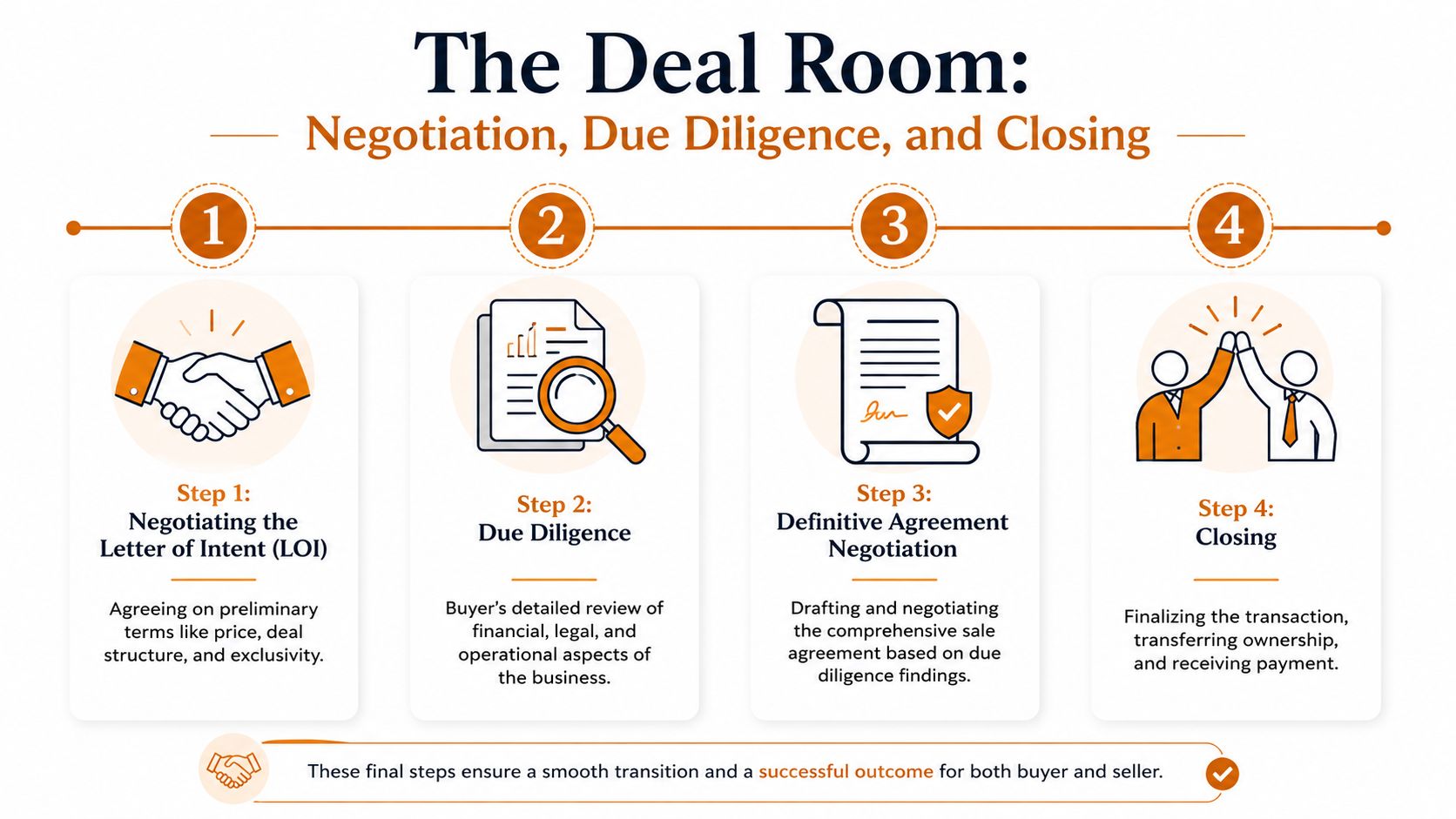
The LOI is where optimism meets structure. Buyers use it to frame the deal, define the price, and lock in the assumptions that matter most before they spend money on diligence. Sellers should treat it as a working draft of the transaction, not a ceremonial formality.
A good LOI gives both sides enough clarity to invest in the next phase. It should cover price, structure, key contingencies, exclusivity, and the broad shape of the transition. If those points are fuzzy, the deal usually gets harder later, not easier.
Once the LOI is signed, the in-depth verification begins. Due diligence is not an accusation. It’s the buyer checking whether the story, the numbers, and the contracts match what was presented in the CIM. If they don’t, the buyer may ask for a price change, a holdback, a different structure, or more protection in the definitive agreement.
The most efficient sellers assume every statement will be tested. That means organizing financial statements, tax returns, customer contracts, lease documents, employee agreements, and operating records before the buyer asks. It also means knowing where the weak spots are, because the buyer will find them anyway.
For businesses in the $500,000 to $3 million EBITDA range, the process from listing to closing commonly takes 10 to 12 months, including 3 to 6 months of marketing, 60 to 90 days of due diligence, and another 90 to 120 days for financing approval sale timeline by EBITDA range. That timeline is exactly why exit preparation needs to start well before a listing goes live.
A buyer and lender will usually look closely at these areas:
The definitive agreement turns the negotiated deal into enforceable language. This is where lawyers earn their keep. Asset sales, liability treatment, intellectual property, employee obligations, and transition support all need to be spelled out clearly.
Don’t rush this part just because the buyer is impatient. A fast closing with a broken agreement is worse than a slower closing with clean terms. The right advisor helps the seller separate fixable issues from deal killers, and that judgment can save both price and sanity.
By the time you reach closing, you’re not just transferring ownership. You’re transferring confidence that the business can operate under new leadership without drama.
Closing day feels like the finish line, but the handoff is what buyers remember. If customers are confused, employees are nervous, or the owner vanishes too fast, the value of the deal can erode even after the signatures are done. The transition period is where the business proves whether it was transferable.
Some sellers stay on for a short consulting period. Others agree to an earn-out or staged transition. The right structure depends on how much of the business still lives in the founder’s head, how much the buyer needs continuity, and how much trust both sides have in the operating data.
Communication matters here more than owners expect. Employees need to know what changes, what doesn’t, and who makes decisions now. Customers need reassurance that service, billing, and support won’t collapse in the handoff.
A disciplined transition usually covers:
A smooth transition is usually a sign that the business was built to be sold, not just built to be owned.
Selling an unprofitable or low-profit business requires even more honesty. Guidance in that situation emphasizes starting early, being honest in marketing materials, and considering an asset sale when a buyer is unlikely to value the whole company as a going concern unprofitable business sale guidance. Profitability isn’t a binary gate to exit. Structure, timing, and buyer pool still matter.
The common mistakes are painfully consistent. Owners start too late. They overprice the business. They can’t produce clean records. They leave the buyer guessing about customer retention and owner involvement. Each mistake makes the same problem worse, which is why the sale process rewards preparation more than charisma.
If you’re serious about an exit, start by getting clear on your own decision, then get the business ready to answer a buyer’s questions without you in the room. That’s the difference between hoping to sell and getting to closing. A thoughtful plan, the right specialists at the right time, and a realistic view of what buyers value will save you more time than any last-minute scramble ever can.
If you’re getting serious about a sale, use The Owner’s Shortlist to find the right specialists before the process starts to drift. A short conversation with the right valuation, tax, legal, or financing expert can save months of second-guessing and help you move from uncertainty to a clean, confident exit.
Tell us your situation. We'll connect you with a specialist who works with owners like you. One conversation, no sales pressure.
Found this useful?
Add The Owner's Shortlist as a preferred source and get our articles highlighted in Google Search results.
Add to Preferred SourcesReady to sell my plumbing business? Follow a step-by-step roadmap for valuing, marketing, and closing the sale with confidence and clarity.
October 15, 2026
Learn how to sell your service business with a practical, step-by-step roadmap. From readiness and valuation to deal structure and closing, get actionable
October 14, 2026
Learn how business valuation EBITDA works for service companies. Discover adjustments, multiples, and owner-dependency tests before you sell.
October 12, 2026
Thinking 'I want to sell my landscaping business'? Learn how to value your company, prepare financials, handle labor risks, and find the right buyer quietly.
October 11, 2026