Business Value
SDE vs EBITDA: Which Metric Fits Your Business Sale
Confused by SDE vs EBITDA? Learn when each metric applies to your owner-operated business, how adjustments change valuations, and which buyers prefer which
October 3, 2026
By Remi Taffin · November 24, 2026

Accounting firm valuation multiples run from about 1.0x revenue and 2.0x seller’s discretionary earnings (SDE) for a small practice, up to roughly 9x to 11x EBITDA for firms large enough to draw institutional buyers. BizBuySell data for accounting and tax practices sold from 2021 to 2025 shows a median of 2.04x SDE, or 1.02x annual fees. The middle half of those sales landed between 1.61x and 2.66x SDE.
The Owner’s Shortlist is a free service that introduces Florida owners to one specialist who has valued or sold businesses like theirs. For a practice sale, the first step is a number you can defend, because every multiple below depends on the earnings figure you apply it to.
This is one of the questions we cover across business value. Read the table below by row, never across rows. Each row uses a different earnings measure and a different kind of buyer. SDE is profit with the owner’s pay and personal costs added back. EBITDA is profit after a market-rate manager’s pay comes out.
Reported accounting firm multiples
| Firm profile | Earnings measure | Reported multiple | Source and sample |
|---|---|---|---|
| Small accounting and tax practices sold in 2025 | Revenue and seller cash flow | 1.11x revenue; 2.33x cash flow | BizBuySell Full-Year 2025 Insight Report, 194 sales, median price $500,000 |
| Small accounting and tax practices sold 2021 to 2025 | Revenue and SDE | 1.02x revenue; 2.04x SDE (middle half: 1.61x to 2.66x) | BizBuySell data, as republished by businessappraisal.ai |
| Professional services firms, $2M to $3M EBITDA | EBITDA | 9.2x median | Axia Growth, 26 deals |
| Professional services firms, $3M to $5M EBITDA | EBITDA | 9.7x median | Axia Growth, 35 deals |
| Professional services firms, $10M+ EBITDA | EBITDA | 11.0x median | Axia Growth, 36 deals |
| Accounting firms over $2M revenue, partner retirement payouts | Share of revenue | 76.9% of revenue in 2025, down from 78.4% in 2024 | Rosenberg Survey, 2025 |
Three cautions before you quote any of these. First, BizBuySell’s cash-flow figure is seller cash flow, not normalized EBITDA, so don’t compare it to the EBITDA rows. Second, the Axia numbers cover the professional services sector, not accounting firms alone, and Axia itself says there is no reliable published EBITDA multiple series for lower-middle-market CPA firms. Third, none of the sources above is a list of your buyers, so treat each row as a reference, not a valuation.
Practical rule: find your row by earnings size and by how much of the work depends on you, then treat that number as a starting point.
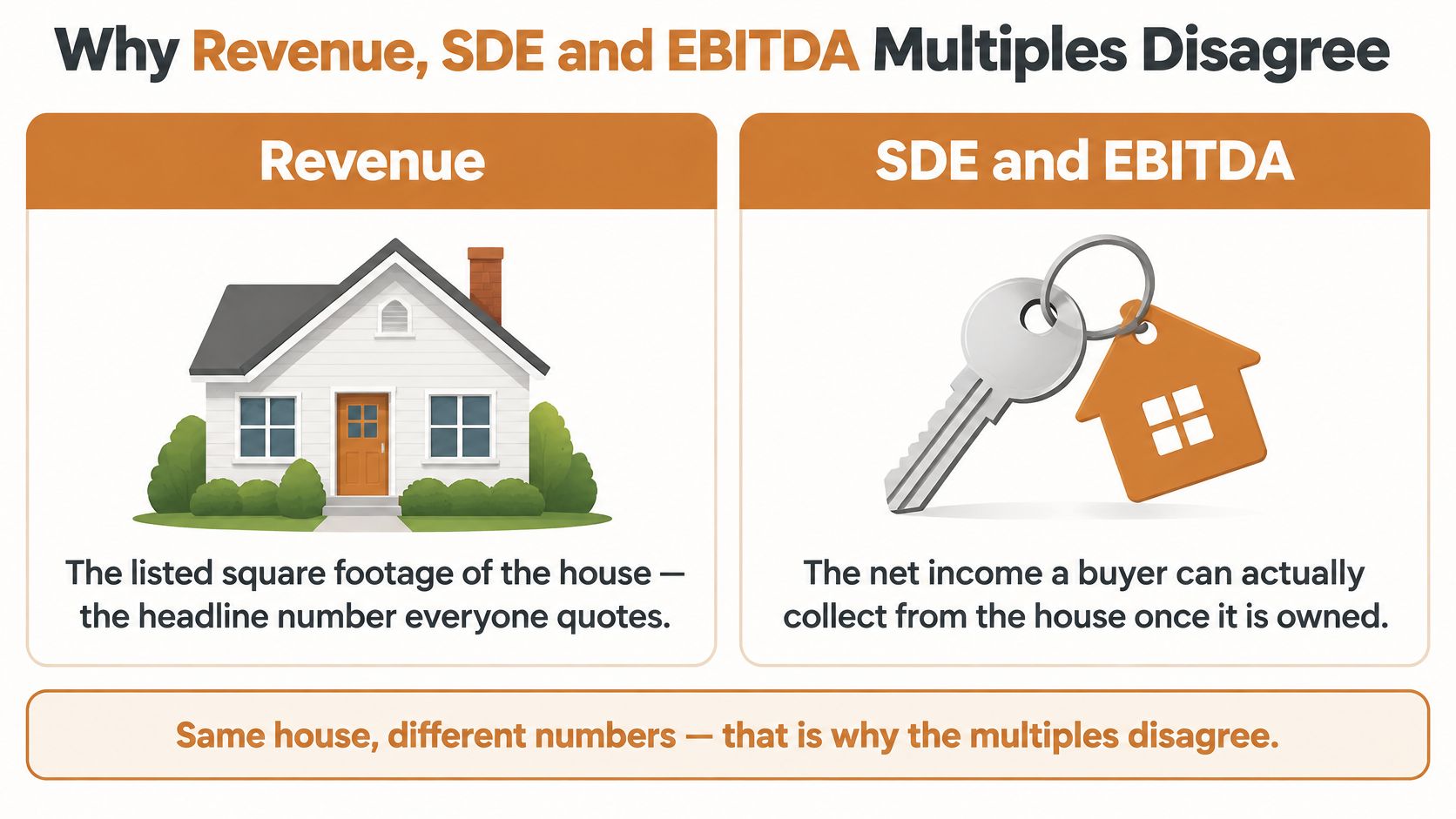
Revenue is the listed square footage of a house. SDE and EBITDA are the rent you can collect once you own it. Two houses with the same floor plan can bring in very different rent, and two practices with the same fees can earn very different profits.
Say two practices each bill $1 million a year. This is a made-up pair, not a reported sale. One runs a 35% margin and the other runs 15%. Apply the same revenue multiple to both and they get the same price, so the buyer of the leaner firm pays more than twice as much for each dollar of earnings.
That’s why a revenue multiple is only a first pass. A study of 76 private equity deals for small accounting practices in Italy, from 2012 to 2018, found that the sales multiple predicted price better than the alternatives it tested. The same study in the Journal of Management & Governance also found that non-financial factors matter, such as a practice’s location in a small town.
So start with revenue, then check it against earnings. Our plain-language comparison of SDE and EBITDA explains which one fits an owner who still works in the business and which fits one who has already handed off production.
Who is buying sets the multiple before your financials do. A partner or an individual CPA buys a client book and cash flow they can carry themselves. They usually pay for it out of the practice’s future earnings, so they price carefully and ask for a long handoff.
A larger platform buyer pays for something else: recurring fees, room to cross-sell, systems, and a second layer of leaders who keep working after you leave. Strategic and financial buyers look at the same financials differently, which is why the same profit and loss statement can produce very different offers.
Owner dependence is the hinge. If you personally do most of the client work and hold the relationships, the buyer has to hire someone to replace you, and that cost comes straight out of the price. A smaller firm with steady recurring fees, a spread of clients and a manager who already reviews work can earn a better multiple than its size suggests.
Before you accept any multiple, answer three questions in writing:
A multiple is only as honest as the earnings figure under it. Work through these six steps in order, and write down each change so a buyer can follow your math.
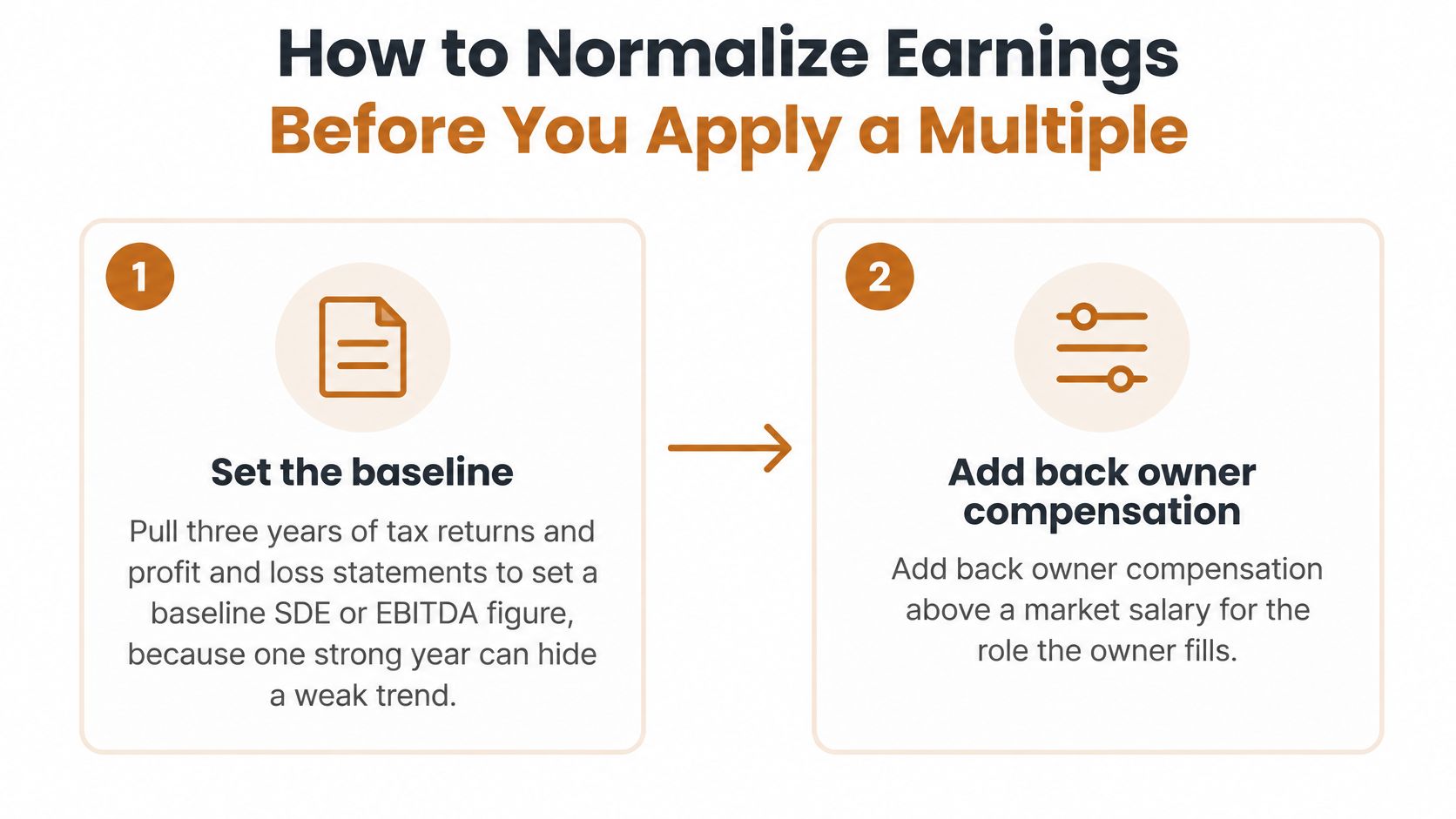
Watch for this: an owner who adds back a full partner salary but never deducts a replacement manager has counted the same labor twice.
Keep a one-page schedule of every adjustment, with the invoice or payroll record beside it. Buyers discount numbers they can’t trace. If you want to see how a buyer’s accountant tests those numbers, read about what a quality of earnings report covers.
Take a practice with $250,000 of SDE that holds up after replacement labor is counted. Here is that one firm at three points in the 2021 to 2025 BizBuySell range for small accounting and tax practices.

Implied value of a $250,000 SDE practice
| Scenario | Multiple applied | Implied value |
|---|---|---|
| Lower quartile | 1.61x SDE | $402,500 |
| Median | 2.04x SDE | $510,000 |
| Upper quartile | 2.66x SDE | $665,000 |
These are illustrations of a reported range, not a valuation of any firm. The gap between the low and high rows is $262,500, and the earnings figure never changed. What changed is how a buyer judged client retention, owner dependence, service mix and handoff risk.
That’s where preparation pays. Documented client relationships, a second reviewer, recurring engagements and clean books move you up within the range. Arguing about the multiple does not.
The same data set reports median annual fees of about $400,000 and median owner earnings of about $208,303. So the typical practice in it is small and run by its owner. If your firm has several partners, a manager and recurring advisory fees, you’re outside the group those numbers describe.
For a cross-check, apply the 1.02x revenue median to your own gross fees and divide the result by your normalized earnings. If the two methods land far apart, review your add-backs first.
A headline multiple gives you a price for the business, not a payout. The step from one to the other is covered in our explainer on enterprise value versus equity value. For a practice sale, the cash you keep depends on how the price is paid.
What the headline price includes and what it does to your cash
| Deal component | Effect on your cash | Terms to check |
|---|---|---|
| Headline price | A starting figure, not cash | Earnings base and sales behind it |
| Debt and working capital | Reduces cash paid at closing | Receivables and unbilled work at closing |
| Cash at closing | Money you can spend on day one | Share of the price paid upfront |
| Seller financing | Paid over time, only if the buyer pays | Rate, term, security and guarantee |
| Client-retention payment | Paid only if clients stay | How retention is measured and who controls service |
| Handoff work | Your time after the sale | Length, duties and pay |
| Taxes on proceeds | Reduces net cash | Entity type and deal structure |
Seller financing turns you into the lender. Your payments depend on the buyer running the practice well, so the rate, term, security and any personal guarantee matter as much as the price. A retention-linked payment pushes client risk back onto you. If you can’t influence the outcome, you hold the risk without the control.
Even inside a firm, a price is often a formula and not a check. In the 2025 Rosenberg Survey, the average revenue multiple used for retirement payments at accounting firms with more than $2 million in revenue was 76.9%, down from 78.4% in 2024.
Two offers with the same headline can leave you thousands apart. A 2.4x deal paid fully at closing can beat a 2.8x deal with a third in a retention payment and a quarter in a note. One is cash, and the other is a forecast that carries your risk.
If you decide to sell, you can find a business broker to run the process and compare offers on cash, not headline. Tax treatment depends on your entity type and how the price is split, so talk to a tax specialist before you sign.
If you’re weighing an offer or just want to know what your practice would fetch, get a free valuation of your practice. Bring your normalized earnings and the five questions above, or call (321) 320-7239 and we’ll talk it through.
Who wrote this: The Owner's Shortlist is not a broker and doesn't sell businesses. We get paid the same no matter which specialist we introduce you to. More about how we work.
Tell us your situation. We'll introduce you to one broker who has sold businesses like yours. One conversation, no sales pressure.
Found this useful?
Add The Owner's Shortlist as a preferred source and get our articles highlighted in Google Search results.
Add to Preferred SourcesConfused by SDE vs EBITDA? Learn when each metric applies to your owner-operated business, how adjustments change valuations, and which buyers prefer which
October 3, 2026
What Is SDE. Learn what SDE means in business valuation, how to calculate it with common add-backs, how it differs from EBITDA, and why buyers and lenders focus
October 7, 2026
Enterprise vs equity value in plain numbers: what a 5x EBITDA offer means after debt, cash, and closing adjustments for a trade business.
October 29, 2026
A strategic buyer wants synergy with their own business. A financial buyer wants cash flow and a return. Here's how each prices and structures a deal.
July 27, 2026