Indication of Interest in a Business Sale: What It Means
Learn what an indication of interest means in a business sale, how it differs from a letter of intent, and what to review before you respond.
November 19, 2026
By Remi Taffin · November 16, 2026 · Updated November 20, 2026

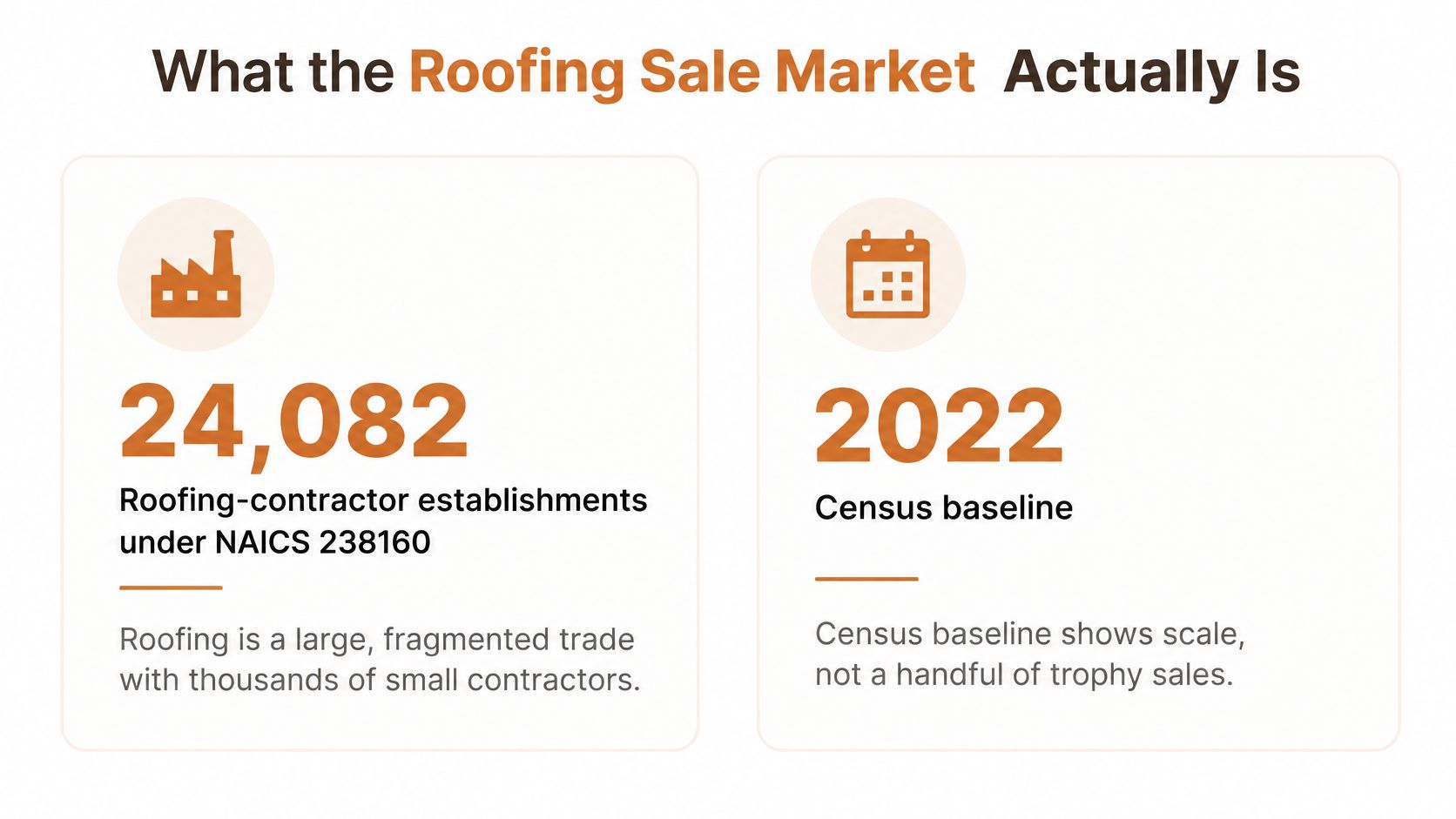
Approximately $69.9 billion in sales, shipments, or revenue came from U.S. roofing-contractor establishments in 2022, according to the U.S. Census Bureau’s roofing-contractor table, which counted 24,082 establishments under NAICS 238160. That’s a substantial industry, but it doesn’t tell you what your company is worth. When you compare roofing companies for sale, the useful question isn’t what price an owner wants. It’s how much dependable profit a buyer can take over, and how much of the eventual price the seller will keep.
The Census baseline covers roofing contractors specifically, not the entire construction industry. Within that classification sit very different operations: residential reroofing crews, commercial contractors, repair specialists, maintenance businesses, and companies supplying roofs for new construction.
Think of the industry as a long street of storefronts. Every business sells roofing work, but the contents of the shops differ. One owner has maintenance appointments already scheduled, another waits for builders to release projects, and another follows insurance-related repairs after storms.
Say a buyer visits neighboring roofing businesses. At one, the office can produce signed agreements, job-cost reports, and a schedule that a production manager controls. At the other, the owner remembers the estimates, holds the customer relationships, and decides where every crew goes.
Both may have respectable sales. Only one has demonstrated how those sales continue when the seller leaves.
A buyer therefore needs more than a revenue total:
A broad customer base and established commercial relationships can give a buyer more ways to maintain operations. New-construction work may be attractive too, but its value needs to reflect project timing and dependence on builders.
Practical rule: Industry size establishes context. Your records establish what someone can buy.
At The Owner’s Shortlist, we publish a plain-language guide explaining how specialists value a business and which methods they use. That kind of explanation belongs beside a comparison of asking prices, not behind an assumption that every roofing company deserves the same multiple.
Roofing valuation ranges by business model
The roofing-specific bands below come from Auctus Capital’s roofing valuation overview; the smaller-construction SDE benchmarks and broader construction-platform average come from Axia Growth’s roofing valuation guide.
| Business profile | Metric | Typical range | What lifts the result | What buyers discount |
|---|---|---|---|---|
| Smaller owner-operated shop | SDE | 2.3x to 2.7x | Documented, nonrecurring owner add-backs | Add-backs that would continue under a buyer |
| Residential roofing | EBITDA | 3x to 5x | Crew capacity and leads not closed by the owner | A year built on one storm season |
| Commercial with maintenance agreements | EBITDA | 5x to 8x | Renewals and scheduled reroofing | Weak job margins or one dominant customer |
| Storm restoration | EBITDA | 2x to 4x | Insurance files and crews that stay | Earnings that vanish when hail stops |
| Larger manager-run construction platforms | EV/EBITDA | About 10.6x, 2018 to 2025 | Management beyond the founder | Using this band for a typical local roofer |
These are reference points, not an appraisal. The smaller-shop range covers construction businesses rather than roofing alone. The platform figure is a broader construction-services average involving private-equity buyers, not a price guide for a local roofing contractor.
Seller’s discretionary earnings, or SDE, is commonly used for a smaller business where the buyer expects to take an active owner’s role. It considers the economic benefit available to that owner, including eligible compensation and discretionary expenses.
Adjusted EBITDA suits a business evaluated as a manager-run operation. EBITDA means earnings before interest, taxes, depreciation, and amortization. Adjustments then aim to describe ongoing operating performance rather than unusual historical expenses.
The distinction matters when you stop working. Your compensation can’t disappear from the calculation if a buyer must hire an estimator, salesperson, or general manager to replace your duties.
Build a reconciliation that starts with tax-return net income and shows each adjustment separately. Identify owner compensation, personal expenses, unusual legal costs, exceptional storm-related results, and potentially nonrecurring equipment expenses. Avoid counting an equipment adjustment twice when depreciation has already been addressed.
For every proposed add-back, attach the invoice or ledger entry and explain why the expense won’t recur. A buyer can reasonably reject an adjustment for a truck, software subscription, or employee benefit that the business will still need.
A signed contract represents work to perform, not money already earned. The buyer needs to know the expected contribution after materials, labor, subcontractors, and other completion costs.
A useful backlog schedule identifies:
Don’t add the full backlog to an earnings-based valuation as though it were cash in the bank. Match your company to the profile that describes how it operates, then defend the earnings figure with records.
Last year’s EBITDA isn’t the business. It’s the result of the jobs completed, prices charged, costs incurred, and claims recognized during that period. Hail, insurance supplements, delayed projects, warranty work, and crew availability can all change that result.
The Roofing Contractors Association of Washington’s summary of a ServiceTitan report says 73% of surveyed commercial trade contractors reported material effects from tariffs during the prior year, 75% expected material and equipment prices to rise over the following twelve months, and 57% identified skilled-labor shortages as a top risk. Those are commercial-trade survey findings, not roofing-only results, but they identify costs a roofing buyer needs to test.
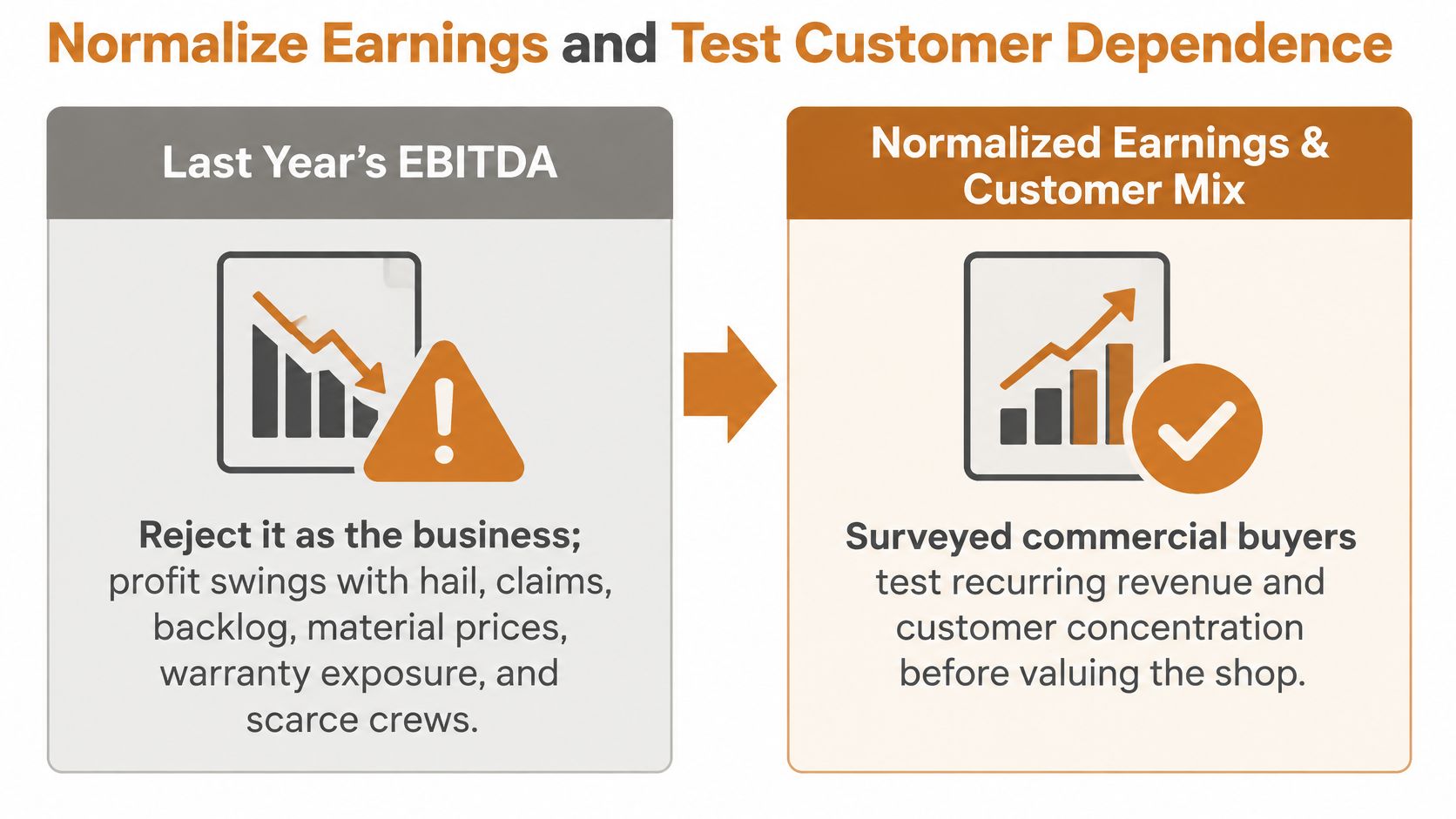
Normalized earnings estimate what the operation can produce without treating an exceptional period as permanent. Use job-level evidence, not a blanket discount to revenue.
Three earnings years a roofing buyer will rebuild
| Year type | What distorts the profit | What to put in the normalized figure |
|---|---|---|
| Ordinary year | Mixed residential and commercial work at typical margins | Use as the base case, with margin by job type |
| Severe-storm year | Insurance volume, temporary pricing, one-time gear | Remove nonrecurring storm profit and owner-only sales |
| Weak-demand year | Slow construction, material inflation, idle crews | Keep renewal revenue, change-order record, and crew retention |
In an ordinary year, separate repair, replacement, maintenance, and new-construction work. Compare gross margins by job type and check whether costs were posted to the correct projects. A delayed supplier invoice can make a completed job look more profitable than it was.
In a severe-storm year, isolate the exceptional work and its associated costs. Don’t remove storm revenue while leaving all the storm-related labor and equipment expense in the calculation. Likewise, don’t assume every insurance job disappears forever; distinguish an established repair capability from a temporary surge.
Owner-only sales need particular care. If those jobs require a replacement salesperson, include that cost; if they cannot realistically transfer, keep them out of the transferable base case.
In a weak-demand year, inspect what the business retained. Maintenance renewals, controlled change orders, and stable crews can show how the operation functions without abundant replacement work. Include the costs of keeping that capacity available rather than assuming idle labor becomes free.
Build a customer ledger showing revenue, gross profit, outstanding receivables, agreement terms, and the employee responsible for each relationship. Group related accounts together. Separate buildings managed by the same property manager may represent a common source of risk.
Test the largest account, the leading customer group, and any builder or insurance program that sends substantial work. Our guide to customer concentration risk explains why a customer list can look diversified while purchasing decisions remain concentrated.
Maintenance agreements need their own review. Record which agreements renewed, which expired, what services you owe, and whether the customer can terminate or must consent to a transfer. Repeat customers are valuable, but repeat business isn’t automatically contracted revenue.
If incoming calls still route through your personal phone, examine resources such as the Mercateer roofing answering service while documenting how inquiries become assigned work. An answering arrangement doesn’t establish transferable earnings by itself; the useful evidence is a repeatable process that another owner can operate.
A storm book depends on when the next weather event arrives. A maintenance route gives a buyer scheduled obligations and identifiable customer relationships to manage.
Carry separate ordinary-year, storm-adjusted, and weak-demand earnings estimates into pricing discussions. Label the assumptions and retain the supporting job reports so a buyer can challenge an input without discarding the entire calculation.
Consider fictional Shop A and Shop B, each with $4 million in annual revenue. This is an illustrative comparison, not a reported transaction or valuation.
Their work can look similar from the road while their businesses operate differently.

Shop A specializes in residential storm restoration. The owner closes most jobs, negotiates supplements, and checks production personally. Subcontracted crews handled a busy insurance season, but little future work sits under signed maintenance agreements.
The buyer must determine what survives without that owner and that season. Replacing the seller’s responsibilities costs money, and removing exceptional storm profit leaves a thinner earnings base. Shop A may still suit an experienced operator, but its revenue total doesn’t resolve those questions.
Shop B combines residential replacements with commercial work and maintenance agreements. A production manager runs jobs, account information sits in the company’s records, and no customer controls the schedule.
Its buyer can inspect renewal history, speak with managers during an appropriately controlled process, and compare completed-job margins with upcoming work. That makes ordinary-year profit easier to estimate. Shop B isn’t automatically worth a particular price, but the seller has more evidence to support the asking price.
The following video provides an additional viewing resource alongside this comparison.
Reported roofing transactions increased from 7 in 2018 to 53 in 2024, according to the industry reporting discussed by Roofing Contractor. Those are reported transactions, not a complete count of private sales.
Strategic buyers and investment-backed operators have sought local reputation, experienced crews, commercial relationships, and repair and maintenance work. Geographic expansion can also make an established operation useful to a particular buyer.
For an owner comparing roofing companies for sale, that activity establishes potential interest, not guaranteed competition. The stronger response is to demonstrate what a buyer can continue operating, rather than assume an active acquisition market will excuse missing records.
The listing price isn’t the amount you can spend after closing. Debt repayment, transaction expenses, payment timing, and taxes all affect what reaches your account.
The IRS guide to selling a business explains that a business sale is generally treated as the sale of individual assets, with consideration allocated among asset categories. That allocation affects the seller’s tax treatment and the buyer’s future deductions.
A roofing company may include heavily depreciated trucks alongside inventory, customer relationships, and owned property. Those items don’t necessarily receive the same tax treatment.
Roofing sale assets and the tax question to ask
| Asset group | Typical roofing items | Question for a tax adviser |
|---|---|---|
| Inventory | Shingles, underlayment, metal, fasteners | How much of the gain is ordinary income? |
| Equipment and vehicles | Trucks, trailers, tear-off and safety gear | How much is depreciation recapture, and when must it be recognized? |
| Real property | Yard, shop, or warehouse if owned | Is the property in the deal or sold separately? |
| Goodwill and intangibles | Name, customer ties, trained crew | How much qualifies for capital-gain treatment under the allocation? |
| Seller note | Installment payments after closing | Which tax is still due in the year of sale? |
Depreciation recapture is easy to overlook. Gain associated with previously depreciated property may receive ordinary-income treatment, and recapture can be taxable in the year of sale even when installment payments arrive later.
Seller financing changes when you receive money. It doesn’t automatically postpone every tax obligation.
Start with the agreed price and separate cash at closing from deferred or contingent payments. Subtract debt paid off and estimated transaction expenses, then have a tax adviser calculate the effect of the proposed asset allocation. Keep expected taxes separate from cash reserves needed for obligations you retain.
Gather depreciation schedules, vehicle and equipment records, inventory counts, property deeds, and a draft allocation before that meeting. Include the proposed seller-note terms so the adviser can compare payment timing with tax timing.
Our explanation of an exit tax rate can help frame that conversation, but it cannot replace transaction-specific calculations. Federal principles and state rules must be considered separately, and entity structure can change the analysis.
This isn’t tax advice. Have a CPA or tax attorney review the allocation and payment terms before relying on any proceeds estimate, preferably before accepting terms that are difficult to change.
Build the buyer’s review file before you advertise. The purpose isn’t to produce a polished folder. It’s to make every material claim in the listing traceable to a record.
Use a controlled document-sharing system with named access permissions. Keep sensitive customer and employee information out of broadly circulated marketing material.
Our financial due diligence checklist provides a broader organizing reference. For roofing, give particular attention to the connection between job costing, billing, collections, and remaining completion costs.
If the listing describes recurring maintenance revenue, the file should contain the agreements and renewal history. If it describes independent management, responsibilities should be documented and reflected in actual operations. Correct the description or strengthen the evidence before the first buyer meeting.
Listing is appropriate when you can support the earnings, explain the handover, and estimate what you’ll keep. A strong asking price without those foundations is an opening position, not a retirement plan.
Use the following decision test before committing to a sale process.
You should be able to present ordinary, storm-adjusted, and weak-demand earnings with defensible assumptions. You should also know whether a major account or your daily involvement creates a material gap in what transfers.
A tax adviser should have reviewed a proposed allocation and sketched after-tax proceeds. The estimate can change as terms develop, but it should be specific enough to test whether a sale meets your needs.
Wait if add-backs lack support, renewal history is unknown, or the only persuasive earnings period followed exceptional hail activity. Give someone responsibility for correcting each gap and identify the records that will demonstrate improvement.
Waiting doesn’t have to mean pursuing growth. Delegating estimating, documenting customer agreements, or reconciling job costs may make the existing business easier to evaluate without adding more projects.
Employees, customers, and competitors don’t need to hear that you’re exploring options. Share sensitive records only through a deliberate process with appropriate confidentiality protections.
The Owner’s Shortlist is not a broker and doesn’t sell businesses. We connect owners with a suitable specialist in one conversation when there’s a fit; introductions cost owners nothing and carry no obligation. Our current specialist network is limited to Florida, so owners elsewhere should expect a candid answer if no match exists.
Once your file is ready, speak with someone whose past work includes businesses like yours. Nothing here is legal, tax, or financial advice, and no listing price should be treated as an offer.
Visit The Owner’s Shortlist to describe your roofing company, your role, and what you want to understand before selling. We offer a no-cost, no-obligation introduction to a suitable specialist when there’s a fit in our Florida network, so you can discuss the business behind the asking price before deciding whether to list.
Who wrote this: The Owner's Shortlist is not a broker and doesn't sell businesses. We get paid the same no matter which specialist we introduce you to. More about how we work.
Tell us your situation. We'll connect you with a specialist who works with owners like you. One conversation, no sales pressure.
Found this useful?
Add The Owner's Shortlist as a preferred source and get our articles highlighted in Google Search results.
Add to Preferred SourcesLearn what an indication of interest means in a business sale, how it differs from a letter of intent, and what to review before you respond.
November 19, 2026
Sometimes. In small sales the owner often keeps the unpaid invoices. In bigger ones the buyer pays for them at a discount. Here's how to protect that money.
November 15, 2026
Your business name usually sells with the business. It only stays on the trucks if the contract says so. Here's what buyers do and what to put in writing.
November 15, 2026
What is a data room? Learn how virtual data rooms work in business sales, which documents to include, and how to control who sees them.
November 14, 2026