Roofing Companies for Sale: How to Judge Value
See how to judge roofing companies for sale using earnings quality, customer concentration, multiples, and after-tax proceeds.
November 16, 2026
By Remi Taffin · November 19, 2026 · Updated November 20, 2026
An indication of interest is a preliminary, generally non-binding proposal from a buyer that puts a price range and a rough deal structure on a page or two. It is the earliest signal in a sale, not a commitment, and there is nothing in it you can accept.
The email usually lands on an ordinary Tuesday. A buyer you’ve never met says they’ve reviewed the summary your adviser circulated, they’re “very interested,” and they’d like a short call. Attached is a two page document with a number on it. Your spouse reads over your shoulder and asks whether you’ve just sold the business. You haven’t. You’ve received a question, dressed up as an offer.
The gap between those two things is the whole skill. That number is a range, it comes with conditions attached, and the document itself will ask you for things before anyone pays a dollar. The business of this article is the detail behind the document: what the number really means, what the buyer has promised, and which pages you can’t take back once you’ve signed them.
Picture the morning after your adviser sends a short profile of the company to a list of buyers. One replies within an hour. He’s an owner of a larger firm two states over, he’s bought twice before, and he wants fifteen minutes on the phone. By lunchtime you’re wondering whether you should be negotiating.
You shouldn’t be. An indication of interest is a preliminary, generally non-binding proposal a buyer sends after reading high-level information about your business. It usually states a value range, how the buyer would pay, where the money comes from, and what it still needs to check. It is a screening document, written to be compared with others rather than to be accepted.
The simplest analogy is a contractor’s written ballpark estimate. He’s walked the property, he’s seen enough to give you a figure, and he’s told you what the number assumes. You use that estimate to decide whether he’s worth a full site inspection. You’d never send a deposit against it.
In a process run by an adviser, dozens of buyers see the summary, a shortlist returns an indication, and only a handful advance to management meetings, site visits, detailed diligence and eventually a letter of intent. Most of the people who read your summary will never write anything at all. The ones who do are telling you they’re willing to spend real time and money to look closer.
The definition has a legal history too, which is why the phrase keeps appearing in offers and filings. Under the SEC’s crowdfunding rule on soliciting indications of interest, a company may test whether investors are interested before it files an offering statement, and may collect names and contact details, but it may not solicit or accept money until that filing happens. The line the regulators drew is the same one that matters to you: interest is not money, and it never was.
The number feels like a price because it’s written down and because it’s often bigger than you expected. It isn’t a price. It’s a range with assumptions attached, produced before the buyer has checked a single month of your books.
Treat the first indication you receive as a template. Read it once for the number, then read it again for the conditions, because the second reading tells you who is able to close.
| Stage | Typical content | Binding status | Owner’s action |
|---|---|---|---|
| Indication of interest | Price range or valuation method, deal structure, financing assumptions, diligence scope | Non-binding on price; buyer can revise or withdraw | Compare against other IOIs and choose who advances |
| Letter of intent | Specific price or formula, timetable, key terms, often exclusivity | Price usually non-binding; exclusivity, confidentiality and expense terms often binding | Confirm which clauses bind you and for how long |
| Definitive purchase agreement | Final price, representations and warranties, closing conditions, indemnities | Binding once signed by both parties | Review with advisers before signing |
Read the table from left to right and you’re reading the deal getting narrower and more expensive to escape.
The indication of interest is the cheapest document in the sequence, for the buyer and for you. It gives a range or a valuation method rather than a fixed figure, and it leaves the buyer free to revise or walk away.
The letter of intent is where terms stop being comparable. It typically names a specific price or a formula that produces one, sets a timetable, and often asks for exclusivity, meaning you agree not to negotiate with anyone else for a set period. That last clause costs you real options even though the price in the same document is still not binding.
The definitive purchase agreement is the contract. It carries the final price, the representations and warranties you’re making about the business, the closing conditions and the indemnities that decide who pays if something turns out to be wrong.
In smaller deals, a buyer with a long relationship with the owner will sometimes go straight to a letter of intent with no formal indication round at all. That’s not a red flag, but it does mean you’ve skipped the stage where offers are easy to compare. If a letter of intent arrives first, ask what a comparable indication would have looked like and whether other buyers are still in the process.
Signing that document is a genuine event, and how you sign matters. eSign a letter of intent through a workflow that captures every page and every initial, so the version you agreed to is the version you can point to six months later.
The practical rule is a single question. When a buyer calls their document an indication, ask whether a letter of intent is expected next, what it would add, and how long any exclusivity would run.
An indication of interest exists to convert a vague expression of enthusiasm into a comparable screening proposal. In a competitive business sale, buyers review high-level information such as a confidential information memorandum, then submit an IOI that states an enterprise-value range or a valuation methodology, the proposed transaction structure, financing assumptions, required approvals, and the scope of confirmatory due diligence, as Investopedia’s explanation of the IOI sets out. Sellers use those variables, not the headline price alone, to decide who advances to management meetings, deeper diligence and a possible letter of intent.
A range is honest about what the buyer doesn’t know yet. Before diligence, nobody has checked normalized EBITDA, the working capital the business needs, customer concentration, a quality-of-earnings review, or the debt-like items that will be deducted at closing. A single figure written at this stage would pretend to a certainty nobody has.
So when a buyer quotes one number and calls it firm, ask what it assumes. The assumptions are the offer.
| Term | What to confirm | Why it changes the value |
|---|---|---|
| Cash at closing | Dollar amount paid on closing day | Only certain money; a high headline may be mostly deferred |
| Rollover equity | Share kept in the business and how it is valued | Value depends on a later sale and on performance |
| Seller financing | Note amount, interest rate, term and security | Paid over years and depends on the buyer repaying |
| Earnout | Target metric, measurement period and payout cap | Depends on results the owner no longer controls |
| Assumed liabilities | Debts, leases and warranties the buyer takes on | Can reduce net proceeds if not clearly carved out |
| Price-reducing conditions | Working-capital target, debt-like items and diligence exit rights | Can cut the price after the offer, often late in the process |
Two examples make the last two rows concrete. Rollover equity means you take shares in the buyer’s new company instead of cash, and those shares are worth whatever that company is worth when it’s sold again. An earnout means part of the price is paid only if revenue or gross profit hits a target after you’ve left, and the metric, the measurement window and the cap decide whether that money ever arrives.
The number to distrust is the biggest one. A headline price built on contingent consideration and financing that isn’t committed can be worth less than a quieter offer that wires cash on closing day.
That’s the test to run on every indication you receive: compare implied cash at closing, rollover, seller financing, earnout exposure, assumed liabilities and the conditions that could later reduce price. An IOI quoting a high multiple but leaning heavily on contingent money may be economically inferior to a lower, better-funded one.

The word “non-binding” appears in bold near the top, and owners relax when they see it. The relaxation is usually premature. A document can be non-binding on price and still bind you to something that costs you the process.
Transaction documents typically work like this. The buyer keeps the right to revise or withdraw before a definitive agreement, and nothing becomes binding until both parties execute that agreement. Confidentiality, access to information, exclusivity or no-shop commitments, expense allocation, governing law and similar process terms are frequently drafted as binding exceptions, as a sample transaction document filed with the SEC illustrates.
Indicative economics. The price, the multiple, the payment mix. None of it is enforceable, and all of it can move.
Conditions and exit rights. The diligence the buyer requires and the approvals it needs tell you exactly where it can walk. A financing condition, a landlord consent, a licensing transfer, a lender’s sign-off: each one is a door out.
Expressly binding covenants. This is the layer that matters and the one most often skimmed. Exclusivity, no-shop, confidentiality, information access, expense allocation, governing law.
Suppose the document grants four weeks of exclusivity while the buyer completes diligence. For those four weeks you cannot talk to the other two buyers who also sent indications, and you cannot accept an unsolicited approach. If your buyer’s financing stalls in week three, you restart the process with a colder list and a business that has visibly been on the market.
Four things to check before you sign anything, and they’re worth reading alongside a plain explanation of the letter of intent in business transactions:
Also test financing certainty, the seller representations you’d be asked to give, the working-capital assumption, how debt and cash are treated, and whether the buyer can assign or syndicate the deal to someone you’ve never met.
Read the binding sections before you discuss price. The price is the part that can still change. The clauses are the part that can’t.
Two indications arrive the same week. One leads with a number that makes you sit down. The other is noticeably lower and, reading closely, mostly cash. Without a method, the bigger number wins the argument in your head, and it shouldn’t.
Here’s the sort that takes about an hour and saves months.
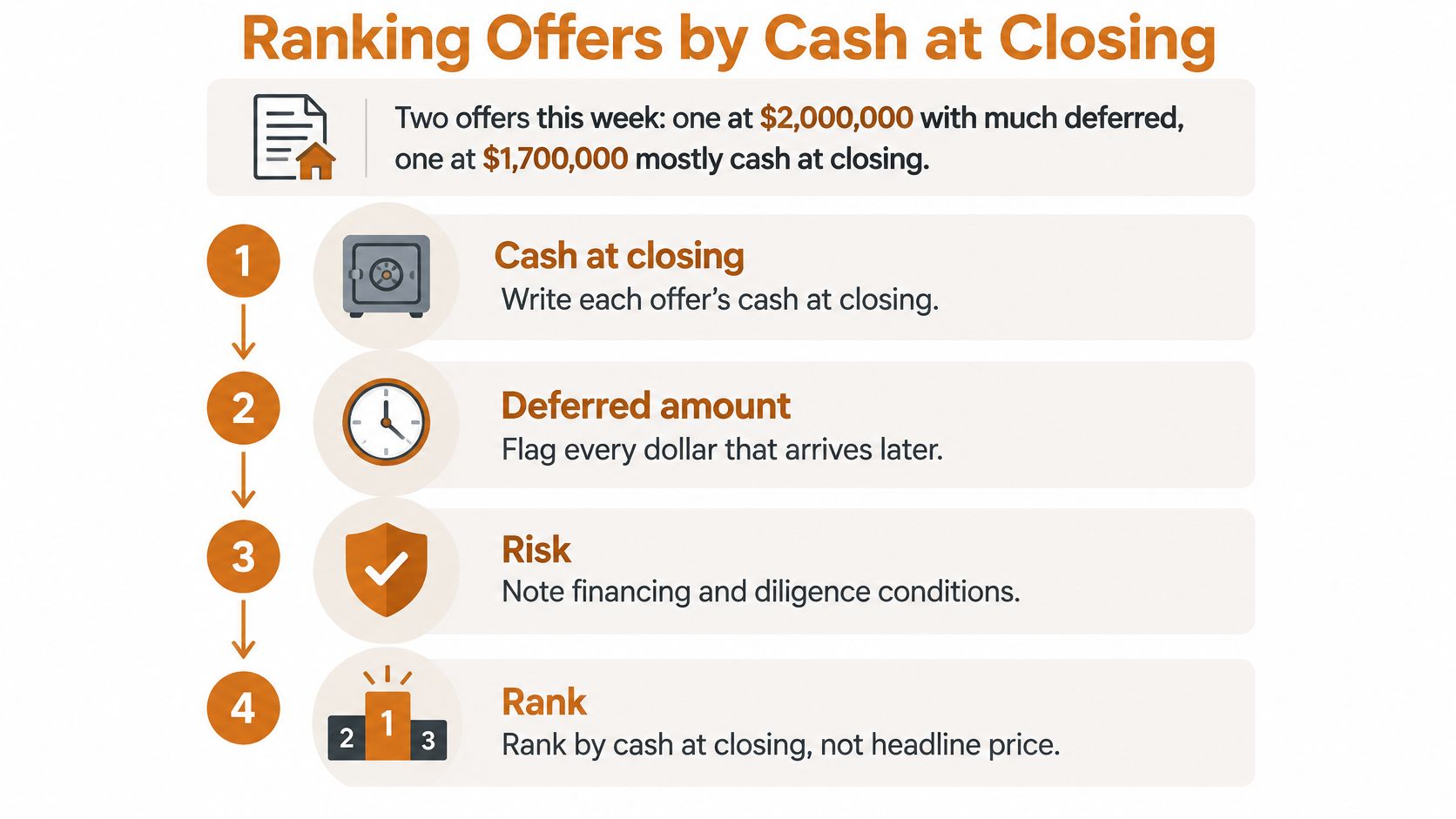
Offer A states $6.0M: $3.5M cash at closing, a $1.5M earnout paid over three years, and a $1.0M seller note. Offer B states $5.2M: $4.6M cash at closing, no earnout, and $0.6M of rollover equity.
| Offer | Headline value | Cash at closing | Rank |
|---|---|---|---|
| Offer A | $6.0M | $3.5M | Weaker starting point because less money is certain |
| Offer B | $5.2M | $4.6M | Stronger starting point despite the lower headline |
Offer B is the better starting point even though its headline is $800,000 lower. The earnout in Offer A depends on a business someone else will be running, and the note depends on the buyer’s ability to keep paying. The guide to how an earnout works is worth reading before you price one in your head at full value.
Public markets make the same point, which is why the disclosure rules exist. Under FINRA’s rule on indications of interest in public offerings, the lead book-running manager reports the names of interested institutional investors and the share quantities each has indicated, and the concern goes back to a November 2003 proposal that underwriters disclose those indications before an issuer fixed its IPO price. Even there, demand moves before pricing and final allocations differ from early indications.
Before you choose which buyer to take forward, send both a short list of written questions. The answers do more sorting than another round of calls.
Put the questions in an email, not a phone call. Written answers are comparable, they’re harder to soften, and they create a record you can hold a buyer to when the letter of intent arrives.
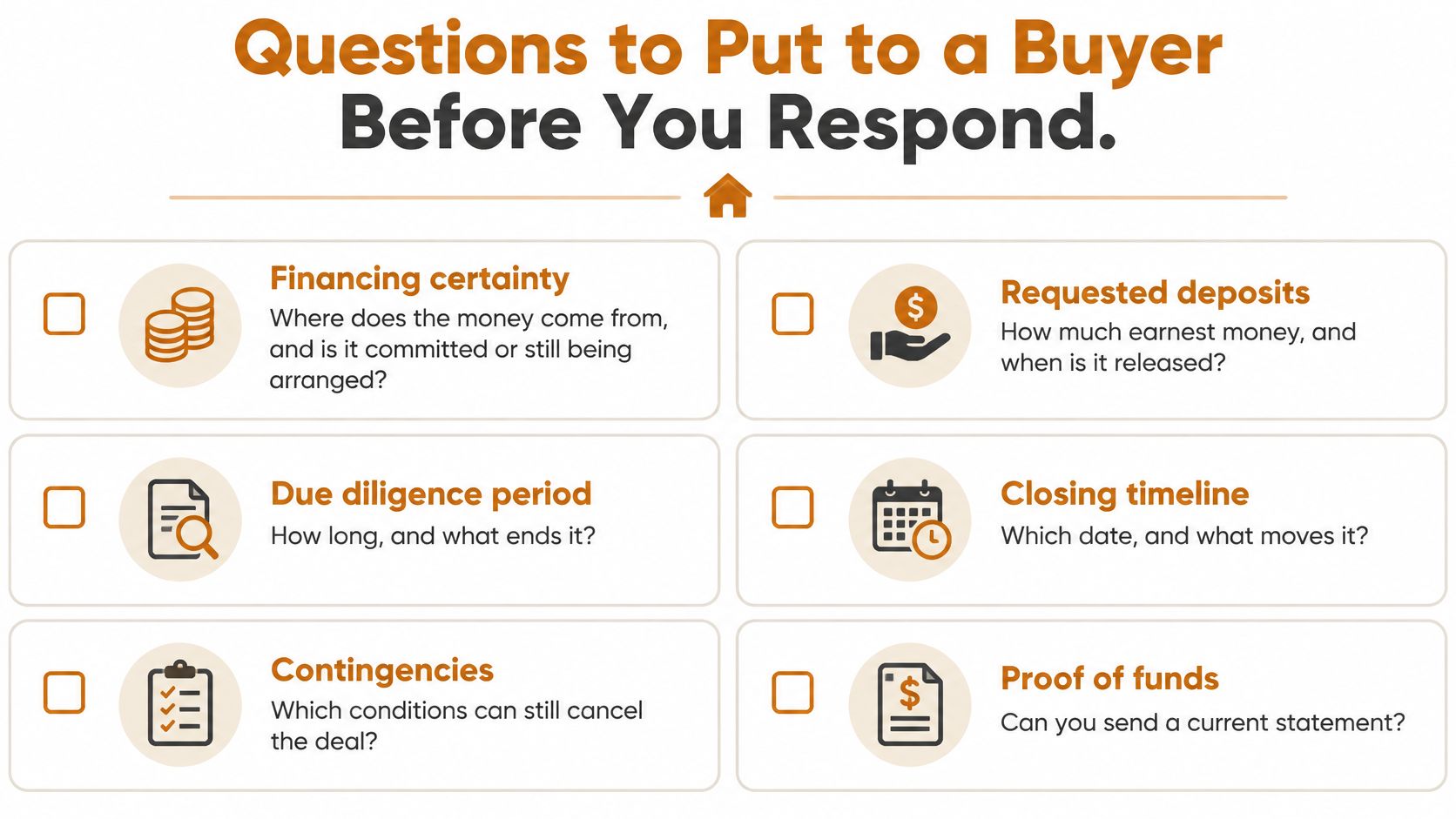
Where is the purchase money coming from? A clear answer names the source: cash on the buyer’s balance sheet, a committed line of credit, a named lender with a term sheet, or private equity with capital already called. A vague answer sounds like “we have strong banking relationships,” which tells you nothing about whether the money exists.
Is it committed or still being arranged? Committed means the buyer can show a letter. Being arranged means you carry the risk of someone else’s credit decision.
Which seller representations are you asking for? Ask for the list, ask how broad each one is, and ask how long they survive after closing. A representation that lives for three years against a business you ran for fifteen is a different proposition from one that expires in twelve months.
What working capital do you expect the business to leave behind at closing? You want a target level and a stated mechanism for a shortfall. Silence here usually means the gap gets settled late, at your expense.
Which debts are repaid from the proceeds, and does cash left in the business add to the price? A clear buyer works through the debt ledger line by line. A vague one says “we’ll handle the usual adjustments.”
Can you assign or syndicate this deal? You’re entitled to know whether the counterparty on closing day will be the person in front of you or a fund you’ve never heard of.
Which approvals are needed, and how long does each take? Lenders, landlords, licensing bodies and regulators all have their own clocks. A buyer who has done this before will name them without prompting.
When would a letter of intent arrive, and when do you target closing? If the answer to the second question is far behind the first, the buyer is still shopping.
The guide to spotting well qualified buyers covers the same ground from the other direction. Record every answer on one sheet, side by side for every buyer, so you’re comparing answers rather than impressions.
If a buyer can’t answer a money question in writing, that isn’t a communication style. It’s information.
Your reply is a process decision, not a sale. Once you’ve compared cash at closing, marked the binding covenants and read the written answers, one of three responses fits.
Whatever you choose, keep the choice, the exclusivity length and the cash at closing on a single sheet per buyer, and fill it in before anyone drafts a letter of intent. Comparisons made after the fact are just memory.
One more thing worth holding onto. The free service here is built for exactly this stage, when an owner needs a plain answer about what a document means rather than a pitch. You tell us your situation and we connect you with the right specialist in one conversation, and you’ll find the same idea behind The Owner’s Shortlist guide to choosing a business broker if you’d rather read first.
You don’t have to sort the two page documents alone at the kitchen table. The Owner’s Shortlist connects owners of service businesses with one specialist whose past deals match their industry and size, and the first conversation carries no sales pressure, because a person reviews your situation before anyone is introduced. If one of these indications is sitting in your inbox and you’re not sure whether it’s real money, tell us where you are in the process and we’ll point you to the right person. Start at The Owner’s Shortlist and describe what you’ve received.
Who wrote this: The Owner's Shortlist is not a broker and doesn't sell businesses. We get paid the same no matter which specialist we introduce you to. More about how we work.
Tell us your situation. We'll connect you with a specialist who works with owners like you. One conversation, no sales pressure.
Found this useful?
Add The Owner's Shortlist as a preferred source and get our articles highlighted in Google Search results.
Add to Preferred SourcesSee how to judge roofing companies for sale using earnings quality, customer concentration, multiples, and after-tax proceeds.
November 16, 2026
Sometimes. In small sales the owner often keeps the unpaid invoices. In bigger ones the buyer pays for them at a discount. Here's how to protect that money.
November 15, 2026
Your business name usually sells with the business. It only stays on the trucks if the contract says so. Here's what buyers do and what to put in writing.
November 15, 2026
What is a data room? Learn how virtual data rooms work in business sales, which documents to include, and how to control who sees them.
November 14, 2026