IOI vs LOI: What Sellers Must Know Before Signing
IOI vs LOI explained for business owners: what each document means, what can bind you, typical terms, sample timelines and when to bring in a broker.
November 6, 2026
By Remi Taffin · November 11, 2026
A buyer has sent you a letter of intent for the business you’ve spent years building. The price looks promising, and they’re asking you to sign so their accountants and lawyers can get started. Someone has reassured you that it’s non-binding.
That reassurance is incomplete. You may still be free to reject the eventual deal while already being committed to confidentiality, restricted buyer discussions, and other obligations. Before you sign, you need to understand both what you’re promising now and what could change the money you eventually receive.
A letter of intent in business, usually shortened to LOI, is a handshake written down before the lawyers prepare the full transaction contract. It records the principal terms of a proposed acquisition before buyer and seller negotiate a definitive purchase or merger agreement.
Say you own an HVAC company. A buyer wants the operating business, but you intend to keep the building. Before anyone spends heavily reviewing records, the LOI should identify the parties, describe what’s being purchased, outline the proposed payment, and establish the conditions for moving forward.
That handshake needs more detail than a price and a signature.
An acquisition LOI normally addresses:
The SEC-filed Therinject LOI, dated in 2009, proposed acquiring 100% of the company, targeted November 12, 2009 for executing a purchase agreement, and expressly excluded specified provisions from its otherwise non-binding treatment. That combination illustrates the central distinction: the parties can agree on a negotiation framework without committing to complete the acquisition.
A term sheet is generally a compact outline of proposed economics and structure. Don’t assume that its shorter length or different title makes it harmless. Its wording may still include operative commitments.
A definitive purchase agreement contains the detailed transaction obligations, including representations, covenants, remedies, and conditions to closing. In a properly drafted non-binding LOI process, that signed agreement, not the preliminary discussion of price, creates the obligation to close subject to its conditions.
An LOI creates a structured path toward a deal. It doesn’t itself transfer ownership.
Before negotiating, identify whether you’re holding a preliminary framework or a document intended to create transaction obligations. Then identify the commitments that take effect immediately.
The clauses most likely to bind you before closing govern your conduct, not the purchase price. Confidentiality, exclusivity, information access, expenses, and dispute provisions deserve separate attention even when the commercial proposal remains open.
The distinction appears in an SEC-filed acquisition LOI that makes the transaction subject to a definitive agreement while separately establishing confidentiality and exclusivity obligations. Treat that as a drafting architecture, not a universal rule about every document carrying the LOI label.
Use this table as a review guide. Usually binding describes common drafting intent, not a legal conclusion about the document in front of you.
| Clause | Usually binding? | What to check |
|---|---|---|
| Purchase price and consideration mix | No, non-binding | Valuation assumptions and what would change the number |
| Deal structure, stock or selected assets | No, non-binding | Which assets, liabilities, and contracts transfer |
| Financing | No, non-binding | Evidence of buyer funds and the timing of funding |
| Due diligence | No, non-binding | Scope of review, timing, and limits on access |
| Closing conditions | No, non-binding | Required approvals and conditions for signing or closing |
| Exclusivity or no-shop | Yes, binding | Length, milestones, outside date, and carve-outs |
| Confidentiality | Yes, binding | Duration and return or destruction of data if the deal ends |
| Access to records | Often binding | Which information is shared and who can see it |
| Expenses | Often binding | Who pays advisers, brokerage, and transaction fees |
| Non-solicitation of employees and customers | Often binding when expressly included | Duration, scope, and triggers for the restriction |
| Governing law and dispute venue | Yes, binding | Which jurisdiction’s law and courts apply |
Notice the distinction between due diligence and access to records. The buyer’s satisfaction with its investigation may remain a non-binding condition of the proposed deal, while your promise to provide specified records may be binding.
Similarly, a proposed post-closing employment restriction isn’t necessarily the same as a binding prohibition on approaching employees during negotiations. Ask counsel to identify which party is restricted, when the restriction starts, and what activity it prohibits.
A heading that says non-binding won’t necessarily resolve contradictory language elsewhere. If the document says the parties shall complete the purchase, but later says the transaction is merely proposed, you’ve created an argument rather than a clear boundary.
Ask for an express non-binding except for provision that identifies the binding sections precisely. Separate headings should make the distinction visible without requiring the reader to infer it.
For each operative restriction, record:
Suppose the acquisition falls apart after the buyer has reviewed your customer list. You need a clear answer about whether the buyer can retain that information, contact those customers, or share it with another portfolio company.
The LOI should expressly state that no obligation to close arises unless the parties sign a definitive agreement. That’s a drafting objective, not an automatic protection supplied by the document’s title. Have an acquisition attorney review the complete wording under the governing law before you sign.
Exclusivity gives the buyer protected negotiating time. For the seller, it means giving up some ability to pursue alternatives while the buyer investigates the business.
A no-shop clause may prohibit soliciting, encouraging, negotiating, or accepting competing proposals. Meanwhile, the buyer gains access to financial records, customer information, contracts, and operating details.
Public LOI examples described in the SEC-filed transaction materials include periods ranging from 30 days for due diligence to 90 days of mutual exclusivity, with extensions tied to defined conditions. Those examples aren’t a recommended duration for your sale.
The arrangement is asymmetric. The buyer benefits because it can spend money investigating without immediately competing against another offer. You bear the opportunity cost if the buyer moves slowly or lowers its proposed price after alternatives have gone quiet.
Say a landscaping buyer asks you to stop discussions with other interested parties. That request is more defensible if the buyer has an identified diligence team, available financing, and a document schedule than if it just wants time to explore the opportunity.
Attach exclusivity to observable milestones:
Avoid an automatic extension merely because the buyer says diligence remains underway. Define what progress qualifies and who confirms it.
Ask counsel to negotiate appropriate carve-outs for unsolicited superior proposals, fiduciary or legal obligations, and ordinary-course operations. These aren’t permissions you should assume exist without express drafting.
A superior-proposal carve-out also needs mechanics. Receiving an unsolicited approach, discussing it, and accepting it are different activities, and the clause should explain which are permitted.
Don’t grant protected time solely in exchange for enthusiasm. Ask what the buyer will deliver during that time.
The decision isn’t whether exclusivity is good or bad. It’s whether this buyer’s resources, timetable, and credibility justify temporarily giving up competing opportunities.
An earnout is part of the purchase price paid only if the business achieves defined targets after closing. The difficult question isn’t just how much might be paid, but who controls whether the targets can be reached.
Fasken’s discussion of SRS Acquiom’s private-target deal study reports that earnouts appeared in 24% of non-life-sciences deals in 2025, with median earnout potential reaching 34% of the closing payment. These are deal-study findings, not a prediction of what a service-business owner should accept.
Consider a commercial-cleaning company whose proposed earnout depends on retaining customers. If the buyer later changes account managers, raises prices, or moves contracts into another entity, the seller’s payout could become disputed even though the seller no longer controls those decisions.
The negotiation needs to connect payment targets with operating authority.

The LOI needn’t contain the full earnout agreement, but it should settle the principles that would make or break your willingness to sell:
Our guide to what an earnout is explains the payment mechanism. Your transaction documents must go further by assigning control and resolving calculation questions.
Compare offers using expected proceeds, not their maximum advertised total. A largely cash offer may leave you better positioned than a higher offer whose contingent payment depends on decisions you can’t influence.
Have your advisers compare collection risk, tax treatment, operating control, and the assumptions behind expected performance. Don’t treat the earnout’s maximum as money already earned.
Re-pricing before closing deserves similar discipline. Ask the LOI to identify the valuation assumptions, the findings that could justify an adjustment, and how the buyer must explain a proposed change.
For example, if the price assumes recurring customer contracts remain in place, specify how verified cancellations would be assessed. A documented adjustment principle gives you something concrete to negotiate against, even where the purchase price itself remains non-binding.
Seller safeguard: Don’t exchange a clear cash price for a contingent promise without understanding who controls the contingency.
Calling an LOI non-binding says little about the seller’s final proceeds. Escrow, holdbacks, indemnity exposure, and contingent payments can change what you receive and keep.
The DealLawyers discussion of the private-target deal study reports that 88% of 2025 deals included an escrow or holdback. That finding concerns retained purchase proceeds, not the frequency of exclusivity provisions.
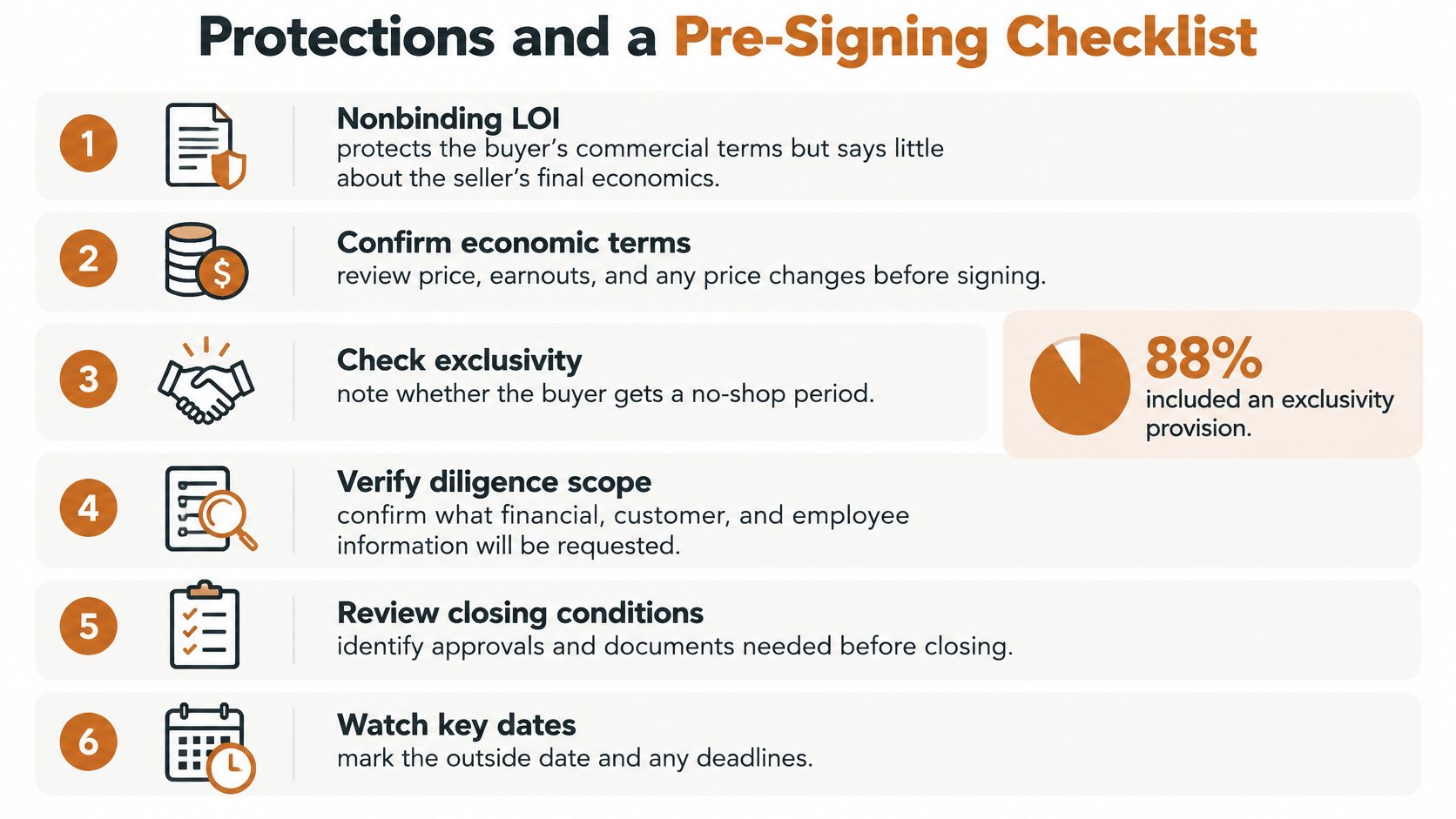
Use the checklist visual as a prompt, then document the actual negotiated protections.
Check how the LOI interacts with your business-sale confidentiality agreement. For electronic execution, PDFWix’s best practices for secure electronic signatures provides a useful process resource; signature security doesn’t replace legal review.
Our listed specialists work with owners on valuation, taxes, legal matters, deal structure, or family transfers. Introductions are free, with no obligation after the conversation, and we’re not a broker or a business seller.
Non-binding isn’t permission to sign casually. An abandoned acquisition can still leave a dispute about a binding process obligation.
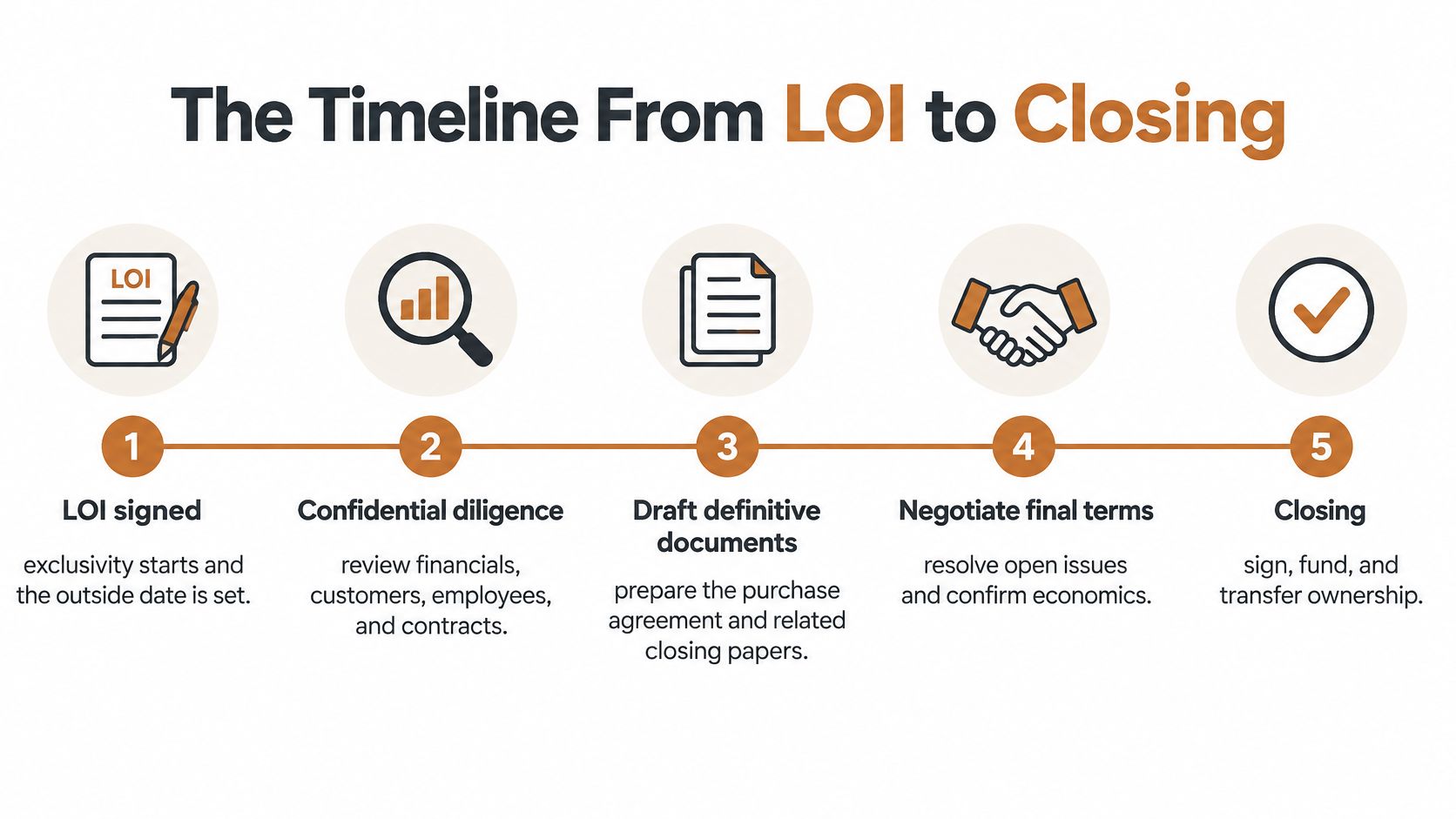
The route to closing should be a sequence of deliverables, not an indefinite investigation. Keep a shared calendar showing who owes what, which questions remain open, and when you’ll assess whether the buyer is progressing.
This timeline illustrates the main stages, though signing and funding may occur together or separately under the negotiated documents.
For broader context on the professionals and work involved, use our explanation of the M&A process. Keep the timetable specific to your transaction rather than treating another deal’s schedule as a promise.
The accompanying video offers another way to follow the transaction sequence.
Repeated information requests, delayed drafts, and unexplained price questions deserve a dated response. Ask what remains unresolved, who owns the next action, and whether the buyer can still meet the agreed deadline.
Before extending exclusivity, have counsel assess your termination rights and surviving duties. An independent business-side second opinion can help you decide whether to continue, invoke the outside date, or walk away.
We connect Florida owners by phone or a short form with a specialist whose past work fits their business. The specialist, not our site, is party to any engagement, and our editorial content isn’t legal, tax, or financial advice.
Before you sign an LOI or extend a stalled buyer’s exclusivity, visit The Owner’s Shortlist to discuss an introduction to a specialist whose past deals fit your business. Tell us which terms concern you, such as re-pricing, earnouts, or retained proceeds, so we can help you find an appropriate person to speak with, without cost or obligation.
Who wrote this: The Owner's Shortlist is not a broker and doesn't sell businesses. We get paid the same no matter which specialist we introduce you to. More about how we work.
Tell us your situation. We'll connect you with a specialist who works with owners like you. One conversation, no sales pressure.
Found this useful?
Add The Owner's Shortlist as a preferred source and get our articles highlighted in Google Search results.
Add to Preferred SourcesIOI vs LOI explained for business owners: what each document means, what can bind you, typical terms, sample timelines and when to bring in a broker.
November 6, 2026
Yes, and skipping one is a common seller mistake. Here's what a transaction attorney handles, what it costs, and how to find the right one.
April 1, 2026