Do you need an attorney to sell your business?
Yes, and skipping one is a common seller mistake. Here's what a transaction attorney handles, what it costs, and how to find the right one.
April 1, 2026
By Remi Taffin · November 6, 2026
An IOI is a non-binding early bid showing a price range, and an LOI is a later, more specific proposal whose exclusivity and confidentiality clauses can bind the seller even though the sale itself is not final.
The popular advice is to focus on the price difference between the documents. That misses the decision that matters most: when you agree to stop talking to other buyers. A more detailed offer isn’t automatically a safer offer, especially if the buyer gets control of the process before you’ve pinned down the economics.
For a long-time business owner, the right question isn’t which document comes next. It’s what you’re giving up, what the buyer must deliver in return, and how much of the proposed price you’re likely to keep.
IOI, LOI and definitive agreement compared
| Document | Main purpose | Price stated | What is binding | Usually arrives |
|---|---|---|---|---|
| Indication of interest (IOI) | Screen buyers and test valuation | Range with stated assumptions | Usually non-binding | After review of the confidential information memorandum |
| Letter of intent (LOI) | Turn interest into a defined proposed deal | Single price or tight pricing formula | Price usually non-binding; exclusivity, confidentiality and expenses may bind | After management meetings and preliminary diligence |
| Definitive purchase agreement | Final sale contract | Agreed price, adjustment mechanisms and transaction terms | Binding on signing, subject to closing conditions | After confirmatory diligence and negotiation, with financing addressed |
An IOI tests interest. An LOI defines a proposal. The definitive agreement creates contractual obligations to complete the acquisition, subject to its closing conditions.
Don’t mistake that sequence for a guarantee of progress. A buyer can advance through discussions without resolving its financing, and a detailed document can still leave essential commercial terms unanswered. Your job is to distinguish more paperwork from more certainty.
A document called an indication of interest deserves immediate legal review if it includes a no-shop obligation. Conversely, an LOI that leaves the payment structure unresolved hasn’t given you enough information to judge the offer.
Use the table to identify what the buyer is asking you to do. Are you acknowledging a preliminary range, agreeing on a transaction framework, or signing the final acquisition contract?
Practical rule: Judge the commitment by the operative clauses, not the document’s heading.
Keep the signed confidentiality agreement alongside whatever arrives next. Don’t assume a new proposal replaces obligations you’ve already accepted.
Before you respond, identify which document you’ve received and which row it matches. If the title and the obligations point to different rows, have your attorney resolve that mismatch before you sign.
An indication of interest is a screening bid, not a completed negotiation. The buyer has reviewed the confidential information memorandum, asked initial questions, and offered a preliminary view of value.
The ACED guide to the M&A process describes IOIs as generally non-binding proposals that set out a valuation range, transaction structure, financing assumptions and major conditions, sometimes in an email or short letter. Their purpose is to help the seller decide which buyers deserve further access, and an accepted IOI doesn’t guarantee a later LOI.
A valuation range is useful only when you understand its inputs. The O’Reilly Mergers & Acquisitions chapter highlights the assumptions owners should examine, including normalized earnings, add-backs, debt, cash, working capital and deferred consideration.
Ask for the following in writing:
Say competing IOIs show the same headline value. One proposes cash at closing, while the other expects you to finance part of the purchase. Those aren’t economically equivalent offers, even before you examine the buyer’s creditworthiness.
Don’t reward an unexplained upper end by treating it as the likely outcome. Ask what operating performance supports that value and what would put the business at the bottom of the range.
Before advancing a buyer, ask: What exactly are you valuing? How will you fund the purchase? What could change your offer? If the answers remain vague, keep the buyer in the screening stage.
An LOI should resolve ambiguity, not move it into a longer document. By this point, the buyer should be able to explain the proposed transaction in terms your attorney, tax adviser and broker can evaluate.
The Acquire.com explanation of letters of intent describes a framework covering price, consideration, diligence, financing conditions, holdbacks, timing and approvals. It also makes the key distinction: the commercial proposal can remain non-binding while selected process obligations are enforceable.
Start with what the buyer is purchasing. An asset transaction and a stock transaction aren’t interchangeable choices. Have your advisers assess the proposed structure before you become attached to the price.
Next, separate the consideration into its components:
Then examine the price mechanism. A stated purchase price can still be adjusted for working capital, debt and other agreed items. Ask your adviser to produce a plain-language bridge from headline value to estimated closing proceeds.
For example, a proposal described as a cash-and-note transaction should show the closing payment and seller-financed balance separately. Don’t let the buyer present their combined face value as though you receive all of it on closing day.
The LOI should identify the diligence scope, financing conditions, required approvals, anticipated holdbacks and intended closing timetable. Give each unresolved issue a named decision-maker rather than accepting a general promise to work it out.
Before signing, pin down whether the price is fixed or formula-based, when diligence must finish, what financing evidence is required, and the outside closing date. Define earnout and seller-payment terms while you still have room to negotiate.
A conditional roadmap is useful only if both parties can tell when the conditions have been met.
Leave legal drafting to counsel, but don’t leave commercial decisions unanswered. The owner, not the document drafter, decides which risks are acceptable.
Non-binding doesn’t mean consequence-free. The Mergers & Acquisitions guide identifies confidentiality, information access, expense allocation, governing law and exclusivity among provisions that can bind parties before the acquisition itself becomes final.
Read those clauses with your attorney before treating the LOI as a preliminary formality.

A no-shop provision can prevent you from soliciting or negotiating competing offers while the selected buyer conducts diligence. You’re giving that buyer protected access to the business and restricting your alternatives.
That matters if the buyer discovers a customer issue, challenges your earnings adjustments or changes its financing plan. You may face a proposed price reduction while your ability to pursue another buyer is constrained. Exclusivity is something you negotiate, not a courtesy you automatically extend.
The Investopedia explanation of indications of interest reinforces why preliminary interest and the obligations attached to subsequent negotiations need separate attention. Don’t assume a non-binding price makes every other paragraph optional.
Use a marked-up copy of the LOI and ask counsel to identify:
Ask what happens if the buyer walks away. Confirm which provisions survive termination and whether any obligations continue after exclusivity ends.
Ordinary business conversations also need protection. Have counsel distinguish prohibited sale discussions from routine customer service, employee management and financing activity.
Before signing, secure a diligence deadline, financing milestone, outside closing date and workable termination rights. Don’t rely on a buyer’s assurance that it intends to move quickly. Negotiate what happens if it doesn’t.
Rank offers by economic certainty, not the largest number on the page. A lower offer with credible funding and straightforward cash consideration can be more attractive than a higher proposal whose value depends on future performance and buyer-controlled decisions.
Panoramic Capital Partners’ explanation of the path from IOI to closing emphasizes how assumptions about structure, working capital, financing, owner compensation and deferred payments become specific conditions as negotiations advance. Those conditions determine what you receive and what remains at risk.
Use the same categories for every buyer. Don’t compare a detailed proposal against another buyer’s unexplained maximum valuation.
Economic certainty worksheet for comparing offers
| Term | What to verify | Effect on certainty |
|---|---|---|
| Cash at closing | Amount actually payable after agreed deductions and holdbacks | Highest immediate payment certainty once funds are received, although contractual claims may remain |
| Seller note | Security, interest rate, term and subordination to bank debt | Repayment relies on the buyer’s ability to pay and your enforcement rights |
| Earnout | Metric definitions, measurement period and buyer control over operations | Payment is contingent on performance and operating decisions |
| Working-capital target | Normalization method, included accounts and target amount | Adjustments can increase or reduce closing proceeds |
| Debt and debt-like items | Precisely which liabilities the buyer deducts | Deductions reduce proceeds without changing the advertised value |
| Rollover equity | Valuation, ownership rights, distributions and exit provisions | Capital remains invested and may be difficult to realize |
| Employment and transition | Required role, duration, compensation and payment conditions | Some economic benefits may require continued involvement |
Our guide to deal structuring helps owners separate purchase consideration from financing arrangements and continuing obligations. The Owner’s Shortlist also publishes a guide explaining how a business is valued and the methods specialists use, including the questions to ask about the valuation approach.
An earnings multiple, asset-based valuation or discounted cash-flow calculation can help explain a buyer’s headline. None replaces a clear payment schedule.
Start with expected cash at closing after debt-like deductions and the proposed working-capital adjustment. Keep transaction costs and tax estimates visible rather than confusing gross sale value with personal proceeds.
Next, show deferred amounts separately and discount them for their payment risk with your advisers. Don’t count a contingent earnout as guaranteed money or treat rollover equity as available retirement cash.
Decision test: Would you still choose this buyer if the contingent payments never arrived?
Avoid double-counting deductions when building the comparison. Ask each buyer to confirm the same proceeds bridge, then investigate differences instead of smoothing them away.
Earnouts and diligence standards remain material negotiated terms, not administrative details. Your preferred offer should reflect both the amount you could receive and the conditions under which you’ll receive it.
Plan the sale around decision gates, not an assumed calendar. Business size, financing requirements, document quality and the buyer’s diligence scope affect the schedule, so negotiate dates for your transaction instead of accepting a generic promise.
Use the process visual as an orientation aid, then put the actual sequence and agreed deadlines into your working plan. The buyer should review protected information before submitting an informed IOI.
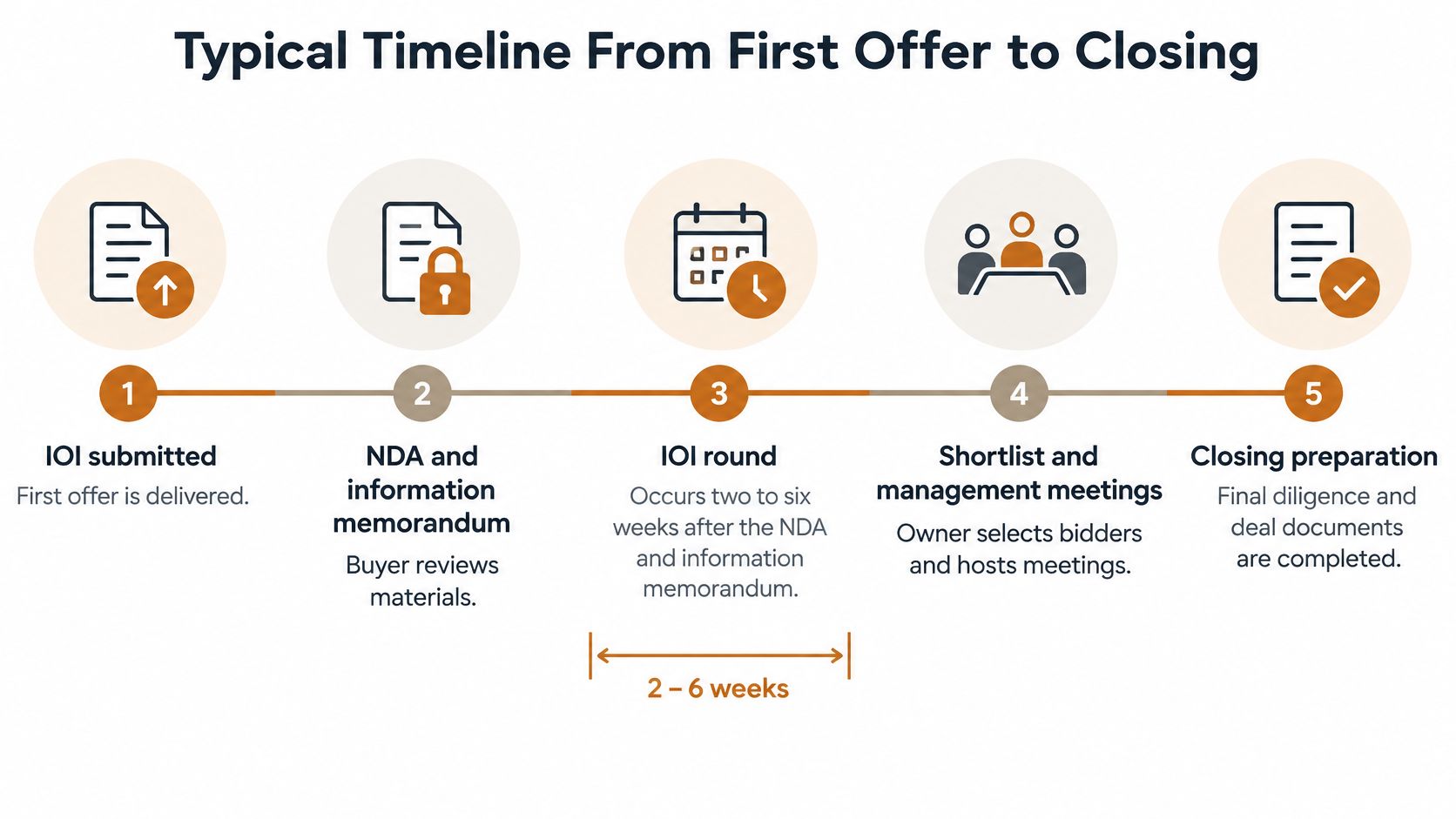
Sample sale timeline and owner actions
| Stage | Typical timing | Owner action |
|---|---|---|
| IOI round | After NDA-protected information review | Prepare normalized earnings and add-back support |
| Management meetings and shortlist | After preliminary bids are evaluated | Organize customer concentration, contracts and key staff data |
| LOI negotiation | After selected buyers complete preliminary discussions | Agree diligence deadline, financing milestone and outside date |
| Exclusivity and confirmatory diligence | During the expressly negotiated exclusivity period | Answer working-capital and debt-like item requests promptly |
| Definitive agreement negotiation | Alongside or following confirmatory diligence | Review representations, indemnities and earnout definitions |
| Closing | After signing and satisfaction of closing conditions, or concurrently where agreed | Confirm consents, payoff letters and closing funds |
Say you own a commercial cleaning business and receive credible preliminary interest. Before management meetings, organize customer agreements, renewal provisions, revenue concentration and key employee responsibilities in a controlled document room.
During LOI negotiations, reconcile your working-capital records and list liabilities the buyer might characterize as debt-like. Have your accountant support earnings adjustments with documents rather than explanations alone.
The exclusivity window overlaps the most sensitive information exchange. Prepare earlier than feels necessary so you aren’t trying to reconstruct financial records while negotiating the final agreement.
For additional context on acquisition discussions, use the accompanying video.
Keep ordinary customer service and employee routines running throughout. Assign a document coordinator and maintain an open-issues log so the buyer’s requests don’t consume every management conversation.
Your working schedule should identify who owes each deliverable and when. A deadline without an accountable person isn’t much of a process control.
Don’t reject an offer merely because it contains negotiable risks. Reject the idea that those risks must remain undefined until the lawyers prepare the final agreement.
Use this visual as a meeting prompt, then ask the buyer questions that require a clear answer.
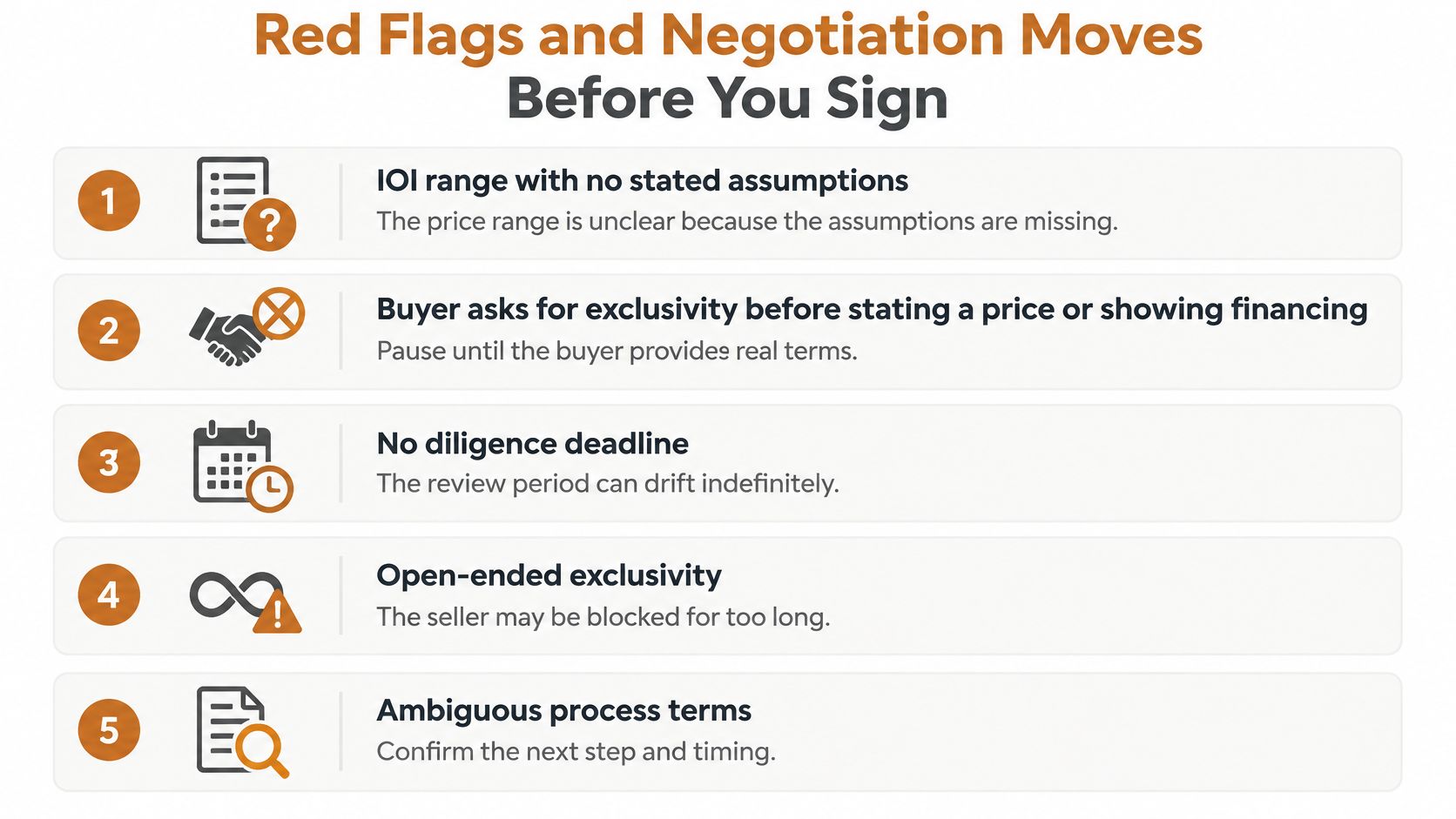
If the buyer needs protected time, ask for a defined work plan and demonstrable progress. If it wants deferred consideration, negotiate the protections attached to that deferral rather than discussing the headline alone.
LA Law Group, APLC’s contract negotiation tips for small businesses can help you prepare for the broader contract conversation. Use that preparation to identify your priorities, then have transaction counsel translate them into enforceable language.
Don’t sign because the buyer calls the document standard. Ask which provisions it will change and why it needs the ones it won’t.
You make the commercial decision. Your advisers should make sure you understand the cost of saying yes.
Get independent review before granting exclusivity, particularly if this is your first sale or the proposal includes a seller note, earnout or rollover equity. A private equity buyer, family transfer or key-employee acquisition also deserves a deliberate review of the economics and relationships involved.
The buyer’s advisers work for the buyer. Their explanation of a provision isn’t a substitute for advice from someone responsible to you.
Ask a prospective broker how they would evaluate your actual payment structure and exclusivity request. Our questions to ask a business broker can help you assess whether their past work fits your situation.
A broker doesn’t replace counsel, and counsel shouldn’t have to infer your commercial priorities. Give both the same marked-up proposal and a written explanation of what matters to you.
At The Owner’s Shortlist, a real person speaks with you and introduces you to a specialist whose past sales fit your business, most often a business broker. You receive an individual introduction, not a directory to sort through.
Owners pay nothing, and there’s no obligation afterward. Most brokers on our list have 25 to 50 years of experience; the specialist list is Florida-based today, and we say so when there’s no good fit.
Nothing on our site is legal, tax or financial advice. Write down the terms you won’t accept, including your limits on deferred payment and exclusivity, then have an attorney and broker review the LOI before signing.
The Owner’s Shortlist offers a free, no-obligation introduction to a specialist whose past work fits your business. Before an LOI restricts your options, visit The Owner’s Shortlist to speak with a real person about finding the right help to compare the offer and negotiate its terms.
Who wrote this: The Owner's Shortlist is not a broker and doesn't sell businesses. We get paid the same no matter which specialist we introduce you to. More about how we work.
Tell us your situation. We'll connect you with a specialist who works with owners like you. One conversation, no sales pressure.
Found this useful?
Add The Owner's Shortlist as a preferred source and get our articles highlighted in Google Search results.
Add to Preferred Sources