How to Finance Buying a Business: A Step-by-Step Playbook
Learn how to finance buying a business using SBA loans, bank debt, seller notes, and earnouts. A practical playbook for buyers of service companies.
October 23, 2026
By Remi Taffin · July 25, 2026
An acqui-hire means the buyer is mainly after the team, not the product. For a seller, that usually feels less like a classic business sale and more like a partial exit plus a job offer attached to the closing.
You may be hearing that word because a buyer likes your people, your technical chops, or your customer relationships more than your balance sheet. If that’s the conversation on the table, stop thinking like you’re selling a whole company and start thinking like you’re negotiating a controlled wind-down with employment terms, tax consequences, and a very different price logic.
A buyer calls, says your team is what they want, and then offers a number that feels light for a “sale.” That gap is usually the point. In an acqui-hire, the buyer is mainly paying for your human capital, usually a cohesive group of employees, not for the product, customer base, or stand-alone assets. After closing, the old business is often shut down.
That changes the deal for an owner. You are not being paid the way a strategic buyer pays in a normal acquisition. You are being paid mostly for delivering a ready-made team, with less recruiting risk and less delay for the buyer.
Practical rule: if the buyer keeps talking about your founders, engineers, technicians, or key staff, but stays vague about the product, the business is probably being priced as talent, not enterprise value.
The core questions are straightforward ones. Who is being hired, who is staying, who gets retention money, and what happens to the company after the papers are signed? The transaction can still be set up as a stock or asset purchase, but the economic center shifts toward retention packages and employment terms, not a stand-alone operating business.
A normal acquisition tries to keep the business alive because the buyer wants revenue, customers, intellectual property, or market position. An acqui-hire usually does the opposite. It pulls out the people, then leaves the shell behind to be wound down or absorbed.
Owners should treat acqui-hire language as a warning label, not a compliment. It can still be a good result, especially if the business is under pressure or the team is the main asset. But it is a different animal from selling a profitable company to a buyer who wants to run it.
The term exists because buyers kept running into the same problem. They needed a capable team faster than they could recruit one, and founders needed some kind of exit instead of a hard shutdown. The market eventually put a name on that deal shape, acqui-hire.
The logic is plain. Hiring one person takes time. Hiring a whole team that already works well together takes even more time. If the buyer wants the people, the working relationship, and the specialist know-how already in place, paying for the assembled team can beat trying to build it from scratch. The value is speed and certainty, not a trophy asset.
The term became visible in early-2010s Silicon Valley, where large technology firms used acqui-hires as a faster way to secure engineering talent and experienced teams. Later legal and advisory writing treated it as a recognized M&A pattern rather than a quirky startup workaround (Analysis Group paper on acqui-hires).
A local plumbing company buying a smaller rival mainly for the two best technicians and the field relationships they already have is the same basic deal logic. The buyer may keep the crew, drop the brand, and let the old entity fade out. The business shell matters less than the people attached to it.
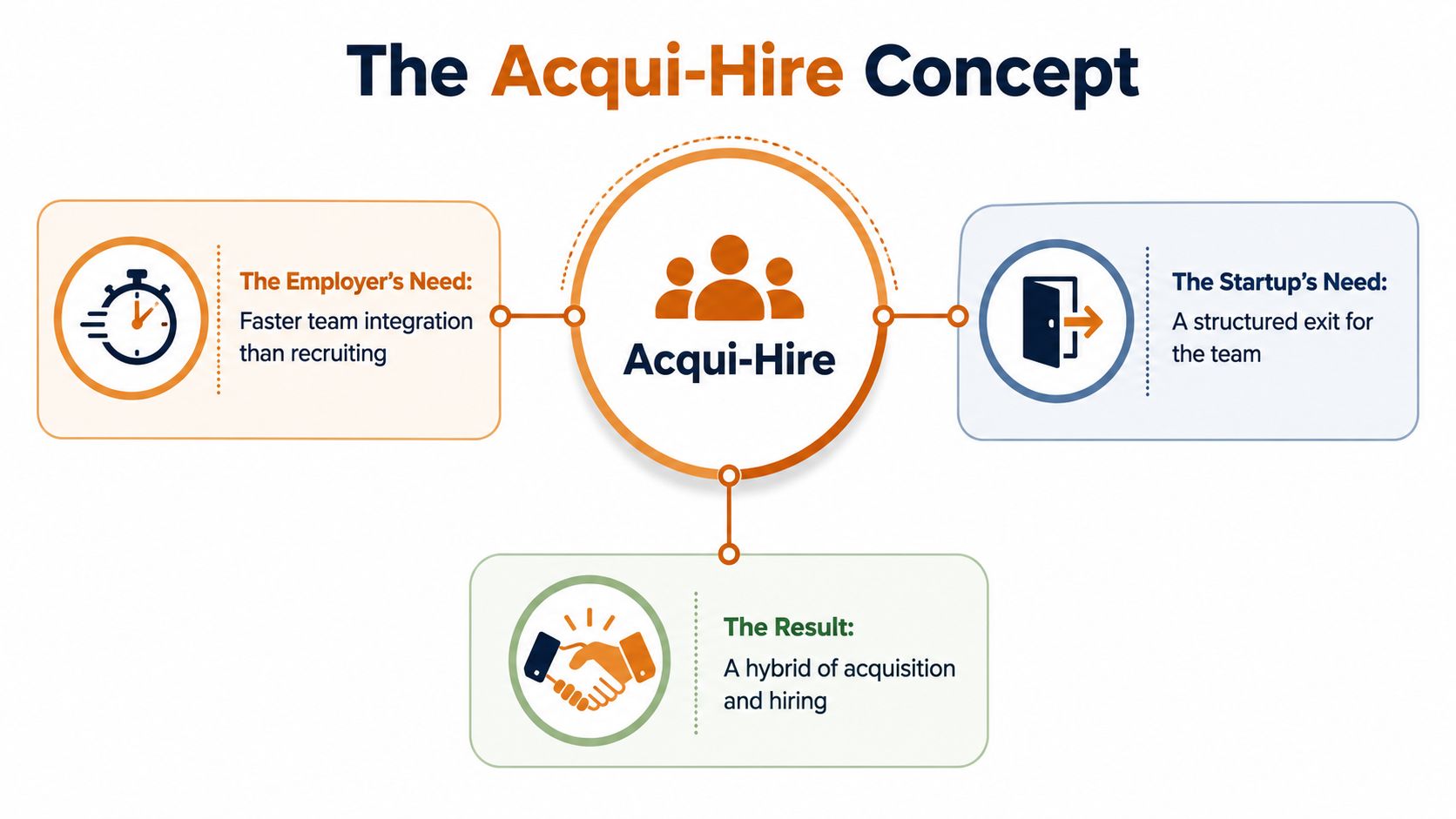
Owners get tripped up here because they hear “acquisition” and expect asset value, goodwill, and customer transfer. Buyers using acqui-hire logic are often after something narrower, the people, maybe a slice of IP, and a clean path to move on.
That is why the term stuck. It describes a hybrid reality, part hiring decision, part acquisition structure, part controlled wind-down for the seller. Once you see it that way, the deal reads very differently.
Owners usually compare the wrong things. They compare an acqui-hire to a full sale and miss the fact that the nearest alternative may be direct hiring. Those three options solve different buyer problems and produce very different outcomes for the seller.
| Dimension | Acqui-Hire | Full Acquisition | Ordinary Hiring |
|---|---|---|---|
| What the buyer wants | Mostly the team and know-how | The whole business, including customers, revenue, IP, and operations | Individual employees |
| What the seller keeps | Usually little, sometimes a shell of the business | The sale process can preserve more value through the going concern | The business stays intact |
| What usually happens after closing | The company is often wound down or merged into the buyer | The business may continue under new ownership | Nothing happens to the business entity |
| How the seller is paid | Compensation economics, retention packages, and deal structure drive value | Price reflects enterprise value logic | No sale price, just wages and benefits |
| What the owner should expect | A job offer or retention role may be part of the deal | A real exit is more likely | No transaction, just employment |
A full acquisition is what most owners picture when they hear “sale.” Someone buys the business because it generates cash, owns assets, or controls customer relationships. An ordinary hiring event is simpler. The buyer just recruits the people they want and leaves the company behind.
An acqui-hire sits in the middle, but it’s much closer to hiring than to a true business sale. The buyer is trying to avoid the cost and delay of recruiting a team. The seller is often trying to salvage value from a business that no longer deserves a clean standalone valuation.
If the buyer wants the people and the company to disappear, it is an acqui-hire. If the buyer wants the business to keep operating, it’s probably a full acquisition. If the buyer only wants one or two people, it may just be hiring with some extra legal packaging around it.
For owners, the danger is assuming the buyer’s language tells the whole story. It doesn’t. Watch what they ask for, what they ignore, and whether they care about the business after the team is moved over.
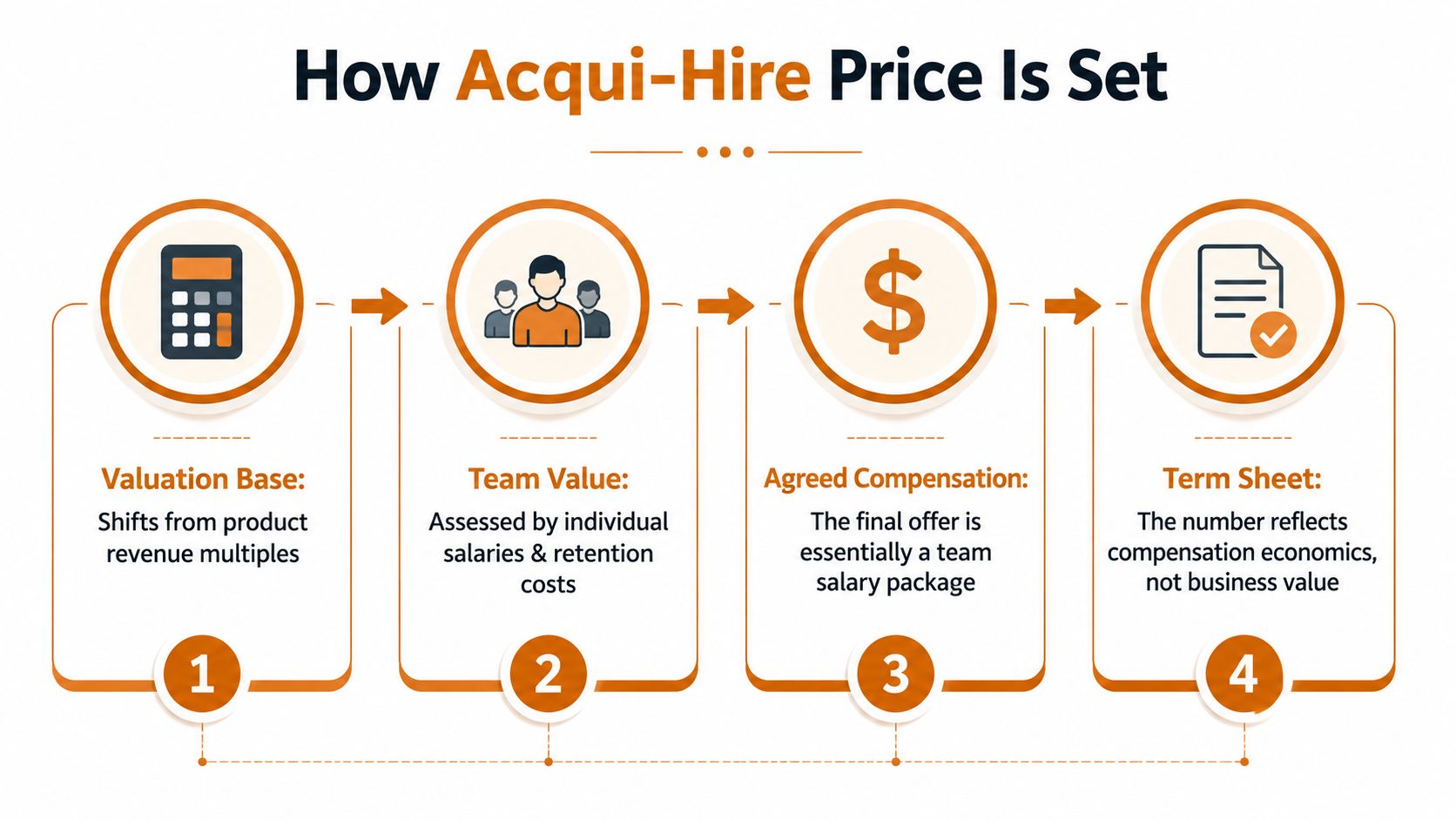
This is the part most explainers skip, and it’s the part sellers need most. When the product is not the point, the number on the term sheet is usually built from employment retention economics, not normal enterprise valuation (Startup SuperSchool glossary). In plain English, the buyer is asking, “What would it cost us to hire this team ourselves, and how much extra are we willing to pay to get them faster and with less risk?”
The better comparison is not a revenue multiple. It’s the cost of recruiting, signing, and keeping the same people through a direct hire process, plus whatever premium the buyer assigns to speed and certainty. That’s why a headline price can look disconnected from the business’s actual operations. The offer is often tied to keeping people in place, not buying the company’s future cash flows.
The seller should compare the proposed package against standalone employment alternatives, not against a fantasy sale price.
That also explains why founders and key staff can be treated very differently from common stockholders. The buyer may allocate value to hiring packages, retention bonuses, and new equity grants, while the rest of the cap table sees much less. If the transaction is structured around talent, investors may recover only a fraction of what they put in.
A useful mental model is goodwill. If you want a clean way to think about how intangible value gets treated in a sale context, review this plain-English goodwill definition. In an acqui-hire, though, the buyer is often paying less for goodwill in the classic sense and more for the cost of moving a functioning team.
If an owner hears a buyer talk about “fairness” or “fit,” that’s not enough. Ask what part of the number is cash, what part is contingent, and what part is really a retention device dressed up as purchase price. The structure tells the truth faster than the headline.
Owners often fixate on the closing number and ignore the aftermath. That’s a mistake. After an acqui-hire, the legal entity, the team, and the contracts can all end up in different places, and those differences affect both risk and cash.
Employment agreements usually do not transfer automatically just because the buyer bought the company. The buyer typically needs new hiring paperwork, new compensation terms, and new retention promises for the people it wants to keep. That means the close is often followed by a second set of negotiations, not the end of the process.
Retention money matters because it keeps key staff from leaving right after the deal. But from a tax point of view, that money is usually treated as ordinary compensation, not as capital gains. That distinction matters because it changes what the recipient keeps after tax.
If the deal is mainly about people, customer obligations can become a messy handoff. Some vendor contracts may end up with the old entity. Some customer warranties may need explicit handling. Some service obligations may need new paper. If the business is being wound down, someone has to decide whether the brand survives, whether promises are assigned, and who answers when a customer calls.
A clean acquisition is easier to explain than it is to execute. In a talent-driven deal, the operating business often gets dismantled while the people move. That is why owners need legal and tax people in the room early, not after the buyer has already sent a term sheet.
Recent U.S. labor data showed that the unemployment rate for computer and mathematical occupations remained well below the national average in 2024 (Duke Law Journal analysis). That helps explain why tech buyers keep paying for retention. Skilled labor is still hard to replace quickly.
The same pressure can show up in owner-operated trades and service firms when a crew is hard to rebuild. A buyer that wants the technicians, installers, or bookkeepers may structure the deal around keeping those people, not around preserving the old company.
For a practical owner-side checklist on employees and deal transitions, review what happens to employees when you sell a business. The short version is simple. If you don’t know what transfers, what ends, and what gets rewritten, you don’t yet understand the deal.
A bad acqui-hire often starts with friendly language. The buyer says they admire the team. The advisor says the process is “straightforward.” Then the owner discovers the deal is mostly about getting people cheaply and discreetly. That’s when you need to slow down.

Then ask direct questions. Who is being hired? What happens to the legal entity? What happens to customer contracts? Who handles the tax treatment of retention money? Has the advisor worked on a controlled wind-down before?
The terms matter more than the pitch. If the buyer’s lawyer, HR lead, and finance team are already coordinating behind the scenes, your side needs to be just as organized. That’s why owners should interview advisors the same way they’d interview a key executive. If the answers are fuzzy, move on.
Ask how the advisor gets paid, what they’ve handled in a wind-down, and whether they’ve negotiated talent-heavy deals before. If they can’t answer cleanly, they’re guessing with your exit.
You can also use these practical questions for a business broker as a template, then adapt them to an M&A lawyer or tax specialist. The point is not to collect a stack of forms. The point is to force clarity before anyone gets emotionally attached to the buyer’s story.
Acqui-hire logic shows up far outside Silicon Valley. It appears any time a buyer wants a trained team, a working client relationship, or a specialized crew faster than it can build one itself. The business category changes, but the deal instinct stays the same.
A regional HVAC company gets approached by a larger platform buyer. The buyer likes the install crew, the service manager, and the dispatch discipline. The owner expects a sale of the brand and route book. Instead, the buyer talks mainly about keeping the technicians and folding the rest into its own operation. That is an acqui-hire wearing a trades-company label.
A bookkeeping practice gets interest from a local accounting group. The buyer is less interested in the small firm’s name than in the relationships its bookkeepers have built with long-time clients. The owner may receive a modest transaction, while the staff gets absorbed and the practice itself is retired.
A small software reseller with a few in-house engineers gets called by a larger channel partner. The buyer already has distribution. What it lacks is technical people who know the product stack and can support implementation. The buyer doesn’t need the reseller to remain a separate business. It wants the team and the know-how.
In each case, the seller gives up the standalone company faster than they expected. What they gain is a cleaner outcome than a hard shutdown, plus a way for the team to keep working under a stronger owner. What they lose is the chance to sell the business as a continuing enterprise with all the usual upside.
The pattern is consistent. The buyer is buying capability, not a brand story. Owners who understand that early can negotiate better retention terms, clearer employment transitions, and fewer surprises when the old entity gets dismantled.
Use four blunt questions. If the answer to most of them is “yes,” the deal deserves serious attention. If not, you may be looking at a dressed-up layoff rather than a good exit.
The next move is simple. Bring in a valuation specialist if the price seems fuzzy, a tax professional if compensation and proceeds are mixed together, and a lawyer if the employment and wind-down pieces are messy. If the buyer wants speed, that’s exactly where sloppy sellers get hurt.
For many owner-operated firms, an acqui-hire is a reasonable outcome. It can preserve jobs, salvage some value, and give the founder a path forward. For others, it’s a weak offer wrapped in polite language, and the best answer is to walk.
If you’re facing that choice, start with specialists who understand sale structure, taxes, and legal transition before you sign anything. A clear first conversation can save you from accepting the wrong deal at the wrong price, and that’s exactly what The Owner’s Shortlist is built to help you do.
Tell us your situation. We'll connect you with a specialist who works with owners like you. One conversation, no sales pressure.
Found this useful?
Add The Owner's Shortlist as a preferred source and get our articles highlighted in Google Search results.
Add to Preferred SourcesLearn how to finance buying a business using SBA loans, bank debt, seller notes, and earnouts. A practical playbook for buyers of service companies.
October 23, 2026
Explore 5 confidential information memorandum examples for owner-operated businesses, with required sections, practical guidance, and common pitfalls.
October 22, 2026
Partners who disagree on selling usually settle it one of four ways: a buyout, a partial sale, a sale together, or what the agreement forces.
October 20, 2026
What is deal structuring, explained for service business owners. Learn asset vs stock sales, earnouts, seller financing, holdbacks, and the questions
October 19, 2026