What Is a Backlog? Meaning, Math and Cash Impact
What is a backlog? Learn what it means for a service business, how to calculate it in dollars and months, and how to read it for cash flow.
November 9, 2026
By Remi Taffin · November 18, 2026 · Updated November 20, 2026

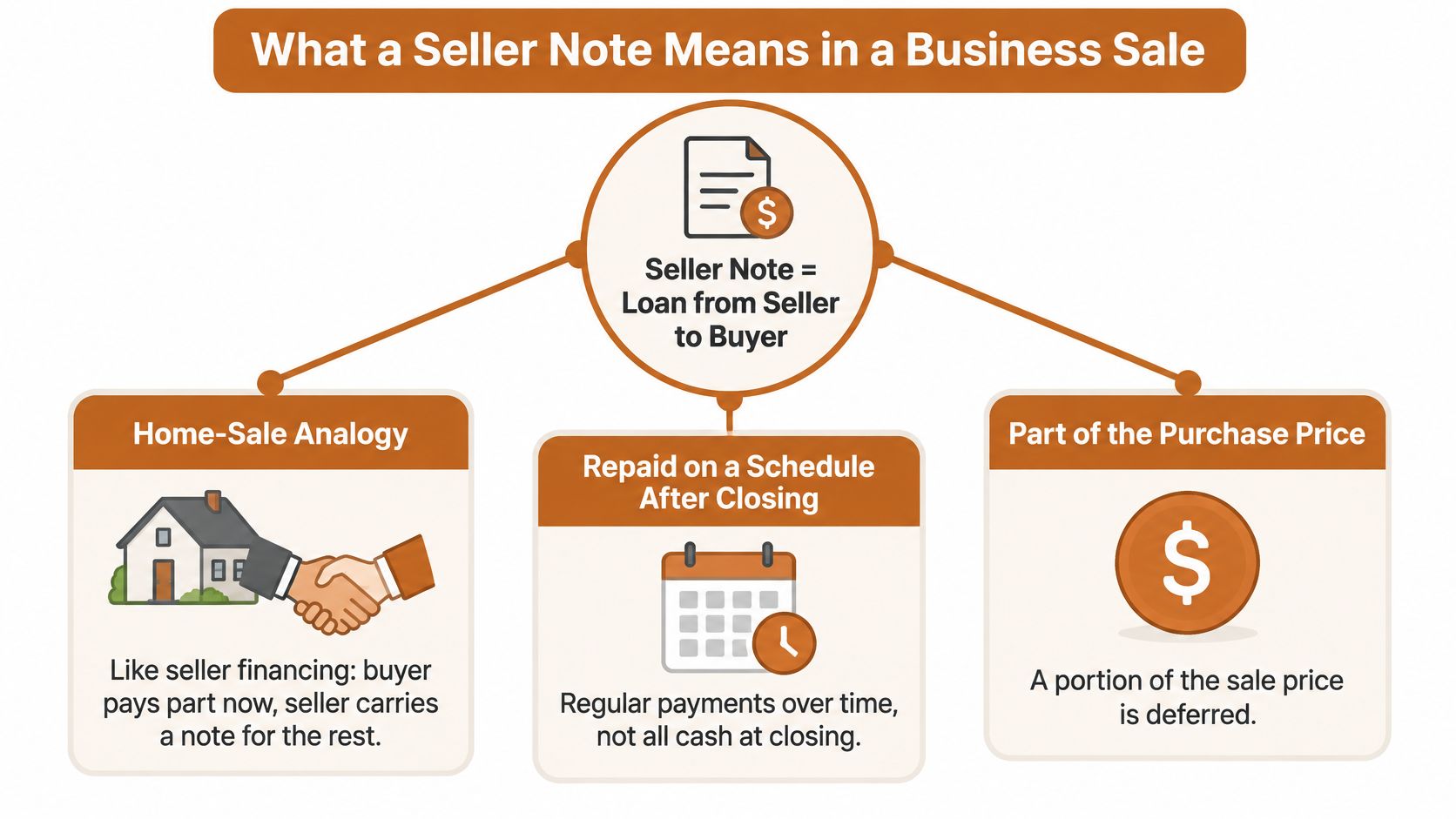
A seller note is a loan the seller makes to the buyer for part of the purchase price, repaid on a schedule after closing.
If you’ve sold your business but the buyer still owes you money, have you finished getting paid, or have you started lending? That distinction matters more than the sale price on the agreement. You’re giving up ownership while accepting a promise that depends on the buyer’s ability to pay.
For a service-business owner preparing to retire, that promise deserves the same scrutiny a lender would give it.
Think about a home purchase financed with a mortgage. The buyer takes ownership, but a lender provides some of the purchase money and expects repayment. With a seller note, the business seller fills that lending role for part of the price.
The buyer doesn’t hand over that portion at closing. Instead, the buyer signs a promissory note, a written promise to repay under specified terms. Those terms establish the unpaid balance, interest rate, payment dates, final due date, and what the seller can do if the buyer defaults.
The financing arrangement looks like this:
A business purchase can combine several sources:
These aren’t competing descriptions of the purchase. They’re separate pieces of the same financing package.
Among the self-funded buyers in the 2023 Self-Funded Search Study, 45% of completed acquisitions used seller debt financing, while approximately 58% used an SBA 7(a) loan; more than 60% of seller notes represented between 10.0% and 19.9% of the total purchase price.
Unlike a conventional bank loan, the seller is the creditor. Buyer and seller negotiate the note, although the bank may limit what they’ll accept.
For context on how financing fits into the larger transaction, the By Design Law Firm acquisition guide, from By Design Law Firm & Legal Consultancy, PLLC, is a useful companion to reviewing individual deal documents.
The central shift: You’re not simply agreeing to a later payout. You’re deciding whether to become the buyer’s lender.
Use the following table as a reading checklist, not a substitute for reviewing the actual documents. A proposed interest rate tells you little without knowing when payments begin and how much remains due at the end.
Core seller note terms and reference values
| Term | What it sets | Reference point from research |
|---|---|---|
| Principal | Share of the price the seller lends back | A negotiated portion of the purchase price, generally a minority component |
| Cash interest rate | Annual rate charged on the balance | Distinguish interest paid in cash from interest accrued but unpaid |
| Payment deferral | Whether payments begin immediately or later | Full standby means no cash interest during the standby term; verify principal restrictions too |
| Maturity date | When the final payment is due | Deal-specific; no single market figure applies |
| Payment schedule | Frequency and amortization of payments | Deal-specific; the note must state how the balance is repaid |
| Prepayment right | Whether the buyer can pay early | Deal-specific; permission and any penalty must be written into the note |
Principal is the amount lent, not the entire sale price. If the agreement describes a headline price that includes seller financing, separate the cash you’ll receive at closing from the amount you’ll still be owed.
Cash interest is money paid to you. Accrued interest is interest earned under the agreement but not yet paid. Don’t build a household budget around accrued interest as though it’s arriving in your bank account.
Deferral requires particular care. A buyer may describe a proposal as giving the business breathing room. For you, it means waiting longer to collect, so ask exactly which payments are prohibited and when that restriction ends.
Amortization means paying down principal over time. Maturity is the final due date. They aren’t necessarily the same: a note can use a gradual payment schedule but require a large remaining balance at maturity.
That remaining amount is a balloon payment. Ask how the buyer expects to fund it rather than assuming another lender will refinance it.
Prepayment also affects your planning. An early payoff returns your principal sooner, but ends the future interest stream.
Before signing, confirm:
Consider a hypothetical sale, not a market benchmark. A buyer purchases a service business for $2,000,000, pays $1,700,000 at closing using personal cash and a bank loan, and signs a $300,000 seller note.
Assume the note charges 6% annual interest, with equal monthly payments that fully repay it over five years. Rounded for illustration, the payment is about $5,800 a month, or approximately $69,600 a year.
The distinction is immediate: the seller has transferred the business, but hasn’t collected the entire price.
The timeline separates the closing proceeds from the continuing loan:
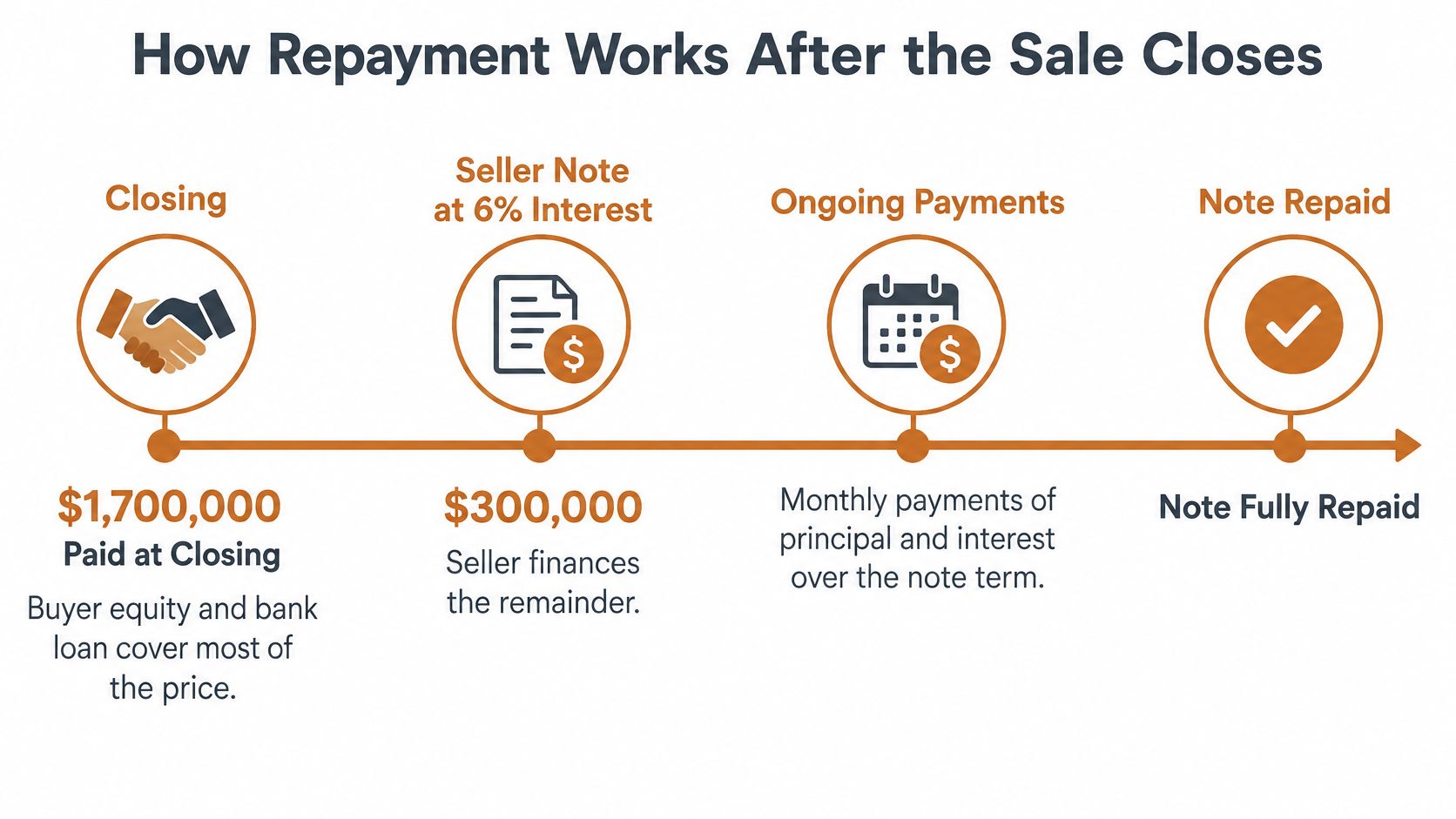
Early payments contain more interest because the outstanding balance is larger. As principal falls, less interest is due, so more of the same monthly payment reduces the loan.
Using the rounded payment in this hypothetical example, the seller receives roughly $348,000 over the term on the $300,000 balance. That total includes returned principal and interest. It isn’t all profit, and it assumes every payment is made.
The buyer expects to fund repayment from operating cash flow, meaning cash available after running the business. Review recurring customer revenue, seasonal slowdowns, payroll, equipment replacement, and working capital, the money needed to cover day-to-day obligations.
A profitable HVAC company can still face a cash squeeze while waiting for customers to pay. Model those periods before accepting the schedule.
Practical rule: Judge the required payment, not just the interest rate. An attractive rate won’t help if the business can’t afford the bill.
When payments stop, the seller needs enforceable rights, not reassurance. Baton’s seller-note guide explains why sellers must evaluate collateral, guarantees, repayment priority, and the buyer’s ability to service the debt.
Treat the signed documents as lending documents:

Protection terms and what each one does for the seller
| Protection | What it gives the seller | What to check |
|---|---|---|
| Collateral | A claim against specified assets if the buyer defaults | Assets covered, enforceability, and lien priority |
| Personal guarantee | A claim against the guarantor personally | Who signs, financial capacity, and any cap |
| Subordination | Establishes the seller’s position behind senior debt | Payment restrictions and who collects first |
| Default remedies | Contractual rights after a default | Notice, cure period, acceleration, and enforcement limits |
| Financial covenants | Restrictions on borrowing, owner withdrawals, or other conduct | Reporting frequency and consequences of breaches |
| Fixed versus contingent payments | Defines an unconditional schedule or performance-based obligation | Payment triggers and what constitutes nonpayment |
Subordination means the senior lender gets paid before you after a default or liquidation. A lien is a legal claim against property securing a debt. Having collateral doesn’t ensure recovery if the bank’s prior claim consumes its value.
Read the subordination agreement alongside the note. It may restrict collection even when the buyer has missed a payment.
A low-rate note with weak collateral and an aggressive balloon can be riskier than a higher-rate note with stronger security and gradual principal repayment. The borrower might manage the installments but lack the cash for the balloon.
For additional explanation alongside your document review:
Those rights aren’t automatic permission to take the business back. Have counsel explain what you can enforce.
Receiving money later can change when you recognize taxable gain, but it doesn’t mean every tax bill waits until you’re paid. Under IRS Publication 537, a sale generally qualifies as an installment sale when at least one payment arrives after the tax year of sale, allowing eligible gain to be recognized as principal payments arrive.
The word eligible matters. A business sale includes different assets, and the purchase-price allocation determines how much value is assigned to each category. Inventory and depreciation recapture, which can require recognizing previously deducted depreciation, don’t necessarily receive the same treatment as capital gain.
Interest is generally treated separately from gain on the purchase price. Your documents and repayment schedule should distinguish principal from interest and use commercially supportable terms.
Ask your accountant to prepare an after-tax cash-flow schedule rather than estimating total taxes. Compare tax obligations with the closing proceeds and later payments. Our explanation of installment-sale tax treatment provides additional context for that discussion.
Deferred payment isn’t the same as deferred tax on every part of the transaction.
In an SBA-backed acquisition, full standby means no principal or interest payments during the SBA loan term. Subordinated seller debt meeting applicable standby requirements may receive different treatment for the buyer’s equity injection, the contribution required to fund the transaction.
A note that receives payments is generally debt whose repayment must be supported by business cash flow. Don’t assume every seller note helps satisfy the buyer’s equity requirement.
Longer deferral may help the buyer obtain financing and preserve operating cash. For the seller, it means less cash in hand in the near term and a longer stretch of exposure to business failure.
Ask the lender to confirm current eligibility requirements and permitted payment terms. Before signing, have transaction-specific legal and tax advisers reconcile the note, purchase-price allocation, tax projections, and lender documents.
A request for seller financing isn’t automatically evidence that the buyer is unsuitable. It can be a practical way to bridge the difference between available financing and an acceptable purchase price.
A historical study published in the Journal of Small Business Strategy examined 26,000 private acquisitions and found that 8,978 transactions, approximately one-third of the sample, included a seller note. That establishes the structure’s presence in the sample, not the safety of any particular buyer.
The tradeoff is straightforward:
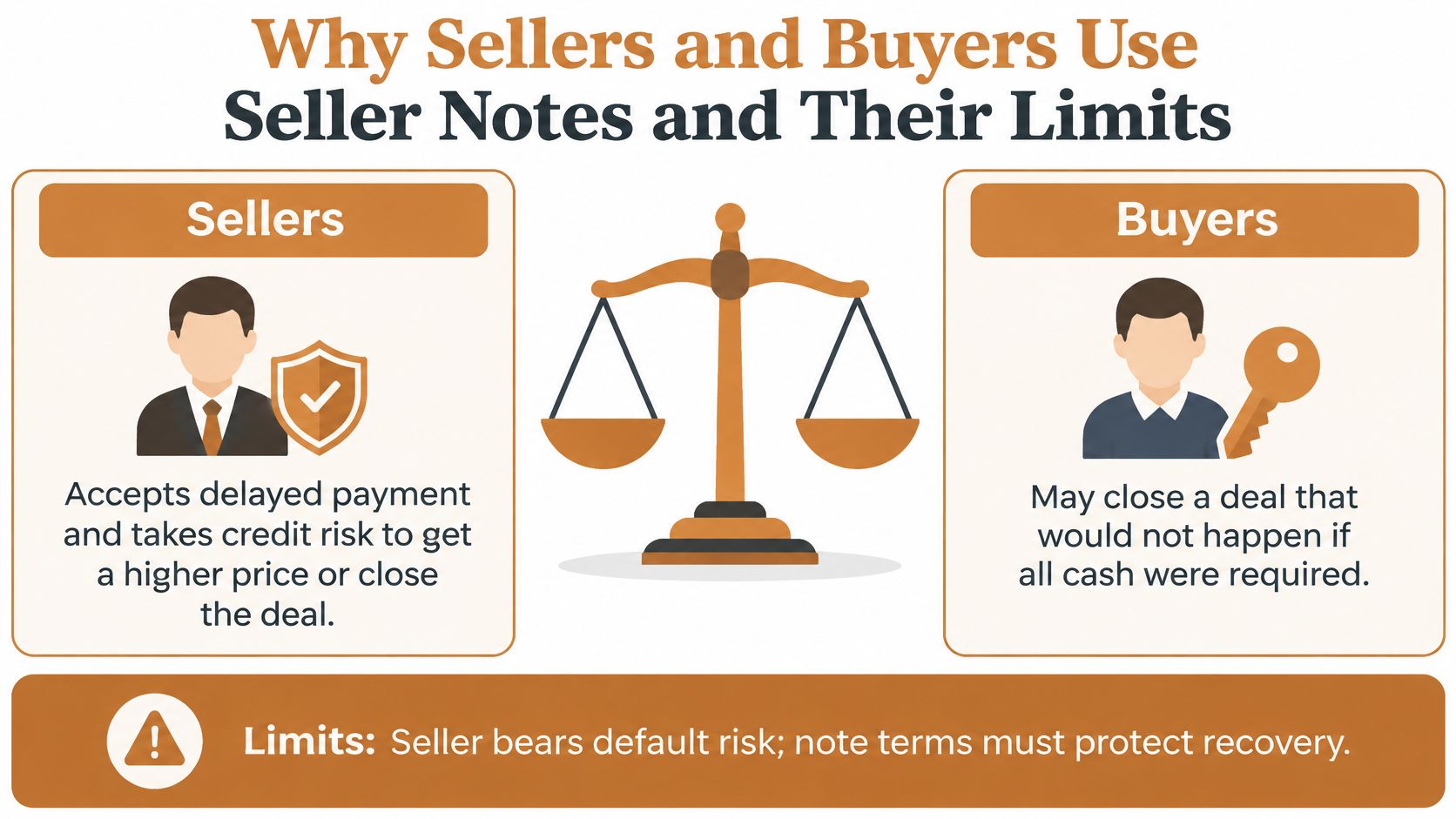
The buyer gets time to pay and may complete a purchase that an all-cash demand would prevent. The seller accepts credit risk, the possibility that the borrower won’t repay as promised.
For an established plumbing or commercial-cleaning company, the buyer may also value continued transition support. A seller willing to leave money outstanding can signal confidence in customer relationships and the business’s durability. That signal doesn’t replace the buyer’s own diligence or the seller’s assessment of the borrower.
Seller financing isn’t necessarily a replacement for the entire financing package, either. Its purpose is to make a workable transaction possible, not excuse a buyer from contributing capital or demonstrating repayment capacity.
A conventional fixed seller note establishes a debt obligation. An earnout makes additional purchase consideration contingent on agreed results. If a buyer uses the terms interchangeably, review what an earnout is and have counsel identify exactly what must happen before payment becomes due.
Neither label makes collection certain. A fixed obligation can remain legally owed while the borrower lacks the resources to pay.
Be cautious when:
A note is useful only when the buyer’s financing needs and your tolerance for delayed, uncertain collection are compatible.
In 2025, 23% of surveyed business owners planned to provide seller financing, while 62% of buyers expected it to be part of a transaction, according to BizBuySell’s Q2 Insight Report. Prepare your position before a buyer asks, rather than negotiating from surprise.
Use these questions to assess a proposal:
Our guide to financing a business purchase can help you understand the buyer’s alternatives. You don’t have to accept a note just because it’s included in an offer.
A specialist can help compare repayment structures before you commit. Start with an amortization schedule, a downside cash-flow forecast, and a written explanation of collection rights. These tools make proposals easier to compare than headline price alone.
Listed specialists are independent professionals. We don’t endorse, guarantee, or warrant their services, so verify their credentials and relevant experience yourself.
Before the first offer arrives, write down your preferred balance, rate, first payment date, maturity date, and prepayment right. Also identify which terms you’re willing to negotiate and how much closing cash you won’t compromise.
Tell us your situation at The Owner’s Shortlist, and we can connect you with an independent specialist whose work fits your seller-financing questions in one conversation. Introductions cost owners nothing and carry no obligation afterward; bring your proposed terms so you can discuss repayment risk before accepting an offer.
Who wrote this: The Owner's Shortlist is not a broker and doesn't sell businesses. We get paid the same no matter which specialist we introduce you to. More about how we work.
Tell us your situation. We'll connect you with a specialist who works with owners like you. One conversation, no sales pressure.
Found this useful?
Add The Owner's Shortlist as a preferred source and get our articles highlighted in Google Search results.
Add to Preferred SourcesWhat is a backlog? Learn what it means for a service business, how to calculate it in dollars and months, and how to read it for cash flow.
November 9, 2026
Learn accretive vs dilutive: when EPS rises or falls, how financing flips the result, and what service-business owners should ask before a sale.
November 1, 2026
Selling the business doesn't mean selling the building. Here's how a sale-leaseback works, what rent to charge, and what you give up along the way.
September 25, 2026
Business loan vs line of credit explained for owners. Compare cost, flexibility, collateral, cash-flow impact, and the right scenarios for trades and SMBs.
September 24, 2026