Sale-Leaseback: How to Sell Your Business and Keep the Building
Selling the business doesn't mean selling the building. Here's how a sale-leaseback works, what rent to charge, and what you give up along the way.
September 25, 2026
By Remi Taffin · November 1, 2026
Accretive means combined earnings per share are higher than the buyer’s standalone EPS, and dilutive means they are lower, as in a buyer at $2.00 that falls to about $1.94 in one structure and rises to about $2.07 in another. The popular advice says chase the accretive deal and reject the dilutive one. That advice is too simple for an owner.
A buyer can make that label flip by changing price, shares, or debt, without paying you more or making closing more certain. If you’ve run a service business for years, you need to see what’s behind the word before you trust it.
The test for accretive vs dilutive is narrow. Accretion means the combined company’s earnings per share (EPS) comes out higher than the buyer’s standalone, pre-deal EPS, and dilution means it comes out lower, a per-share test set out in academic merger research from NYU Stern.
EPS can fall even while total profit climbs. If the buyer issues shares faster than earnings grow, the same profit gets spread across more claims on it. The reverse happens too: a buyer purchasing a target at a lower earnings multiple than its own shares carry can lift EPS without either business running any better.
| Case | Earnings | Shares | EPS | Versus $2.00 | Result |
|---|---|---|---|---|---|
| Standalone buyer | $100 million | 50 million | $2.00 | , | Baseline |
| Issues 12 million shares | $120 million | 62 million | About $1.94 | About 3.2% lower | Dilutive |
| Issues 8 million shares | $120 million | 58 million | About $2.07 | About 3.4% higher | Accretive |
Read the table row by row. The buyer starts with $100 million of earnings on 50 million shares. That’s $2.00 per share, the line every later number is judged against.
The target adds $20 million, so combined earnings reach $120 million in both deal rows. The target’s operations are identical in each. Only the share count changes.
With 12 million new shares issued, 62 million shares now claim that $120 million. Each share gets about $1.94, so the buyer’s existing owners hold a smaller claim per share even though total earnings rose by $20 million. That’s the confusion most sellers hit first: bigger company, thinner slice.
With 8 million new shares, the denominator is 58 million. EPS rises to about $2.07. Same earnings, fewer new claims, opposite label.
Total profit going up doesn’t settle the question. You have to ask how many new shares, or how much new debt, paid for that profit.
Several levers move the result without changing how well the businesses run trucks, crews, or dispatch:
None of those levers tells you whether your price is fair. A buyer can call the purchase accretive because it paid a low multiple for your earnings. That’s good arithmetic for the buyer’s shareholders, and it can mean you left money on the table. The label describes the financing outcome, not your cash at closing, your tax bill, or your position if you stay on.
So stress-test the claim before it does its work on you. Ask which inputs produced the number: how many shares were modeled, what multiple was assumed for your earnings, how much debt was layered in, and which synergies were counted before they exist. Each of those inputs is a choice the buyer made, and each can be rerun with different assumptions.
Preparation matters before a buyer frames the numbers for you, and owners who want a grounded starting point can use deal preparation advice from Nexist alongside their own accountant’s review.
Don’t argue with the label. Ask to see the inputs that produced it.
Pro forma EPS is the buyer’s estimated earnings per share after the deal closes, calculated as if the two companies were already one. You compare it with the buyer’s standalone EPS before the deal. Higher is accretive, lower is dilutive, and the whole label rests on this one fraction.
The formula is pro forma EPS = (buyer earnings + target earnings + after-tax synergies − incremental financing costs − purchase-accounting effects) ÷ pro forma diluted shares, which is the standard way acquirers and their advisers model the effect of a deal on per-share earnings.
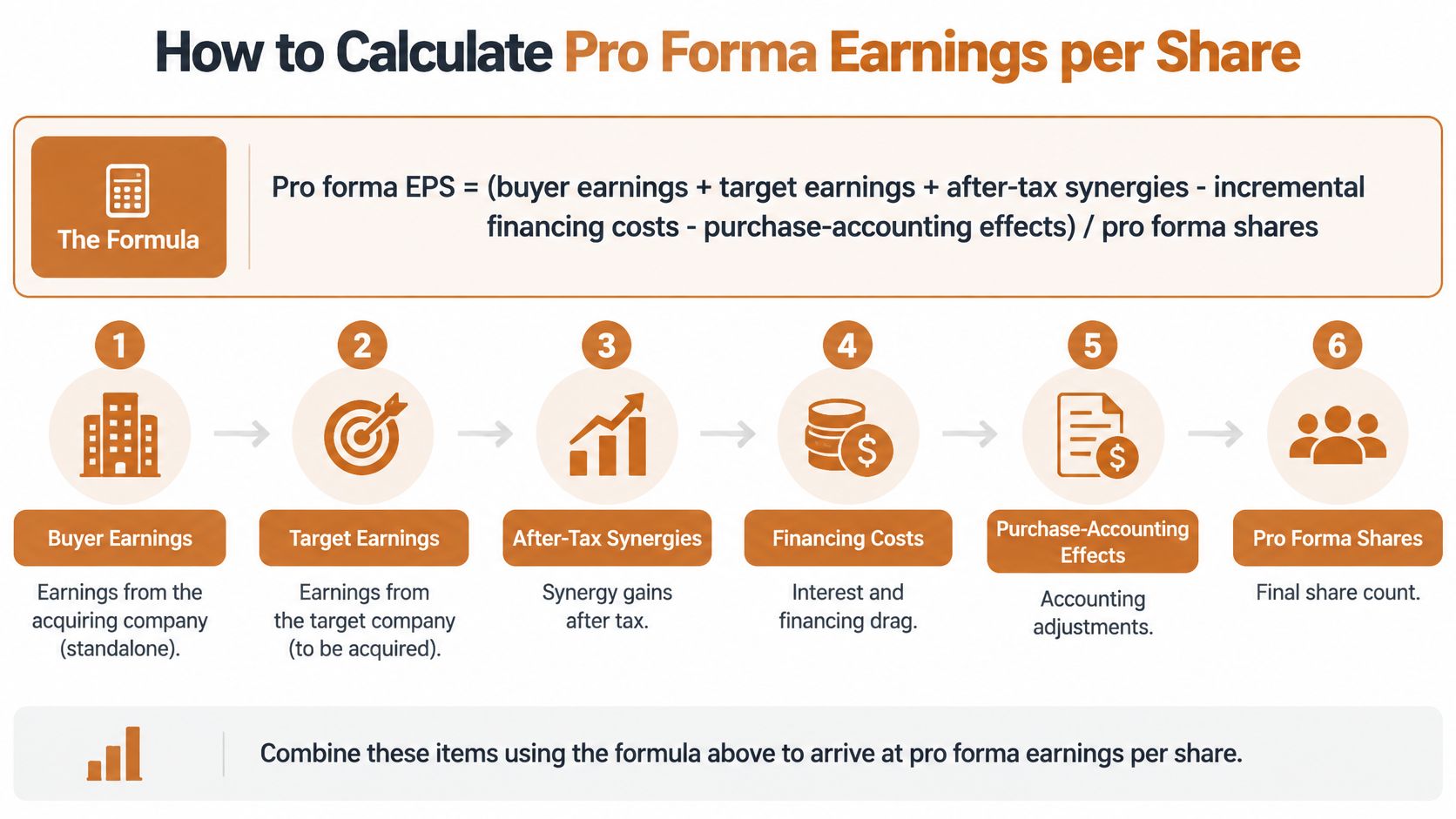
Notice what the formula does not contain. Your price is absent. Your cash at closing is absent. So is every obligation you carry after you sign. Each input describes the buyer’s income statement and share count, which is why a buyer can call a deal accretive while nothing about your position improved.
Ask for two versions. The first is reported GAAP EPS, which includes that amortization. The second is cash EPS, which adds acquisition amortization back so you can see the underlying cash earnings.
Practical rule: If a deal is dilutive only because of amortization, it’s a different conversation than a deal that’s dilutive because interest eats the earnings.
A sound deal can look GAAP-dilutive on paper. A weak deal can also hide behind cash EPS if the buyer adds back costs that keep recurring. The reconciliation between the two versions is the useful document, not either headline alone.
Two inputs reverse the sign most often. Financing cost determines how much earnings survive after the buyer pays to borrow. The share denominator determines how thinly what is left gets spread. To stress-test an accretion claim, ask the buyer to rerun the same formula with lower synergies and a higher rate on the new debt. A deal that stays accretive on cautious inputs rests on solid arithmetic. A label that only survives on the buyer’s friendliest assumptions was never a statement about your price, and it tells you nothing about what you keep.
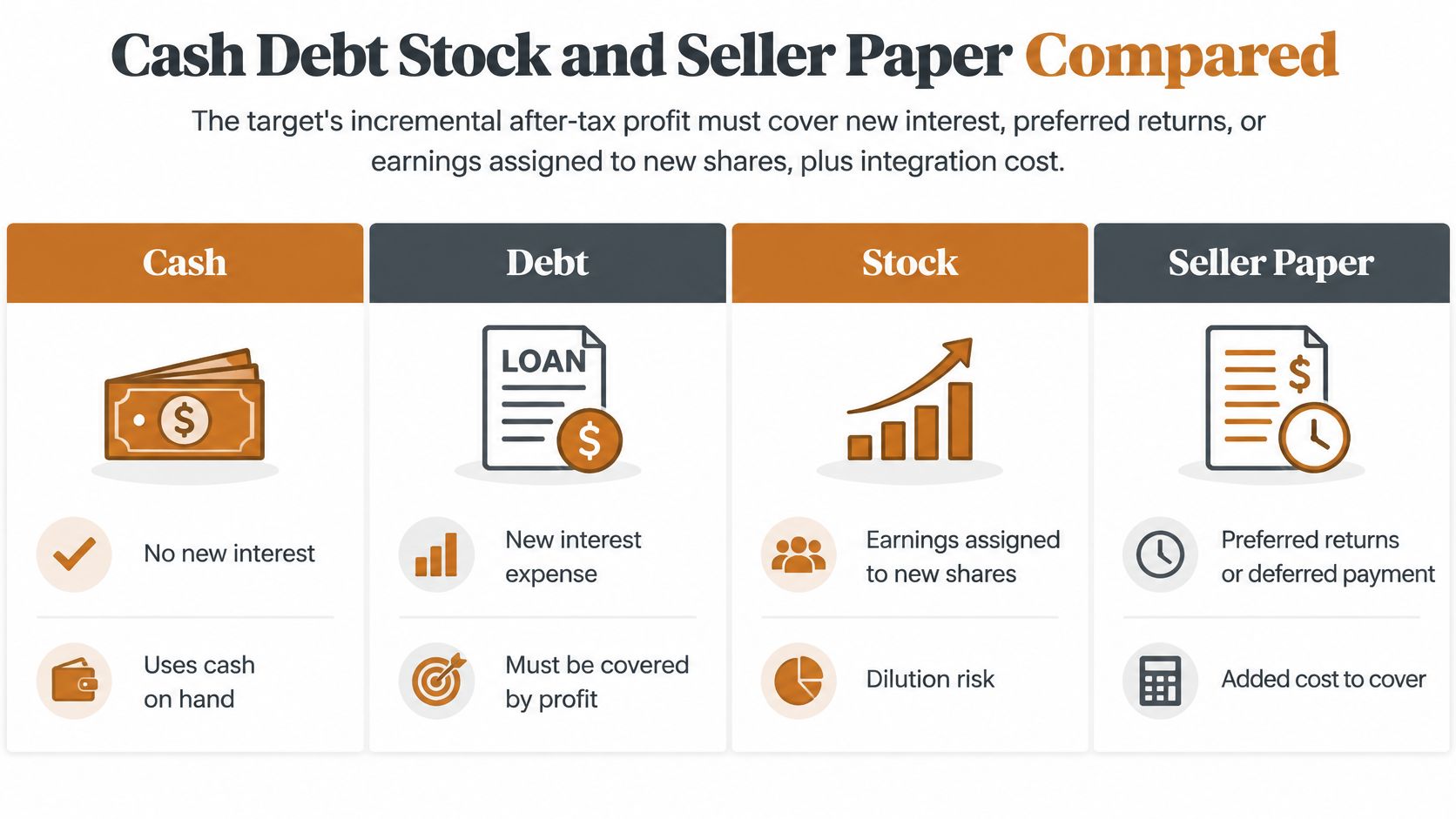
The break-even rule is simple. The target’s incremental after-tax profit must cover new interest, preferred returns, or earnings assigned to new shares, plus integration cost. If it doesn’t clear that bar, the deal dilutes the buyer no matter how it’s described.
How the buyer pays decides which cost you have to clear. It also decides how sturdy the buyer is after closing, which matters if you’re rolling equity, holding a note, or staying to run a division.
| Funding mix | What moves in the EPS math | Resilience | Main risk |
|---|---|---|---|
| All cash | No new shares; cash has an opportunity cost | Often the highest EPS | Buyer left undercapitalized |
| New debt | Interest cuts earnings; share count unchanged | Accretive only if earnings cover interest | Rate reset and default risk |
| Stock or rollover equity | Share or equity denominator rises | Preserves cash | Dilutive if new equity outruns earnings |
| Seller financing | Interest plus a future payment; may delay new equity | Bridges a price gap | Future cash obligation |
| Earnout | Contingent; can postpone dilution or more debt | Protects buyer if plan is missed | Seller may never be paid |
Cash usually produces the friendliest EPS figure because no shares are added and no lender takes interest. For a buyer of a $1 million to $50 million service company, though, draining cash to close can leave too little for payroll swings, trucks, or a slow season. The EPS looks strong. The balance sheet may not.
Debt keeps ownership intact, which is why buyers like it. It’s accretive only while the earnings they bought beat the after-tax interest with room to spare. Rates reset, customers churn, and that cushion can vanish.
Stock and rollover equity protect the buyer’s cash, but they spread future earnings across more owners. Seller paper and earnouts shift timing and risk toward you, so it’s worth understanding the mechanics in our guide to seller financing for a small business sale before you accept either as a bridge.
The backdrop makes this choice harder to wave away. In Deloitte’s M&A trends survey, private credit remained a leading financing mechanism in 2025, commercial lending declined, concerns about default risk increased, and cash financing rose from 33% in 2024 to 40% in 2025.
A cash-funded deal can be more accretive per share and less resilient at the same time, if it leaves the buyer undercapitalized.
Ask the uncomfortable version of the question. What happens if financing costs rise or the acquired business misses plan? A buyer who can’t show that case hasn’t stress-tested the accretion claim. He’s only presented the version where everything works.
One filing shows the trap clearly. A company reported adjusted EPS growth while higher net-interest expense partly offset operating gains, and described its acquisition as approximately neutral to adjusted EPS for the quarter in results filed with the SEC. Growth, offset, and neutral, all in the same result.
That’s why accretive shouldn’t be read as good. The label usually describes one per-share earnings effect. It says nothing direct about debt load, lost customers, integration trouble, or cash left after obligations are paid.
Diluted EPS itself blends two moving parts, earnings and potential shares from options, restricted stock, deal equity, and other contracts. Change either part and the label can move while the underlying business stands still.
Pin the buyer down on which measure improved:
Public reporting permits adjusted measures that can differ significantly from GAAP results. Two buyers can describe the same deal differently and both point to a real number. You need to know which number each one chose, and understanding the plain definition of synergies in business helps, because expected savings often sit inside the adjusted version.
For a seller, the buyer’s synergy story doesn’t by itself raise your price. It doesn’t improve certainty of closing, and it doesn’t protect your pay if you stay on under an employment agreement. Those are negotiated terms, not side effects of accretion.
The practical test is whether the deal creates value after financing costs, one-time adjustments, working-capital needs, integration spending, and the chance the plan is missed. If a buyer can’t walk you through that test, the accretive label is a headline in search of support.
Public buyers screen on first-year EPS because investors react to it quickly. That gives a single percentage more authority than the evidence supports.
A Harvard Business School study of 224 completed transactions from 1975 through 1994 found that greater EPS accretion had a positive and statistically significant relationship with acquiring-company abnormal stock-market performance around the announcement and through as long as 18 months after completion. That is a real relationship. It is still only a market reaction, separate from your proceeds, your risk, and your seat after closing.
The same study found the effect was much smaller than conventional managerial and practitioner beliefs implied. Markets may reward accretion, yet they do not treat it as a complete measure of deal quality. Owners should not either.

Changes in accounting rules, and options or other potentially dilutive securities that are not yet shares, can shift reported EPS even when the business itself has not changed. The label can move while routes, technicians, margins, and customer churn stay exactly where they were.
Share count is the quiet lever. Securities that have not become shares can still shape the calculation a buyer shows you, and financing choices decide how many claims exist after closing. A buyer can cite accretion produced by cheaper debt, a temporarily low share count, or adjustments made before synergies are proven. None of that raises your price, wires cash with more certainty, or improves your position if you stay on.
Translate that to a private sale. Ask which earnings were used, which shares were counted, which securities were left out, and what the percentage looks like in a soft month when interest, receivables, and one lost commercial account hit together. If the answer holds only under flattering assumptions, treat the first-year number as an opening claim that needs documents behind it.
The same label means different things depending on where you sit in the deal. Three common situations for service companies show how quickly the right answer changes.
Say an HVAC owner buys a smaller plumbing competitor nearby. Route density improves, two dispatchers become one, and overlapping service areas cut drive time. If those gains hold and after-tax earnings cover the new interest, the purchase is accretive and the debt gets paid from real savings.
If key customers leave because their favorite technician quit, or the loan rate resets higher, the same deal turns dilutive. The hinge isn’t the broker’s headline. It’s debt service in a soft month and working capital when receivables stretch. Owners weighing this kind of growth can read how a buy and build strategy works in practice before signing a note. We also publish a guide explaining how PE rollups work, for owners approached by a platform doing several of these deals at once.
In a recapitalization, a sponsor buys a majority stake and you keep a minority rollover. The sponsor’s new equity works like issued shares. Your claim on future earnings gets diluted, even if the combined platform grows faster than you’d have grown alone.
Taking mostly cash looks cleaner. You keep less upside, but you’ve converted risk into money in hand. Rolling more preserves upside and leaves you exposed to the sponsor’s debt and exit timing. Neither is automatically right, which is why we publish a guide explaining how a recapitalization works, including a worked example with real numbers.
Owner’s check: Don’t ask only whether the platform’s EPS rises. Ask what percentage of the future company you’ll still own, and what that stake must be worth at exit to beat cash today.
A sale to a child or a long-time manager is often funded with a seller note because bank financing won’t cover the full price. The note can make the buyer’s cash flow look workable from day one. On paper, everyone’s comfortable.
Your real risk is collection. You’re the lender now, and the business you built is the collateral. A structure that looks dilutive to an outside buyer may still suit you here if you keep security, a personal guarantee, and payments sized to slow months. Prefer cash certainty when retirement depends on this money. Accept a less flattering structure when control, family continuity, or a safer note matters more than the percentage.
When a buyer leads with accretion, ask for paper, not adjectives. The documents below show whether the claim survives contact with financing and timing.
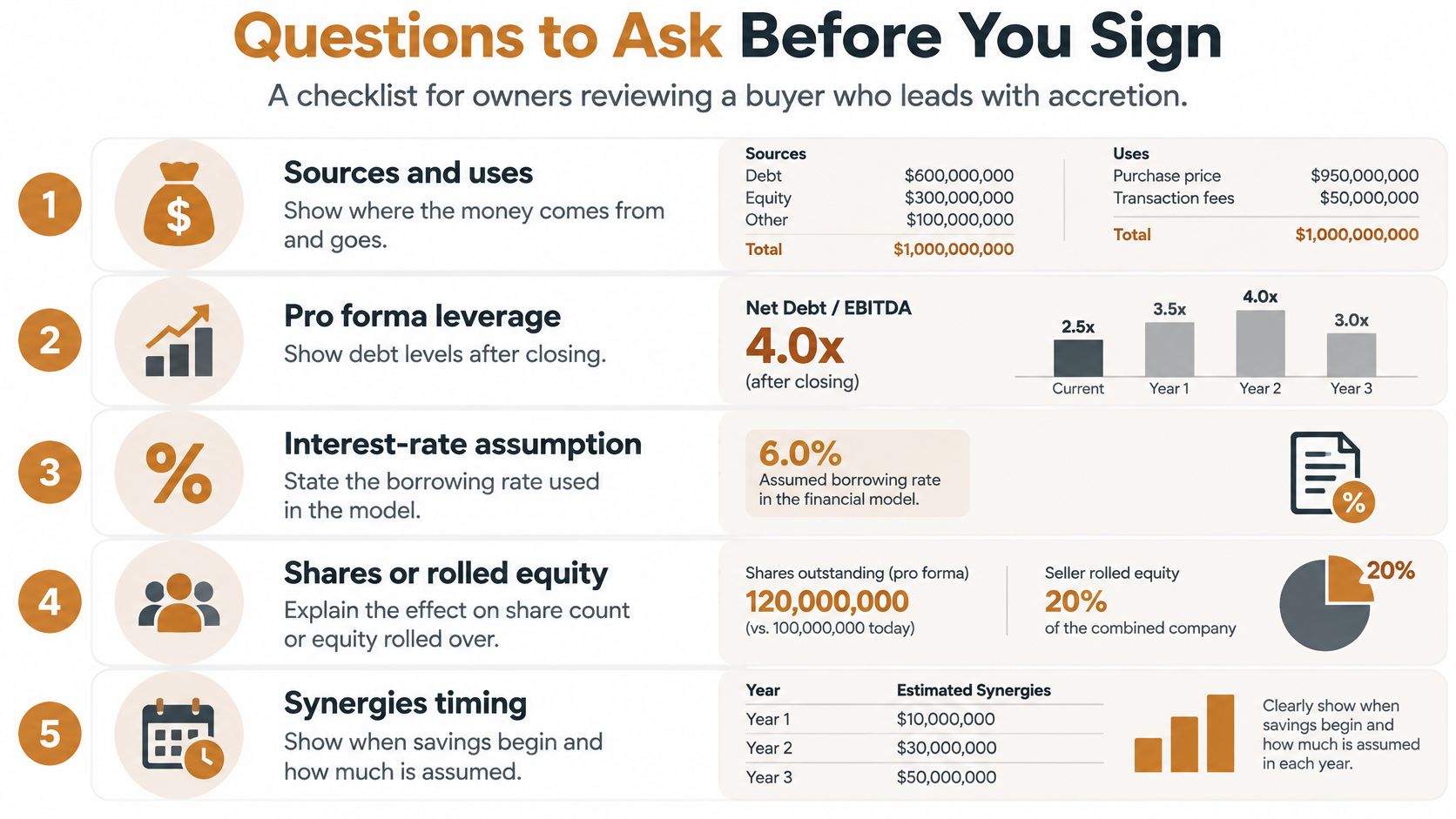
Then ask which figure is accretive, GAAP EPS, adjusted EPS, or cash left after debt service. If the answer changes depending on the measure, you want to know why before you sign a letter of intent.
Check the offer against your own business too, using adjusted earnings, normalized owner compensation, and working capital at close. We publish a guide explaining how a business is valued and the methods specialists use, which helps you keep purchase price separate from the buyer’s per-share story. Match the offer to taxes and to who gets paid after closing, including any seller note, earnout, or rolled equity.
Nothing in this article is legal, tax, or financial advice. Take the buyer’s model to your own accountant and attorney.
Don’t accept the word accretive until the sources-and-uses page and the downside case are in hand.
If a buyer is presenting your business as accretive and you want a plain-language read on what that means for your price, terms, and certainty of closing, we can introduce you to one specialist whose past work fits your business, and owners pay nothing for that introduction with no obligation after it. Start with a confidential conversation at The Owner’s Shortlist before you accept any headline percentage at face value.
Who wrote this: The Owner's Shortlist is not a broker and doesn't sell businesses. We get paid the same no matter which specialist we introduce you to. More about how we work.
Tell us your situation. We'll connect you with a specialist who works with owners like you. One conversation, no sales pressure.
Found this useful?
Add The Owner's Shortlist as a preferred source and get our articles highlighted in Google Search results.
Add to Preferred SourcesSelling the business doesn't mean selling the building. Here's how a sale-leaseback works, what rent to charge, and what you give up along the way.
September 25, 2026
Business loan vs line of credit explained for owners. Compare cost, flexibility, collateral, cash-flow impact, and the right scenarios for trades and SMBs.
September 24, 2026
Understand seller financing tax implications for owners, from installment sale rules and capital gains to depreciation recapture and state tax considerations.
September 16, 2026
Learn what is seller financing, how it structures business sales, and why 80% of small deals use it. Clear examples, math, and red flags for owners.
September 6, 2026